It was time for a change of pace for my adventures this weekends. I could blame the damn indoor wall I built in our shed; the cold spell that hit on Monday last week making niggles feel that bit worse; the aging process resulting in the body being more susceptible to injuries; a string of back to back days of climbing; or a lack of self-discipline and climbing a bit harder than I should have on some recent trips. But when all is said and done blame is like hindsight, pretty pointless. So this weekend my shoulders were telling me a rest from climbing was needed:
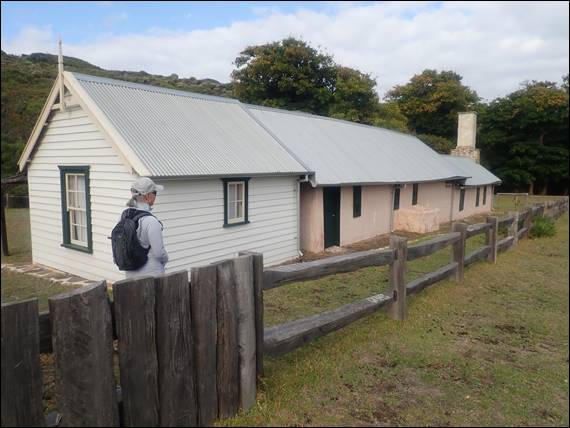
While I accepted I needed a rest from climbing, having a five day a week desk job, I still had to get outdoors and opted to head out for a walk with Lisa. It took a bit of negotiations, during which we went from adventurous rock hopping along the coast to a well-trodden circular path. So it went from hopping across coastal on pebbles, which was never going to fly with Lisa, to a hike starting and finishing at the heritage-listed Ellensbrook House in Yebble. A property managed by the National Trust of Western Australia, and which is on the Cape to Cape trail:
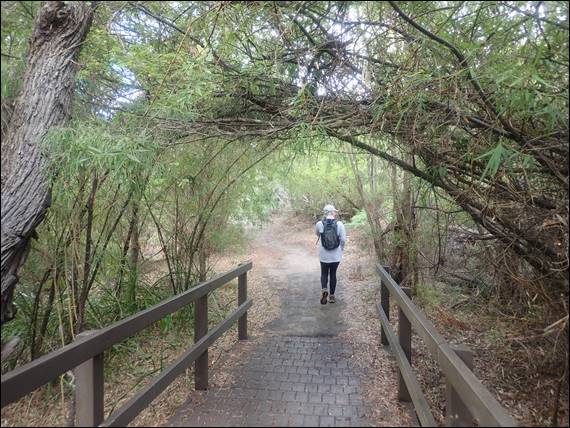
A home built in 1857 by, and for, Ellen and Alfred Bussell with the assistance of labour from the local custodians, convicts, and deserting sailors. After a quick look round we left the bricks, mortar, and paved path behind and headed south on the Cape to Cape trail. Unlike my solo hike in July last year (https://sandbagged.blog/2022/07/17/a-voice-in-my-head/), which comprised a circular loop immediately north of Ellensbrook, I was pretty sure this trail would be an easy one to follow. It certainly started that way, as we wandered through a tree lined path:
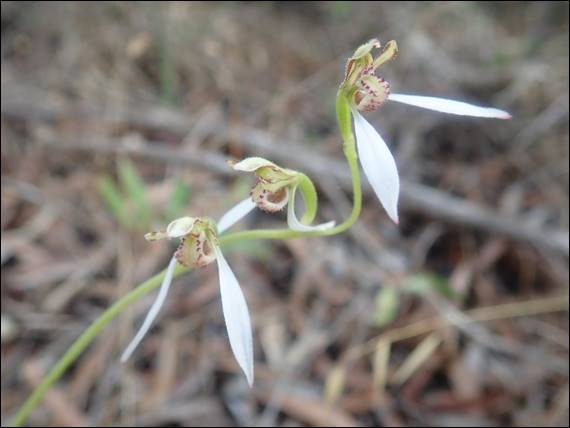
I wasn’t looking for orchids but couldn’t miss the above and numerous other Common Bunny Orchids (Eriochilus dilatatus ssp multiflorus). Last year the first one of these we spotted was in late April at Jarrahdene, some 20km to the south. An early flowering, widespread, and commonly found orchid along the coastal strip. The scientific name comes from a mixture of Greek and Latin words that mean enlarged wool lip, the reason becoming evident when you take a closer look. This find heralds the start of my hunt for orchids this year, but it will be a slow start with not too many early starters in the South West:
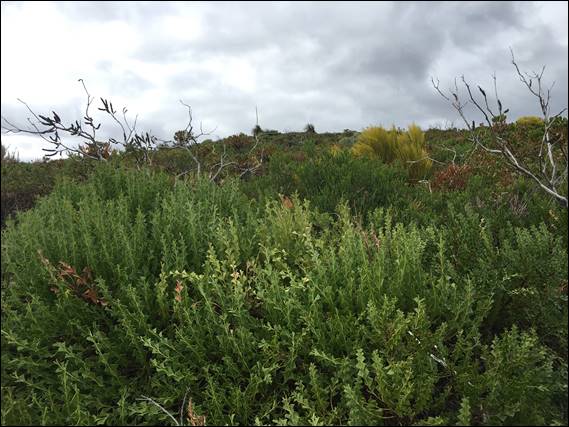
Reading some peoples reviews of this section of the Cape to Cape trail, a few people indicated the high vegetation resulted in long sections with no vistas. But when you start to look in more detail there are plenty of interesting aspects. For example the huge variation in foliage as shown above, with different hues, shapes, and textures. Birds can be heard but are not often seen in the low shrubs, but checking the ground the more you look the more you see. As Lisa walked ahead of me I spotted something jump off the path as she passed, so I got on my knees and searched under the scrub:
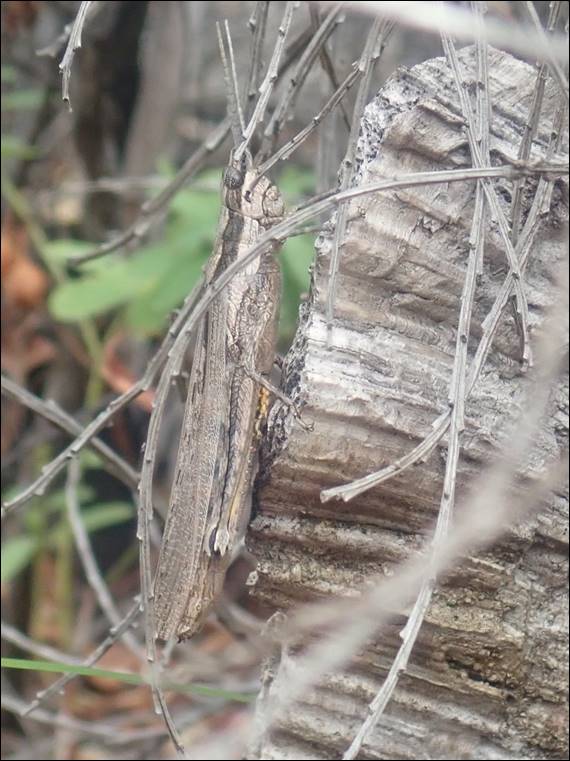
It took a while to spot what it was, a Bark-mimicking Grasshopper (Coryphistes ruricola). I’ve checked out what I could find of this creature, and all there was that they are found throughout Australia except Tasmania, and the textured grey-brown patterns result in them being very well camouflaged. I can contest to this and it took me a while to spot it, and then a while longer for Lisa to also see it. Looking at the images in more detail I noticed under its body there were some yellow egg shaped objects attached to it, but grasshoppers lay their eggs under the soil so they can’t be that:
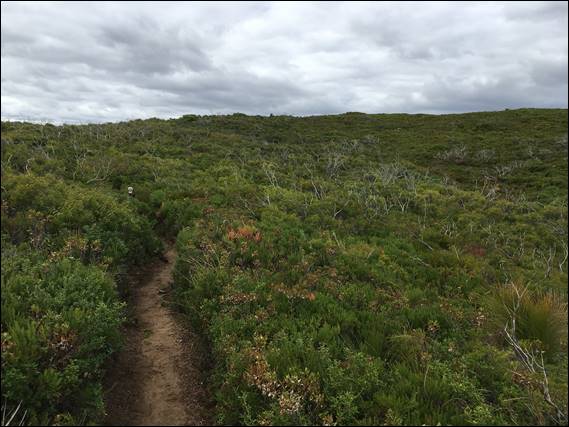
We wove our way along the meandering path; up and down the secondary dunal system, with occasional glimpses across the landscape as the vegetation height receded before coming back up. Lisa spotted the below termite mound, which in itself may not seem too special unlike the more spectacular mounds of Cathedral or Magnetic termites found in other parts of Australia. But such mounds, regardless of stature, are an important pat of the landscape. This was probably a mound built by Amitermes obeuntis, the more common species in the south west:
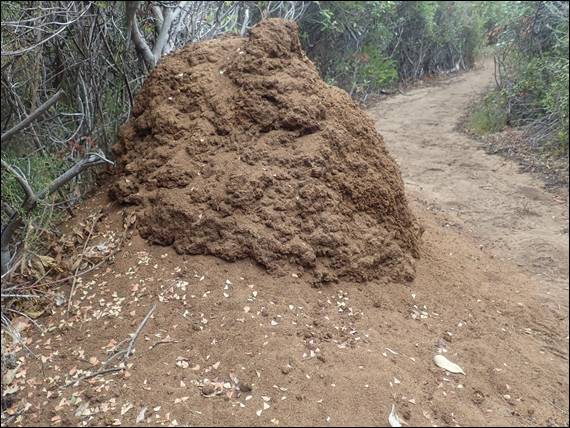
Being one of just over 150 termite species found in Western Australia, according to a 2015 study. Of the identified species approx. 14% were found to build mounds, and all of the mounds checked out contained more than just termites. Also being a home to a myriad of vertebrate. The average number of additional inhabitants was 30 with the maximum being 150. This included predators of termites, as well as other creatures. The bigger numbers were found in the more arid and northern areas of Western Australia. Where the environment is more hostile, and the mounds likely provided the best and safest habitat:
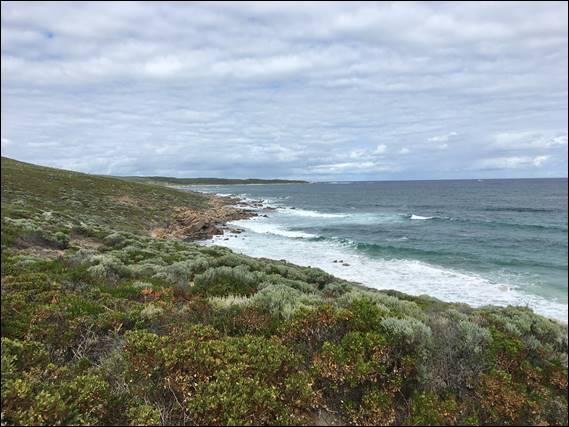
I’m starting to get off track. Something I am pleased to say we were not doing as we left the Cape to Cape trail. Following a 4WD track towards the coast before it hooked right to take us back northwards. This took us to a stretch where we had to walk along beach, but before we got to that there was the need for a half way pit stop. During which the customary flask of tea and cheese butties came out, providing a spot of very welcome refuelling. Once we hit the coastal stretch of the walk, which isn’t part of the Cape to Cape, the views never left us:
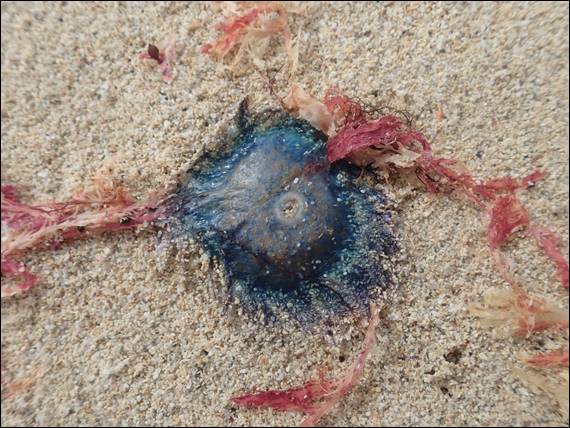
There was a fair bit of beachcombing happening on the beach stretch, the sand was patterned with red weed that had been washed ashore. Scattered amongst the weed we found Portuguese Man O’ War (Physalia physalis), not unlike our local beach. More interestingly, there were also the above Blue Button (Porpita pacifica) that like the Man O’ War is a colonial organism. Comprising a float, being the button that is up to 30mm in diameter, under which a colony of hydroids hang like tentacles. These collecting prey and move them up to the underside of the float where the mouth is located:
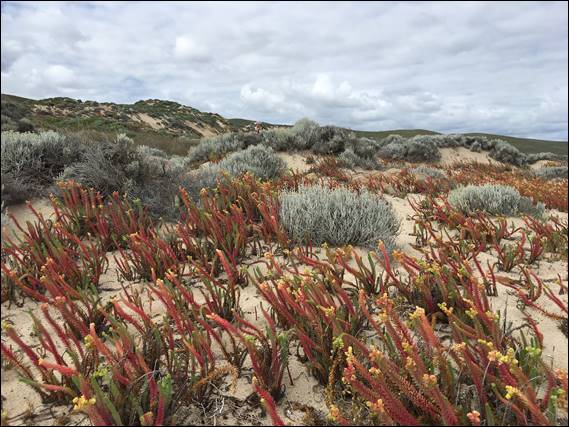
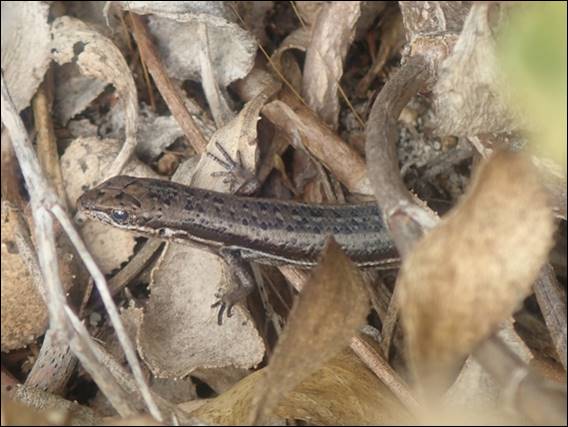
After the beach walk, we found a faint path that led up the primary dune for a short distance before following the top of that for the remainder of our day out. The sun was on occasion poking out, and it felt a nice warm temperature. Not just for us but also the skinks that were now out, and we only saw fleetingly as they dashed for cover when we approached. Most disappeared before we could see them, although we managed to get close to a couple of them that I have identified as the Buchanan’s Snake-eyed Skinks (Cryptoblepharus buchananii) below, and I also spotted one Western Three-Lined Skink (Acritoscincus trilineatus):
I have only seen the latter skink once before, at Wilyabrup. Rather than include an image here I have provided a link to that post (https://sandbagged.blog/2022/11/19/a-cool-find/). It was hard to know whether to look at the waves of the ocean; the scrub, which hid birds that we could only hear; or the path below our feet. No doubt we missed loads, but not this and one other Red Velvet Mite (Trombidium Fabricius). Adults are typically 4mm, so I am not sure how we spotted them. Mites are arachnids, having eight legs and mostly prey on the eggs of whatever small insects they can find:
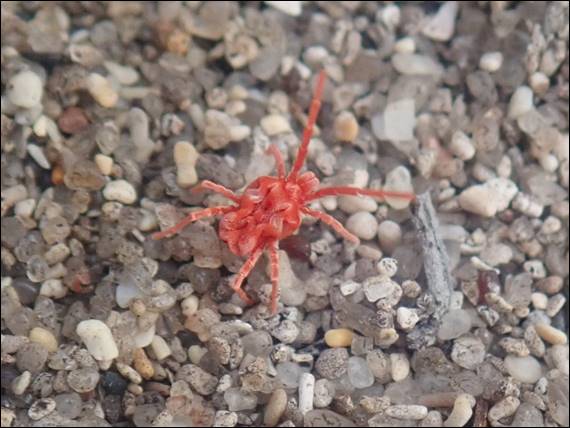
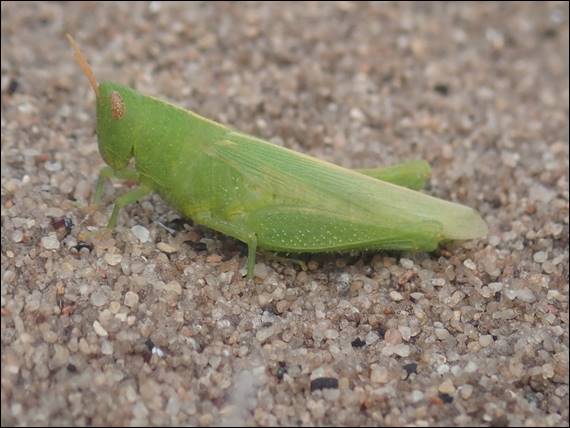
The larvae of these mites are external parasites, finding a prey that they can clutch hold of while they suck the juices of their living host. This made me wonder if what I had seen on the Bark-mimicking Grasshopper were mites. It is possible, but being yellow in colour I assume they were not the larvae of the Red Velvet Mite. Another find that I am also not sure of, is the following green grasshopper. I have searched many sites but despite the yellow antenna, fleck patterned eyes, banded hind legs, and body shape, I cannot find a match:
Lisa and I were now at the tail end of our first walk of the year, a very pleasant and varied 10km’ish loop that we would highly recommend. Before we got to the last stretch to take us a short distance inland back to the car, there was one more obstacle of the Ellen Brook crossing. I had read that in high flow periods you’ll get wet feet. Being Autumn I guessed we would not be at risk, so hadn’t mentioned it to Lisa so she wouldn’t worry about it during the walk. I was fortunately right, and as such Lisa gave the walk five stars on AllTrails, as it ticked all the boxes:

 Sandbagged