There was a slim possibility of bagging three mornings of climbing on the trot, but Rongy had other plans for today so it was not to be. Instead, and seeing the conditions had looked not too bad yesterday afternoon, I decided on a dip. Truth be told I could drive an hour and find some clear waters with good visibility. My motivation to spend several hours driving to get out for a climb, does not however extend to going for a dip. As such I have to suck up the conditions that the convenience of my three minute walk to the beach offers:
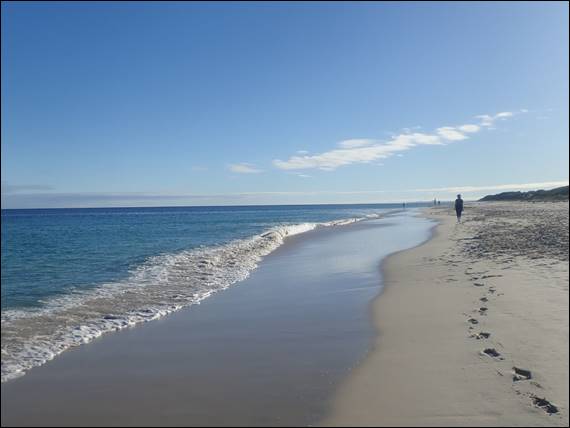
To my surprise, and for the first time I have seen it, several people were fishing off the beach right on the spot where I normally head in. It’s the area with the best bit of reef, and normally people fish in the open sandy bay away from this area. The open sandy areas also being the place I have seen the most shoals of herring, so my guess is that the people fishing were not local and didn’t have that knowledge. To avoid their lines and upsetting them I went in the open areas and swam further out to the reef:

The visibility was ‘ish at best, and while there was a bit of life about it was hard to see well. The low angle of the sunlight was not helping my cause. As such rather than chase fish I decided to just soak up the feeling of being in the water, only going down for a closer inspection on occasion. I did like the above Lace Coral Bryozoan (Triphyllozoan moniliferum), which being a coral you may realise is actually a cluster of animals. These are less than a millimetre in size and called a zooid:
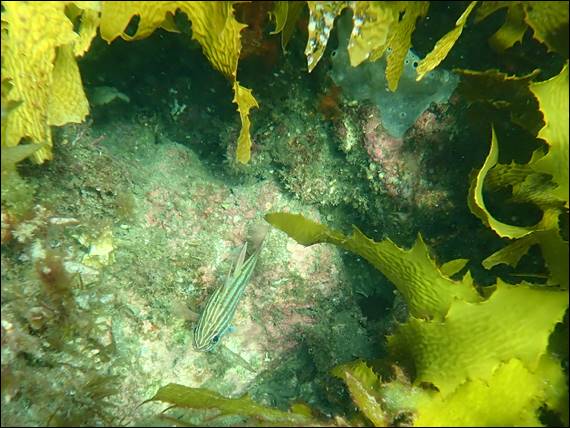
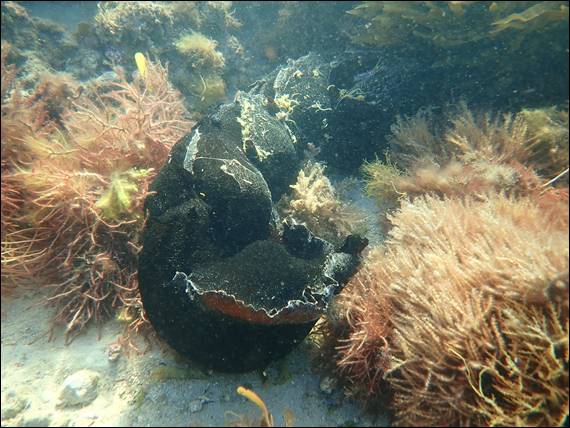
Like many marine creatures they are calcifying animals, and can make structures out of calcium carbonate, such as shells. The difference being that they create a far more diverse mineral composition, resulting in an enormous range of shapes and sizes. My next find is one I have included several times before being the Giant Sea Hare (Aplysia gigantean). Growing up to sixty centimetres in length it is the biggest sea hare in Australian waters, but this one looked way bigger than that so deserved a closer inspection:

It took me a while to figure it out, but there were six or more in a row. These creatures are hermaphrodites and often mate in numbers, with as many as twenty having been recorded at one time. Forming a line with some using both female and male reproductive organs, while others only use female or male. Mating mostly commonly occurs during January and March, but can occur into early autumn. The resulting spawn is long and stringy clumps of orange coloured eggs, something I have as yet not come across:
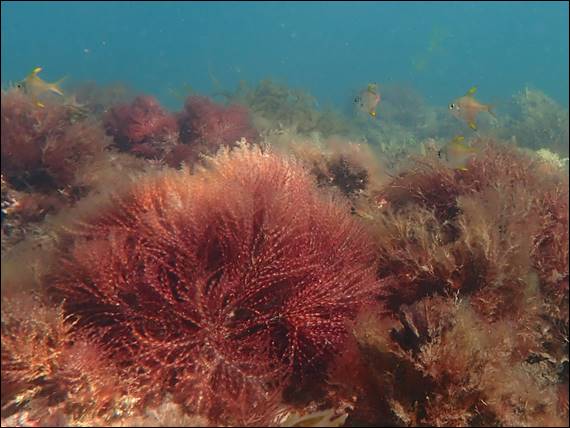
I left the amorous procession alone, and wandered back towards the sandy bay, not seeing too much more but enjoying being followed for a bit by a small school of juvenile Western Pomfred (Schuettea woodwardi). These fish would normally spend their day hidden in caves away from the eyes of predators, coming out at night to feed on tiny planktonic crustaceans. But today they were quite content to swim with me in the open water. Leaving the water I got home to rinse my snorkel gear for the last time this hopeless season before packing it away:
 Sandbagged