After a successful dive yesterday I was keen for a second dip before the usually relaxed start to the working year, during January, would come to an abrupt end on Monday. You may be pleased to know that this also signals a likely slowdown in posts, as my time to get out into nature will be mostly limited to weekends. Geoff was keen to join and suggested going in from the northern most beach access, near the Capel Rover Mouth. I have not been to this part of our local beach since last snorkelling season and was surprised to see seaweed piled up:
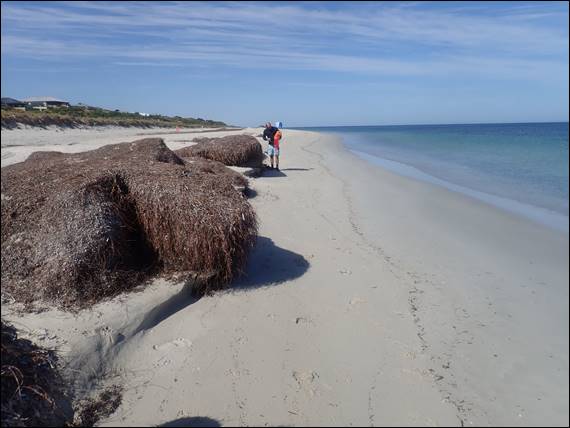
This accumulation of weed is common in winter and is usually buried under the sand as summer comes on, leaving the pristine and inviting sandy beaches the tourists flock here to use. Being the last weekend of the summer school holidays, many would be on their way, or preparing to be on their way, home making for quieter beaches for us. That said there seemed to be one or two out and about, including several paddlers. Thankfully there were no jet skis. Like yesterday the water looked flat and calm so fingers crossed the visibility would be good:
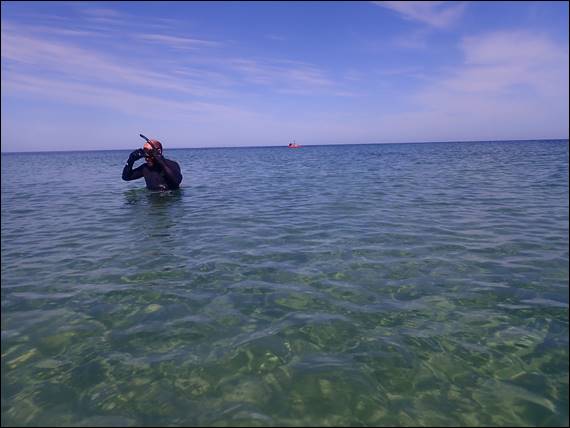
I will confess up front that I took a lot of images, and we saw heaps. Not that life was swarming round us, we had to move about to find the many treasures we did but we stayed in the water for just over two hours. Plenty fo time for us to explore lots of nooks and crannies for quite a way along the reef towards and just past the Capel River mouth. As such from this point onwards I will attempt not to type so much this time, allowing the pictures to do most of the talking:
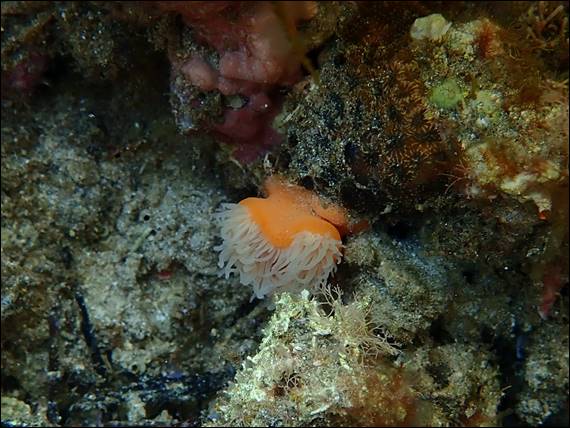
I almost immediately spotted a Short Tail Nudibranch (Ceratosoma brevicaudatum), and then thought I saw a second a bit further along. But as the weed parted in the low swell it was Sea Anemone, and it was the orange body that had caught my eye. I do not recall previously seeing one with this coloured body, not that it has helped me one bit in trying to identify it. Sea anemones are named after a terrestrial flower, although these underwater beauties are not plants but predatory animals of the order Actiniaria:

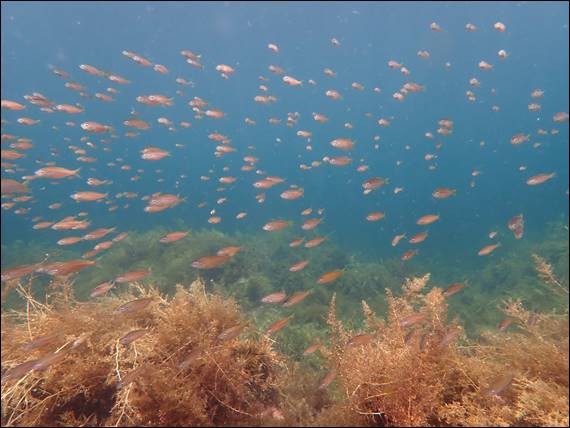
There were plenty of small fish in reasonably sized schools, some discrete species and others mixed. The above was a cluster of possible juvenile Western Pomfred (Schuettea woodwardi) and Western Gobbleguts (Ostorhinchus rueppellii). The larger fish were also about, with a few that I do not see at the spot where I can walk to the beach near our house. They are probably there, just more prominent here due to the more extensive reef system. Below was a solitary King George Whiting (Sillaginodes punctatus):
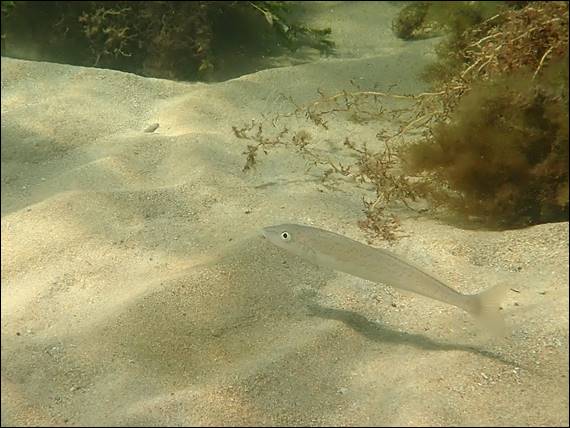
There are 13 species of Whiting in Australian waters, and the King George Whiting has spots along it’s body and small sized scales that are clear-cut ways to distinguish this species. It is a highly prized table fish but a little pricey, maybe because of the need to catch it by line or only by specific netting techniques. In addition to being the largest of the species, it is the only member of the genus Sillaginodes. My next find was hidden in a small hole in the reef in which I saw some movement, being a Hermit Crab (Pagurus) having a feed:
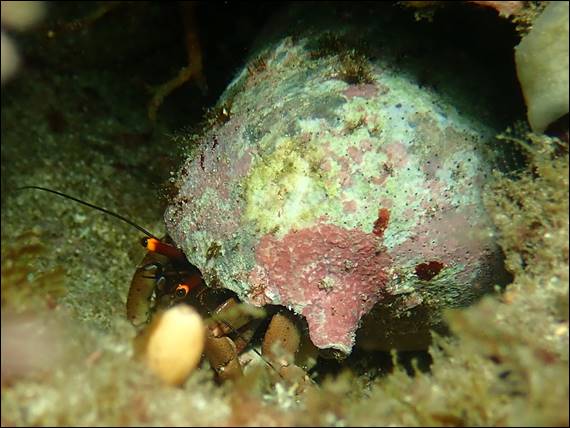
Despite trying I was unable to narrow down the species any further. Hermit Crabs are unique in the crab world as they do not have a hard shell, resulting in their soft bodies being exposed. To overcome this they borrow whatever casing may be suitably sized, until they outgrow it. The term hermit is used to describe someone who does not yearn for or need company, which is ironic as Hermit Crabs are known to be a social creature. There was much diving to check out caves and ledges, and under one I found this:

I got all excited about finding another species of nudibranch. And while this may be a Pustulose Wart Slug (Phyllidiella pustulosa), which is a nudibranch. It could also be a Mimic Flatworm (Pseudoceros imitatus). The Flatworm looks very similar, neither have external gills and the two antenna look almost the same on the two creatures. The only difference I can think to use to differentiate it was the amount of volume of its body. Unlike the one I found in Dec 2021, which looked flatter (https://wordpress.com/post/sandbagged.blog/7293):
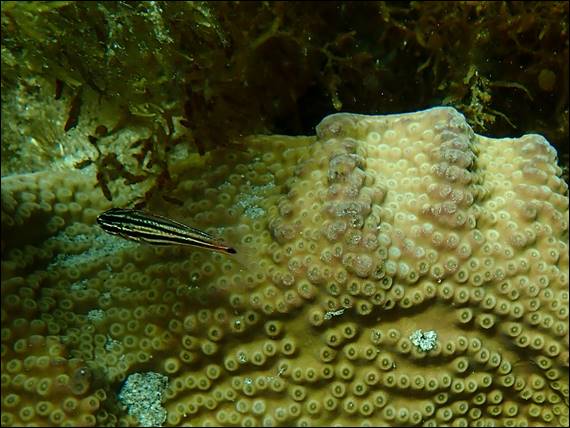
So taking a punt back in 2021 I probably found a Mimic Flatworm, which I incorrectly identified, while the one today was a Pustulose Wart Slug. I was also pleasantly surprised during this dive to find a few corals, and on several separate occasions I spotted a single small striped fish swimming about in the bowl that these corals made. The coral was a hard coral of the Astreopora genus and I believe, but am not completely convinced, the fish was a juvenile Western Striped Cardinalfish (Ostorhinchus victoriae):
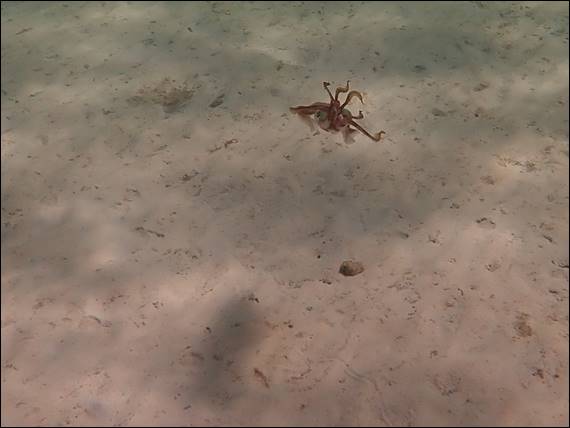
There was no end of discoveries on our dive, way too many to include. Some of the nicer finds that won’t get shown today include one or more Rock Lobster, Western Rock Octopus, Cuttlefish, Boarfish, and Stingaree. We also spotted a few Southern Calamari Squid (Sepioteuthis australis), putting on their usual defensive display to make themselves look more aggressive and dangerous, before using their incredible speed to simply disappear:
We also heard the familiar noise of Bottlenose dolphin (Tursiops truncatus), and were lucky enough for them to pass us twice as the cruised up and then back down the coastline. Unlike the squid and many other fish, they were in no rush and slowly swam past us. With a second day of favourable weather the water was a little clearer, and the visibility was helped also by having the sun higher in the sky to allow more light to filter through the water. Instead of an image I have included a short video:
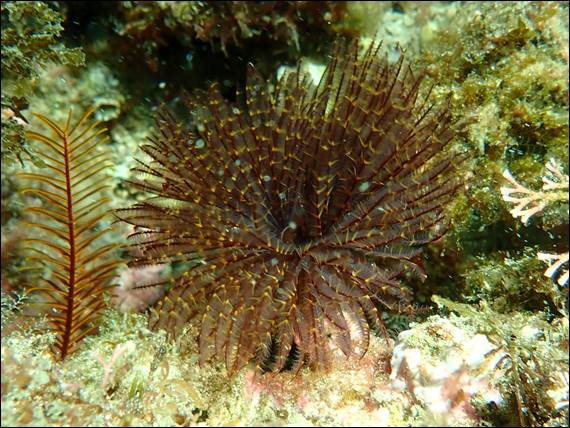
At one location I spotted two types of Feather Duster Tubeworm (Sabellidae). The first is a repeat find what I reported a couple of years back further along the coast past the River Mouth and the coastal feature called The Point (https://wordpress.com/post/sandbagged.blog/5843), and then there was this other species. Information on these seems to be sparse and I have not managed to dig any deeper into the names of the two types I found:
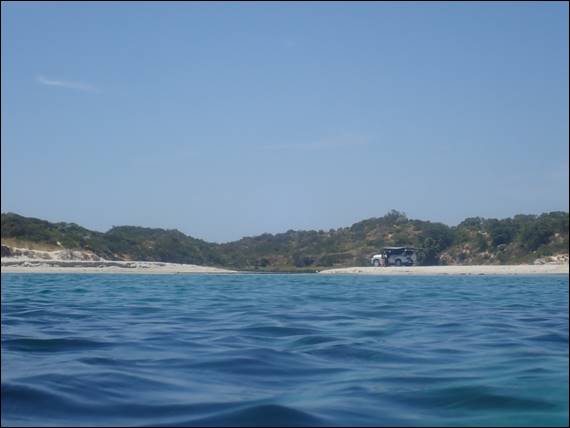
Below is an image of the Capel River mouth, as we saw it today. Geoff had told me someone had recently opened up the river mouth to allow a connection between the river and ocean. I doubt it was to allow water from the river, which doesn’t flow in summer, out. So there are two options. Either the trapped river water was at risk of forming algal blooms and becoming smelly so they let sea water in. Or someone wanted to prevent all the holiday 4WDs from crossing this point and going past The Point by digging a channel in the beach:
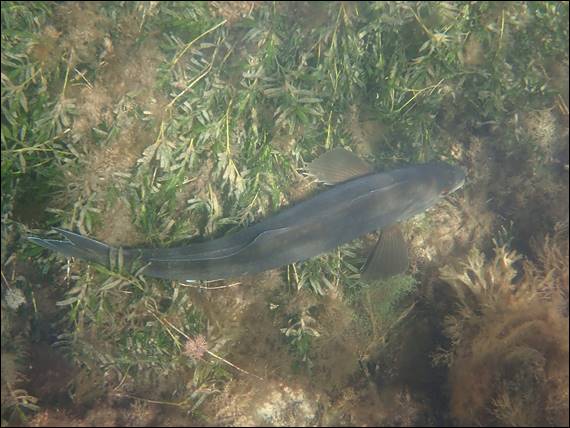
It sounds as if there may have been some disgruntled holiday makers as they attempted to get a quiet bit of beach to celebrate Australia Day, so the latter possibility may not be so far-fetched. Snorkelling with Geoff is good as he thoroughly checks every spot hoping to find Rock Lobsters. In one cave he spotted a big Dusky Morwong (Dactylophora nigricans). Calling me over, I went down and saw the fish as it escaped out the back of the cave. Whether it was the same fish or not, a Dusky Morwong later swam past Geoff before settling in the weed to rest up allowing me a great birds eye view as I swam over it:
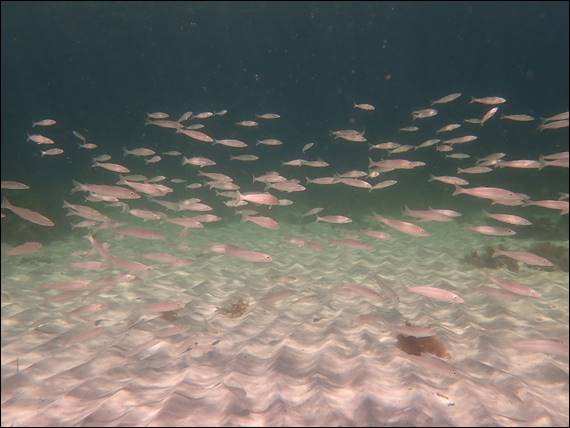
One last image, which was taken as we were on our way out. Another species of Whiting, being the Southern School Whiting (Sillago bassensis). A fish people are often seeking to catch fishing of the beach, along with the Australian Herring (Arripis georgianus). We finally exited the water with toes and finger tips just starting to tingle, but we were not at the point of our teeth chattering. The timing was however good as the winds soon changed to an onshore, which meant the water would soon be not quite so calm:
 Sandbagged