I did wonder if the title of my last post may have made some think that they would get some long overdue underwater images. And I did indeed consider taking my snorkel gear when we climbed at Castle Rock, as I knew the water would be clear. The coarse sand there settles quickly. It is also closer to Cape Naturalist, and as such is offered more protection from the regular swells that seem to be occurring this year. I have been down to our local beach a few times since my last dip, which was over a month back on Christmas Day. Only for a walk, and the wind and swell conditions have resulted in water not looked inviting:
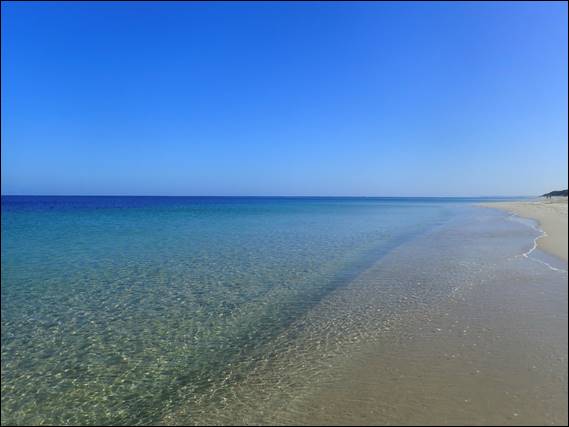
Chatting to some keen divers at work who live in the area, and regularly visit this stretch of coast albeit by boat so further off shore, they have a theory that the Capel River is to blame. North of the river mouth they feel the water clears up that bit quicker than south of where the sediment rich waters of the river come out. They feel it is the fine sediments from the river that accumulate over winter in the near shore areas, and these create an environment that is quick to become cloudy. Having climbed for the last two days and with the weekend free I was however keen to go in whatever the conditions. Being pleasantly surprised to find flat calm waters. Not quite the millpond we saw at Castle Rock yesterday, but not too shabby:
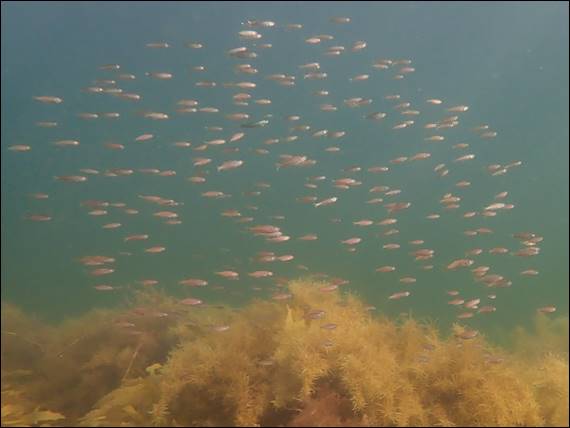
There was certainly sediment in the water column, and to avoid too many beach goers I had popped in at 8am before the sun had got high in the sky. This meant the light penetration was not the best. No matter and I was encouraged when encountered small schooling fish, something I feel is a first this season. Having tried to identify these fish before without much confidence, I won’t try again. But this Short Tail Nudibranch (Ceratosoma brevicaudatum) is an easy one, and I have included images of them a few times over the years. They are the most commonly found species, which might be because they are the biggest of over 100 species of nudibranchs in the family Chromodoridae identified in Australian waters:
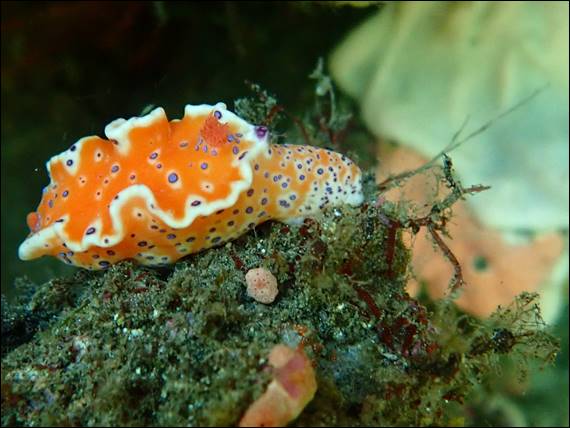
They are also considered the most abundant of the species, plus have very vivid colouration. Growing up to 15cm certainly makes them easier to spot. That said I can’t recall seeing them much bigger than 10cm and this one was even smaller. Based on the short gills and small size of the purple dorsal ‘tail’, where most of the distasteful toxic chemicals are stored, I imagine it is a young one. I would like to see more species, and to do that I would need to stay under water longer. The above nudibranch was in +4m of water, and I can only stay down at that depth for approx. 30 seconds. I had the same dilemma of limited time, when I spotted this tail. After some careful checking of what was hiding under the weed I had to go up for air:
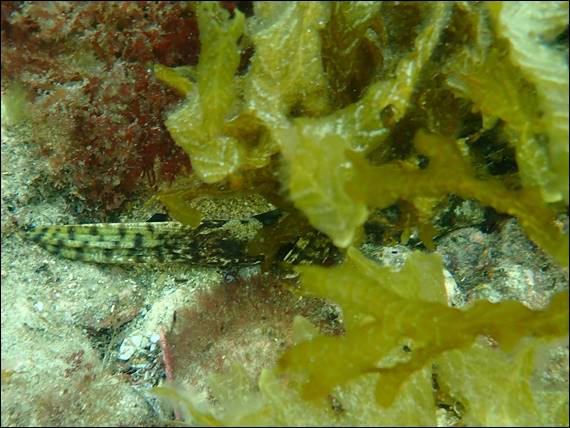
Fortunately I had not disturbed the fish and on my return attempted to get an image. While I snapped one, as I steadied myself for a better shot the fish darted away so all you get is this slightly blurry picture. Obviously a flathead, and I believe this one is a Longhead Flathead (Leviprora inops). It would have been nice to have had a bit more time to get some more features on (digital) film. The main distinguishing feature I captured and have used to identify it was the length of the fringes coming down from the top of the eye. These break up the large black eye and help the fish stay camouflaged. To help me stay down longer there are non-scuba diving options I am considering, such as floating hookahs that pump air to you or small portable handheld tanks. More toys and money, so they probably not something for this year:

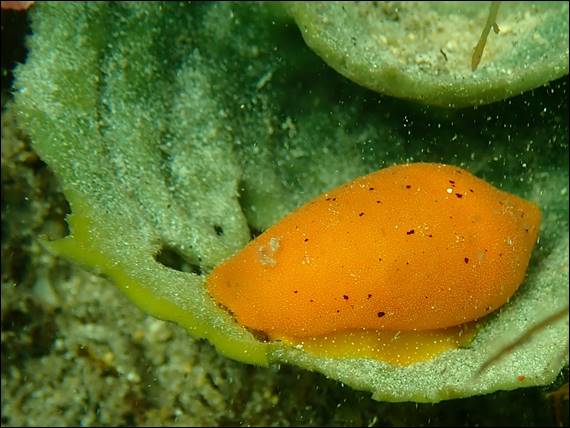
My next find was a shell and I would not normally try to identify them as like the weeds I find them very challenging. This one however was spectacular. Based on the shape this could be a Strombs Shell, of which I found one specimen (Strombus luhuanus) that had a somehow similar colour (http://www.stromboidea.de/?n=Species.ConomurexLuhuanus). The shape is also similar to Cone Shells such as Conus bullatus, although the coloration of these from what I have seen is generally more speckled. Looking at the images of the shell I found, it looks to be covered in a fleshy substance that is orange with tiny white spots. You can also make out the foot of the gastropod that lives inside, being a slightly paler orange colour still with tiny white spots. Sadly, despite multiple duck dives, I never got to see the eye stalks nor proboscis:
With so much cumulative underwater time I needed a rest, and looked up just in time to see a Pied Cormorant (Phalacrocorax varius) fly right over my head as it headed towards the shore. These birds primarily feed on fish, and are often seen bobbing about on the ocean looking below for a feed. When they spot something, diving down using their feet to propel themselves and half open their wings to control or steer their direction. I was lucky once to observe one swimming under water: https://sandbagged.blog/2022/03/25/taking-on-the-jellies/. Some birds have a uro-pygial or preen gland at the base of their tails that exudes an oil, which the bird can spread with their beak to help make the feathers water resistant:

Not all Cormorants have well developed preen glands, which seeing they are in the water a lot may seem counterproductive. However, the oil would make them more buoyant and limit their ability to fish underwater. Instead, like many water birds, can have feathers with a tighter structure to slow down the rate at which water can get between each bard of the feather and saturate them. That is why we commonly see cormorants perched with wings outstretched, drying them ready for the next foraging session. The next fish I see most times I go out but rarely get very close too, being a Bluespotted Goatfish (Upeneichthys vlamingii):
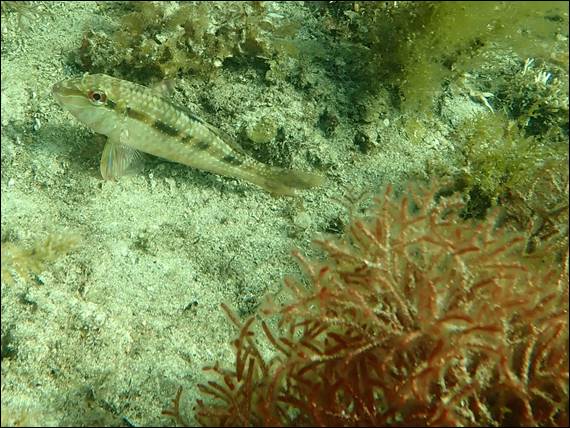
I was interested to read that they are known to quickly change colour, and can become more brightly-coloured at night. Something for me to look into another time, as you may be wondering what the next image is all about. Well I heard the obvious trill and squeak sounds of a Bottlenose dolphin (Tursiops truncatus), which I thought sounded some distance off so I looked up for any signs of dorsal fins. When I popped my head back underwater all I saw was the fuzzy outline of a silhouette, as a single large adult swum approx. 10m away from me. Like I said the conditions weren’t perfect but I had no complaints and thoroughly enjoyed finally being back in the water:
 Sandbagged