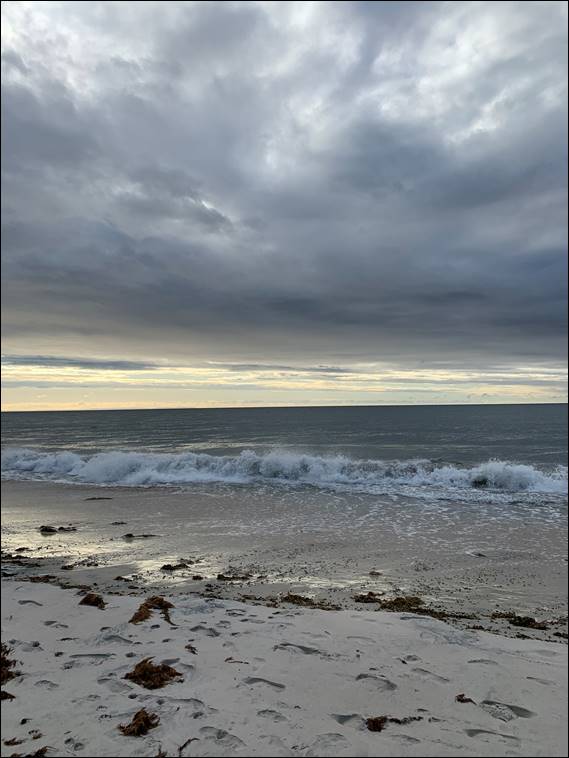
After getting excited, some three weeks back, when I swapped the reference books that are sat next to my computer from orchids to fish, I have since not had to open them up. During this time the wintery weather, which seemed to intersperse the short spring spell we had, continued into what was now officially summer. Seaweed was still being washed up along the shoreline, albeit only in much reduced quantities. But it was still a good indication of what the visibility might be like. That said, prior to today I have been in twice:
Both times it was a bit murky and there was very little worth mentioning, other than this Southern Baler (Melo miltonis). I’ve previously mentioned the larger species called the Northern Baler (Melo amphora), which is quite common. Sadly the southern species is less common, mainly because the large attractive shells are harvested for ornamental purposes. They are at their best when the shell is occupied, as when unoccupied the pattern started to bleach. This means the molluscs are being killed to satisfy our need for pretty things:
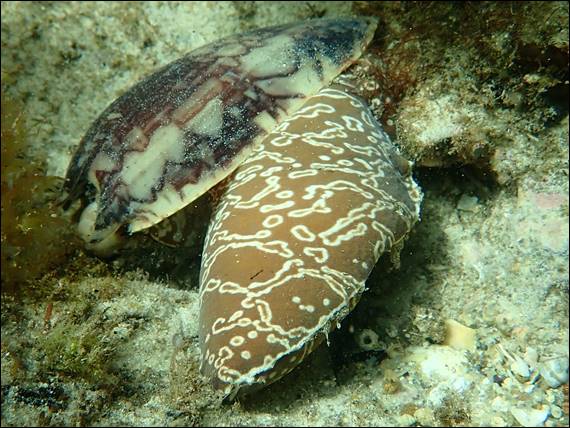
It is uncommon to find them in the daytime, when they are normally buried under the sand hiding from prey. They come out at night to feed on molluscs such as scallops and turban shells. One day I’ll have to find out how these soft bodied creatures manage to get their prey out of their protective shells. Today, after several days of good conditions Geoff, Nana and I decided to head into the water. The Capel River mouth has been opened up to allow flushing of the riverine water to improve the water quality and reduce the risk of algal blooms forming:
As such the best reef was not accessible and we decided to go in and check the section of reef I spend most of my time exploring. It felt a little luxurious being picked up and driven the short distance to the beach, but certainly wasn’t going to complain. The water was flat, but the swell was enough to keep the weed swaying back and forth and to stir up a bit of sediment close to shore. My duck diving did however pay off when I stumbled across two small nudibranchs, and sadly this was the best image I could manage:

They were no more than 20mm long, so I assume they were relatively young. My first guess was maybe one of the Harlequin Nudibranchs species, but on closer inspection I believe they are probably Red-netted Nudibranchs (Goniobranchus tinctorius). These are said to be a very common species with a wide distribution. Found throughout the Indo-Pacific region, and in all waters off the Australian coast except Victoria and Tasmania. However, to find them takes a good eye and patience, and most importantly when snorkelling an ability to hold your breath:
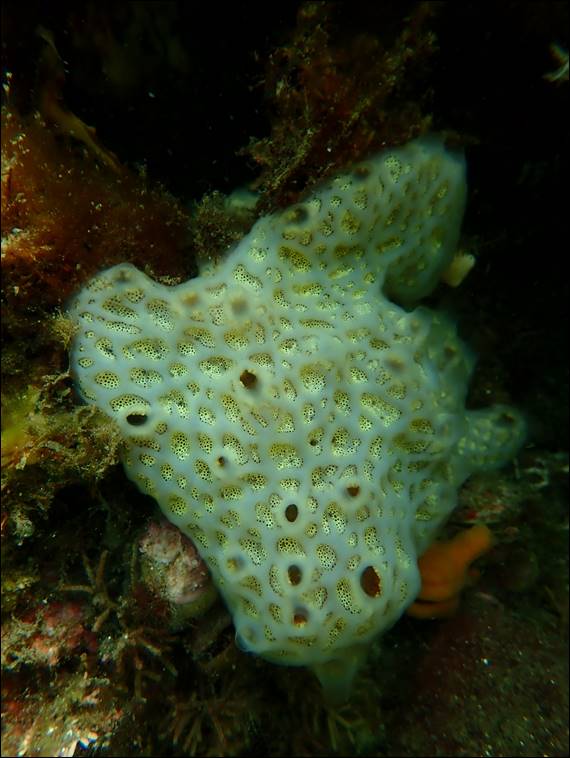
You will noticed I skipped past the above image, and try as I might I have no idea what this was. I have seen the delicate underlying honeycombed structure before, and back then thought it may have been a sponge. I have however not previously seen it with the ghostly looking lattice that is encasing this one. The find below was however easy to identify as the Senator Wrasse (Pictilabrus laticlavius), they grow to 30cm in length and this one was 15-20cm. While not fully grown I was able to tell by the colouration it was a male:
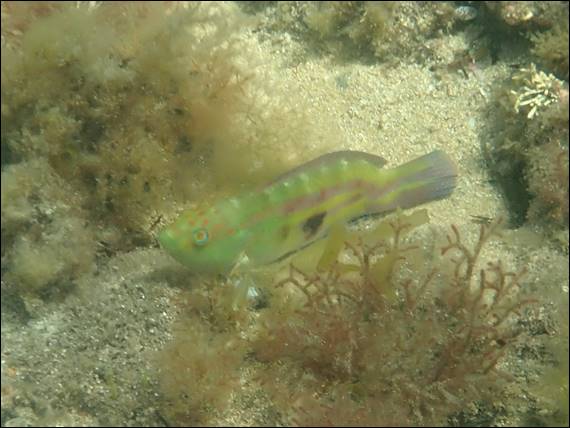
The males are highly territorial, while the females can roam across the boundaries that the males so fiercely defend. These fish are what is called protogynous hermaphrodite. In the early staged of their life they are female, free to roam. Then, anywhere from their second to fifth year, they will change into a male. And start to defend their patch while living until an age of up to ten years. We continued to check out the underwater landscape, and maybe as a result of feeling ‘safety of numbers’ ended up much further out than I have been before:
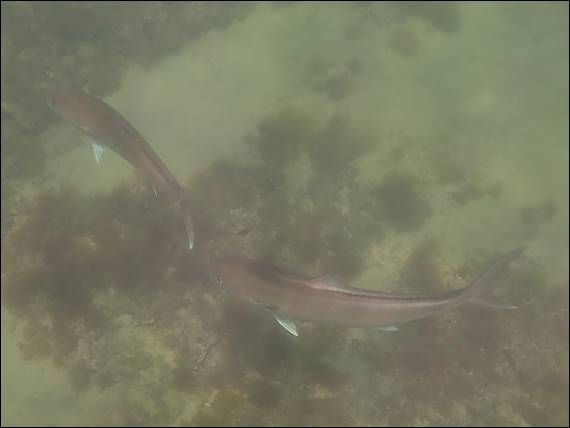
A small school of three Samson Fish (Seriola hippos) circled us with curiosity. Close to a meter long, these fish are named after the biblical figure of Samson due to their strength. Found in the waters off Western Australia more than anywhere else in their range. Fishing restrictions imposed on ‘good-eating’ demersal species have resulted in Samson Fish becoming a more sought after catch-and-release species. Care is required when releasing them during spawning activity, a time when they display non-feeding behaviour and have little in reserve to deal with the stress of the experience:

I also spotted the above coral, something not found in the reef area I normally stick too. It has been very hard to try and identify it, despite having some great close up images. The closest I am brave enough to share is that it may be of the Turbinaria genus, comprising colonial stony corals. This genus can form many shapes, which their names allude to including disc, scroll, cup, vase, pagoda and ruffled ridge corals. The polyps clearly seen below are only found on one side of these structures, and are usually housed in raised tubular skeletal cups:
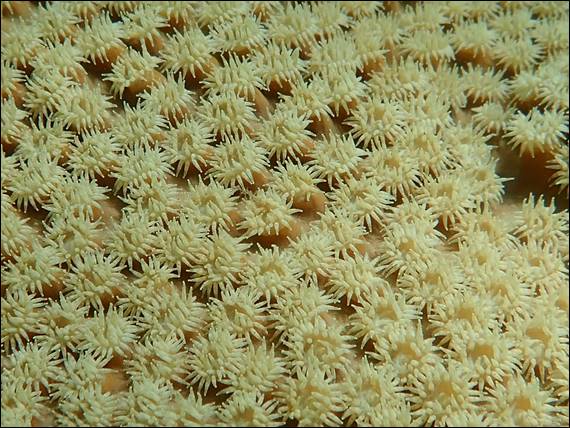
Just like the Southern Baler and Samson Fish, these corals are also at risk from us. Being found in water depths of 2 to 15m they are susceptible to coral bleaching due to changes in temperature, light, and/or nutrients, all occurring due to the way we live our lives. These triggers create stress that results in the polyps eject the coral’s algal symbionts. Without this algae the coral in unable to survive. All that aside, the three of us really enjoyed the dive and what we are still able to see. So I’ll endeavour to be a bit more cheerful in my next post:
 Sandbagged