For those that may be wondering if I have given up looking for orchids, the response is both a yes and no. Certainly as summer approaches and the land dries and temperature warms up, the abundance and variation of orchids on display in our area is declining. I’ve been out hunting a few times, but have not come across any new finds or anything particularly startling. In a way it feel like it has all come to a rather abrupt end this year, and the only orchid that I am hanging out to see come into flower are the Slipper Orchids (Cryptostylis ovata) at Manea Park:
I’ll be heading back their next week to check in on them, but have a feeling it may be a few more weeks before they start to flower. In part as the warming weather is being interspersed with bouts of almost winter like spells. This is not stopping all plants from continuing on their expected flowering timeframe, such as these Pixie Mops (Petrophile linearis), yet another plant that is endemic to southwestern Western Australia. That said their flowering period is relatively long being from August to December:
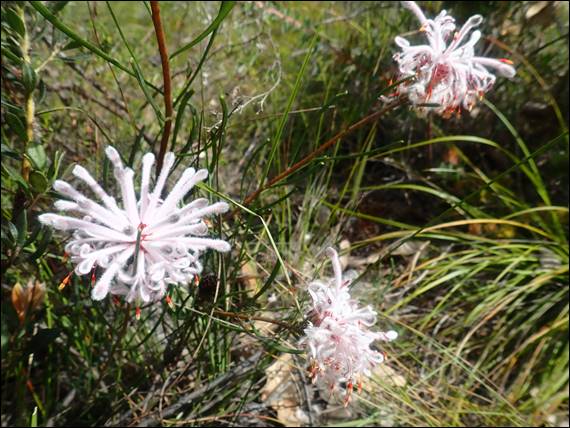
It is not an uncommon plant and can be found in woodlands and heathlands along the coastal plain stretching some 400km down the coastline of Western Australia, from Jurien Bay to Yallingup. Although it has also been found in some areas along the south coastline. While common to see I really like these flowers. Like the Rose Coneflower (Isopogon dubius), which also grows in Ambergate Nature Reserve where Lisa and I were walking today, it has delicate protrusion that come out of the end of each limb of the flower, as shown below:
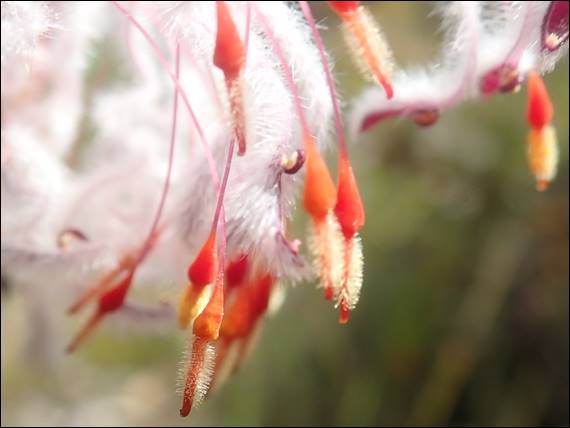
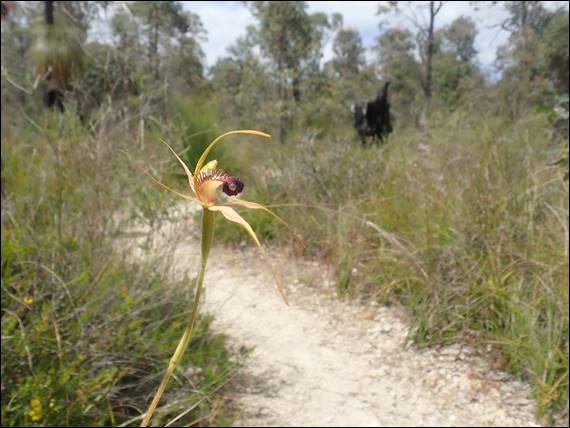
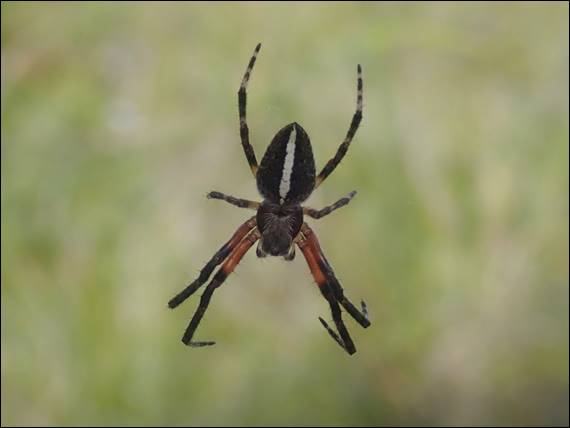
I wonder if maybe the name also is why I am drawn to looking at these plants, with the Genus name meaning rock (petros) love (phileo) in Greek. Lisa and I spotted several orchids, such as the Swamp Spider Orchid (Caladenia paludosa) in the first image, but most of my attention today was more drawn to the insects. And one that can be regularly found between November and December is the Christmas Spider (Austracantha minax). This is the female, which you can tell as they are one ones that sit in the middle of the web, while the males lurk unseen in the vegetation round the edge of the web:
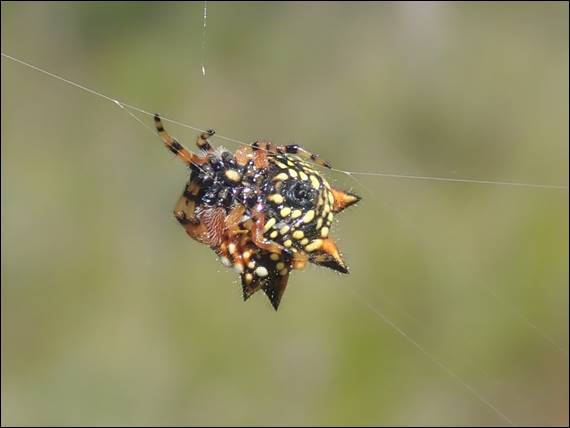
The females grow to just over a centimetre, while the males are half that size further adding to the difficulty in spotting them. While we tend to only see the females in abundance for these two months, they are still about for the rest of the year. The reason they are hidden from view is that during the earlier stages of their life cycle they are much smaller. These cheeky little spiders are known to hook their webs onto those of other spiders, which is thought to be done to allow them an increase their foraging area. While the above spider was easy to identify the next one, despite much research, has alluded me:
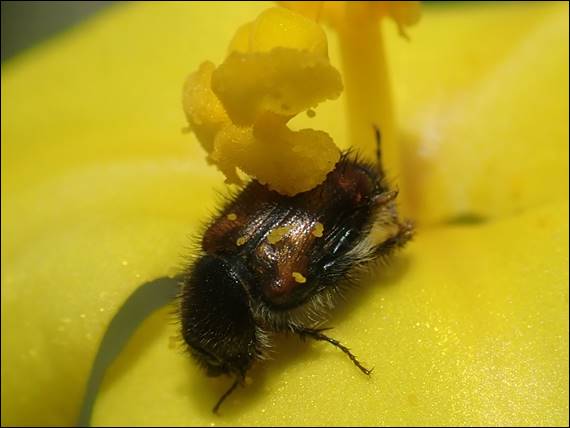
I also have spent a long time trawling through sites to identify the beetle below, which is happily assisting with the pollination process of a Yellow Flag (Patersonia umbrosa). In trying to identify this beetle I did however find out the difference between a beetle and bug. The former have mandibles, or chewing mouth parts, whereas a bugs mouth is designed to eat by piercing and sucking on plant tissue. Also while both beetles and bugs have wings the way they are structured is different, with the wings of beetles being protected under a hardened forewing that forms part of the shell:
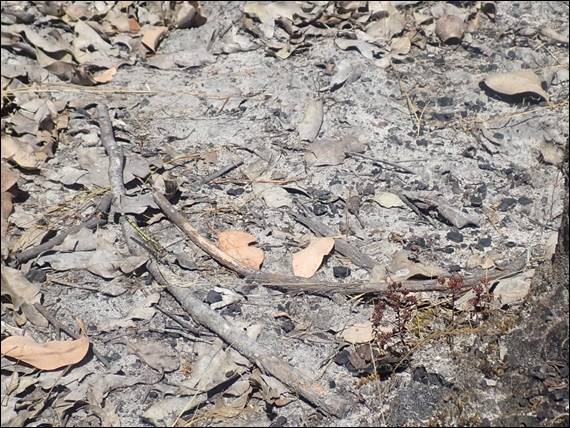
The mix up between beetles and bugs for some is no doubt created by the names, for example what is known as the Ladybug over here is in fact a beetle not a bug. That said, back in England we always knew them as a Ladybird Beetle. One last image from our walk today, before we headed off to find some food. This dragonfly, if you can spot it, didn’t allow me to get any closer. So any attempt to identify it would be as futile as my attempts with the spider and beetle above, and be a complete stab in the dark:
 Sandbagged