I make no apology for not working today, and instead getting out to hunt for orchids. It is the one day of the year that I really should not be stuck in an office. But now that I have been out I am once again stuck in front of a screen, and have been for a while. My trip today was guided by one of my orchid books, which has a bunch of mud maps of places worthy of a visit. I decided on a bit of a road trip to a few of them and started with two worthy spots just out of Gracetown, not too far from the coast:

The landscape here comprised low scrub, with no protection from the elements. And today there was a stiff westerly coming from the ocean, and above it was all a bit grey and murky. In fact it had rained most of the way down and I did wonder how I would go. The condition was however not such a bad thing, as direct sun tends to result in capturing good images a bit tricky. The white and yellows tend to reflect all that brightness back into my ‘point and shoot’ camera and stuffs up the contrast:

I do wonder if I need to consider a phone upgrade at some point, as my iPhone 6 just like my Olympus tough camera does not use any image modification. The images taken by others, with more up to date phones, tend to provide an image more akin to what we actually see by taking a number of images at different exposures and then layering them. You could call it auto ‘photoshopping’. And while I do not like the idea of modified images, as I feel it takes the skill out of taking good images, it would be handy:

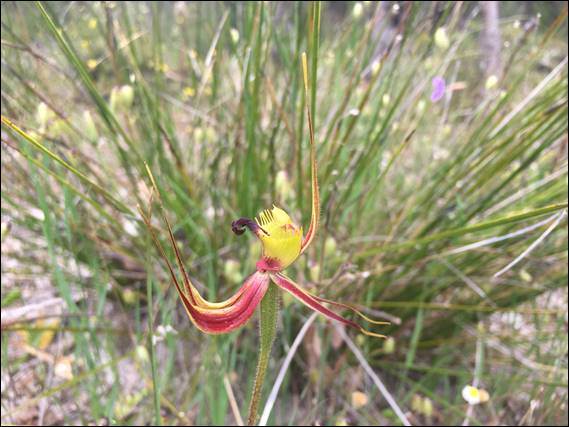
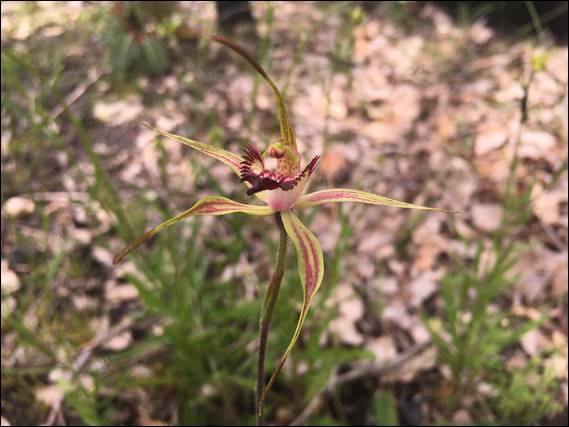
Today started very well. I was a little surprised that a spot like this, being exposed to the full force of whatever the Indian Ocean might throw at it, would have been a bit harsh for plants as delicate as Orchids. I could not have been more wrong and managed to find lots, including the one that I was very keen to spot. That is the first orchid image and is the Funnel-web Spider Orchid (Caladenia infundibularis). The one above is not so clear and may be the same, but the clubbing on the petals is more prominent. I am however not game to try and identify it:
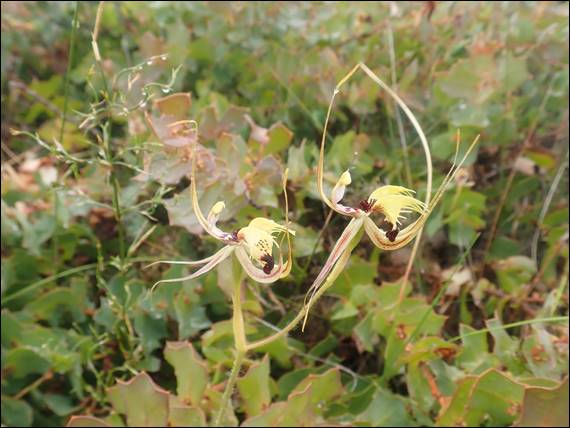
I also tried my contacts, but they also were not convinced on that one, but it is clear that the above image is of two Forest Mantis Orchids (Caladenia attingens). I thought they looked pretty unusual with the forward facing labellum on both of them, but I have been advised that they are just getting old and past their best. Funny how I felt they looked really interesting, as opposed to old and tired. The next spot on my list was literally several hundred meters up the road, and it may seem a little strange to expect anything different:
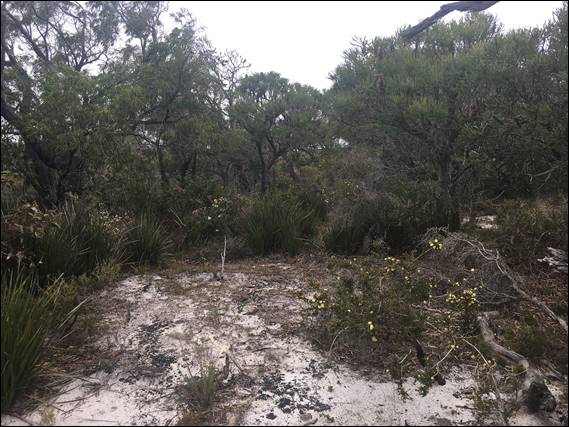
However, the vegetation complex changed here and was more of a banksia woodland, which provided bit more protection. It also had different understorey vegetation, as well as some open sandy areas. I mentioned at the start that I had been on the computer for a while, as it has taken me a long time to try and work out what I had seen. While I do have access to a very friendly and helpful expert, I do not like to use them unless I have given identifying my finds a good crack and I am still really stuck:
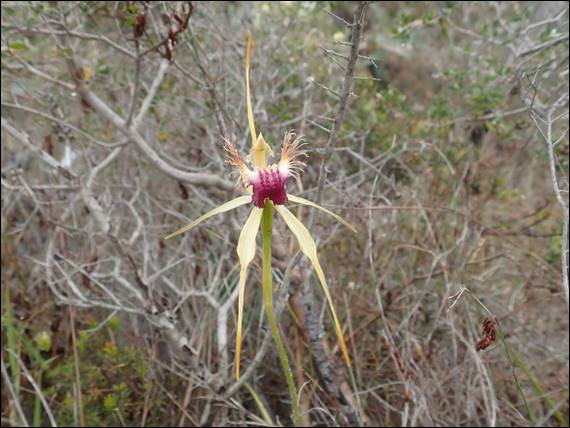
Lisa and I spotted the above and below orchids recently, but I was still excited about seeing them for only the second time. As such I have included an image of both, being a Scott River Spider Orchid (Caladenia thinicola), above, and Swamp Spider Orchid (Caladenia paludosa), below. These two I was able to identify, although it did feel a little strange finding these on a high sandy ridge. I thought they would prefer wetter conditions. But this year I have been fooled a few times by believing what I read, so I should be used to expecting the unexpected:

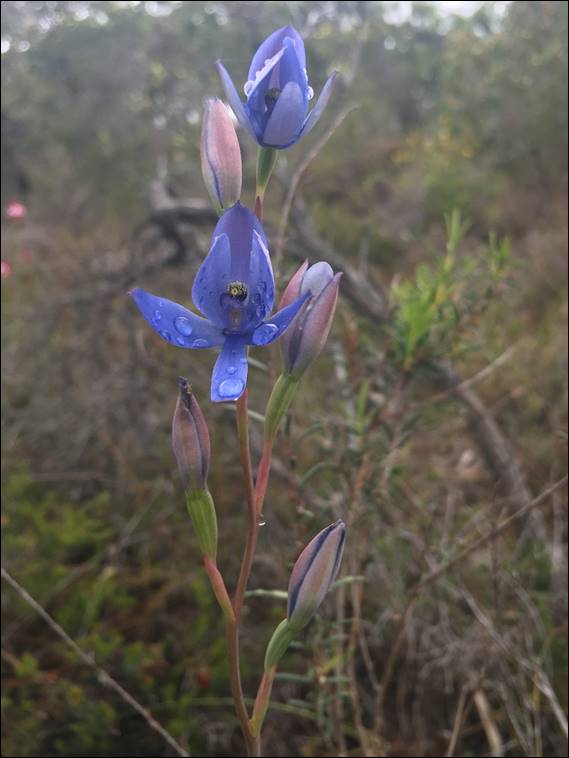
Due to claggy weather, while I found lots of sun orchids none had fully opened up. In fact most looked like they had decided to stay asleep for the day, keeping their flowers safely tucked up in their closed buds. This was the only one I found that was anywhere near open, so it was the only one I could identify. Being a Blue Lady Orchid (Thelymitra crinita). I feel the water beading on its petals may have made it think that it had made a mistake by starting to open. Although it did make for a lovely image:
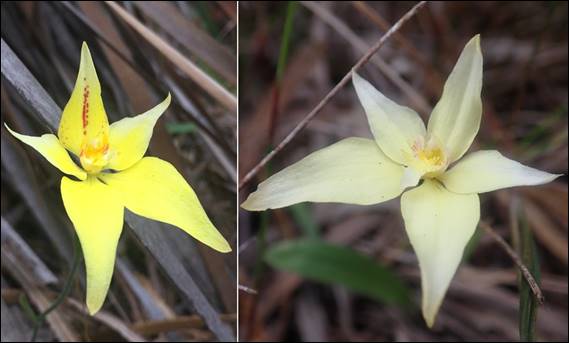
There were of course a few usual suspects in addition to what I have included, and below there are two images of Cowslip Orchids (Caladenia flava) I found. My reason being that the one on the right is an albino form, the only albino I have found of this species to date. Even with the relatively dull weather taking an image of the albino form was a tad tricky with my basic cameras. That wraps up the finds at Gracetown, and it was then time for me to drive to the next spot:
I took Caves Road towards Yallingup, but stopped before I got there. These spots are noted in the book as being a few kilometres before getting to the road that takes you down into Yallingup. The landscape was again Banksia woodland, and this time I lucked out. Finding a few orchids but nowhere near in the quantities as the first two spots and also not the range of species. In fact I would go so far as to say they were a little disappointing, especially the second one closer to Yallingup as that one seemed to be full of weeds and not much else:
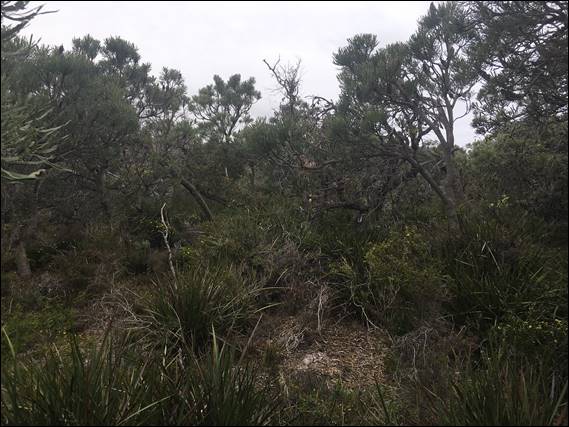
Not put off I drove on towards Dunsborough, and had in mind to try a spot that is not listed in the orchid guide. We have driven past Big Rock Reserve many times and I have often said it looks like it would be a nice spot. This reserve comprises ironstone flats, with more rocky soils but also including sandy rises. And has a variety of vegetation complexes, but mostly comprising Jarrah, Marri and Banksia woodlands. And I had more success here than at the documented sites:
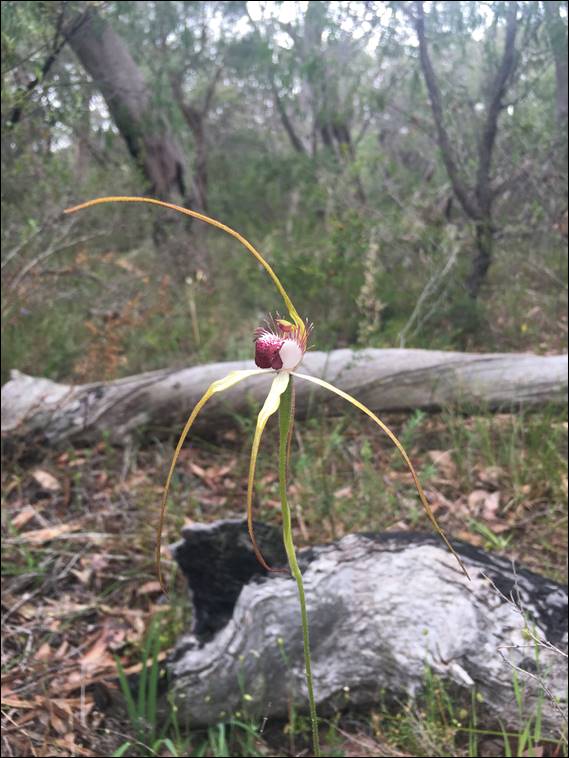
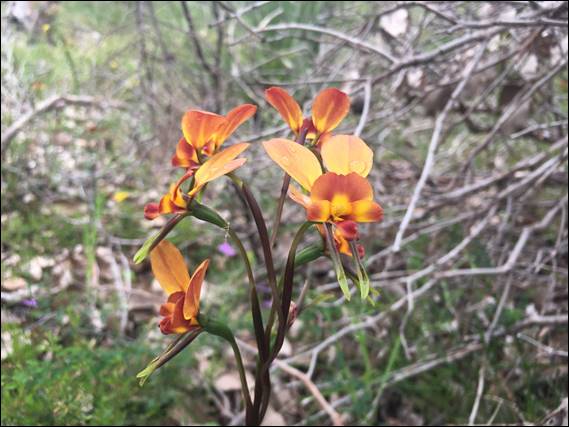
The reserve seemed to be relatively weed free and had many flowers, including quite a few repeat orchid finds. The above Giant Spider Orchid (Caladenia excelsa) was a new one for me, as was the Giant Donkey Orchid (Diuris amplissima) below. I spent more time here than at both of the last two spot. This is a reserve I will have to remember for earlier in the season next year, to see what else might be about:
As I started to make my way back to the car I came across, and had to include an image of, this Forrest Mantis Orchid (Caladenia attingens). While a repeat find from today this specimen is in its prime. In fact I do not recall ever seeing one looking quite so vibrant, with the lower sepals being almost entirely red. Even checking back through my images from today, and before all the other specimens I have seen of this species look positively dull in comparison:
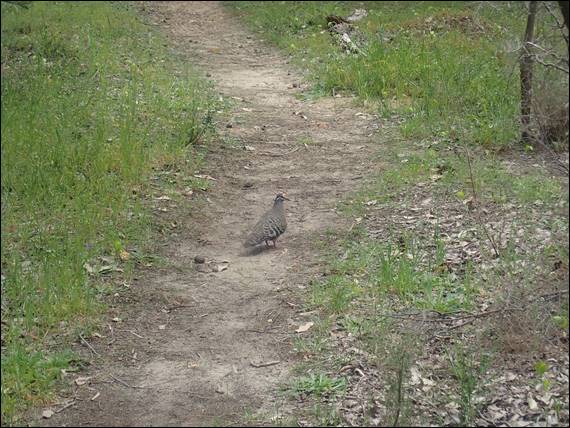
Driving on to Dunsborough I headed to the Blythe Nature Reserve, a tiny reserve surrounded by houses. But reputed to be very good for flowers and orchids. Signs requested visitors to stick to the path, and I had to laugh as this Common Bronzewing (Phaps chalcoptera) was also adhering to the rules. Walking some 5 to 10m ahead of me for over 200m and even taking the turns that I was taking in the path. And it didn’t take flight until it had literally just got past one of the entrance gates to the reserve:
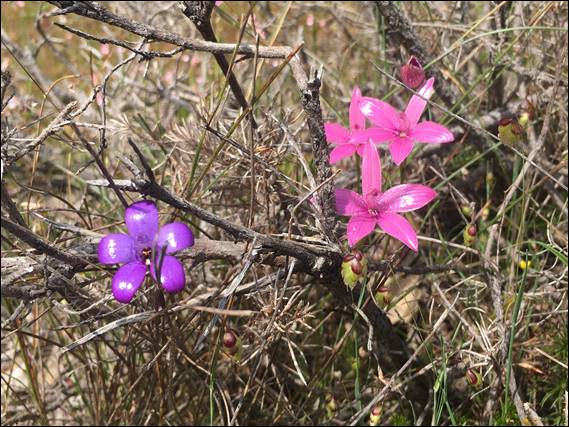
I feel like I missed the best time to visit this reserve, and there wasn’t much about to see orchid wise. But it was definitely worth coming, as after years and years of thinking I might have seen a Pink Enamel Orchid (Elythranthera emarginata) I have finally come across them. And now that I have seen them there is no way I could ever get them confused with the Purple Enamels again. I thought the best way to identify which is which by checking the labellum, but they are also clearly different in shape and size:

Very excited with the above find I had one last place to check out, again in Dunsborough and being the Meelup Regional Park. I have been here plenty of times, mostly it has been to the middle and northern parts of the park. Therefore, today I wanted to check out the southern section that is right on the edge of Dunsborough. So I finished as I had started, being close to the ocean. The key difference being the Geographe Bay is protected from the wrath of the Indian Ocean, so the waters here looked calm and blue:

I was again not disappointed and also was a little amused when I came across hundreds of Pink Enamel Orchids, this time some of them were mingled in with Purple Enamel Orchid (Elythranthera brunonis) proving a perfect photo opportunity to show you what I mean about how different they are. Even though the Purple Enamels can and do change the hues quite considerably with age, there really is no way to get these two mixed up now. Also seeing so many today I wonder if I have simply not been looking in the right places for Pinks Enamels all these years:
Mind you I didn’t find them in the first five places I had been today. I might check a few of the other spots near Capel and Collie to see if they are sprouting there this year too. Enough talk of the Pink Enamels, as I wandered about I came across some poorly looking Chapman Spider Orchids (Caladenia chapmanii). It seems their time is over, but others were coming out now including the Dunsborough Spider Orchid (Caladenia viridescens). Yet another first time sighting for me:
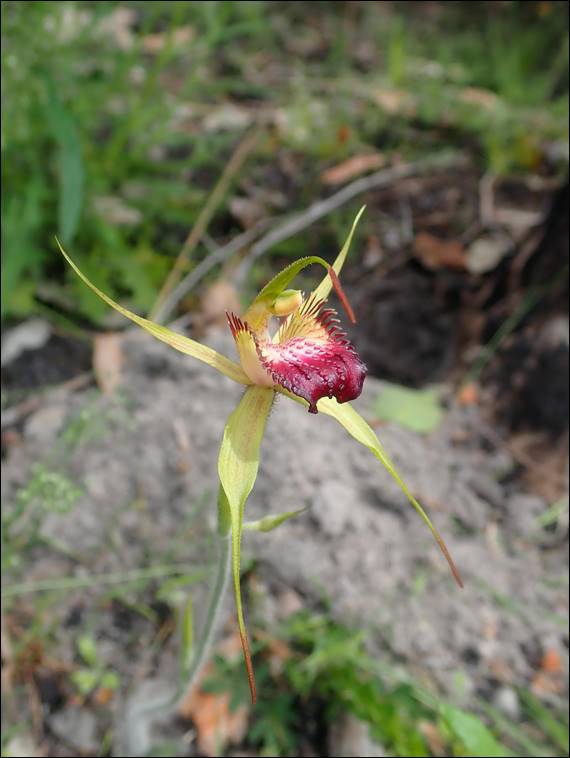
As was this Tuart Spider Orchid (Caladenia georgei), which is the last one I found worthy of inclusion. My road trip had taken me to seven sites, and all had provided finds of some sort although there are definitely two places I would not return to. So all up it had been a very successful morning out, and then it was time to head home to start unravelling what I had found. It was a perfect way to spend today, but sadly tomorrow it will be back to work:
 Sandbagged
Happy birthday!
LikeLike
Ha ha thanks Howsie 😀
LikeLike