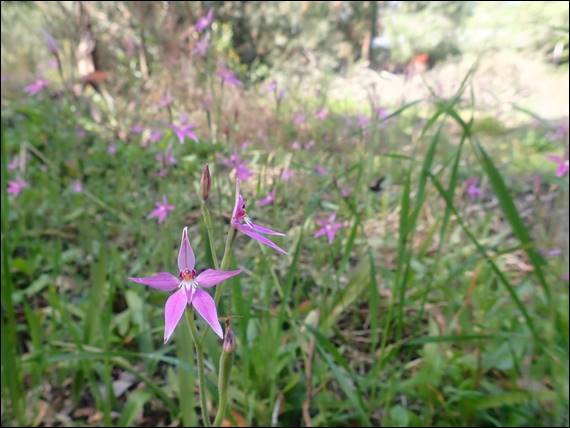
I was trying to tell myself not to send another post of my orchid hunting this weekend, but as you can tell I didn’t listen to myself. Today I went to two spots, the first being a small patch of bush called the Katherine Chauhan Reserve. No more than 10 acres (4 hectares), surrounded by suburbia in Bunbury, and managed by the local community. Rongy cycles past this place and has often told me he has seen a fair few orchids here, so after dropping Lisa off for her Pilates class I went for a wander to check it out. And I was not disappointed finding areas of the land covered in hundreds of Pink Fairy Orchid (Caladenia latifolia), Sandplain White Spider Orchid (Caladenia speciosa), Sandplain Donkey Orchid (Diuris tinctoria), and Cowslip Orchid (Caladenia flava):
I also stumbled across a Zamia Palm (Macrozamia riedlei) a true prehistoric plant from the division Cycadophyta, from which some plants existed 250 to 60 odd million years ago. This species is endemic to southwest Australia, and like some orchids has an interesting relationship with a specific insect. Similar to some orchids it uses deception by releasing an aroma, this time to attract the male Cycad Weevil (Rhopalotria mollis). However, it goes step further, and once the weevil’s job is done the plant then changes its scent to one that results in the male weevil feeling unwelcome. Resulting it leaving before it can start to do any real damage:
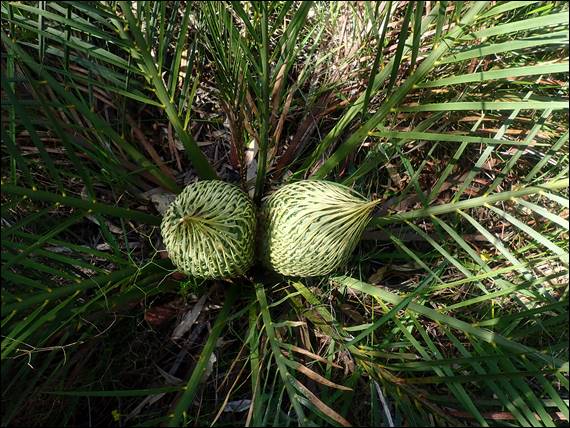
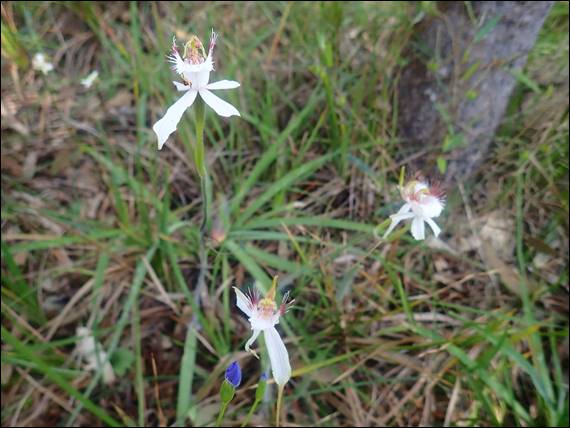
The large cones of this palm have edible seeds. However, for human consumption they need to be prepared correctly, as the plant has bacteria in it that both fixes nitrogen and creates a toxin. There are tales from 1829 of passing sailors eating the seeds and likening the taste to roast potatoes. Waking the next morning with symptoms of poisoning, but also recovering within a day or two. While I saw no sailors there was something in this reserve that was hungry, with lots of the Sandplain White Spider Orchids having been nibbled. In all cases it was just the long white petals that had been taken with the main flower remaining:
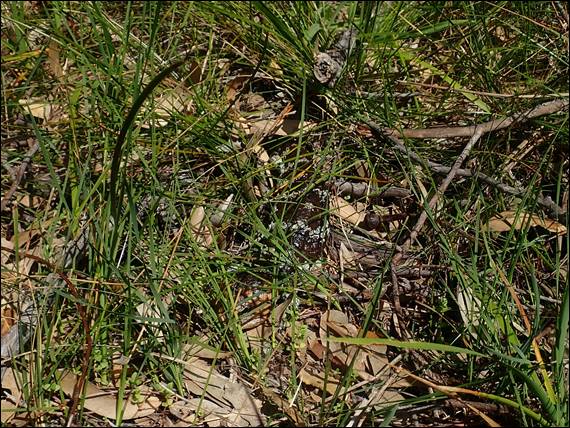
With so many orchids about, I was treading extra carefully and only just in time spotted this Bobtail Lizard (Tiliqua rugose) hidden under the grass. Bobtail Lizards have a head and tail of a similar shape, no doubt to confuse predators who will then have a 50-50 chance of attacking the head. However, unlike many other lizards this one cannot escape by shedding its tail should a predator takes hold of it. As I did a bit of research into these lizards I also found that the females are in charge of mating choices, and are attracted to more attentive males:
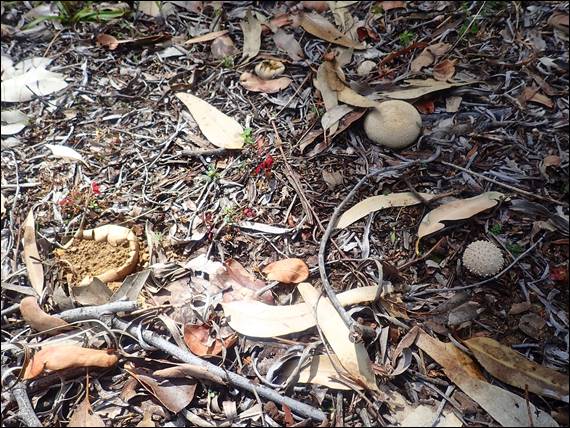
The males are made to follow the female round for a few weeks to prove their attentiveness, before sealing the deal. And while I’ve read that they are monogamous, research has also suggested that if a male becomes to inattentive the female will find another more “new-age” guy. It seemed that the Earth Balls, like the orchids here, also seemed to believe in safety in numbers. My wander in this small reserve was on a time limit. And it was now my turn to be attentive and get back in time to pick Lisa up, after which we had to hit a few shops:
Once the town stuff was done we went to Manea Park to see what might be out. I can confirm that, just like at the small reserve today, the mosquitoes were not out. At least not in force like I had experienced on Friday. Not too far down the track I spotted a single flower of a Blue Lady Orchid (Thelymitra crinita). The name of the genus comes from two Greek words, thelys and mitra meaning “belonging to women” and “headdress” or “turban”. This reference was chosen to describe the hooded column in the middle of the flower, which will often have wings or glands atop. And it is this feature that can be used to identify the different species:
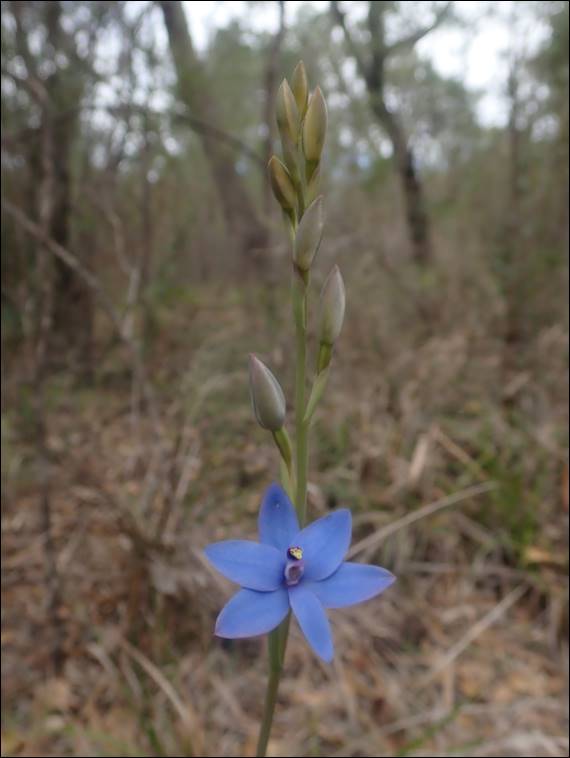
The Blue Lady is the most common of some 130 species of Sun Orchids, and like others it can have up to fifteen brightly coloured flowers providing a spectacular show. However, individually the flowers tend to be rather plain compared to other orchids. Not being as intricate, nor having a labellum that is at times the spectacular centre piece of orchid flowers. Also unlike other orchids they also will close up in cloudy weather and at night. Another common orchid is also starting to make an appearance, being the Common Mignonette Orchid (Microtis media):
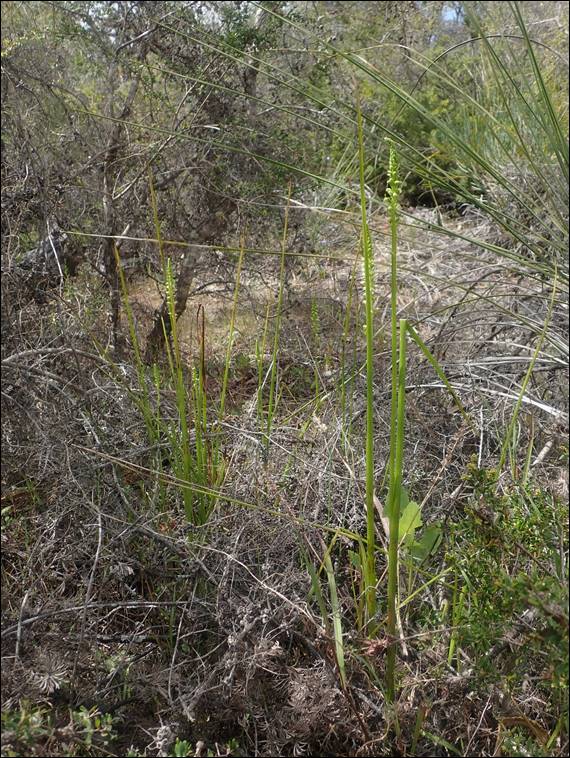
The Common Mignonette Orchid is extremely widespread, so much so that it is not unusual to see them forming colonies in urban areas. I have even seen the odd one or two in our garden beds. We of course saw many other orchids, which I have over the last week been spotting in a number of other locations. One of them being the Sandplain White Spider Orchid, but for the one below you may notice the brilliant white appearance that is lacking much of any other colour. I was intrigued by this so contacted Noel Hoffman to check it out:
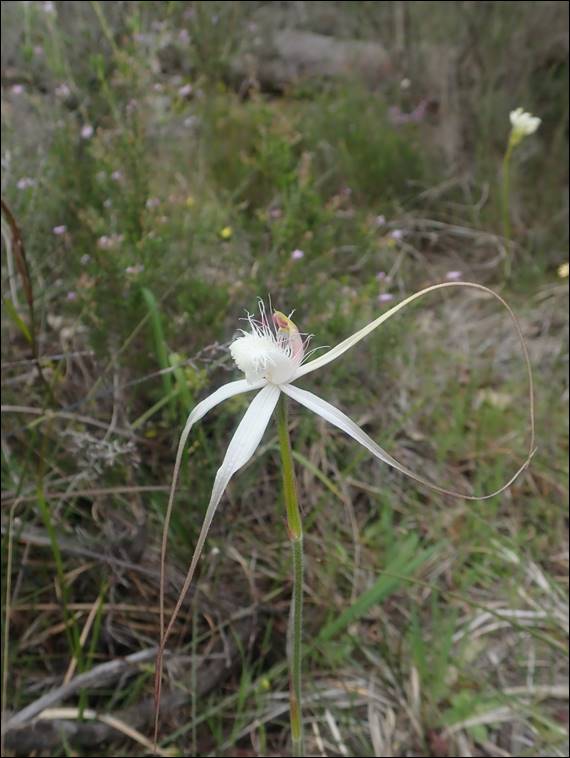
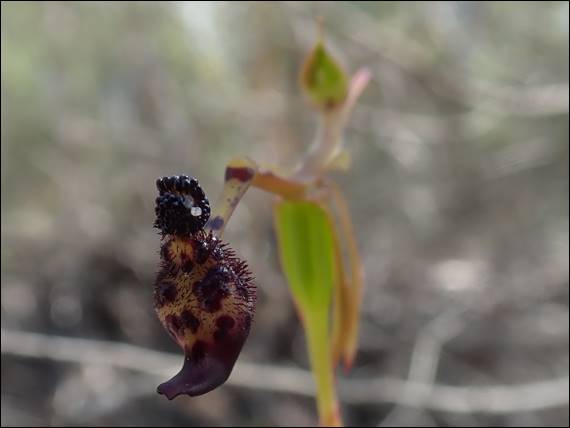
He confirmed my identification was correct, and the lack of colour was due to it being an albino form. I also told him about my next find, which I was very excited about. This is the first time I have seen a Warty Hammer Orchid (Drakaea livida), of the same genus that includes the King-in-his-Carriage (Drakaea glyptodon) that I have seen a bit this season. While I am still very chuffed Noel outdid me in style, as he had just found a Hairy Warty Hammer Orchid (Drakaea andrewsiae). A species that has not been seen for some forty years, and being so rare he had not even included it his book:
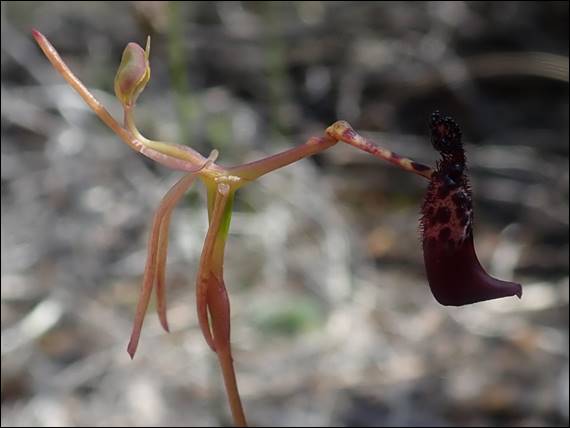
The King-in-his-Carriage is the most common of the Hammer Orchids, while the Warty Hammer Orchid is the more regularly found from the remaining species of Hammer Orchids. I was intrigued by the scientific names of these two, with livida coming from a Latin word meaning “bluish” or “black and blue”. This resembles the blotchiness of the labellum or hammer. While the name glyptodon is due to the likeness, of the hammer of the King-in-his-Carriage, to the head of the namesake extinct giant mammal that is related to the modern armadillo. This cattle sized creature roamed the earth as recently as approx. 12,000 year ago:
 Sandbagged