Despite a not entirely favourable forecast and having driven through belts of rain to get here, Lisa and I were greeted to flat, vibrant, and aqua coloured water extending out into the distant ocean from Castle Rock Beach, which is located in the Meelup Regional Park. Even better, as we stepped out of the car and looked towards the horizon whales could be seen launching themselves out of the water. Crashing back down and sending walls of white water high into the air. So even before we began our walk, we took a load off and sat to watch them play:
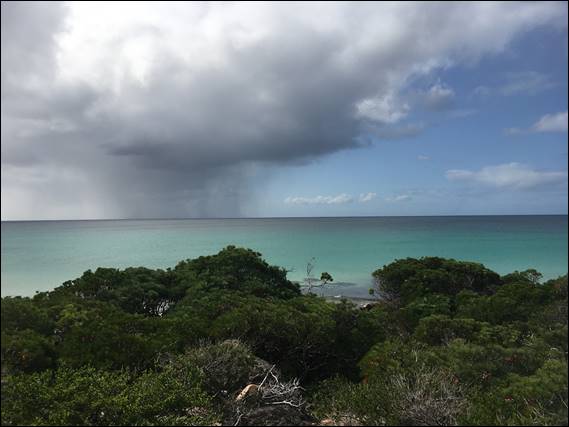
Today’s walk took us along a winding coastal path, which at times goes through tunnels capped by the branches of trees entwined above. Where the vegetation receded on the coastal side the flat blue ocean stretched out, and stopped for a while looking out hoping to glimpse a whales or two. Unlike at Manea Park just yesterday there didn’t seem to be too much in flower, and the most prominent flower I kept seeing was the Southern Tiurndin (Tribonanthes australis). First described in 1839 and the scientific name comes from two Greek words of tribon and anthos, meaning cloak and flower respectively. Possibly due to the frilly fabric texture of the petals:

I kept a beady eye out, but the coastal track was still quite damp, with seepages making the path muddy in places. The cool and wet nature meant that it didn’t feel very “orchidy” to me, and as it was I didn’t spot any in flower. With only a few tell-tale leaves scattered in isolated areas. As such our pace was faster than normal. Soon enough we were well past Meelup Beach, and at the point where it is possible to take a left and head up the lookout circuit. Here the track rises up the rocky hill, which provides vistas but also means the land dries up. Whether this was the reason or not there were more flowers to observe, but still no orchids:
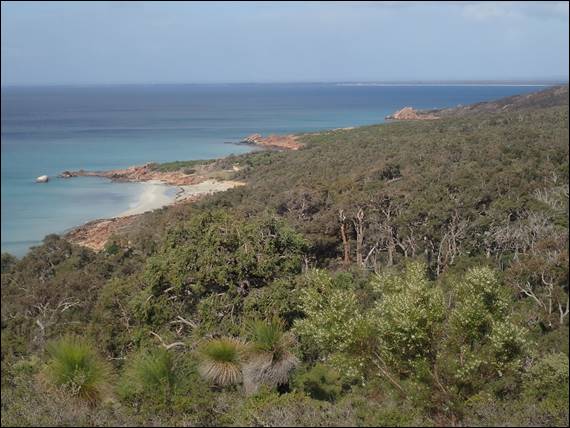
While it was sunny, we had little protection from the wind and it had a chill. So we didn’t hang about for too long, just enough time to spot a few whales far out to sea continuing to play. After which we started the descent back towards Meelup Beach, from where we walked at a reasonable pace. At one point Lisa asked if we had far to go, and I could see Copper Rocks not too far ahead. So I guessed it was ten minutes tops, but if we didn’t muck about maybe five. A few yards later I spotted a heap of promsing looking leaves sheltered under a granite boulder and the mucking about started:

As I stared intently at the leaves that had stems with tiny buds atop, almost willing one burst into flower, Lisa spotted the above Spider Orchid claiming her spider senses had told her it was there. I might add, as an explanation, that we recently watched the latest Spiderman film. In my post yesterday I mentioned how many Donkey Orchids there are, well there are even more Spider Orchids. Close to 400 speices and over 130 of them are found in Western Australia. This makes them the largest single genus of orchids, and therefore for me very tricky to identify. That said it was obviously one of the White Spider Orchids, but which one:

I’m tossing up between the Splendid White Spider Orchid (Caladenia splendens) or the Hill’s White Spider Orchid (Caladenia longicauda ssp. clivicola). Based on the known range of each species it makes sense to be the Hill’s White Spider Orchid. Although, I noted a distinct maroon stripe on the underside of the sepals, which is a way to identify the Splendid White Spider Orchid. Something tells me I’m going to struggle this season, as my new orchid book simply has too many subtly different looking species. However, the next find shown above and below, which this time I spotted with my spider senses, was easier to identify:
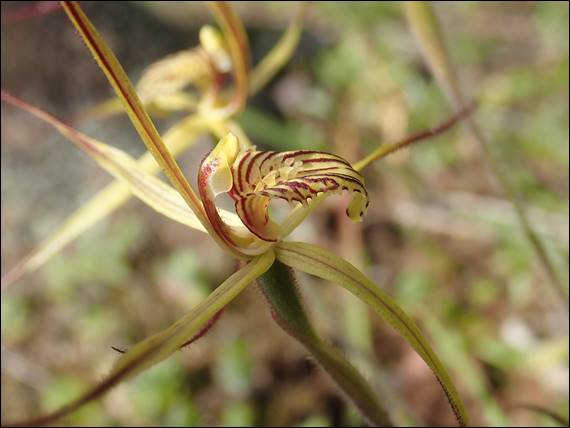
The Cape Mustard Orchid (Caladenia caesarea ssp. maritima) is listed as Endangered under the Environment Protection and Biodiversity Conservation Act 1999. The range of this species is a mere 3.6 square kilometres, and it was first identified in 1972. So it is a relatively new find in botanical timeframes for Australia. The flower on this species only opens for three to ten days. This does not allow a long window of opportunity for pollination, which is assisted by the male Thynnid Wasp. Although, which of the 2,000 species of this genus of wasp found in Australia, I have not been able to identify:
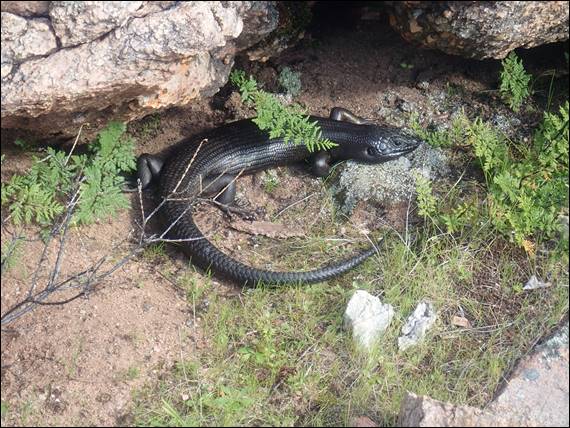
A short distance on we spotted a King skink (Egernia kingii) basking in the sun, and there was a young one next to it that quickly scurried back under the protection of the rocks. Lisa didn’t think that these lizards looked after their young, but I have seen them with young several times. And the proof is in the research, which I found in an Australian Zoologist article from 2003 that outlined a study in which a breeding pair was observed over ten years. They discovered that the young stayed with the adults and basked with them for the first year before dispersing, but even then a single rock shelter could house up to three cohorts:
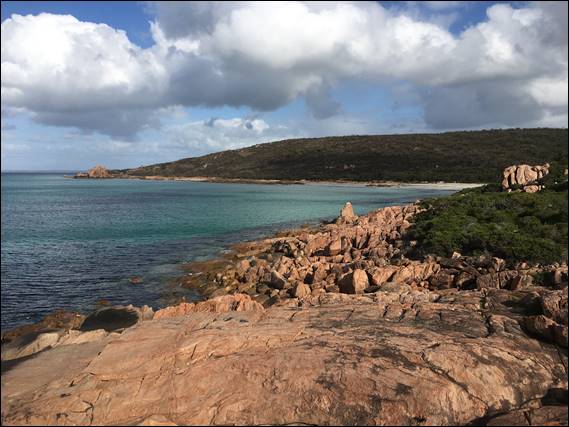
Before the final leg back to the car we looked out and again spotted a whale, but this one was only several hundred meters offshore. Maybe the water was too shallow for it to jump out, or maybe it just wasn’t in the mood for play. But the board and long back breached out of the water a number of times as it effortlessly cruised past us. Finally back at the car, and due to a long week at work, Lisa was happy to sit back and have a cuppa while I scooted to Castle Rock. Not to climb, but to check for any more orchids:
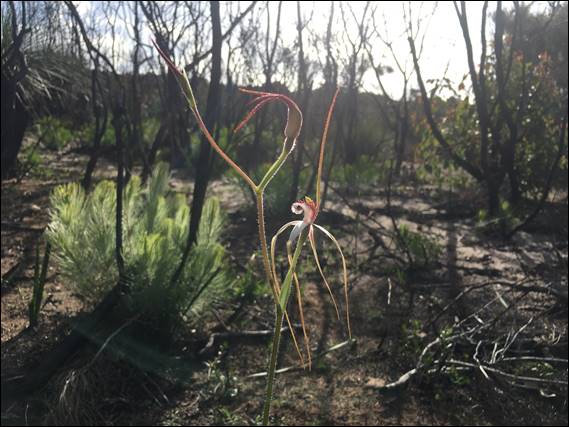
I had a theory, as I knew this end of the park has been more badly affected by the fires of January 2022, when approximately 190 hectares or 40% of the park was burnt. Some species will come out after an area has been burnt, so I was keen to see if I could spot any and I did. But just one and again a White Spider Orchid, which like the one Lisa found may be a Splendid White Spider Orchid (Caladenia splendens), or possibly or the Hill’s White Spider Orchid (Caladenia longicauda ssp. clivicola). Either way I was happy with what we had seen during our walk, both plants and animals. And now my cuppa was calling me:

 Sandbagged