Yesterday evening Josh messaged to ask if I had heard about the Queen of Sheba Orchid being spotted round Bunbury. He mentioned that the word on the street was that it had, but he didn’t have any more details. And nor did I. Why is all this relevant, well this orchid is only found in here in Western Australia and to boot is one of this State’s most protected species. While there are three variants, they are all equally rare and also all equally sought after by orchid enthusiast:
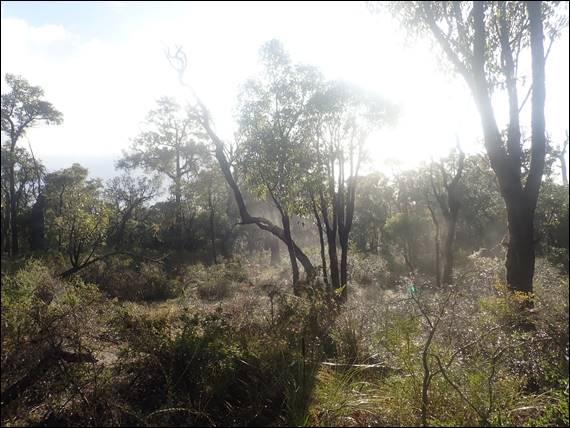
The thought of seeing one was enough for me to decide to head out this morning. Lisa sadly was still not right and was again laid up battling against another bug she had brought home from school. So went by myself on an unexpectedly clear and bright morning, which not at all what had been forecast. As I started my search the moisture from the rain of yesterday and over most of the night was creating a misty look, as it evaporated out of the bark of the trees. It was almost as if they were smouldering after a fire. I had come to the one place in Bunbury that I had heard this elusive orchid has previously been spotted in years gone by, Manea Park:

I hadn’t intended to be out too long, aiming for just a quick look round to stretch the legs. This park is the pretty large and my hopes were not high for success, but it wouldn’t hurt to have a go to find it. Needless to say I moved slowly and spent a lot of time just looking about, and there were two things that struck me. The first was just how many Sundews (Drosera) were about, both in numbers and variety. These carnivorous plants were studied by Charles Darwin in the 1870s. And with over 50% of the documented species of worlds sundews being in Australia, he was fascinated at how they could survive in such harsh environment and in such nutrient poor soils:
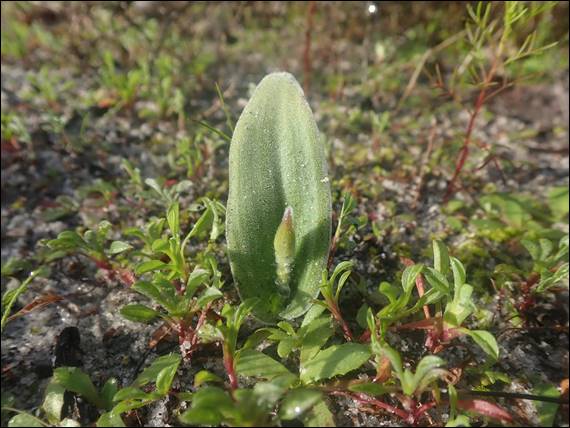
The second thing to strike me was that there were so many orchid basal leaves. A wide variety of sizes, shapes and patterns, with close to all of them yet to start to showing, let alone extending, its stem upwards. My knowledge does not extend to knowing the leaves of all the species, of which there are over thirty recorded in Manea park. I spotted the above leaf which did have a short stem just beginning the next stage of the plants life cycle, but even this didn’t give me enough information to take a stab at what it might be:
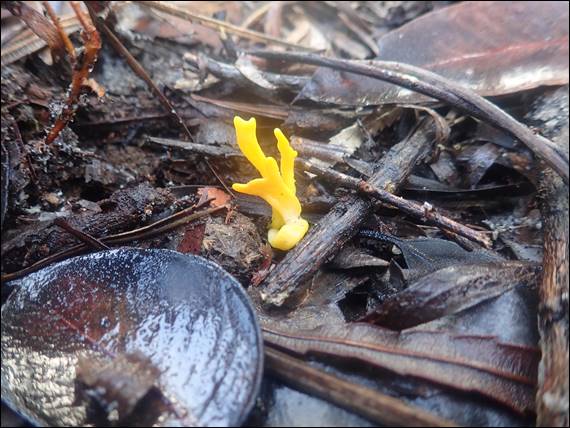
Most of the colours about were greens and browns, although there was the occasional small display of colour. Quite a few plants are starting to flower, often with concentrated clusters of small blue, purple, white, or yellow flowers. As such I thought I’d come back with mostly flower images. There where however many other interesting finds, and the above was by far the most brilliantly coloured one. A Yellow Stagshorn (Calocera viscosa), which I found starting pop up in a couple of locations. Shining so brightly that it looked fluorescent:
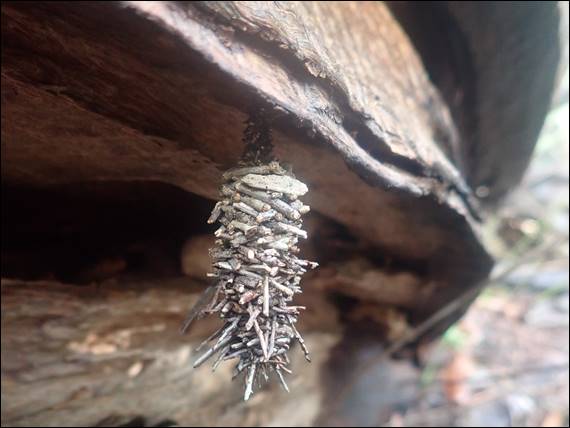
I was not moving fast both to look about and to make sure I trod very carefully. So far the only orchids I found in bloom were Banded Greenhood and Jug orchids. And on one such occasion the above cocoon also peek my interest, I see these every so often. They are associated with the larva and pupa stages of a Bagworm Moth life cycle, which is in the Psychidae family. The caterpillar makes this mobile home using silk to which it sticks the carefully cut up twigs. Based on the configuration of twigs this one is probably of the Plutorectis genus, which is quite common in Western Australia:
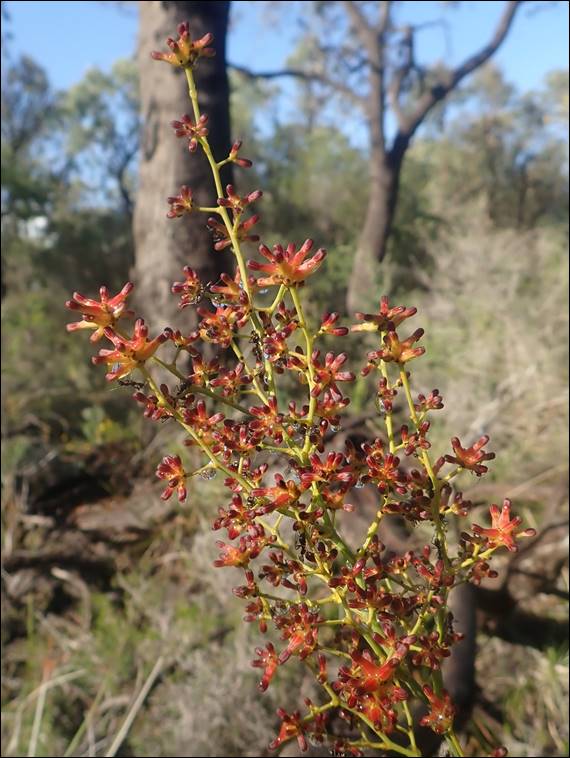
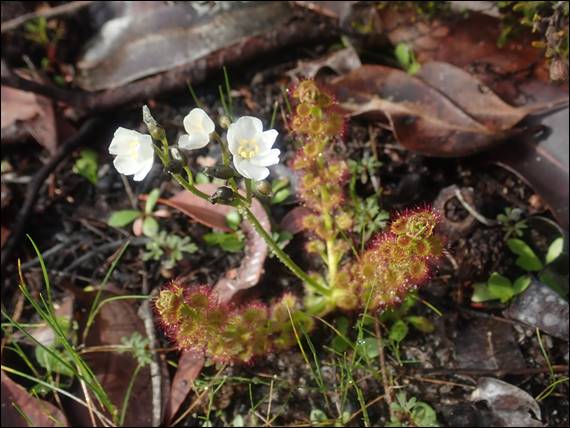
I’d hazard a, safe, guess that the caterpillar was now in its pupating phase. As the mobile home is hanging in a relative sheltered space with the end, where it would have had room to poke its head out of, now closed off. I have included the above image just because I enjoyed watching the ants busily going about life, and not in the least bit worried about me staring at them. Another plant that I was pleased to find in flower was this Sundew, it was the only one I spotted in flower but despite the additional detail I can still not narrow down which Sundew it is:
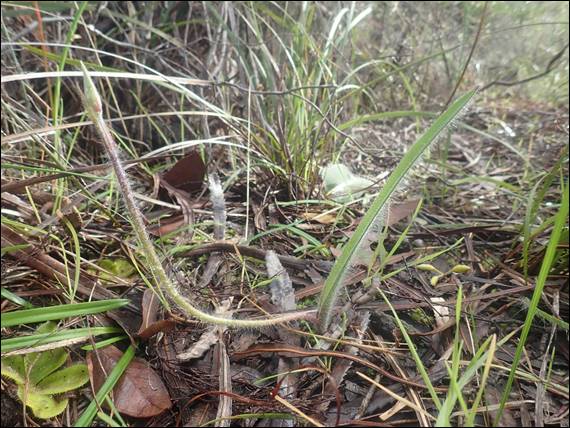
As I continued my journey through the bush, following one track after another, I had no idea of where I was. I also still had not found any orchids in bloom, which I have not previously spotted this season. On the side of the track I stumbled across an obvious stake, which I assume someone had placed to mark a find. It’s wasn’t a Queen of Sheba, or at least I didn’t see one, but I did find the following orchid with a very hairy leaf and stem. The bud was not open yet and without seeing the flower I’m not game to guess what it was. Quite a few orchid can have this hairy texture, so there are a few species it could be:
I thought with such a clear marker I could find it again another day after work so I could check the flower and identify it. But as I continued on my journey along the numerous criss-crossing tracks I again lost my bearings, and now have no idea where it was. I did however stumble across the following single Murdoch Snail Orchid (Pterostylis ectypha), which is quite different to the Slender Orchid that I found at Ambergate last week. These have very short sepals, the little ears poking up on either side of the main body, and they are also not as tall:

Time was slipping away from me and my expected “not so long” trip was getting longer and longer. But in fairness it is easy to loose time in Manea Park, being touted as Bunbury’s premier bush reserve and sporting quite a range of landscapes. This includes swamps filled with paperbarks, that at this time of the year come with the joyful sound of frogs. Through to dry sandy woodlands, on which a wide variety of Banksia grow. So I was quite happy pottering about despite my lack of success in finding the elusive orchid, although I was beginning to feel like I should head back soon:
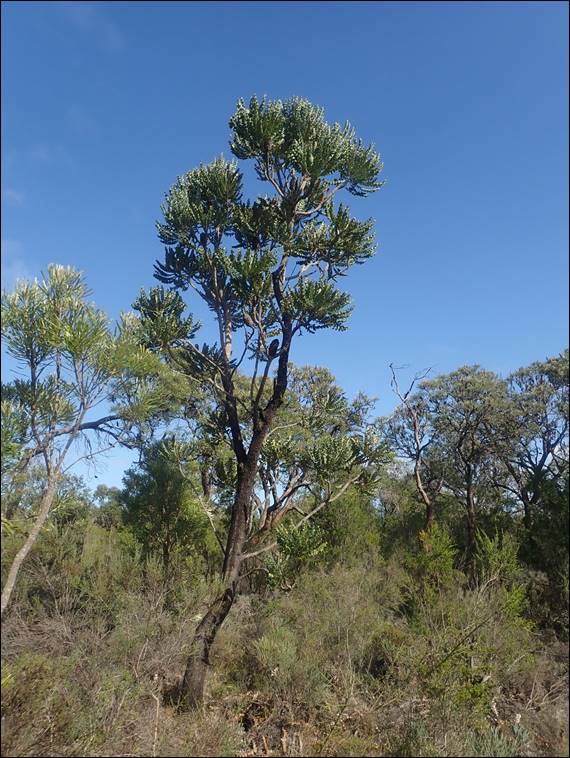
When I sussed out where I was I got ready to hoick back to the car, until I spotted this solitary Yalgorup Donkey Orchid (Diuris porphyrochila). It is the first time I have found this species, which is described as growing in sandy soils in Banskia woodlands. It looks similar to the Common Donkey Orchid, but has flowers with more purple and brown colouring. Donkey Orchids are probably the most well-known type of orchids in Western Australia, and there are approximately thirty named species in the state. I’ve seen a handful of these:
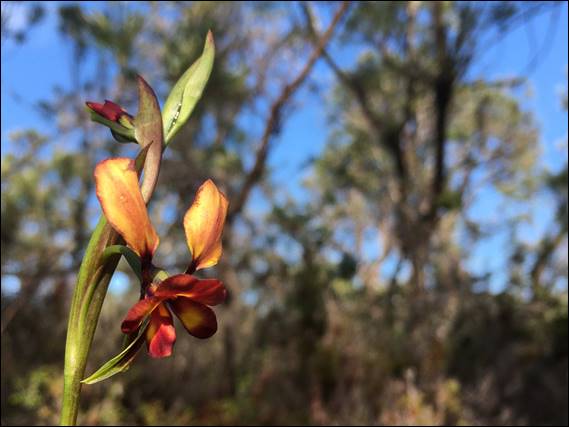
The above find got me all excited again and I decided to follow a few more tracks before getting back to the car. But being now really starting to be conscious of time I walked at a faster pace, which hopefully didn’t result in me missing any orchids. The track changed from a limestone to sandy path as it cut through the lower landscape, where there were swampy areas on both sides. Here there seemed to be more fungi popping up or maybe I just noticed them due to the clear ground. I thought this one might have been easy to identify but I was wrong, and as yet can’t work it out:
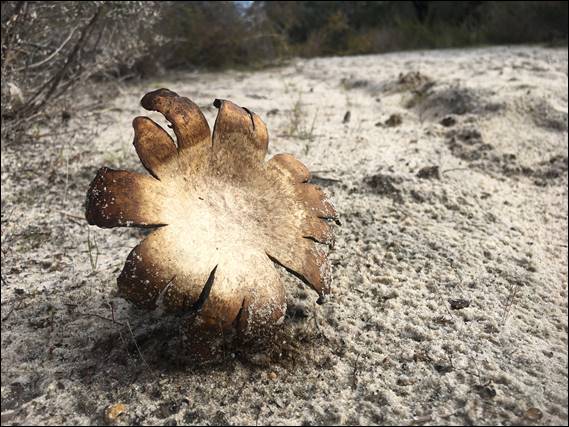
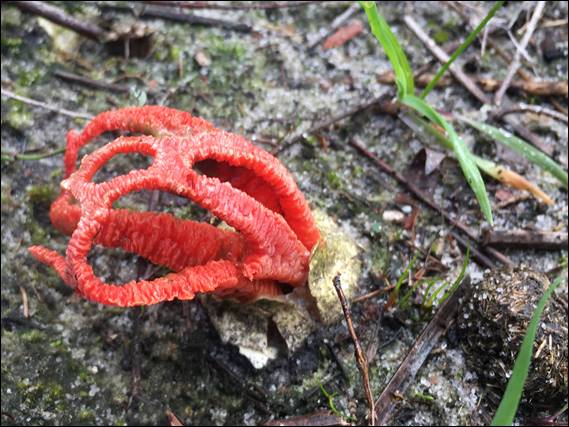
While I liked the above fungi, my next find had me just as excited as when I spotted the new Donkey Orchid. It is the first time that I have come across a Craypot Stinkhorn (Colus pusillus), which is quite an alien looking plant. It has very distinctive coloured and textured arms that resemble an open weave basket. These arms burst out of a gelatinous egg that is partially buried in the ground, and when it pops open it smells like faeces or rotten meat. And with very cool find, now it really was time for me to make a move. I was more than happy with what I had found today, but despite scouring the area for three hours I was unable to confirm the word on the street:
 Sandbagged