We dug out our ‘walking round in circles’ book to see where would be a nice place to go for a walk today. Lisa tend to likes to have an idea of where we are going, so as to provide a little certainty of the terrain and any difficulties we might encounter. And this book provide a good overview of what to expect on the walks listed, and she of course has an app on her phone to help with that too. Needless to say she would have hated the bush bash that Howsie and I endured yesterday up at Oakley Falls. Hated is not a word I would use lightly, but in this case it is very apt:
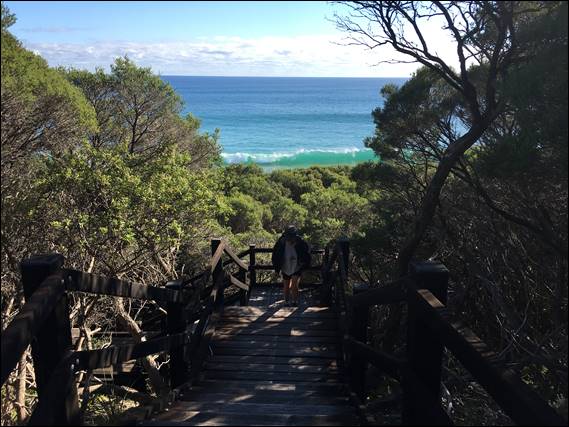
We picked the Cape Clairault loop, a short 6.5km circuit that starts from the Injidup beach carpark, heads south inland before working its way back along the coastline. The carpark was packed, but we were the only ones out walking. The vast majority here were in the waves surfing, but there is another type of surfing that this spot is known for that I will mention later. We left all that behind and made our way up the steps to link in with the inland track, which led us to a wonderful enclosed track with winding and entwined branches creating a protective arch overhead:
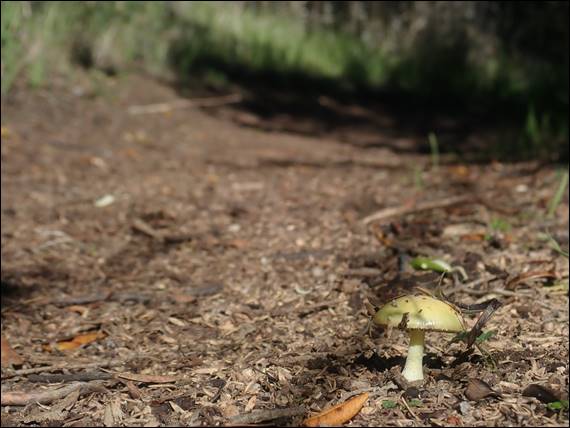
I’m not sure what drives me but I spent probably an hour trying to identify the above fungus. Booklets, google searches and image matches didn’t help me come up with a positive identification that I am confident with, and the closest I could get to was that it may be a member of the Amanitaceae family of fungi. If I was going to take a punt it may have been a Vermilion Grisette (Amanita xanthocephala), as the name suggest they are usually a reddish orange colour and often referred to as chestnut in the descriptions I’ve found. But they can be found in a paler yellow form:
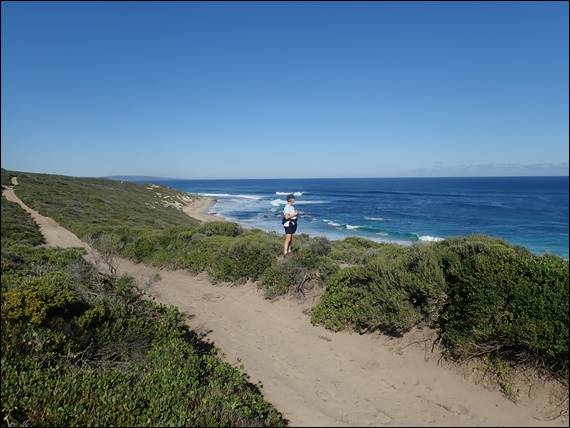
Searching what at times seems endlessly for these finds is a bit like whale watching. Looking out to sea hoping to see a splash or spray to hint something big is out there. Whale season is on and they have been spotted, even off our local beach. And while it is lovely to see them and I will stop for a while I prefer close encounter finds. Lisa however is happy to sit or stand there for ages and when we spot them, she can stay for much longer that I would prefer. Today despite the water further out being relatively calm, due to there being only a very light wind, no sign could be seen of these gentle giants:
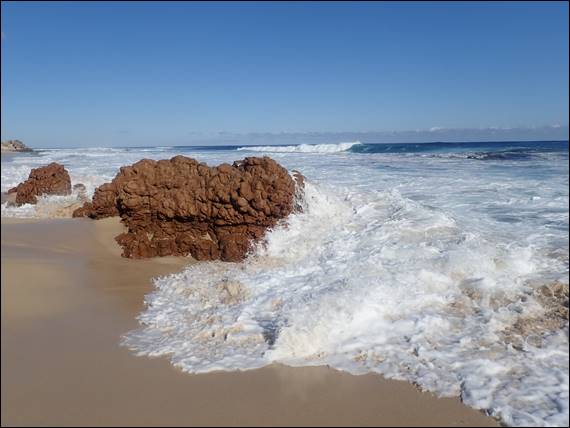
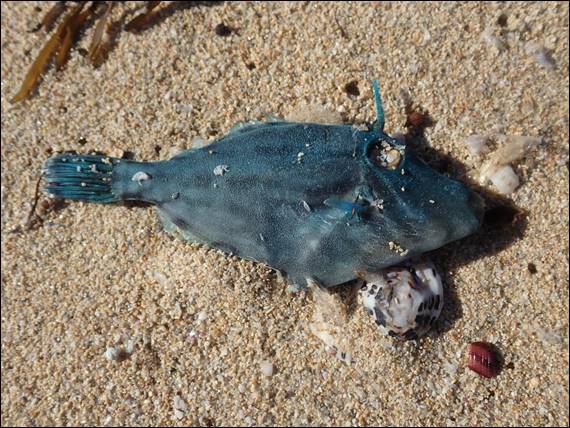
While the water far out looked flat, there was a good swell. The fact that so many were out surfing was testament to that. It also meant when we hit the coast to walk back the waves were front and centre, drawing our attention. Every now and then I like to find a small memento to give to Elseya, it doesn’t happen too often but when it does it has to be something really nice. So I was also watching out for any good finds on the beach itself. I did like the desiccated leatherjacket below, but was mostly looking for that perfect shell. Sadly there was lots of rubbish washed, from small bits of plastic through to large sections of smashed boats. And like the boats most shells I found were broken or damaged:
Now you may be thinking the collection of shell is illegal, and indeed they are classified as fish under in the Western Australian Fish Resources Management Act of 1994. However, there is a daily bag limit for the collection for shells, just like fishing. But this is only for personal use and not for commercial gain, and the rules state you can take up to 10 shells of any one species per day. But life is never that straight forward, there are restrictions for specific species and ‘no take zones’ where you can’t take anything regardless fo the species. With the latter usually associated with marine parks and reserves:
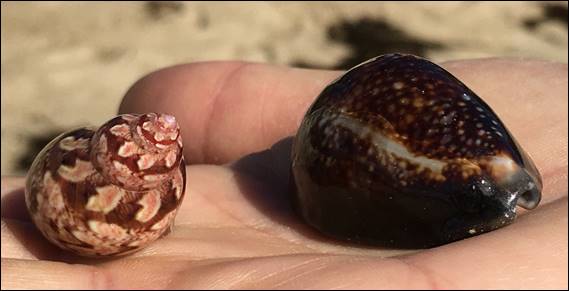
The beaches round here really are not the best for finding shells in good conditions, but I did spot the above two. The left hand shell being a Variegated Pheasant Shell (Phasianella solida). A naturally polished shell both in and out in part as does not have, like some shells, an epidermis nor a nacre. Or in layman terms an outer layer of skin nor inner shell layer. It is common to see them damaged and/or bleached from the sun, but this specimen was vibrant and very recently beached. The other shell is a Serpent’s head cowrie (Cypraea caputserpentis) and one I have not found as often, and very rarely in such good condition:

This shell is widely used in jewellery. It is very distinct by the base colour and pattern, which can but does not always include the clear longitudinal line. When used in craft and jewellery, and to draw out more vibrant colours, the dorsum, or top, is dipped in acid which makes it go a more purple colour. Although personally I am not sure why you want to do that. The coastal stretch of our walk was really fun, sandy stretches were broken by small rocky headlands. Some rocky sections extending into the ocean so you had to scramble, over and at times through them. But nothing ever too serious, you just had to take your time:
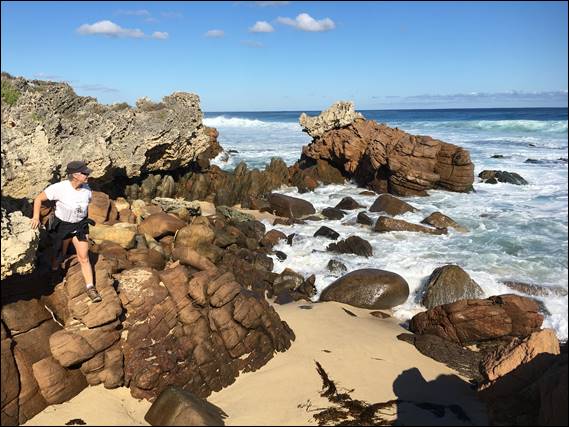
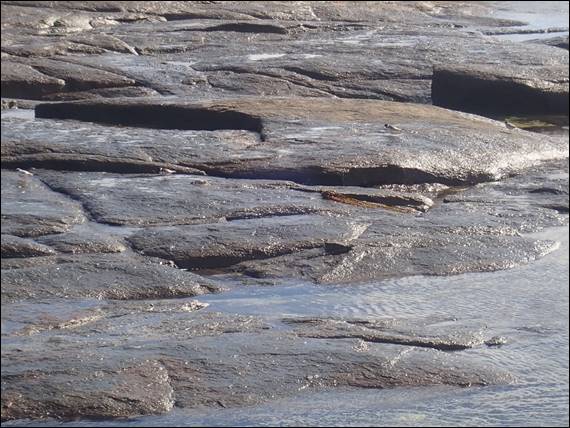
Cape Clairault is formed by a wide level granite outcrop, here the larger waves would wash over this feature and with today’s swell and tide this was never too deep. Lisa took the safer higher ground, and if look closely below you will see her. While I explored the rock holes in this wave washed area, and on a couple of occasions enjoyed the feeling of the bubble filled white water washing over my ankles. I also spotted a small group of Hooded Plovers feasting on the rocks. Separated from me by a deeper section, I wasn’t able to get too close but watched them intently for some time. In part as I understood they were a vulnerable species:
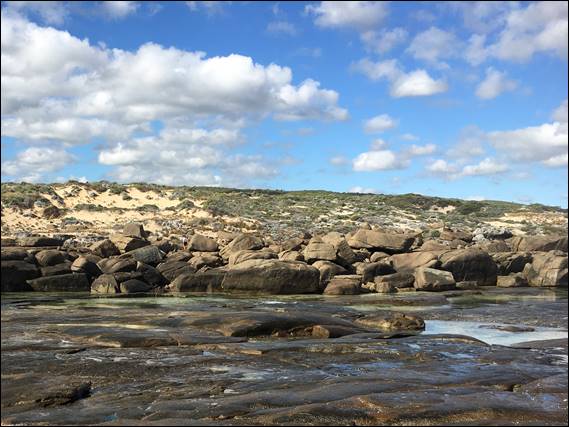
They are known to nest, amongst other places, on beaches at the high tide mark. This makes their nests susceptible to many dangers. I found one such nest years back on a trip to Moses Rocks, and got a few good images of it that show just how precarious their situation can be https://sandbagged.blog/2016/11/06/rumpoles-rocks/. Having looked into this bird in more detail, I now know that of the four states they are found they are listed as vulnerable in South Australia and Victoria and critical in New South Wales. However, in Western Australia they are secure and not under threat:
Furthermore, there is an eastern and western species, and their extents do not overlap. So these were Hooded Plovers (western) (Thinornis rubricollis tregellasi). As we rounded the cape the last stretch of Injidup beach came into view. The last, and only, time we have been here was in January of 2009, when we had the place to ourselves. We carried a big box of stuff to the sand dunes where we picnicked, swam, snorkelled, and rolled down the dune. Despite my image below today it was busy, with most people in the water surfing. But I did at one point spot a couple of people enjoying a different type of surfing, down the sand dunes:

 Sandbagged