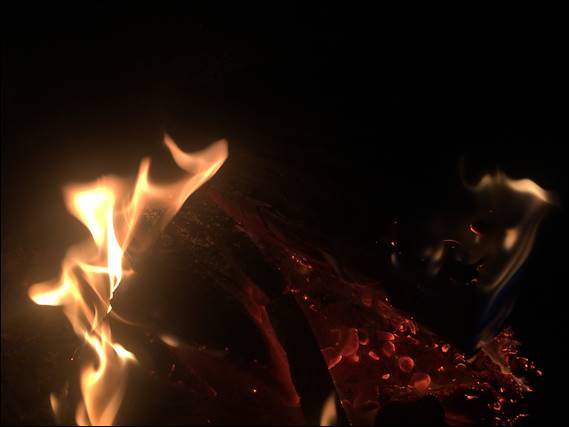
The winter solstice is almost upon us, but I can’t afford to take a day off work on Tuesday to celebrate it with a climb. With shorter days, a lower sun, and winter being well and truly upon us some might struggle to leave the warmth and comfort of their homes. But the forecast for today was just too good to miss, a howling westerly wind that was just shy of gale force and a six meter swell, perfectly coinciding with mid-morning high tide. Yes I really do love conditions like that. So after stoking up the fire at home, I ventured out to a crag that would allow me to really experience the conditions:
On arrival the wind wasn’t quite as strong as I suspected, but the ocean was a mass of white water. After the wide sandy main beach the boulders I usually rock hop across were being pummelled by frequent, big and messy waves. Normally a fun rock hop, today the journey over these large boulders was made that bit more treacherous because of a mass of a green/yellow foam that was being washed up, and then blown round by the wind. These foam events occur when types of surfactants lower the surface tension of the water and trap air to form bubbles:
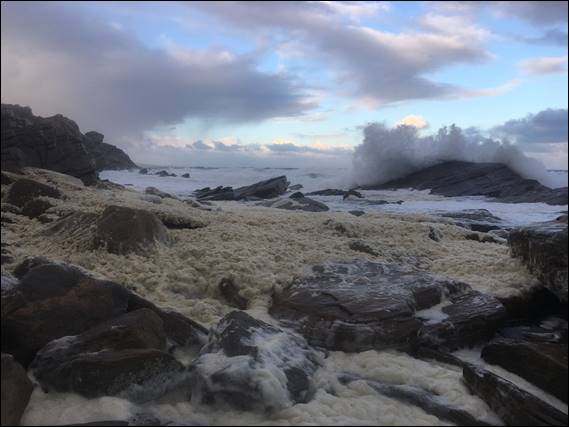
This mass collection of bubbles usually occur when there are more vigorous conditions, such as today. And the surfactants to create it can come from both natural and/or manmade sources. Manmade sources include detergents or dissolved salts, which can become elevated due to fertilizers. While, natural sources can come from the proteins and fats in seaweed and other marine plant life. Foam from natural sources are not harmful, but those from manmade sources can be. The question is which one was I observing today:

Walking across the final small bay, before I would escape these conditions, it felt like an ice rink. I’ve seen this bay as a full sandy beach through to a completely rocky landscape. Today it was the latter except for the land right up against the dune, and every surface that wasn’t under white water, or a foamy mass, was coated in a very slippery green slime. I can only assume this was the residue from the foam, after all the bubbles had popped. And being green I’m taking a punt that this was a natural event. With each step more of the residue stuck to my sandals, leaving a clean footprint behind, as shown above:
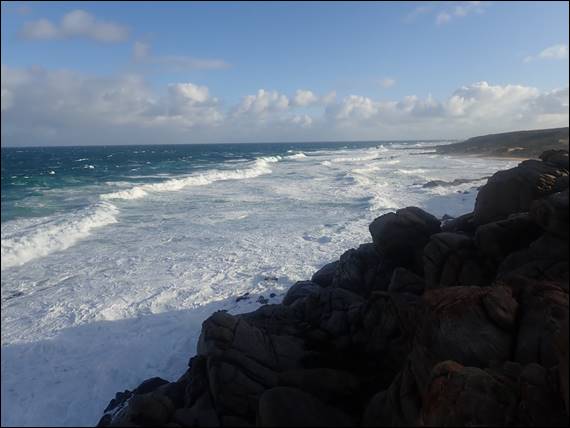
Arriving at the crag, I really didn’t think I would have any chance of climbing from sea level. But had to have a look at the zawn to see just how wet it would be. While the waves were reasonably big, they were nowhere near as big as I’ve witnessed before. But still big enough for my theory to prove right. For trips out like this I intend to climb, but they are also about just marvelling in the experience. The whole time I was there I was smashed with an aural overload created by the rumbling angry water and whistling wind, so I took a short video to give you a hint of what it was like:
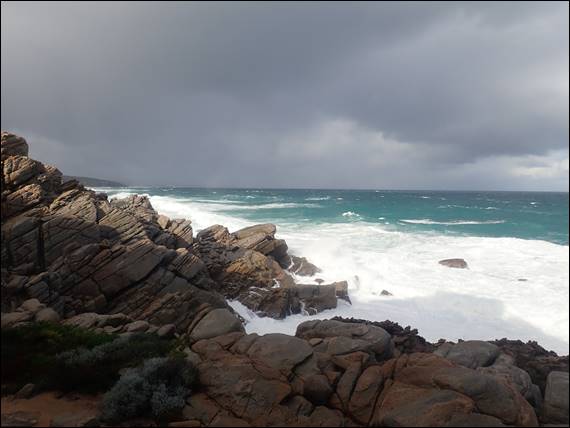
I had tossed up as to whether to head to Wilyabrup or Moses. The former being just over 3km to the south, as the crow flies, and can be seen in the above image if you know what to look for. But my intention today was to enjoy the conditions, for which Moses is way better. It was also a good choice, as I could see the taller cliffs of Wilyabrup being dumped on by rain, while I remained bathed in sunlight for most of the time. I wouldn’t have said the rock was dry it was however way better than I expected, especially with all the sea spray flying around in the air:
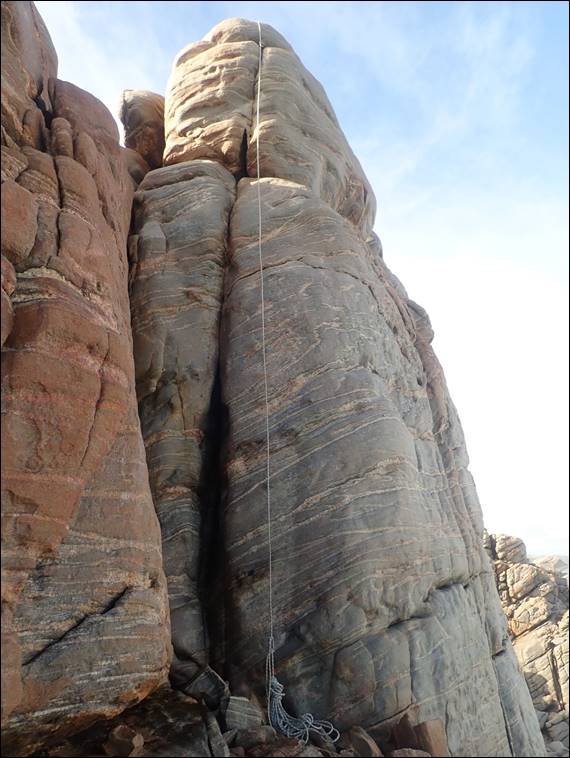
You’ve probably guessed I was out by myself today, as sadly no one else was available to get out. But I still climbed in-between watching the waves below me smash the shoreline, and looking further to the north and south observing belts of dark ominous clouds reach landfall and offload the moisture they carried. With no expectations of how much climbing I might get in, I was pleased to rack up seven very fine lines. And, as is my usual approach when I top-rope solo, ascended each one twice:
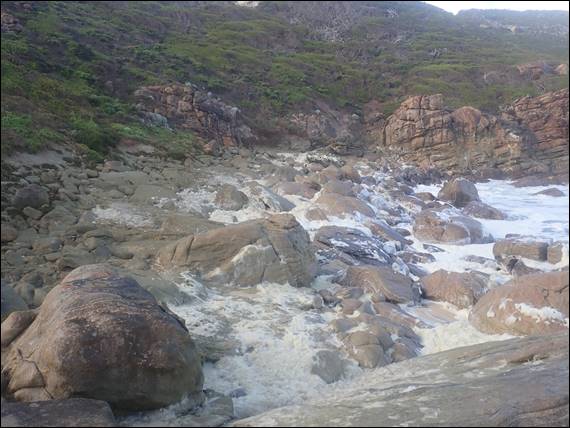
As I finished the second lap of the last climb, my bubble of protection from the rain seemed to have used up all its power. And I could see rain fast approaching. I quickly threw all the ropes and gear into my pack just in time, as moments later the rain fell. And fell it did with big drops that you could feel hit you. Fortunately, it only lasted a short few minutes before clearer skies came overhead. With everything already thrown in the pack I headed out and took my chances, once more, across the slippery bay. The above image showing the extent of all the green slime, and second short video below of waves and foam:
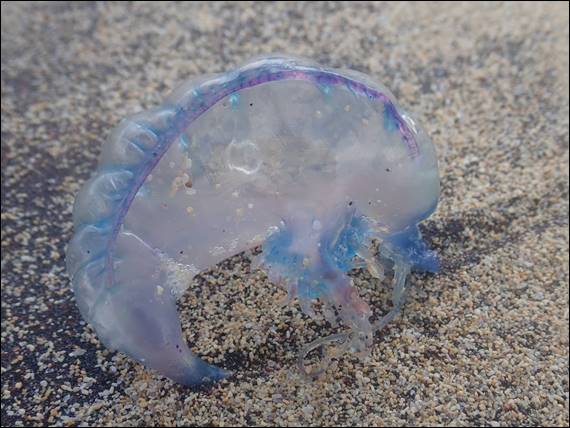
Finally I was back on the main beach, where I didn’t have to watch every footfall quite so carefully. Allowing me to do a bit of beach combing. Above I found a great specimen of a full sized, Bluebottle (Physalia utriculus), with a 10cm long ‘bubble’. It is very similar to the Pacific Man-of-War (Physalia physalis), which grows to about 50% larger. I always assumed these were a jellyfish, but have been mistaken all this time. They are in fact a colonial hydroid that comprises four types of polyps, or clumps of cells. Each polyp has a specific task, being to keep the colony afloat, reproduce, digest food and capture prey:
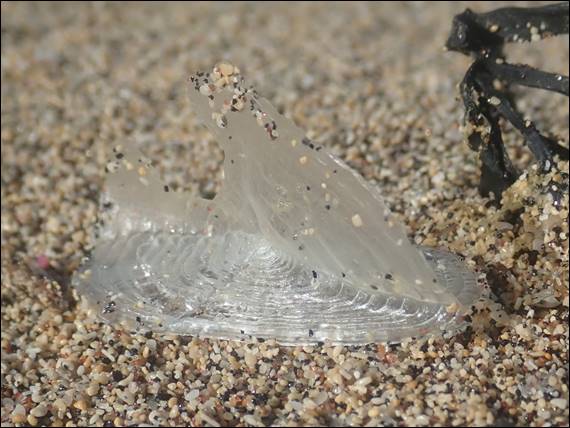
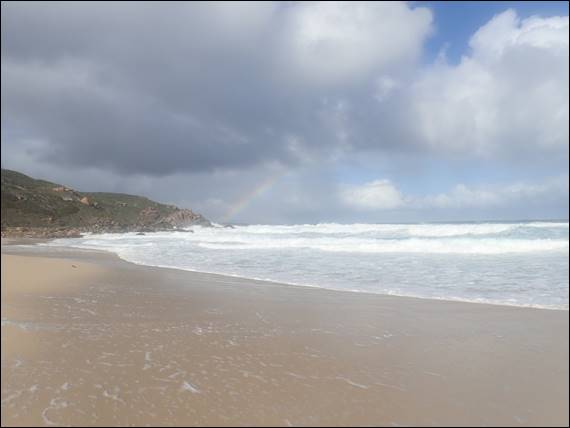
I also came across the above By-the-Wind-Sailor (Velella vellela), which is also not a jellyfish but a colonial hydroid. Again each polyps has a function, one of which being the sail. The sail can be either a right or left sided, and as such it depends on the wind as two which sort ends up being washed ashore. They are usually deep bluey purple, and I’ve seen lots of these on our local beach. So this one, being completely colourless really caught my eye. As I was kneeling down to observe my finds behind me a rainbow hit Moses Rocks, and more rain was coming. So now it really was time to hit the road:
 Sandbagged