A week or so back we were greeted with a lovely red sunrise, but the sailor’s rule of thumb for predicting the weather served as a warning that we were in for a change. There is an element of truth in this, in that weather systems in the mid latitudes will usually move from west to east. After a high pressure system, which is generally associated with better weather, and when the sun rises, in the east, it shines through the relatively clear atmosphere. Hitting the mid to high level clouds, a sign of an approaching low pressure system, as well as illuminating in a red colour as it hits aerosol, dirt, and dust concentrations held in the lower layers of the atmosphere as a result of the conditions:
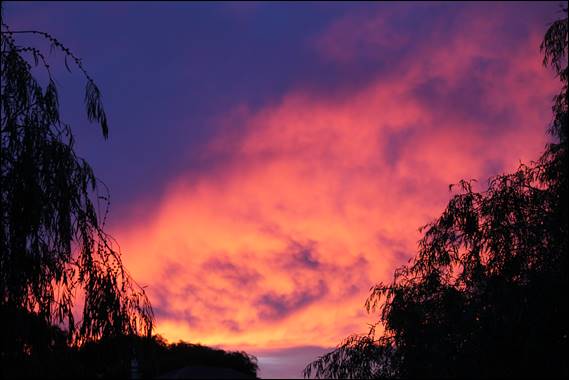
The 2000 plus year old weather prediction method proved right once more, and over the next few days a series of fronts came through bringing rain, bigger swells and winds. The fronts passed and we were greeted with more settled weather, as the weekend approach. This made me hopeful as I was busting to get one more snorkel in before retiring the gear to storage. So on the 1st May I kitted up with my full length weight suit, encouraged by a flat almost glassy looking ocean. People were fishing up and down the beach and I came across their intended prey soon after jumping in, a large school of herring that was barely visible:
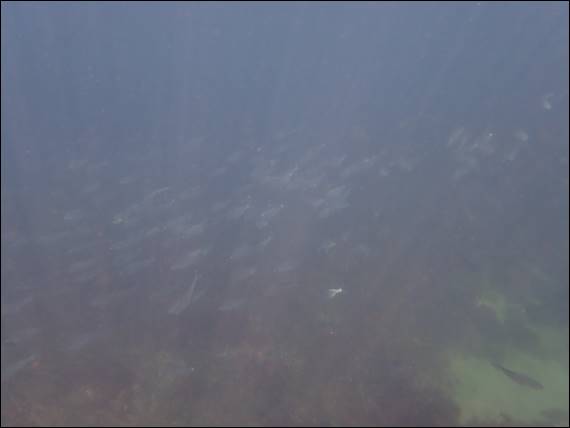
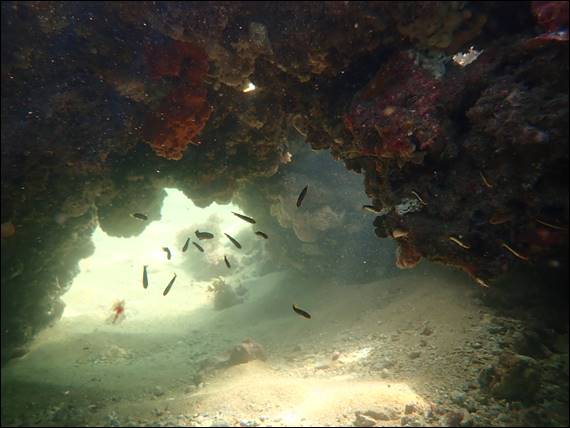
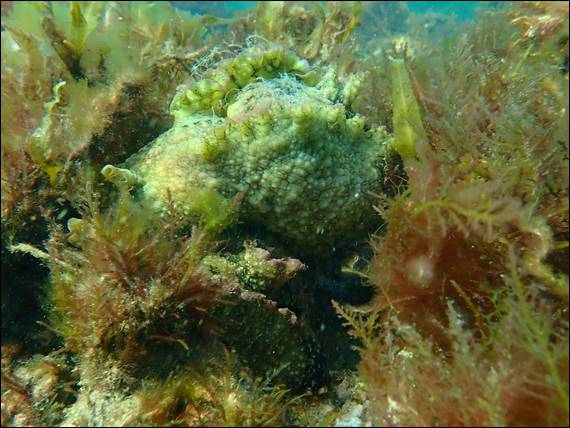
Faced with these conditions the sensible thing would probably have been to go back in, but I kept heading out. Hoping the visibility might improve as I went further out, which is kind of did. I checked where I had found the White-Margin Nudibranch (Glossodoris rufomarginata) in my last two dives, but they were nowhere to be seen and the small tunnel they had called home was now only occupied by Yellowhead Hulafish (Trachinops noarlungae). Undeterred I kept looking about and came across another Black-ringed Sea Hare (Aplysia dactylomela), but this one looked a little different:
The tips of its mantle had a purple tinge and there looked to be a whitish mucus. I’ve read up that the purple is associated with an ink that it may release, similar to a squid or octopus. The colour comes from a photosynthetic pigment, which is found in the sea hare’s favoured food of red algae. Whereas the mucus, called opaline is a clear and viscous secretion. Both are effective chemical defences against their predators, in their own right. However, they are released at the same time into the cavity of the mantle, which is what I seemed to be witnessing. Here they are mixed for a few seconds and then ejected via the siphon towards their attacker, which I did not observe:
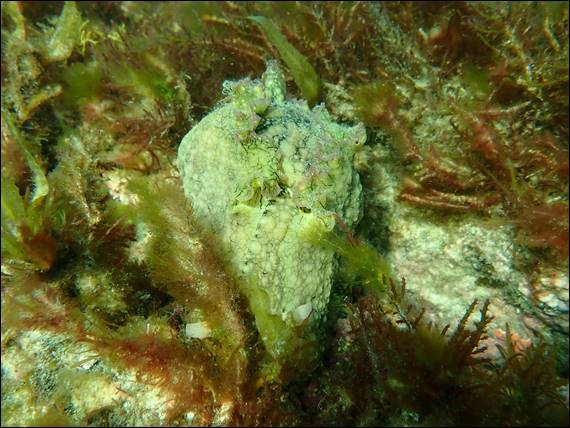
The reason for mixing the two already complex compounds is due to the interaction of components within them resulting in another aversive compound. But like I said I didn’t observe the physical directing of the mixed compounds, and I wasn’t really sure why the sea hare was displaying this defensive mechanism. It was only after I moved round to the other side that I noticed there was a second sea hare underneath, and I assumed they may have been mating. But I am now unsure of that as well, as literature indicates sea hares are hermaphrodites and usually mate in large numbers by forming a long line, as opposed to being on top of each other as I observed:
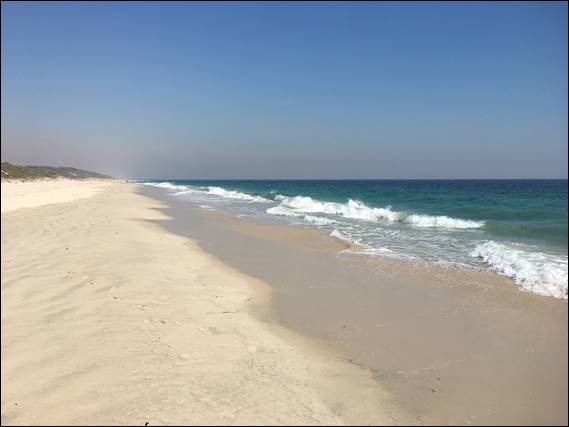
Other than the sea hares, and the usual suspects there were no other finds or actions to report. As such I was leaving this post till the following weekend in the hope of getting in the water one more time. The weather conditions looked to be in my favour all week, until early Saturday morning when as I stirred in bed I could hear the waves. Sure enough when I went down to check conditions the water wasn’t to inviting, plus the light penetration would have been lessened by the smoke that hung in the air. Lingering from recent controlled burns and possibly also a bushfire that had occurred in Bunbury just a day or two back:
As a result I put my snorkel gear in storage, mostly to stop me looking at it and thinking I might get one more dive in. And today Lisa and I headed to Busselton to get a few things. On the way back I spotted a Tiger snakes (Notechis scutatus) on the edge of the road, no doubt wanting to lie on the tarmac to warm up. An action that was likely to result in it being run over. So I turned round to encourage it off the road and watched it slither towards a large tree and disappear into an unseen hole. Unlike my snorkel gear the snake won’t stay hidden until summer arrives, as they do not hibernate like mammals. They do something called brumation, keeping warm in crevices or burrows but still needing to emerge on warmer winter days to find water:

 Sandbagged