The water was as clear as I had hoped, after I observed it from my bird’s eye view when I flew over during my trip back from Melbourne. I’ve since popped in for a snorkel twice, the first dive was with my short wetsuit lasting half an hour and it felt cold so today I went in with my long wetsuit and lasted three quarters of an hour. This made me check the water temperature, something I’ve never done. The monthly average fluctuates between 16 in winter and 22 in summer, and today it got to about 20.5 degrees. The maximum temperature on record was only 24 degrees, so it is more likely that the low sun that made it feel cool today rather than the water itself:
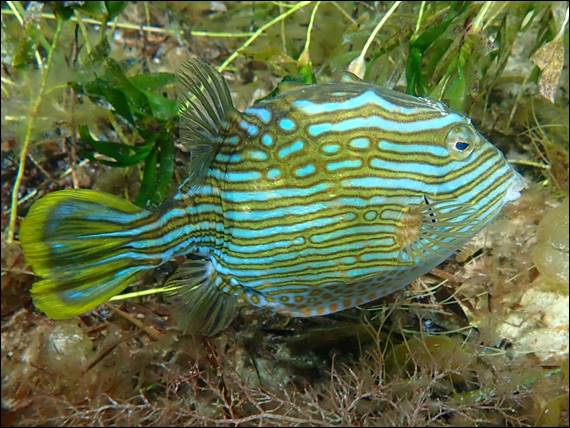
Above is a male Shaw’s Cowfish (Aracana aurita). I have included this image, as in my recent post, and over a few dives back then, I only spotted the less colourful female with orange/brown and white stripes (https://sandbagged.blog/2022/03/31/my-kind-of-candy-store/). I found it odd that today and yesterday I only spotted the males, but have no explanation as to why that may be. Soon after I came across what I believe is a Black-ringed Sea Hare (Aplysia dactylomela). These are identified by the black rings and lines, and they can vary in colour from pale grey to green, to dark brown. This one shows how, as previously mentioned, their ability to camouflage is aided by their diet (https://sandbagged.blog/2022/04/01/eating-habits/):
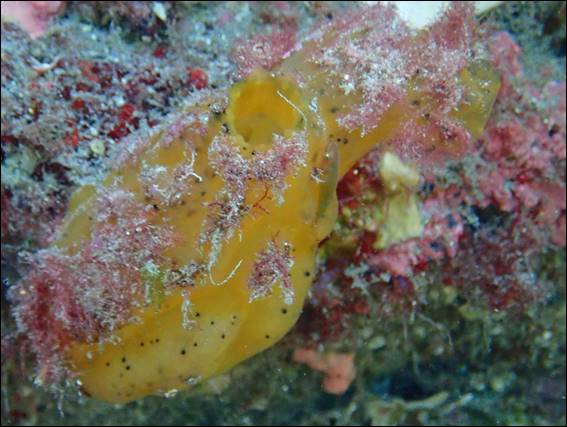
The find below is something I have seen and included in a previous post, in fact I think it is the exact same one. Back then I failed to identify it, but this time, trying harder, I believe it may be a Polycarpa. My rationale being the two openings and soft body. This aligns with being a tunicate, a marine invertebrate animal that is a filter feeder. The closest match I could find was a Fruit Sea Squirt (Polycarpa pomaria), which seems apt considering the passion fruit like appearance of this one, but their range only seems to extend as far south as the Mediterranean Sea. If you look closely, and my reason for including a blurry image, is that there is a small fish attached to it. I spotted the fish after inspecting the image on the first dive, so went back today and the fish was still there but I couldn’t get a better image. The best Rongy and I can come up with is that it may be a Goby:
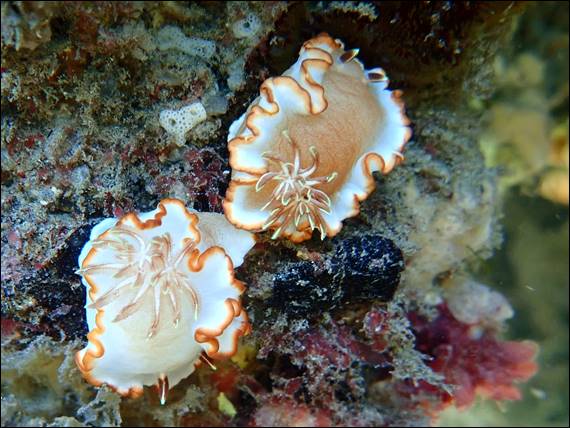
The finds kept coming and I stumbled across several White-Margin Nudibranch (Glossodoris rufomarginata), noting that name actually translates to ‘red margin’. Interestingly, as these creatures age they become more frilly. While I’m not going to guess their age I will guess that these two are in the act of reproducing. The sex life of these creatures is complicated. Not only can they have detachable organs, but they are thought to be simultaneous hermaphrodites. Meaning they poses male and female sexual organs, and can use them both at the same time. Both creatures impregnate the other at the same time, which does not happen until after they have courted by entwining their bodies:
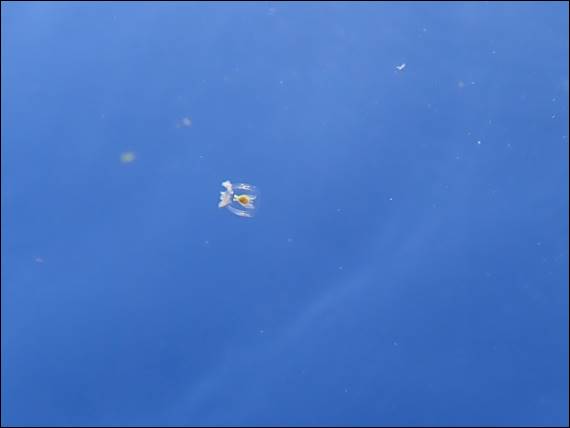
On both dives not only was the water visibility great, but I saw lots and lots of fish, sea stars, squid and jellyfish. The combe jellyfish were again drifting with the tide, but I also spotted quite a few of the jellyfish shown below. These were the size of a pinhead, so very hard to capture in an image. When left alone their legs would splay out in a circular pattern perpendicular to the body. Almost completely straight and looking rigid, making them look like a seed that has been caught in spiders web. Despite trying hard I was unable to get a good image of that, and equally I have been unable to identify the species:
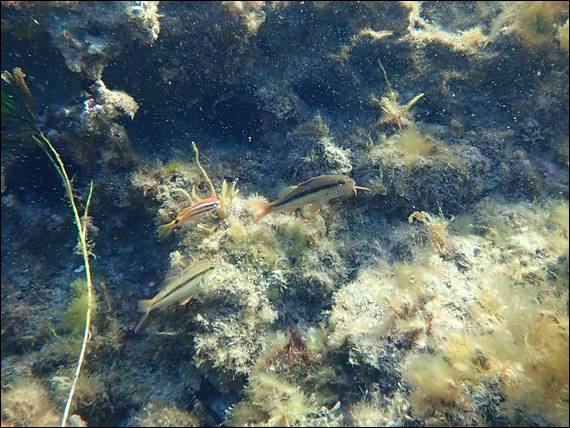
On most dives I get to see Southern Goatfish (Upeneichthys vlaminngii), they can be highly variable in colour, but are often whitish to pale pink with a brownish to reddish stripe along the side. The two feelers below the mouth used to search through the sand for food. Today I spotted these two with a small stripped fish following them, and I saw them several times and each time the three swam away together. I believe the striped fish is a Blacksaddle Goatfish (Parupeneus spilurus), with the distinct black saddle, preceded by a yellowish to whitish patch on the tail giving it away. I’ve not seen this fish before and have read that as juveniles, unlike when they are adults, they usually congregate in small schools. Maybe this one got lost and has adopted the two Southern Goatfish:
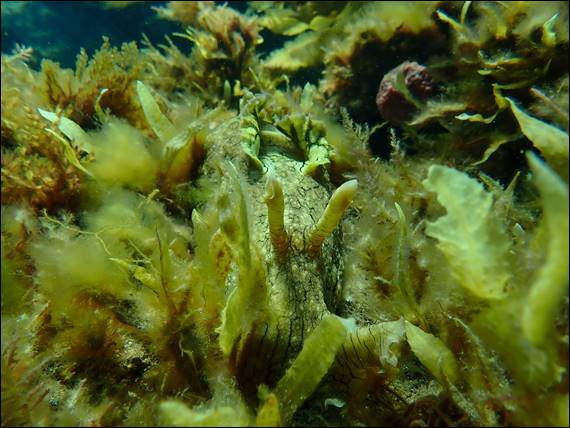
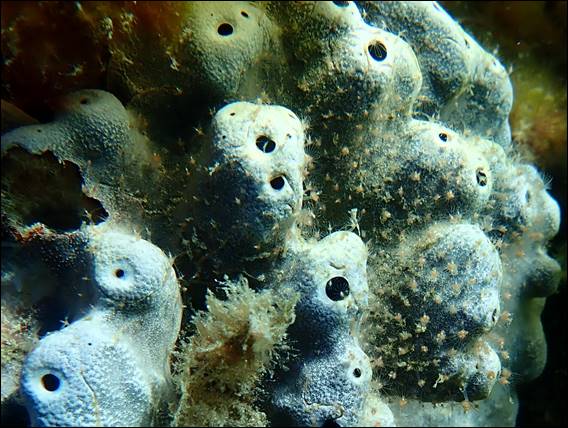
For my last image of this post I’m again not going to be able to fully identify what I found. I often spot calcareous sponges, a hard shelled primitive multicellular aquatic animal. This one looked a bit tatty, with broken portions of the grey outer shell. I also noticed that small tentacles were protruding from some surfaces, something I have not noticed before but will keep an eye out for in the future. I believe these are hydroids, a vascular plant, that is squatting in the remains of the calcareous sponge. I’d love to get a second opinion on whether I’ve got this right:
 Sandbagged