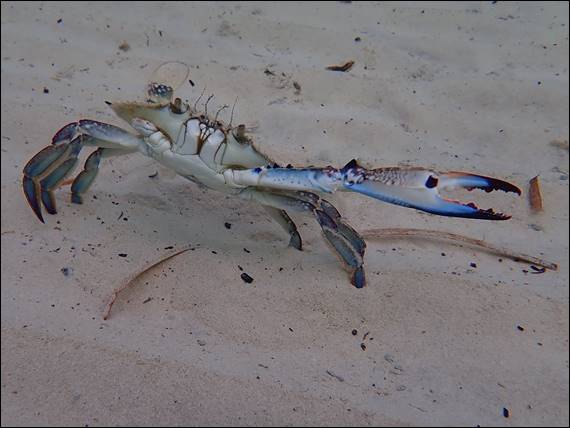
Driving home from work Lisa has started to do what I often do, which is a quick trip up and over the dune to check the condition of the water. I hadn’t been in today, despite working from home, but the report from Lisa was the water was glassy. Tempting me to go down for a dip with her. It was late, already five o’clock so the sun was quite low. Still it was glassy and the water was clear. Swimming out I came across a not so healthy looking Blue swimmer crab (Portunus pelagicus). These usually hide under the sand in the day, with only their eyes poking out watching for prey. They are reported to be voracious hunters, as well as scavengers, and are even known to eat other blue swimmer crabs:
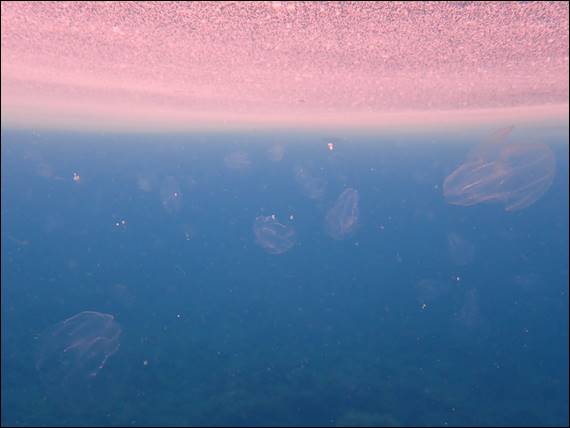
Leaving the crab to hunt, I came across a milky sheen that I though may have been from the chum that people fishing had thrown into the water. Below this were thousands of Comb Jellies (Ctenophora), the name ctenophora made from words that mean “comb carrying” in Greek. While innocent and harmless in appearance, comb jellies are carnivorous animals. Known to prey on zooplankton, but also small crustaceans, fish larvae, and mollusc larvae, and even, like the blue swimmer crab, their own kind. Their body has an opening, which is a mouth and once their prey is inside this closes and small cilia (hairs) work like teeth to pull the unlucky victim apart:
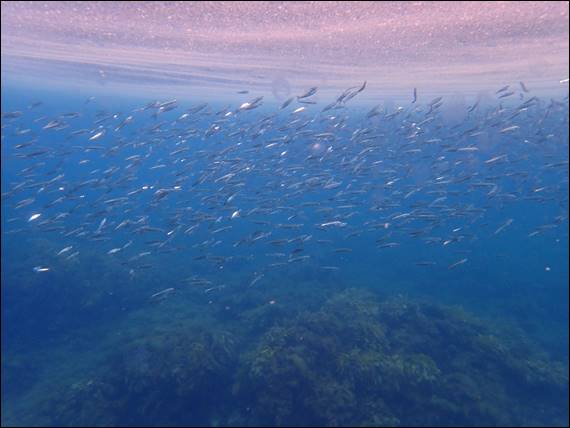
Drifting through the jellies I didn’t realise quite how far out I went, and I was brought back to my sense by flashes of silver all around me. These are referred to as baitfish, but really the term baitfish is applied to any species that are easy to catch and in abundant supply. Which means they are common, breed rapidly, and usually small. I’m pretty sure these were Australian anchovy (Engraulis australis). They live for about six years and grow to no more than 10cm normally, swimming at times in unison providing a spectacular display of flashing silver, as they change direction. Being so small the recreational limit for catching them is measured by volume rather than numbers, being a 9 litres bag:
Distracted by these two creatures that were in huge numbers I was now at the point I would normally not go past, and would normally only go to when there was great visibility. The water was really clear, but the sinking sun meant looking to far sideways was getting harder. So instead I concentrated on looking down, where a reasonable school of Banded Sweep (Scorpis georgiana) was darting about. A fish that I see every time I head out, without fail. Almost feeling like it is too common a sighting to include in my posts. Even the Fish of Australia website seems to think people aren’t all that interested in them, with very limited information on this fish being provided:
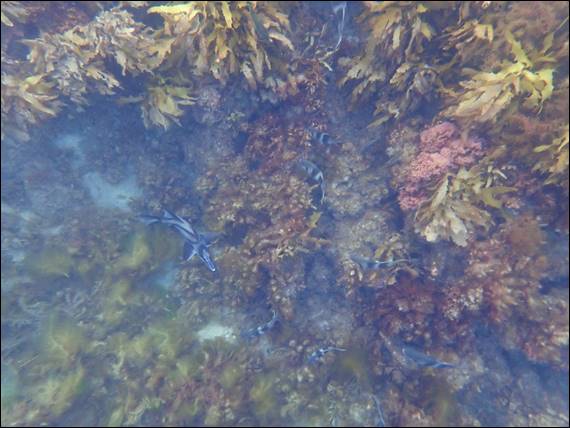
But what caught my eye most, was the fish on the left in the above image. I’ve seen the Longsnout Boarfish (Pentaceropsis recurvirostris) once before, and it was extremely skittish. So before anything else I took a video of it swimming about, and then went down to take a closer look. It is a very sought after recreational fish. It is also a species of ray-finned fish, and like rays this fish has spines that are reported to be venomous. It’s Latin name is derived from recurvus (curved upwards) and rostrum (beak, bill, snout). Growing up to half a meter in size, so this one was fully grown. It is one of very few fish species that feeds on brittle stars, another creature I have only seen once:
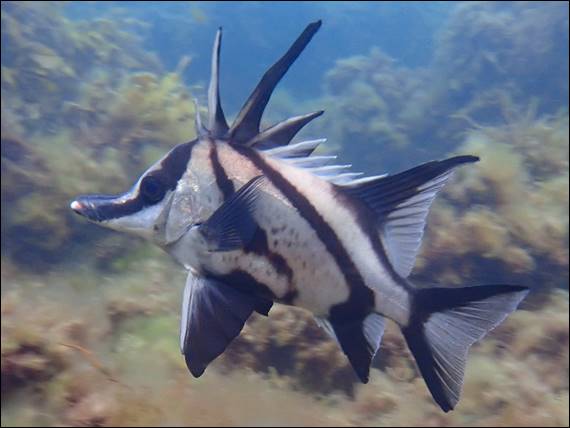
As the image above might indicate on this encounter the fish was not so afraid of me. I went down numerous times to check it out in more detail. Eventually leaving the fish in peace in exactly the same place I first saw it. Soon after I came across a Giant Sea Hare (Aplysia gigantea). Sea hares and nudibranchs are both types of sea slugs, but they belong to different orders. Something else that differentiates the two being their diet, sea hare’s are herbivorous and nudibranch’s are carnivorous. Sea hares have practicality no predators, partly due to their toxic slime, but also their camouflage capabilities. Not that this is being displayed by this species:
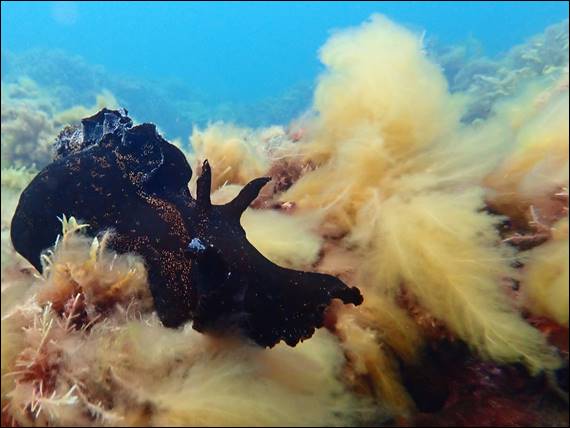
The ability to camouflage is aided by the diet. Sea hares graze on the algae and as they do they take up the pigments, and sometimes the toxins, found in the algae. This results in their colour being really variable, and to some degree they can become quite literally be what they eat. I have seen one smaller species a long time back and didn’t see it until I was right on top to it, as it blended perfectly with the surround vegetation. There were plenty of other fish out and about, probably due to the time of the day. But as the sun lowered further and light penetration reduced, I drifted back to the shore where Lisa was still it the water, and who was very happy to have had a dolphin drift very close past her:
 Sandbagged