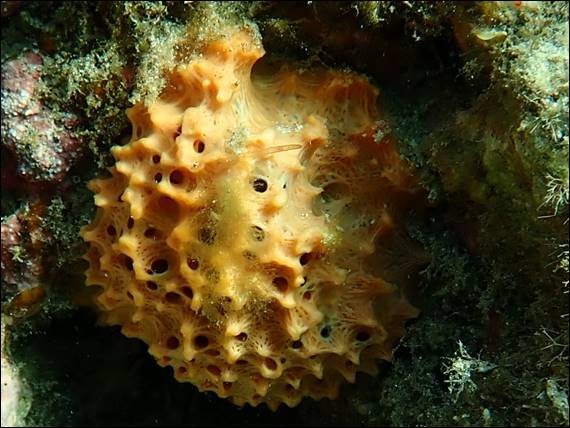
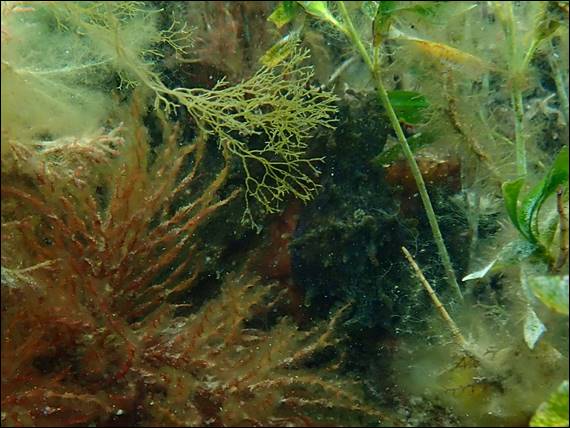
Well I just keep getting surprises each time I put my head underwater. And this week, being lucky enough to have to work from home, my chances of doing just that increased. Not every day has been ideal for a dip but a few certainly have, and I’ve made the most of it. There are quite a few golf ball sponges on my local reef, both red and orange. They normally have a regular warty surface, but this Orange Golf Ball Sponge (Tethya ingalli) seems much more textured than others with some very architectural structuring. Maybe it isn’t a golf ball sponge:
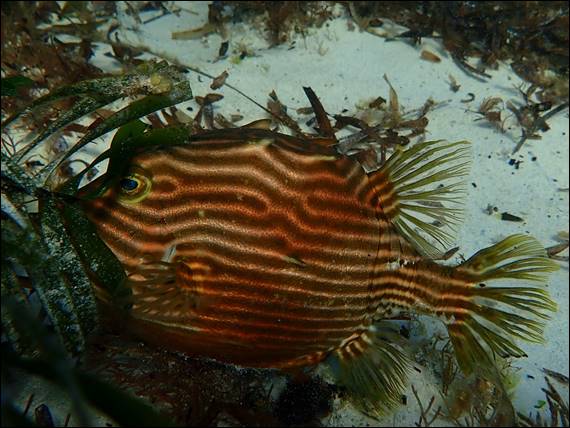
During almost every dive this week I have been lucky to come across a female Shaw Cowfish (Aracana aurita) or two. With not a male, which has a very different colour, in sight. This is one of the boxfish family, also called trunkfish and, like this one, cowfish. The trunk and cow fish names refers to the often slightly extended mouth and/or horn like protection on the head. These fish have a hard and rigid carapace, or in layman terms a protective or defensive covering. Something that we would obviously notice on say a tortoise or crab, but do not usually associate with fish:
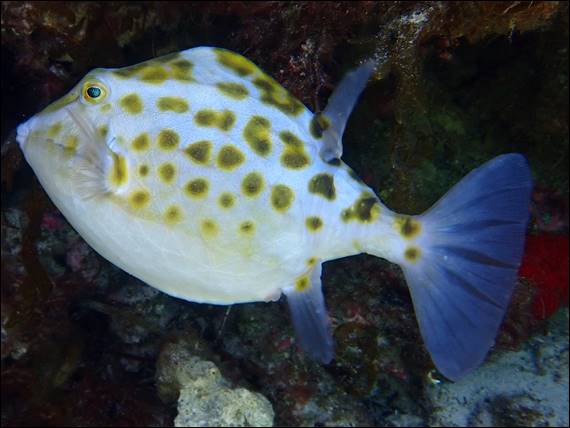
I’ve also come across the female Western Smooth Boxfish (Anoplocapros amygdaloides), again with no males in sight. Similar in shape to the Shaw Cowfish, minus the horns. Both of these fish, like all boxfish are usually found scouring the ocean floor. They feed by blowing away the sand to expose prey, which comprises benthic invertebrates. I’ve watched them go about their grazing, but whenever I get to close they stop and drift away. Not having the ability to put any great speed into their escape, which is probably why they have a protective covering:
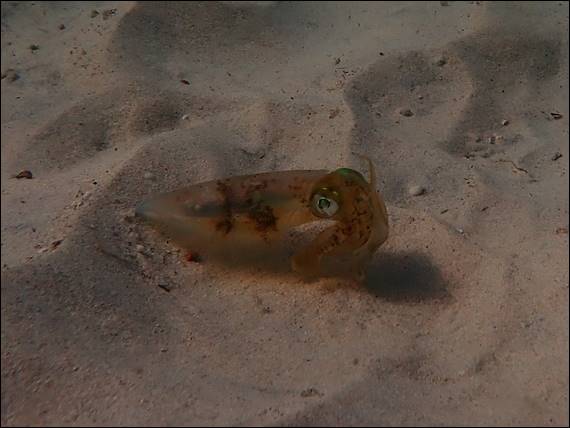
On one dive I was chuffed when I came across a small Southern Calamari Squid (Sepioteuthis australis). I would normally see these swimming about in the open water, but this one was resting on the bottom, tucked up against a small clump of weed. The colours and pattern made it look like the weed, but it was shallow enough for me to spot it. Unlike the box fish squid can disappear in an instance, but before this one went on its way it changed colour to match the sand and give me a bit of an aggressive display with its tentacles:
Some might feel like it would get boring seeing the same creatures and plants, but not for me. Every encounter, whether it is a repeat or new find, fills me with the same excitement and sense of joy. No matter how small, big or indeed fleeting it may be. Each time I head in, I wonder what I might see. But on one day I really didn’t feel like I would see much at all. Instead of making the most of being able to get out when there was a bit of light in the sky, I waited till Lisa was home and went in while she bobbed about:
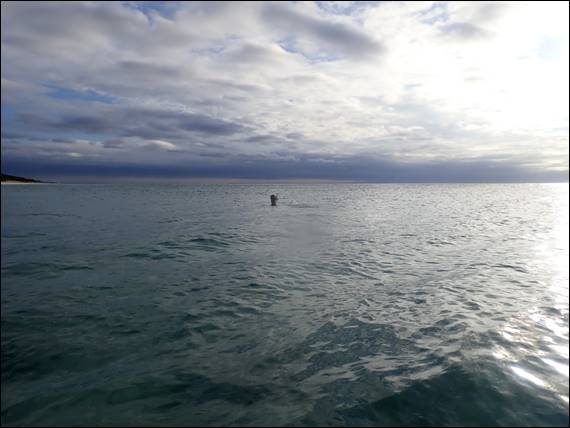
By this time of the day, the sun has slunk pretty low and the visibility wasn’t all that great. But if you don’t try you don’t know, so I chanced it leaving Lisa to float about near the shoreline. There wasn’t much to see, or maybe the visibility wasn’t good enough to allow me to see it. I instead watched the weed starting to build up in the sandy bay, getting ready for a front that would assist it in launching an attack on the beach. Forming neat rows, as if a harvester had just come along and piled up the hay ready to make bails:
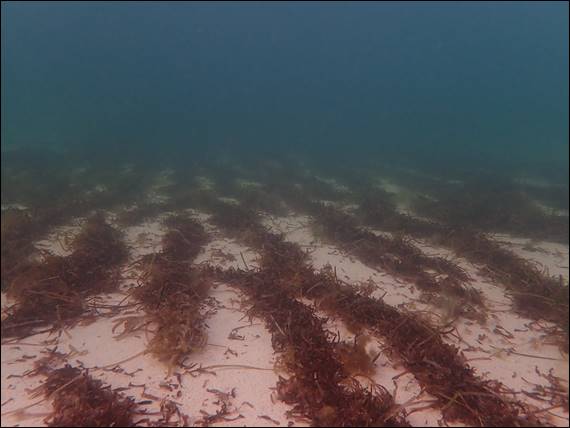
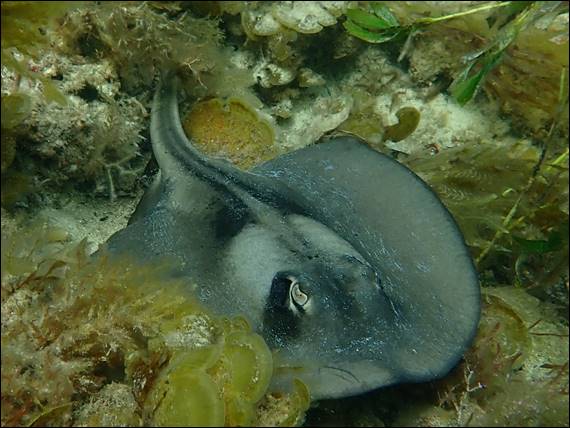
I watched the rows of weed gently shifted back and forth with the swell, feeling the coldness of the water creep inside me. The water is cooling off, or the warming strength of the sun is reducing. Either way my tolerance to stay in has reduced, but it was again worth it as just before I got out I stumbled across a Bight Stingaree (Trygonoptera ovalis) in the shallows, and surrounded by Sand Whiting (Sillago ciliata). I normally only see young bight stingaree, about a foot long, but they grow up to 60cm in length:

I spent a fair bit of time on one of the clear days going down checking under rock shelves, finding quite a few fish including a great Blackthroat Threefin (Helcogramma decurrens). I’ve not spotted this here before, but have seen them down by the river mouth. So while my images from this week were pants, if you want to see this very cool looking fish check out the last image in this post https://sandbagged.blog/2021/03/14/barren-ground/. Checking out these nooks I was also taken by the vast array of sponges:
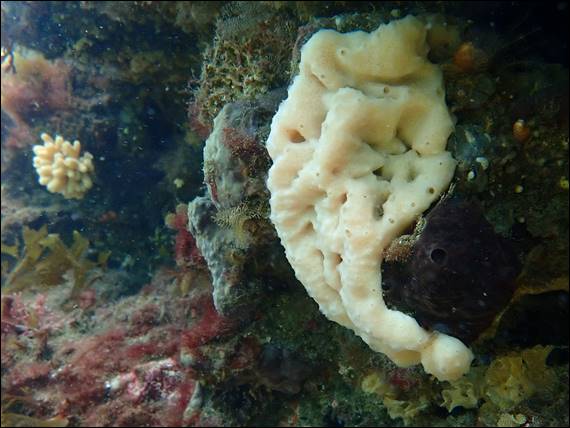
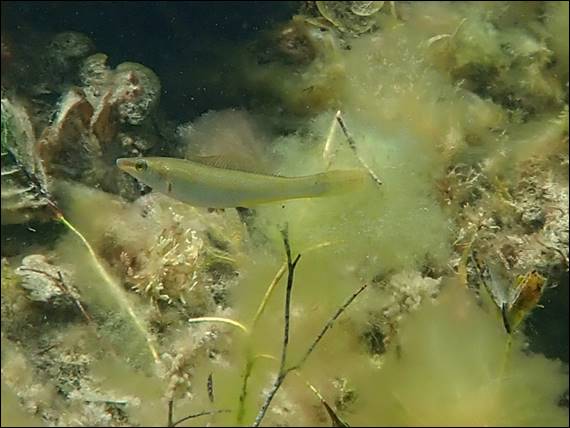
There are at least four sponges in the image above, all being calcareous sponges. And with 774 species of calcareous sponges, I have not been successfully in working out which ones they are. I did however manage to identify this Blue Weed Whiting (Haletta semifasciata). It is said that despite being very common in parts of its range, as a result of its camouflage it is rarely seen. This is the second time I have captured this fish on my camera, and this one is likely to be a juvenile due to its relatively small size and greenish colour:
Drifting about watching the weed looking for anything unusual, I thought I spotted a patch where the colour seemed to be shifting unnaturally. I’m not quite sure how I spotted it, but as I went down I could make out the shape of a Western Rock Octopus (Octopus djinda). It was a light grey colour when I first spotted it, and it was as it changed to this mottled darker colour that it caught my eye. As I approached, the water went an inky colour and sediment lifted into the water column. It was gone, but I was very, very happy to have seen an octopus after what seems like way to long:
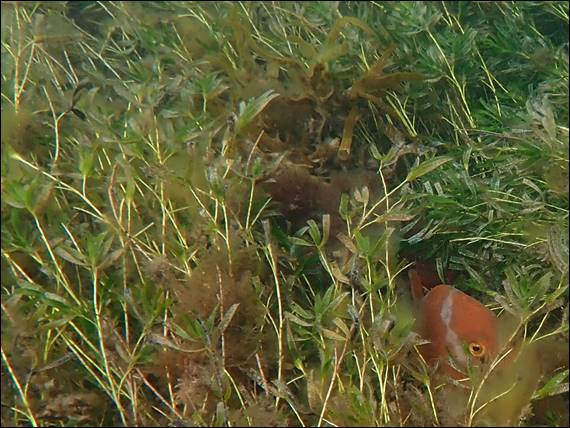
Travelling along a bit further, another creature was also doing its very best to hide in the weed. But this one couldn’t change its bright white and orange body, and it looked quite comical as it attempted a avert my gaze. I left this male Humpback Boxfish (Anoplocapros lenticularis), to play it’s game. As I ticked off yet another sighting this week of a species of the boxfish family, of which there are only 23. Strange how I’ve only seen the male Humpback Boxfish, whereas it is the female Western Smooth Boxfish and Shaw Cowfish that I see:
There is one more find that I wanted to share. In the last few dives I have drifted a bit further away from my usual spot, just a short 500m or so along the coastline. The ground is way more open and barren so less places for things to hide and check out. But to my surprise I came across three Bight Stingaree including this one, which at 60cm would have been full size. Displaying the lighter overall colour and pattern from which the other name it is known by comes from, a Striped Stingaree:
 Sandbagged
I need to get my butt back in the water before it’s too rough. But not too phased if I can’t. Although I do want to get back into winter wakeup dips in the ocean.
LikeLike
Today might be ok out there, as for winter dips I’ll leave that to you 🥶!
LikeLike