The beach is a short three minute walk from where we live, and jumping in the water after work is always so refreshing. It can also help to wash away whatever thoughts of work may remain lurking in the back of my mind. Despite knowing this, I rarely make use of the extravagant luxury of where we live. In part due to wanting to snorkel and see something, as opposed to just bobbing in the water. Often I’ll do a quick drive over the hill to check the water before getting home, and if it doesn’t look snorkelable then I don’t bother:
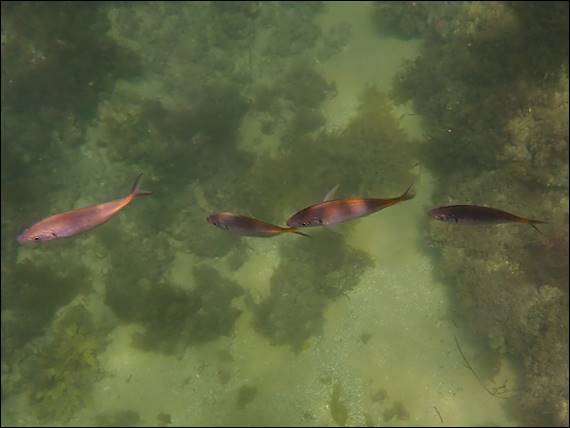
This week however, the water looked inviting, seeming to be relatively calm and potentially clear. The stark contrast in colour between the water over the sand and reef being a great indication of how good the visibility was likely to be. As a result of this I have taken advantage, and had a couple of dips during the week and one today. The first dip was on a hot and bright day with amazing visibility, and I soon found myself 150m plus from shore. Here four fish appeared and stayed with me for the majority of the dive. Staying mostly below me, and not being afraid as I duck dived down:
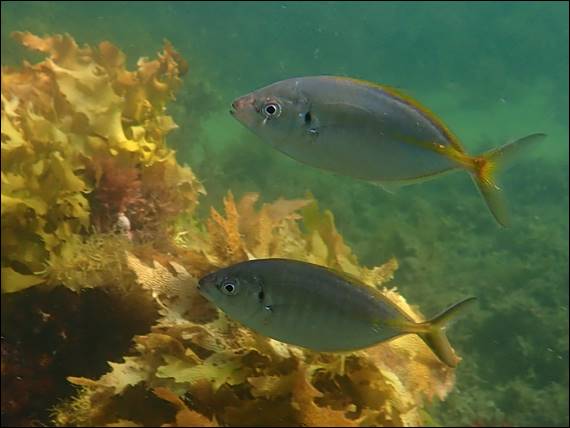
My initial thought was that they were herring, but the yellow tail indicated not. And due to their relative lack of inhibitions, compared to herring, I was able to get some great images and identified them as Silver Trevally (Pseudocaranx georgianus), a fish I do not recall seeing too often. For the second dive the sun was again bright in the sky, but the water was a little murkier. Maybe for that reason I found a few shoals of smaller fish out in the open. Below these Yellowhead Hulafish (Trachinops noarlungae) are a species I normally only find under a ledge or in a cave. They have a very distinctive yellow shaped tail that looks a bit like an arrow:
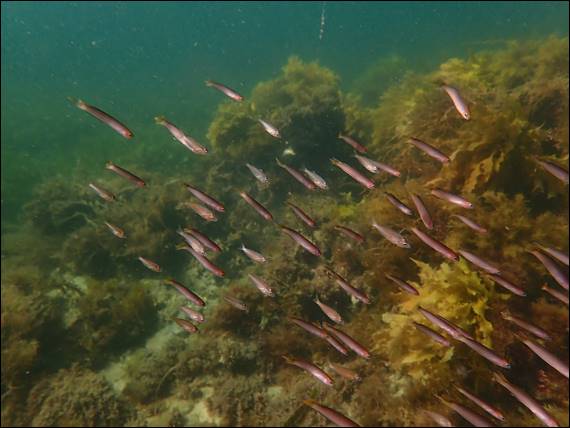
Being a carnivorous fish, known to feed on feed on crabs, fishes, and larvae, these darker recess are where they are more like to find a feed. I can only assume that the other fish intermingled with them, with a deeper and shorter body, are also carnivorous. With Rongy’s assistance we think they may be juvenile Silver Trevally. Another shoal of fish that has popped up in the last few dives are the ones below. While hard to see in the images they are different to the silver fish mixing with the Yellowhead Hulafish, plus I have seen these more frequently brazenly swimming in the open:
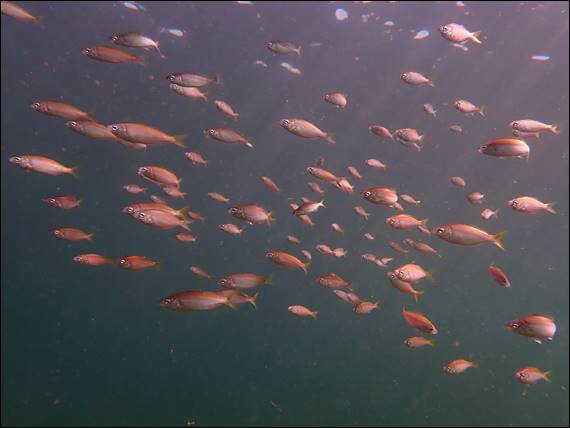
Again a bit of guess work, but Rongy and I thought they may be Juvenile Yellowback Fusilier (Caesio xanthonota). The Yellowback Fusilier feed exclusively on plankton, which would explain why I see these out in the open water more often. And again if we have guessed right, an interesting fact about these fish is that they can protrude their upper jaw outwards. Making snatching plankton out of the water easier. My next find is one that I have included in quite a few posts, and I will no doubt do so again. Every time I see Bat-wing Seaslug (Sagaminopteron ornatum) flying through the water I’m captivated:
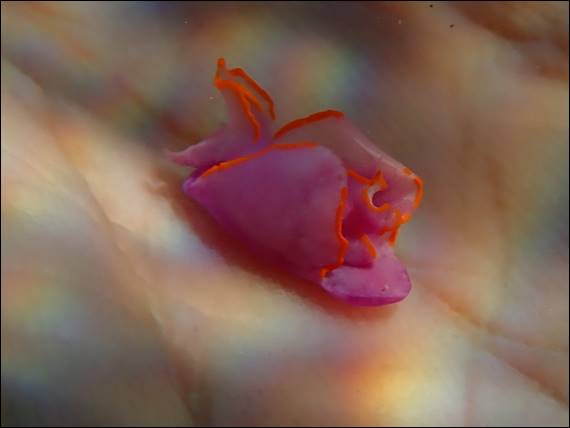
This time however, I allowed it to rest on the palm of my hand and it’s lobes, which are normally flapping as it swims through the water (check out the video of this in the linked post https://sandbagged.blog/2021/02/14/deja-vu/), curled upwards to provide protection for its main body. These sea slugs belong to the Gastropteridae family, and can be found in tropical through to artic waters off Alaska. However, one thing the many species have in common is that they are small. The largest is only an inch long, and some are mere millimetres long. This species found in Western Australia is approximately one centimetre in length. And this happened to be the same size of my next find, something I have not come across before:
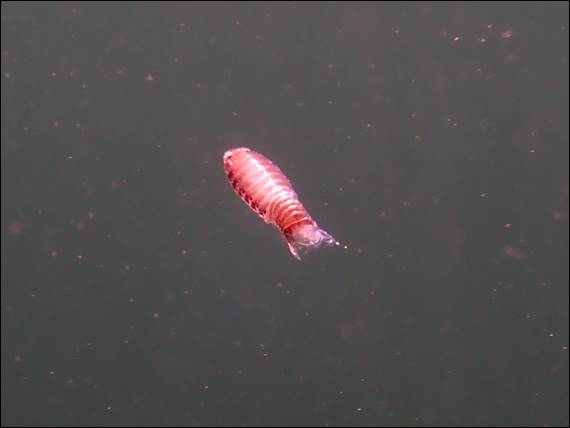
To provide an idea of scale I also included the next image. I’ve been told it was a sea louse, and that they are not often seen floating about like this. Most people will find them attached to their catch, as they reel a fish in. They use suction to attach themselves to the fish, and can move along the scales as they graze on the hosts body. They can, as such, become a lethal parasite. There have been reports of people getting nasty rashes and reaction to sea lice, but today despite seeing two of these I didn’t notice any after effects:

Today’s dive was again different, the water was clear enough but the sky was a bit cloudy. Resulting in the visibility being that bit reduced, and I immediately noticed that there were quite a few Comb jellies (Phylum Ctenophora) bobbing about in the water. These resemble jellyfish, but they are part of a distinct and diverse group of their own. They capture their food by literally sticking to it, not having or using the paralysing stinging tactics of true jelly fish. Although I have read there is one species called Ctenophore (Haeckelia rubra), not only does it eat other jellyfish, but it takes their stinging cells and uses them as a weapon on its own tentacles:
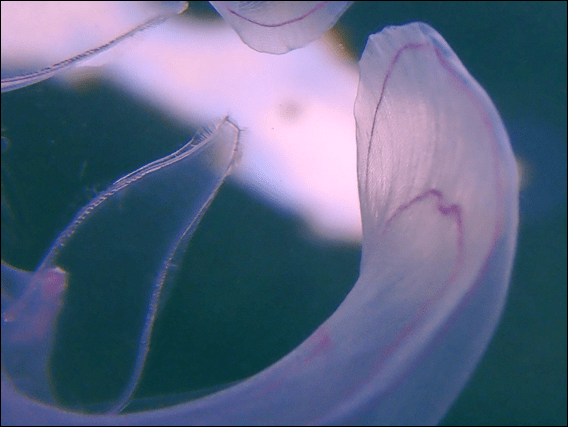
The stinging type is found in Australian waters, but it is not the ones I see. Or at least I have not to date been stung by them. Watching the light catch the rows of tiny hairs move in unison along each ridge is quite special, so I always stop and spend time with these gentle jellies. Today however, and on three occasions, I found something else hovering right next to them. And as I moved round to get a better look the tiny newly hatched Horseshoe Leatherjacket (Meuschenia hippocrepis), would swim to the other side of the jelly. I took lots and lots of images in the hope one would be in focus:
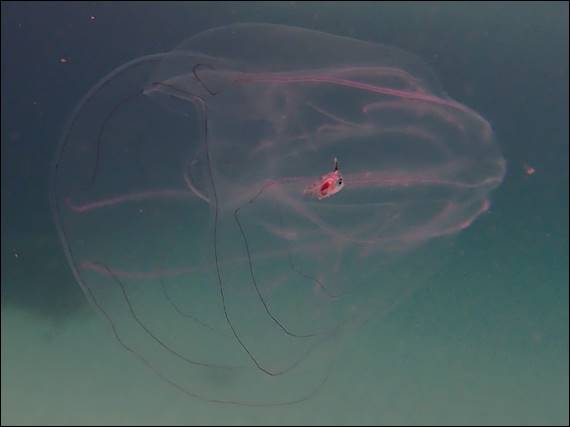
The camera doesn’t always pick up the translucent body of these jellies and this tiny fish was less than five millimetres long so again not big enough for the camera to focus on. I was both rewarded and really happy to have captured a few reasonable shots. The one above being my favourite, really showing the tiny fish’s dorsal spine and blue eye. These are by far the smallest fish I have seen, and it is amazing to think that they will grow into a fish that can be as much as 120 time longer, at sixty centimetres. While not the full adult size I did see some more mature specimens of this fish, and maybe due to the cloudy weather they along with numerous other fish were out and about:

Today duck diving to check out the caves I regularly frequent, I was often faced with a good variety of fish. Being dark it was hard to get a good image, but the above one wasn’t too bad in which I watched a Horseshoe Leatherjacket, Squareback Butterflyfish, Juvenile Moonlighter, Western Striped Cardinalfish, and Orange Spotted Wrasse. Or were they watching me. As a result of the reduced visibility from the lack of direct sunlight I stayed relatively close to shore today, no more than 75m. Spending a fair bit of time combing the weedy bottom, which is where I found another shoal of small one centimetre long juvenile fish:

I am not game to try and name the above fish, although they could be from the bullseye family. But the below Impressive Pencil Urchin (Gonicocidrais impressa) is something I have found and had identify before. Swimming over the sandy bay towards the beach I spotted an oddly shaped collection of weed, which was not moving in the usual or expected rhythmically way as the gentle swell went back and forth. As I got close the spines became evident and in-between the weed covered spines I could see the armoured round body of the urchin. The ends of the spines on these urchins have cupped suckers, allowing them to hold on to the reef in rough seas:

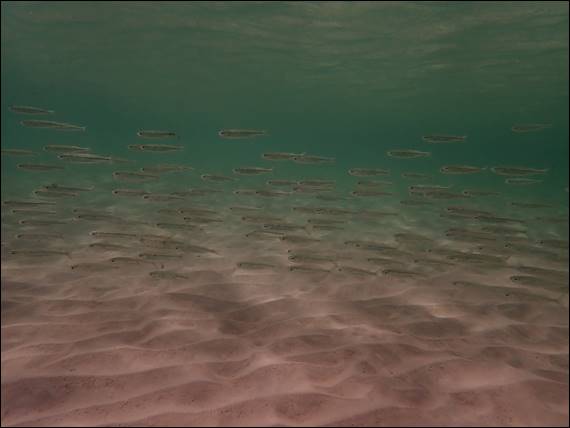
It is the first urchin I have found so far into the sandy area, and I am not sure it was intentional. Compared to the reef this was a very vulnerable and unprotected environment for the urchin. Leaving nature as I found it, I swam on back to the beach. And as I approached the shoreline a large shoal of Hardyhead Silverside (Atherinomorus lacunosus) blocked my path. A couple of thousand swam in a long seemingly never ending line, between me and the beach that was no more than five meters away. So I stopped and let them cross my path, which took some time. Watching them disappear before getting out of the water:
 Sandbagged