For the first time since before the school holidays, two months back, the conditions along our stretch of coastline seem to be improving. The last week has been another scorcher, mid-thirties and above most days but this time there have not been the strong easterlies to churn up the water. As such this week I have had a couple of mid-week dips. The first one was just to cool down, but it was so good that Nana joined me for a second dip on Thursday. Before my first dive I wasn’t convinced, maybe jaded and feeling like I have been tricked once too often into thinking it would be good:
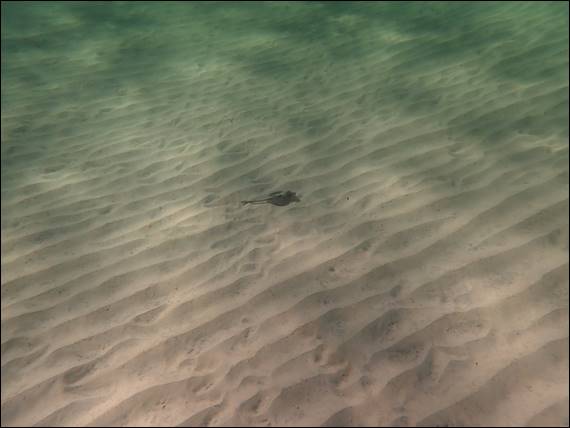
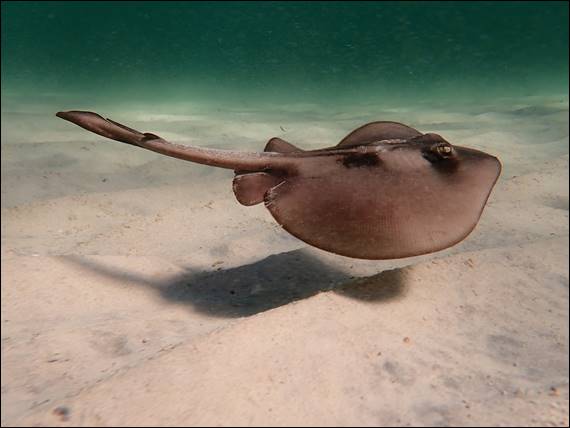
But as I swam out, the sunlight pierced right down to the sandy base. Casting that familiar, soothing and rhythmical pattern the sun makes, as it gets deflected by the surface ripples. It was a hugely welcome sight. Just the water clarity was enough to make me smile, but then saw a Bight Stingaree lounging about below making me smile even more. This species is also known as the Striped Stingaree, and the Latin name Trygonoptera ovalis reflects this distinct oval (ovalis) shape of its disc. Chatting to Nana on the second dive, during which we saw no rays, we remarked how absent the numerous rays, which are normally found here, have been this season:
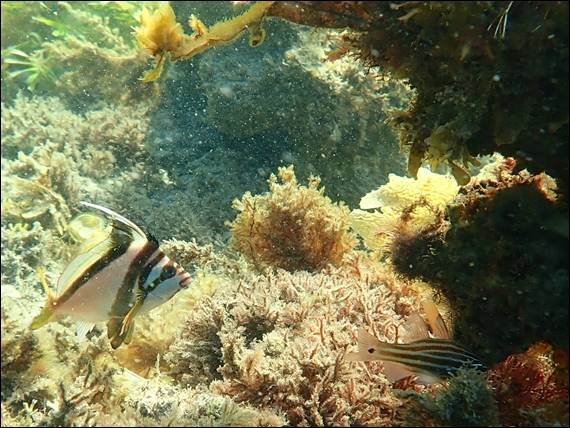
While we didn’t see any rays on that second dive, as with the first there was a lot of active fish life. The place seemed calm and had a tranquil feel to it, and maybe the fish had also noticed the change and come out to feed. On clear days like this I venture out up to about 150m, and it gets a little deeper. If you bob about on the surface in one spot your eyes become accustomed, and you start to see the movement of numerous fish. I was happy to see two fish in particular, ones that I have not frequently seen on the reef off our local beach. The first being a fish that is endemic to Western Australia being the Magpie Morwong, Goniistius gibbosus:
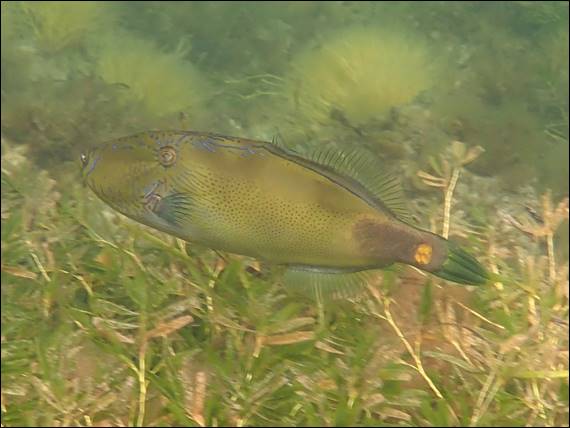
The second is the Spinytail Leatherjacket, Acanthaluteres brownie. I have only ever seen a few of them, but on both dives this week I saw groups of up to eight of them foraging in the weed. These are very skittish fish, and are quick to slink away, so I have never really got a good image of them. I think that I may have only ever seen the female of this fish, as checking on the Fish of Australia website it indicates the males seem to be much more brightly patterned. The females are still very striking, and also display the namesake two pairs of spines just in front of the tail:
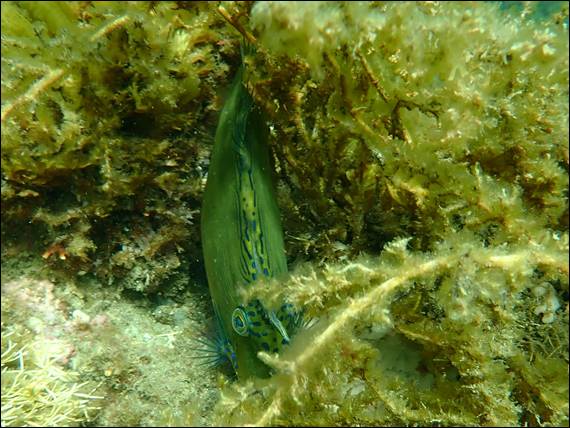
No matter how many times I went down, nor how far away I went down from the fish to try and sneak up on them, they seemed to allude me. The deeper water gave them plenty of notice of what I was up to and I could see their bodies shifting into position to keep a better eye on where I was. Eventually I gave up with this game of cat and mouse, reverting back to bobbing about content with seeing all the other fish. Closer to shore the depth reduces and there are large areas of weed:
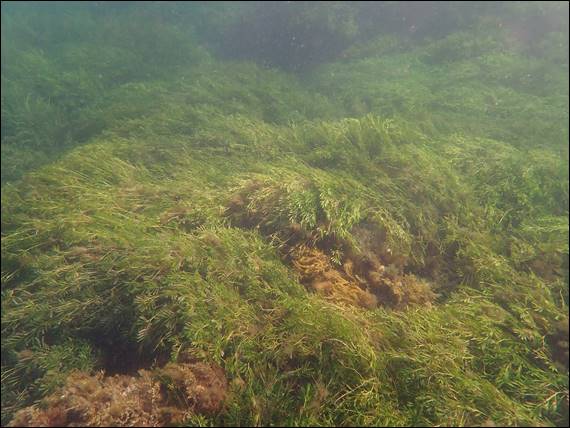
In these weedy areas while I see lots of fish, it is way too easy for them to duck undercover. It is however a good place to spot cephalopods, such as cuttlefish and squid. The former do not usually move as fast and are less skittish, and the latter tend not to go into the weed from what I have observed. I didn’t spot any cephalopods this time, but did start to see groups of the same leatherjacket. Being shallower I had a slight advantage this time, and was eventually rewarded with an almost in focus image, as this fish darted away:
Nana hadn’t been snorkelling in this area before, and was pleasantly surprised. Like me she is happy to float there and just watch, but also like me she pops down every so often to take a closer look for hidden gems. Each section of the beach has its own distinct feel, our spot is a bit deeper and more open. Wave walk is next prominent section heading north east, which is like a nursery being shallow and sheltered. Then off the beach where Nana and Geoff live there are lots of small bommies, followed by the Capel River Mouth area which has large open sandy bays between large bommies. Finally you hit the extensive reef that stretches for another six kilometres past the point, which is the densest reef:

They are all good, but I do like the ability to walk out of the door and dive in off the beach. This week’s two dives were about the fish, but I spotted many other creatures and this one had to be included. Something had taken a bite out of the otherwise perfect Vermillion biscuit starfish, Pentagonaster dubeni. Despite having been mauled, the distinct pebble like pattern still prevailed in the fleshy white body under the skin. Sea stars are echinoderms, meaning “spiny skin” in Greek, which is exactly what their skin is on the upper side. Although the spins can be very small, hard to see and are not a form of protection from prey:
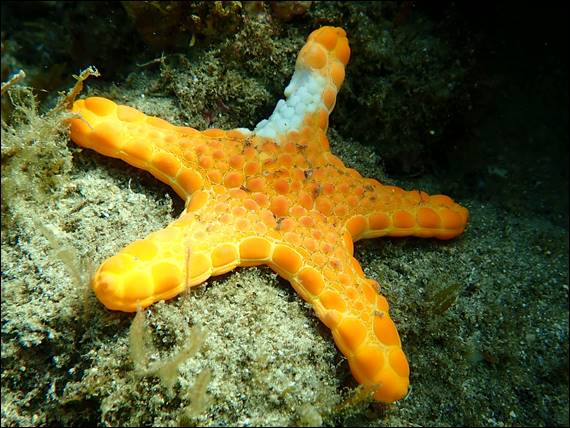
The primary function of the spins, or pedicellaria, is to keep the skin free of unwanted objects. Whereas for other echinoderms the spins are a form of protection, such as sea urchins. As we started to come back to shore, Nana spotted a blue swimmer crab and couldn’t resist a closer encounter. Seeing if by mimicking the crabs actions, it might accept her as one of its own. It certainly seemed to confuse the poor crab, as it didn’t swim away and seemed frozen to the spot. It looks like we might be in for some more favourable winds conditions for a little while, so with calmer waters we are hoping a few more rays might start to come back to say hello again:

 Sandbagged