Early Friday morning I woke just a few minutes before the alarm went off. It was dark, as I quietly crept round the kitchen making a cup of tea. After last week’s break in our Friday morning routine, due to the amazing hike in the Stirling Ranges, the ritual was restored. This week only Howsie and myself headed to Welly Dam to start the last day of our working week with a climb. We were both feeling a bit weary. Maybe from the big weekend away, the heat that had stayed up, and/or the hay fever that had suddenly come on again. Regardless we were keen, and smashed out eight fun routes and still got to work for 8am:
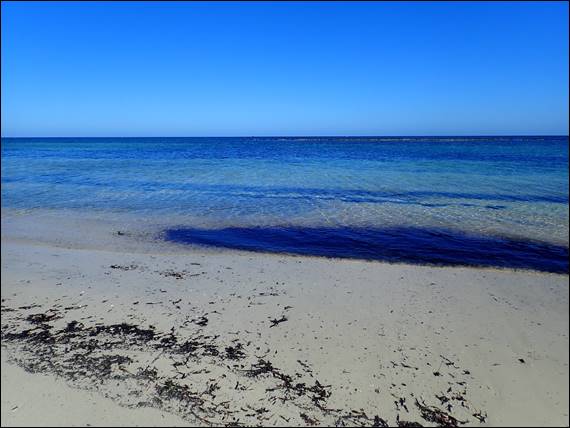
Saturday came and it was not such an early start, although I do find it hard to stay in bed much past 5am. Especially when it is light an hour before that and the dawn chorus, which often rouses me from my slumber, starts half an hour earlier than that. At 8am today it wasn’t time to start work, but to be picked up by Eski and head out for a snorkel. The conditions were great, an extremely low tide, minimal swell and hardly a breeze. The Capel River is still flowing so we weren’t able to head past the point, but that same reef extends a long way eastwards so we accessed it via The Huts near Stratham:
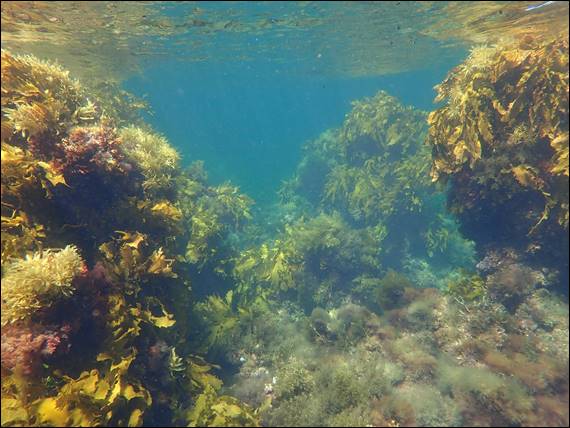
I’ve been down this way once before, and had an amazing dive when I swam with a cuttlefish for what felt like ages. Today we were driving past where I had previously gone in. Past the mob of cars parked up at the first point, at the end of the bay of the main Stratham beach, from where the divers had put their boats in. We counted a neat line of fifteen boat trailers, and at least 20 cars. And also past the location where the commercial fishing crew had built their huts, in days gone by. It was busy on the water. But driving that bit further we came to an area of reef that both Eski had been keen to check out and was completely empty and away from the crowds:

The cray pots had all been emptied much earlier in the morning, and were now set ready for the next night to trap unsuspecting crays, which are really rock lobsters. The reef here was varied and interesting, lots of caves, crevices and swim throughs. We saw lots of life, even if most of it was skittish and didn’t hang about for too long. I even spotted a pair of Zebrafish (Girella zebra), which I don’t recall seeing on this reef that stretches for 7km from Stratham to Peppermint Grove Beach. With the conditions being as they were, visibility was brilliant. Not that I needed to see far when a Batwing Slug (Sagaminopteron ornatum) swam right in front of me:
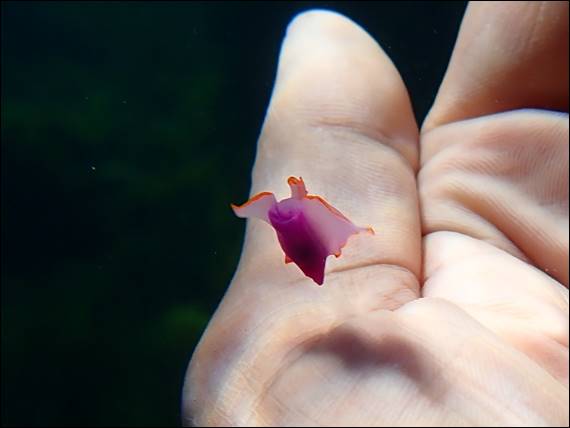
I’ve seen these a few times now and have even videoed them swimming, https://sandbagged.blog/2021/02/14/deja-vu/. These are a opisthobranch that quite literally meaning “gills behind”, and they sit behind and to the right of the heart. They are often called sea slugs or sea hares. This stunning species was first see and identified in Sagami Bay, Japan, which is where it got its scientific name from. They fall in the gastropoda class and are normally found on the sea bed or on a surface, being benthic crawlers. If they are disturbed they can vigorously flap the enlarged parapodia like wings. Calling them wings is however a bit demeaning, as they can also be used by some creatures for sensation and/or respiration:
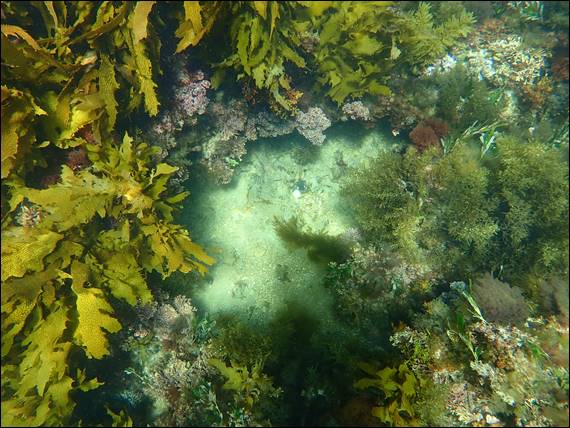
Above in a sandy clearing I spotted an old friend, a Gloomy Octopus (Octopus tetricus) and had to take a quick video of his bobbing head. He’d collected a few shells and stones to try to and conceal himself, but it really wasn’t very successful, and I was a little surprised at just how exposed a location he was in considering all the reef around him. My next find was under a ledge and I had to duck dive and go upside down to see it. The light wasn’t great, and nor was my breathe holding capabilities, so I sadly didn’t get any really clear images. But I was so excited that I simply had to include an image:
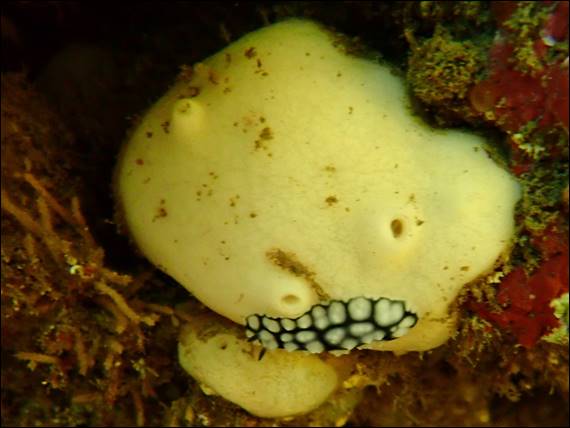
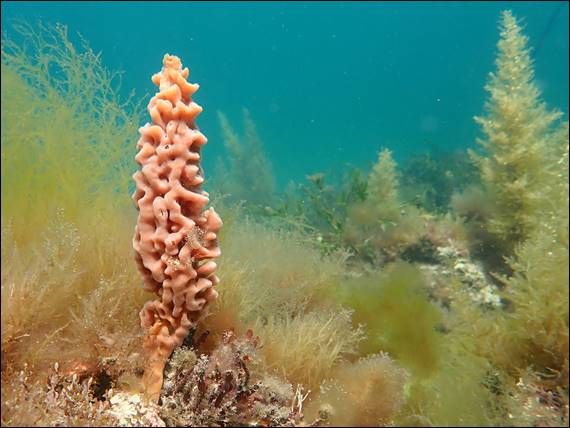
The oddly named Pustulose Wart Slug (Phyllidiella pustulosa) is a nudibranch, which means something like “naked gills”. However, this species doesn’t have the external gills seen on most nudibranchs, which will look like a collection of feathers at rear of the body. Instead the wart slug family has it’s gills hidden, or more likely being protected, on their ventral or underside area. Sea slugs are the most common nudibranchs in the tropical Indo-West Pacific waters, yet I have seen very few and have to date not been able to get a great images of one. This particular one is also one of the few monochrome species, with most having a splash or more of vibrant colour:
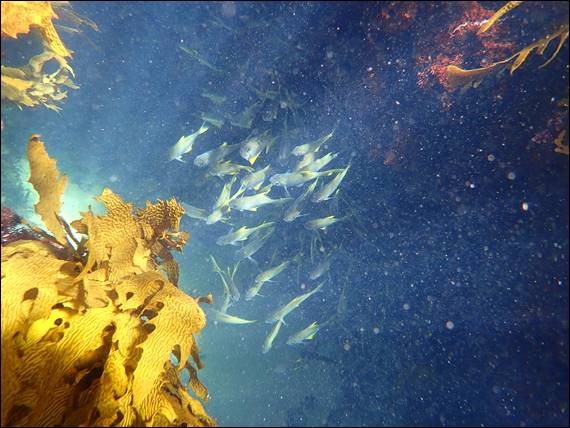
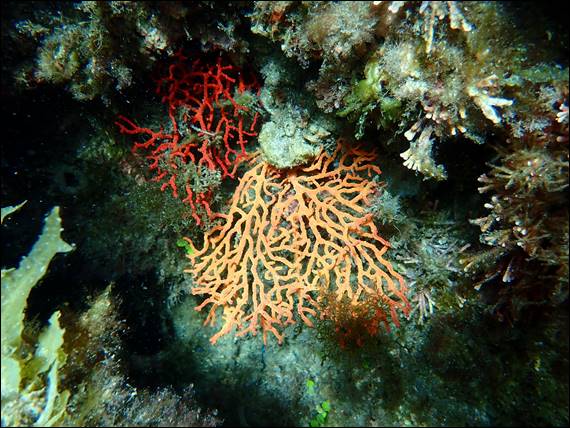
I saw heaps of fish but not many big shoals, other than the Western Pomfred (Schuettea woodwardi), with the mob above drifting lazily about in a narrow crevice. I went down to see them but didn’t dare following them, as they moved to a narrower area with a roof looming overhead. Today I also spotted quite a few Sea Fans (Gorgonia), but with some 500 species I wasn’t game to narrow them down. These soft corals will usually be oriented to allow the prevailing water current to flow through them. This will maximise the opportunity for the polyps to collet any small food particles from the water. It would be great to see them when the polyps are not hidden away under the leathery tissue of the coral, as they were today:
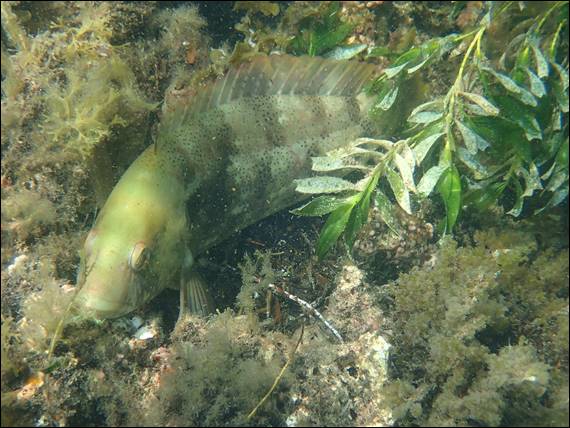
My last image from The Huts is a male Brown-spotted Wrasse (Notolabrus parilus), or also known as an Orange-spotted wrasse. A fish I have often seen and included but today I came across one in the shallows that was happy for me to get really close image. This occurred both as I swam out and then again as I came back in. There are some 600 species of Wrasse and I do see other species, but this is the only one that tends to sit round long enough for me to photograph. While it is a relatively large species of wrasse, at up to a foot long, the largest is the Maori Wrasse, which can be as much as 2m long. I was lucky to swim with one of these gentle giants way back in the mid-90s when I dove on the Great Barrier Reef:
We were in the water for over an hour and it was a great dive, Eski’s catch bag came out of the water empty. But that wasn’t a huge surprise, the crays were there but with such deep hiding holes there was little hope of catching any at that time of the day. As we drove out we came across a commercial fisherman who was pulling his net from the rear of his boat, still on the trailer of his ute. He’d spied a small shoal of fish that could be seen swimming in the shallows near the beach, and was slowly walking out and round them to trap them. It reminded me when Elseya first saw this type of drag net fishing in 2008 near Albany, admittedly on a much bigger scale. She was devastated as she watched the process unfold. We drove on, past where all the cars were still lined up and headed home:

On Sunday I had been invited by Ash to head out to Wilyabrup with him and his mates for a climb. Some may be surprised to hear that I declined, and this was for several reasons. First I was feeling a tad weary from last weekend’s big hike, Friday morning’s climb at Welly Dam and a busy four days of playing catch-up at work. In addition there were going to be road closures resulting in the need to take the long road out during which I would have to battle with roadworks. Lastly it was going to be hot and my hay-fever has been blowing up recently. With all those thoughts rattling round in my brain, the idea of a cool dip in the ocean seemed more appealing. So for the second day as 8am arrived, Eski and I headed out:
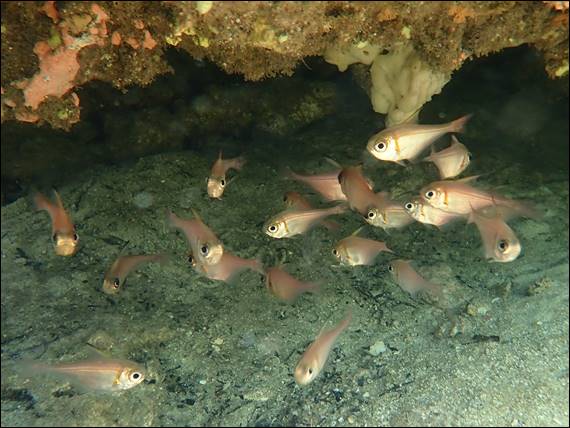
On the way home on Saturday we had driven to a few places including a spot of Peppy Beach that he was keen to check out. So that is where we headed today, neither of us knew the area so just went for it. The bottom soon disappeared below us, 6m or more. It was a long swim over mostly sand followed by level broken and lifeless ground, a little disappointing. But we were in the water now so preserved. Tracking eastwards, with the direction of the swell, the depth gradually decreased and eventually the reef took on a bit more form. We also started to see signs of life with fish darting about here and there. The first significant sighting being a small cave with a small shoal of Rough Bullseye (Pempheris klunzingeri) lurking inside:
We were aiming for a place where I knew the reef was reasonable and hopefully had more life in it. Wave Walk’s reef has always come across as a bit of a nursery, shallow waters with plenty of ledges, crevices and weed. Sure enough as we got closer fish popped up all over the place and I captured a heap of them on camera. As I crossed a particular wide crevices I noticed a movement out of the side of my eye. A Samson fish (Seriola hippos) lazily swam in the opposite direction to me, sadly at a healthy distance only allowing me to catch a silhouette image:
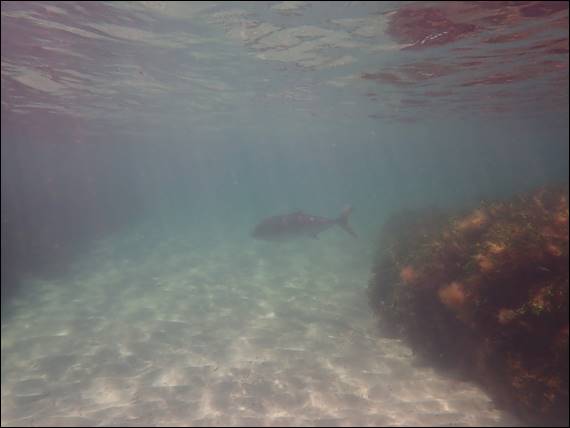
To give you an indication of size, I guessed it was a good meter long. These fish grow very fast, reaching 60cm within the first two years of its life. They can grow to approx. 180cm in length, weighing in at a healthy55kg and living for up to 32 years. They are powerful predatory fish and called Samson fish based on, well, Samson who was given superhuman strength. I also came across quite a few Western Smooth Boxfish (Anoplocapros amygdaloides) and love seeing these clumsy looking fish awkwardly swim with their whole body seemingly wobbling, as they try to go faster. But this box fish had me baffled:
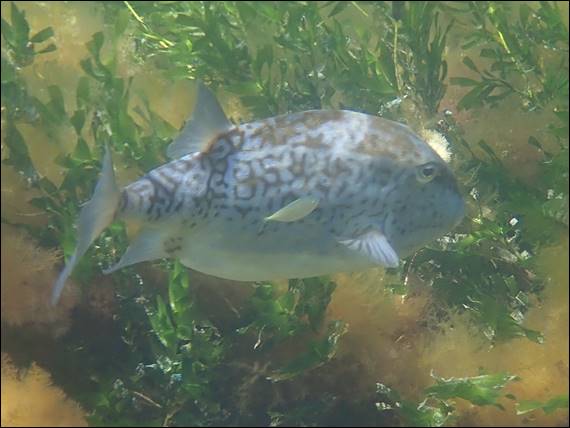
I’ve now discovered that this is the male Western Smooth Boxfish, and it has a very different pattern to the white with brown spots I expect with them. In fact I do not recall seeing one like this before and it seems that only large males will have this pattern that changes from spots to brown blotches, lines and spots. If you look closely in the image above you will see that there is a small fish following alongside it. This fish, which I have not been able to identify, latched onto me and followed me for the rest of my dive which was another 20 minutes or more. Hanging round my flippers every time I looked back:
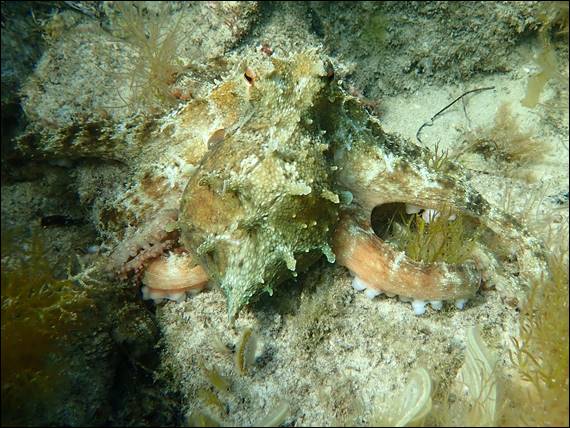
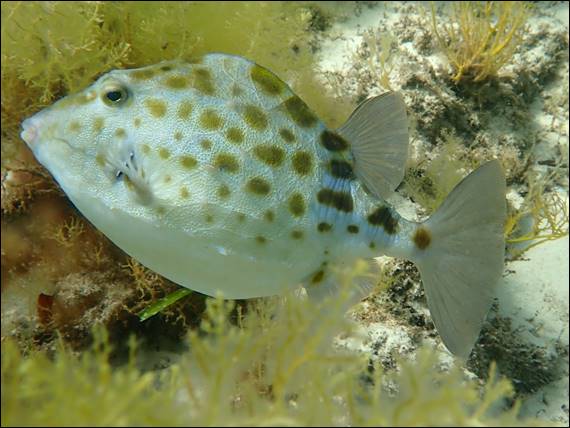
My next find also had me very excited. The above Western Rock Octopus (Octopus djinda) was completely in the open. Unlike the smooth scaly looking pale to dark blue, grey skin of the one in the video clip from Saturday, this one was beautifully camouflaged against its background. Not only by its colouration, but also the skin texture making it look more rocky like. Whilst I saw lots of other fish including Garfish, Herring, White Bait, Trigger Fish, Herring Cale, Wrasse, Sweeps, and more. I thought I would include this image of what is either a female or small male Western Smoot Boxfish, so you can see just how varied the pattern is between this and the large male:
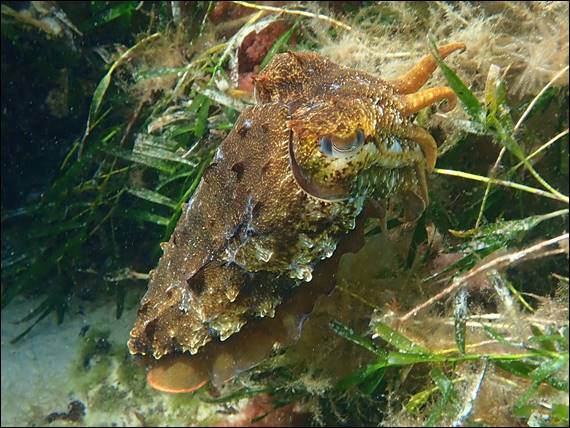
The swim back towards where we came in was approx. 500m and we were going against the swell, which was fortunately not very strong. After close to an hour and half in the water my legs were tiring, but I kept seeing more life that was worth diving down for. That included this young Giant Cuttlefish (Sepia apama), which are sometimes referred to as ‘chameleons of the sea’. This one swam across various ground including weed, sand and reef and put an amazing display of changing colours and skin textures as the environment changed. They can grow to 50cm, and that is measured just for the mantle so not including the tentacles, this one was a small one with a mantle of probably no more than 20cm but no less impressive to see:
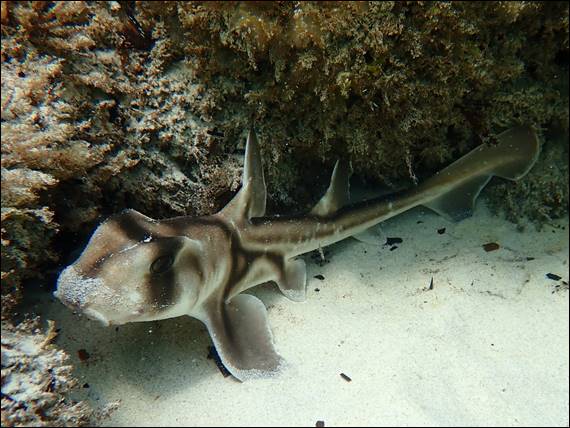
I was finally a mere 20m from shore and the final stretch was a sandy bottom broken up only by a few small bare rocky outcrops. I really didn’t expect to see anything else, which is when I spotted a juvenile Port Jackson Shark (Heterodontus portusjacksoni). No more than 30cm long. They pose no threat to humans despite growing up to just shy of 2m in length, using their unique flat grinding teeth to pulverise crustaceans and molluscs. That said their the dorsal-fin spines are venomous so care is required. I felt extremely lucky to find this nocturnal fish out at this time of the day, and it was yet another first for me during what turned out to be a very successful dive:
 Sandbagged