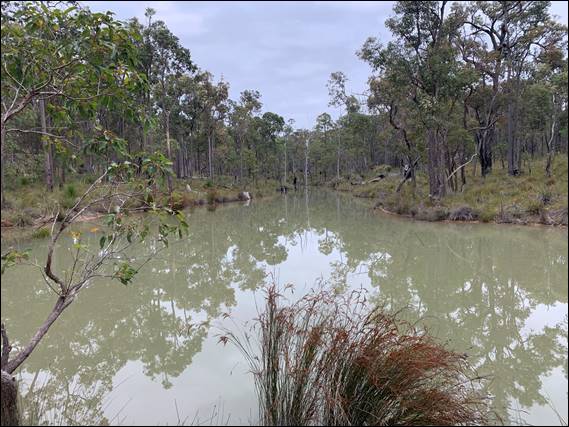
Lisa and I couldn’t work out when we had last visited this spot. I didn’t think it had been too many years but my images indicate it has been ten. Crooked Brook is a great hidden gem, not too far from where Lisa works in Boyanup. A possible reason this place is kept in tip-top condition is that it has been jointly managed by The Crooked Brook Forest Association, basically a bunch of volunteers, and state government for fifteen years. There is nothing like a sense of ownership to get people to come out, lend a hand and keep a place in good condition:
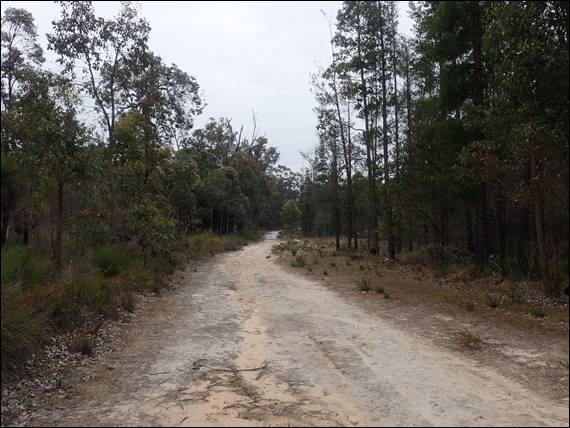
There are four walks ranging from a mere 700m to ten kilometres and we thought we had been round all of them, but as we set off on the longer hike it really didn’t feel familiar. The Crooked Brook Forest has a sliver of pine plantation reaching into it, and the start of the walk followed the divide between native bush and plantation along a wide track. I’ve said it before and stand by it that walking on such wide tracks just doesn’t give you that feeling of being in amongst nature. However, the pine forest with its open bare ground did remind me of good memories of a walk or two in the Netherlands many years back:
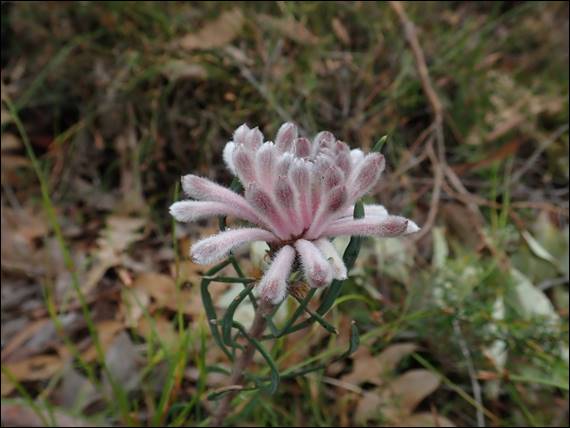
It felt like the plants were a long way away and it was easy to get into a big stride and not have a good look to see what was about. Fortunately the circuit, as we found out, was very varied and it went over granite hills and sandy swampy areas and as you can imagine this provided a continually changing floral display. So while it may have started a little bland on the flowers and colour front it certainly improved a lot. The interesting flower below caught our eye as it looked all velvety and soft and quite different to anything else. It’s an endemic plant to the area called a Pixie Mops, and is an understorey plant that doesn’t grow above a meter in height:
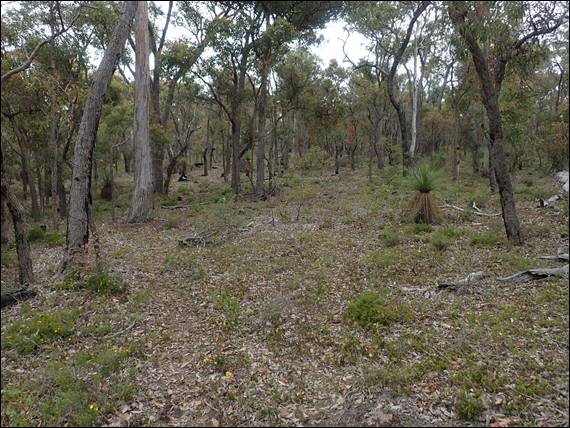
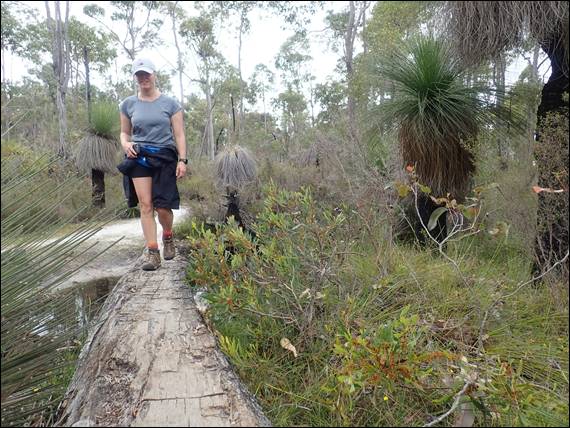
Within a short distance we were guided by the markers off the wide track and into the sort of path that we really enjoy. The Marri trees closed in and the ground cover was right by our feet. What struck us about this general area was that there didn’t seem to be too much thick understorey, and some places like below were very open. Unlike so many places we have walked this year, here the vegetation seemed to mostly go from upper storey straight to ground cover. Meaning you could gaze a long way into the bush and giving quite a different feel:
It certainly started full of greens and browns with only a splattering of colour. This was another flower that really caught out attention and we found them in both pink and white. The flower head certainly looked a lot like the small coastal groundcover we have seen so much of. These however were a shrub, with flower heads not so tightly packed and more sparse on longer branches. I’ve asked Howsie if he could identify it but without more images and detail all he could come up with was what I managed to find, in that it is a Pimelea:
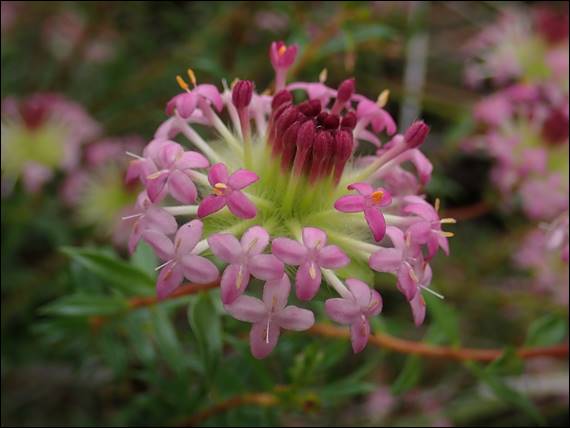
There are some 150 species of this plant including about 110 in Australia and 36 in New Zealand, and they are commonly called Rice Flowers but I can’t find out why. They can be found as herbs, which I assume are the ones we have seen along the coast, or small shrubs which is what we found here. The flowers are easily distinguished as they are clumped at the end of the branch and comprise four petal-like sepals and two stamens, which can be clearly seen above. If I was being brave I’d guess that it may be a small shrub native to this area called Pimelea ferruginea:
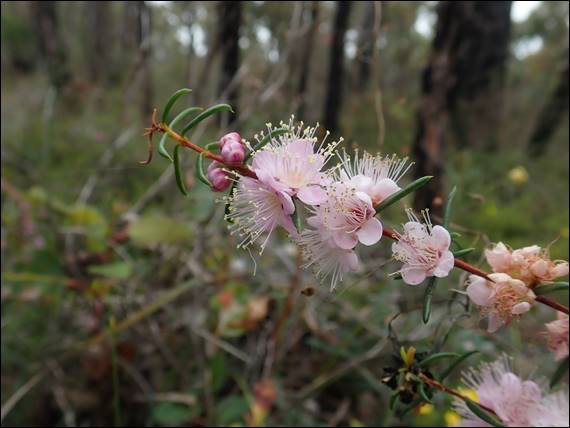
As we went on our way the variety of flower we saw was super impressive, above it is clearly a Myrtle and Howsie has plumped for a Pink-flowered Myrtle or Hypocalymma angustifolium. We found these in both bright pink and this pale pink variety, so he could be on the money as it comes in different shades of pink through to white. One of the reasons I have included it, other than we were both quite taken at this dainty flower, was that if you look closely you’ll see a strand of a spider’s web coming of the last flower on the branch. We seemed to be walking through a lot of these but we never noticed any spiders:
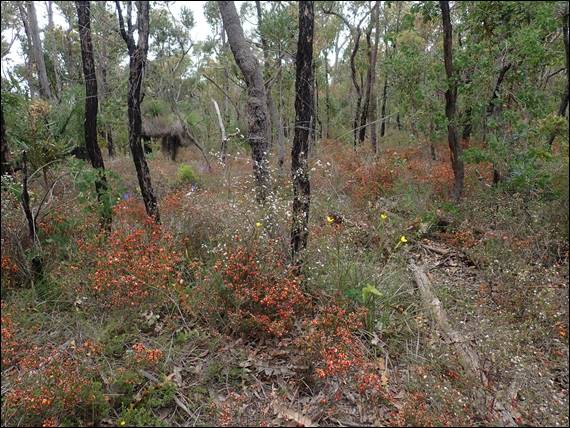
The above image shows how some areas lit up and through these section we slowed down and had a bit more of a look about. The main colour in this image being the brown orange from yet another pea, I thought it may be a Chorizema, but Howsie is probably right with Bossiaea ornata. Regardless of that the story of how Chorizema got its name is way to interesting to not include. It was first recorded by explorers in 1792 and the thirsty exploratory party spotted it near a waterhole, so they named it by linking two Greek words of choros (dance) and zema (a drinking vessel):
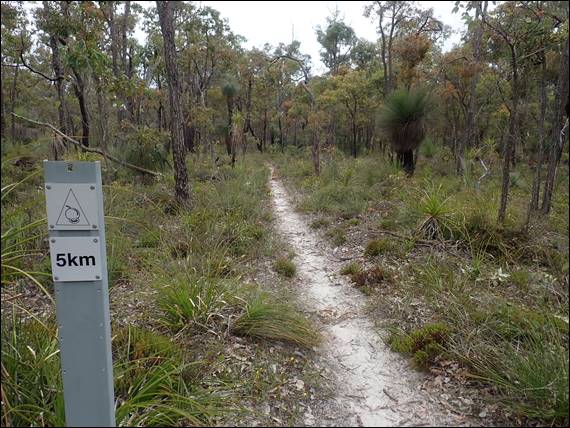
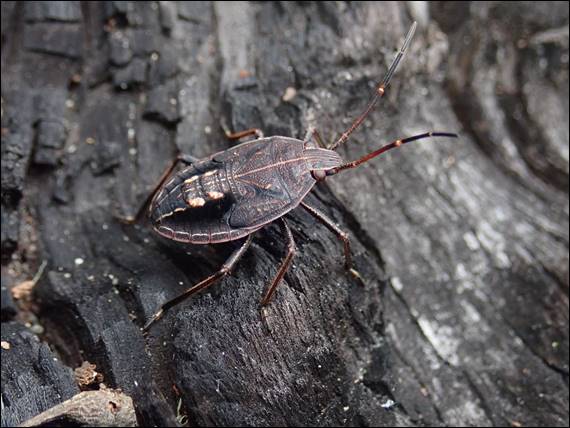
Another unusual aspect of this walk was that it had distance markers ever kilometre. And as per custom we had hauled a flask of tea and cheese sandwiches along with us. As well as other snacks that never made it out of the pack, maybe because it was easy walking and we didn’t need as many breaks to top up the energy levels. At the half way point we found a great spot to take a load off. I spotted this Shield beetle that stayed on the big stump that we used as both a table and chair the whole time we were there. You may be waiting for me to say I’m checking what it is on QuestaGame, but I have decided to stop using the App as I was spending way too long logging all my finds:
So instead I have been using Google Lens to give me a starting point and then research beyond that, for some things it has been great but others it has really struggled on. Now I’m sure you have been waiting with baited breathe to see how we went with Orchid hunting. Well it didn’t feel like that were too many but when we tallied up our find, which included the Forest Mantis, Giant Donkey, Purple Pansy, Purple Enamel, Pink Enamel, Cowslip, White Spider, Jug, Scented Sun, Blue Lady and King in his Carriage Orchid it wasn’t bad at all. But no species that I haven’t seen this year:
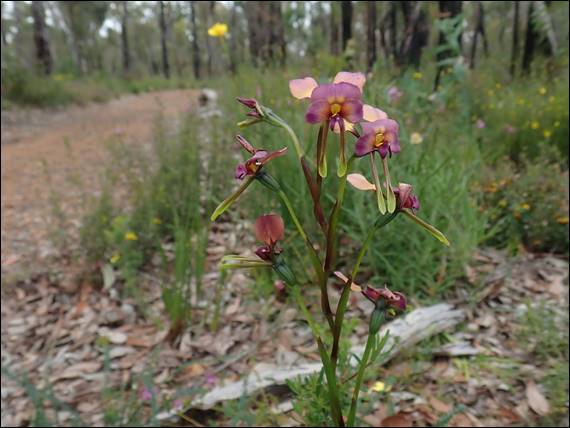
The King in his Carriage was a single plant and very much at the end of its life, but I was really happy to spot it so Lisa could see it. I also thought we were out of luck with spiders until we found three close together near the end of the walk. The most prominent orchids we saw were the Cowslips and Enamel Orchids and there were thousands. The latter started a bit of a game of trying to work out if they were pink or purple enamels, for example are these all the same or not. Some were a bit more obvious and we decided when we couldn’t work it our we’d call them pinkle:
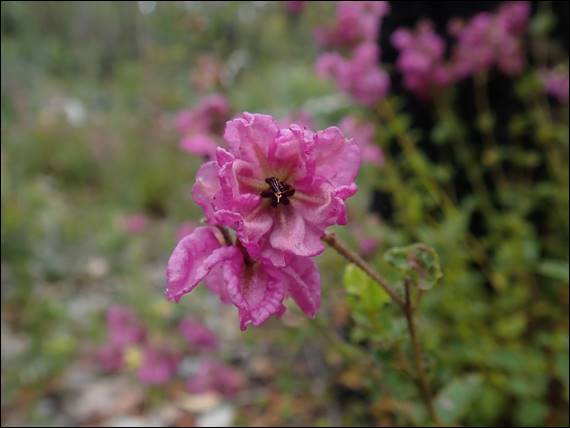
Here is a plant that Google Lens suggested was a Chrysanthemum, which is obviously well off the mark. And Howsie has suggested maybe a Thomasia and as he usually is I reckon he is on the money. I’m going to go a step further and say it may be Thomasia grandiflora, commonly and very originally known as large-flowered thomasia. It’s another true local and endemic to the south-west of Western Australia. And the reason I think I’m right is that the flowers are described as a “pinkish-purple with a papery appearance hanging in pendants from the leaf axils”. This is exactly how I was going to describe it, just like the tissue paper flowers our daughter Elseya used to make:
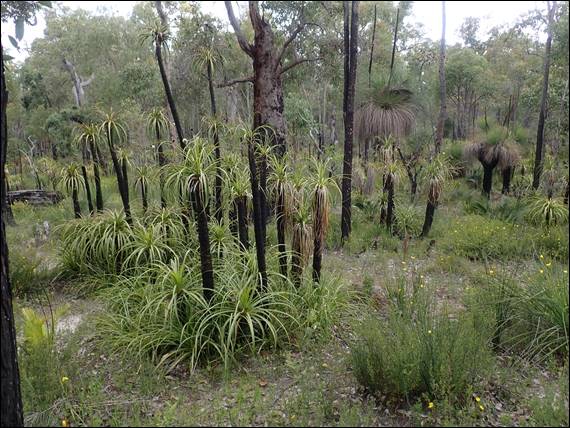
The plants in the next image also really caught our attention, they seemed to pop up in certain areas in vast numbers and we have never seen them before. It wasn’t till the end of the walk that a little sign told us it was called a Pineapple Lily. However, checking it out online the state’s floral database suggests its name is the Pineapple Bush or Dasypogon hookeri. Other than telling me it is a perennial herb or tree-like monocot I can’t find anything out. I do however now know that monocots are grass-like flowering plants, of which only one leaf is capable of producing seeds:
While I haven’t included images to show it, the track did reach the edge of the forest and follow along the boundary with the rolling green pastures of the surrounding farmland. While some may not like the thought of that, it did provide a bigger mix of sights and we didn’t mind having a bit more of a vista every so often. Another aspect of this area that really appealed to Lisa was that it seemed you could take dogs here. We bumped into a few people out with their pooches, and while she said hello to the dogs I scoured the ground:
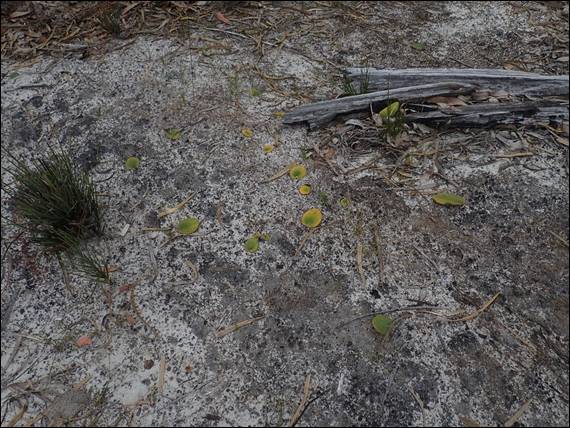
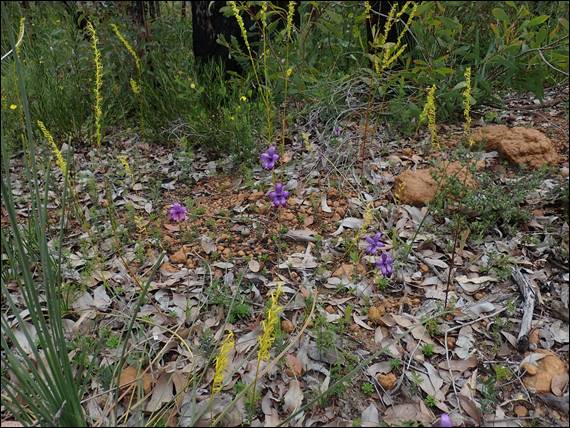
Above, and as we walked through the swampy area, there were heaps of basal leaves telling me orchids were about. But I couldn’t tell if they were yet to come out or had already bloomed and gone back to ground. In this area we only found enamel but that included this fine specimen of both a Pink and Purple Enamel next to each other. Lisa seemed to be able to distinguish the different colours better than me. And without getting into detail women tend to have better colour perception than men, it all comes down to how many and what sort of cones you have in your retina:
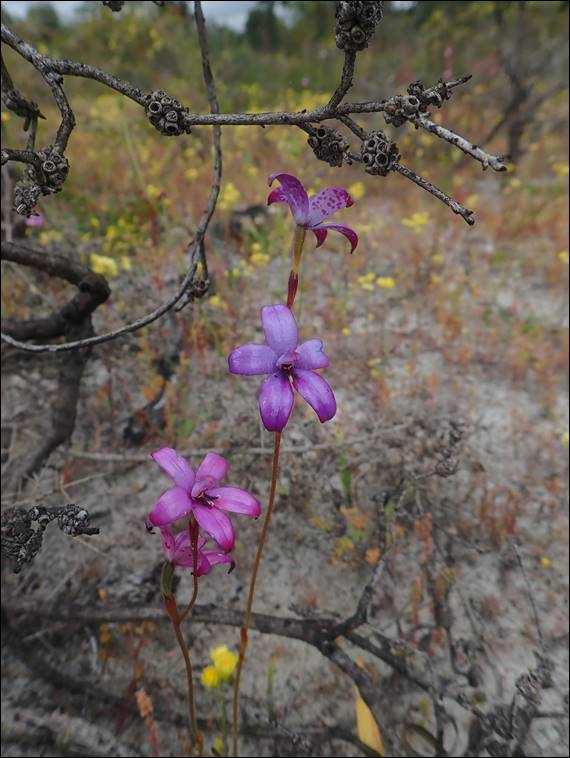
Most people’s colour visualization system is known as trichromacy, which means they see in three colours. But some people can see in four colours, having a tetrachromacy system and women are more likely to have this. So it is very possible that despite only confirming that I have found a Pink Enamel in my last post, I may have been finding them for years. As we neared the end of the hike we decided to add in an extra couple of kilometre loop in, as it had been such a lovely walk. I’m glad we did as we came across some beautiful red and green kangaroo paws, and while I had included in my last post Lisa was yet to see them:
 Sandbagged