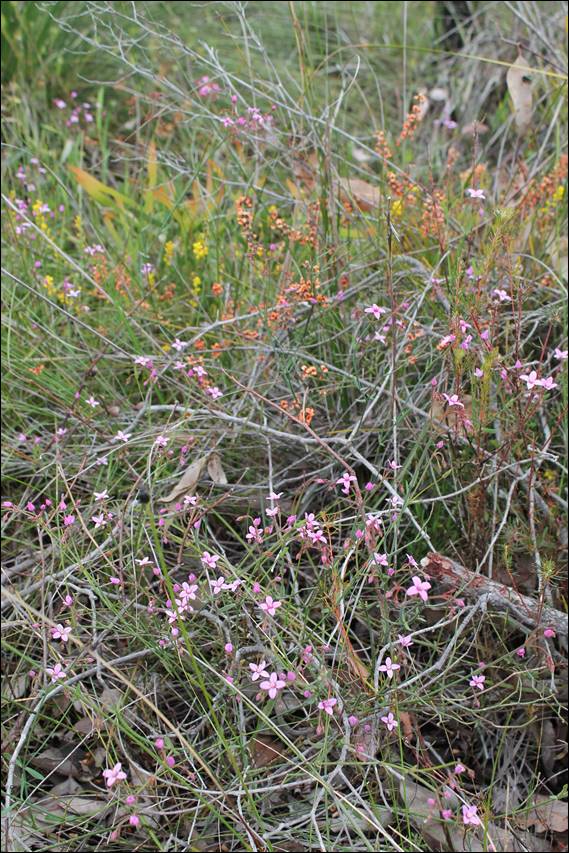
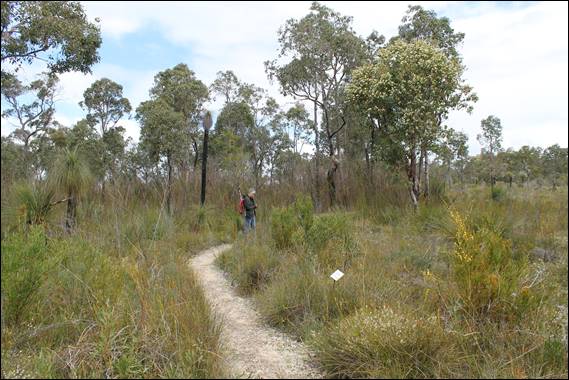
This image just doesn’t do justice to the spectacle we were lucky to observe today, again due to the size of most of the flowers the colour is mostly lost amongst the foliage of the vegetation. Lisa and I have been to the Ambergate nature reserve a few times, last year we came here in spring (https://sandbagged.blog/2020/09/28/flower-power/) and then winter this year. Today we fancied an easy wander just to get out of the house, and the lure of being so close to home, and Busselton so we could head to The Shelter Brewery on the foreshore afterwards, pulled us this way:
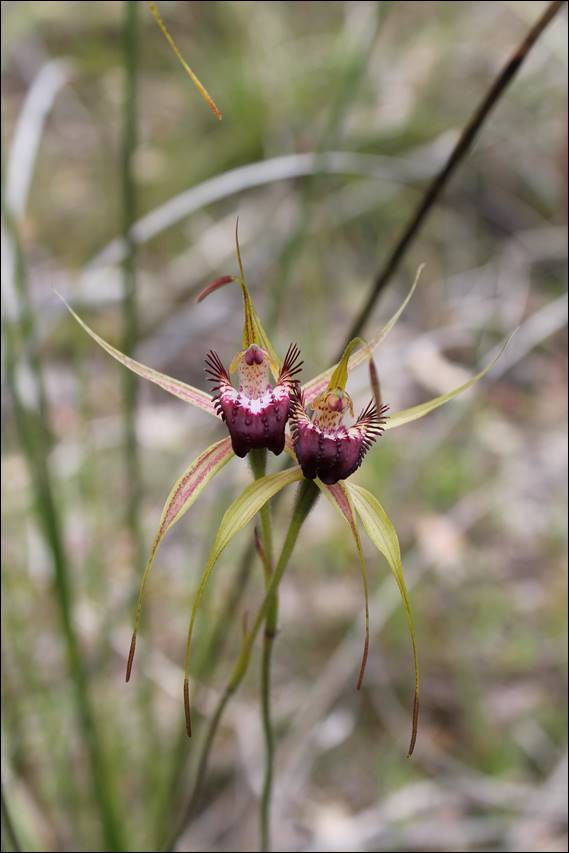
I went through my post from last spring to see what we found back then, and to avoid repeating myself. Also to see if I still felt like I had correctly identified the orchid finds from back then. I don’t think I did too bad last time, but there is one I reckon I got wrong that I will get to later. The first one we spotted was the most common here, obviously a spider orchid but which one. I flipped and flopped between a couple of species before deciding I had got it right last time. The petals and sepals are narrower and more clubbed than the Carousal Spider, which I thought it may have been:
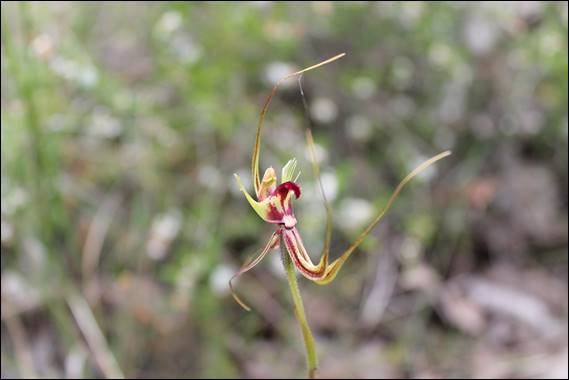
In addition to the above Karri Spider there were a few Forest Mantis out. While we saw heaps of Mantis Orchids down at the Stirling Ranges earlier this week, they were the Fringed Mantis that has a greener labellum that is slightly less pointy towards the end. The Fringed Mantis also has a larger flower that is generally less brightly coloured than this species. In addition the Forest Mantis tends to holds the lateral sepals closer together in a way that it looks like it is praying just like a mantis. I wonder if anyone will now go to my previous post to check if I’m right:
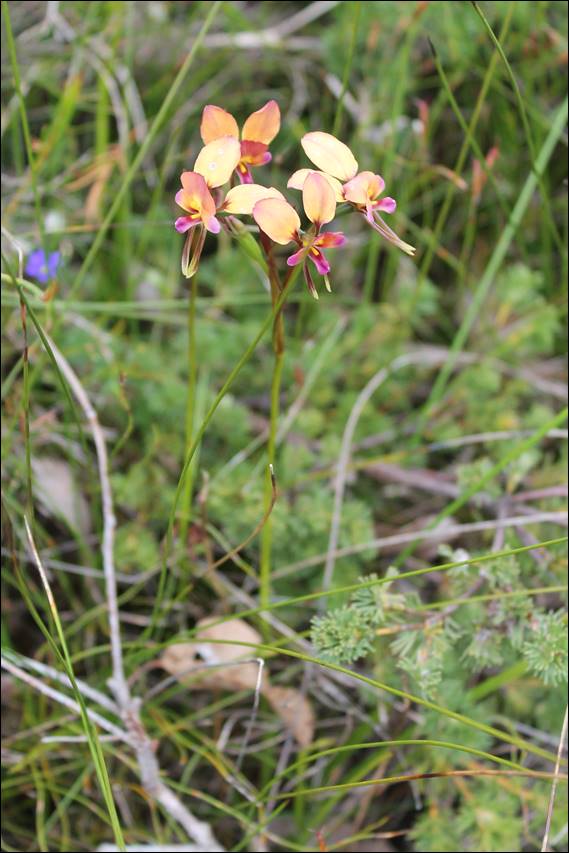
The next find was a small patch of Donkey Orchids, and while I seem to have included images of these in many of my recent posts these are yet again a different species. The bright mauve to purple labellum and labellum wings that graduate to a bright yellow in the middle and mauve ting along the broad ear like petals looked lovely when the sun hit them. This Purple Pansy Donkey has a smaller flower in size and also overall plant height and also has brighter colours than the Giant Donkey Orchid we saw in the Stirling Ranges. I mention that as the Giant also had purple colouring, so from a simple image with no indication of scale they could be confused:
Breaking away from orchids for a while there were a few other flowers that really stood out. Similar to the pink peas that we saw on our walk up Mount Magog, which I believe were the Painted Lady Legume, we today saw large purple peas. Don’t ask me why but because they are called the Common Hovea I decided not to include an image. Instead here is the Brilliant Yellow Flag, which was the flower that stood out the most due to its colour but also its size. It was the biggest flower we saw at up to five centimetres across:
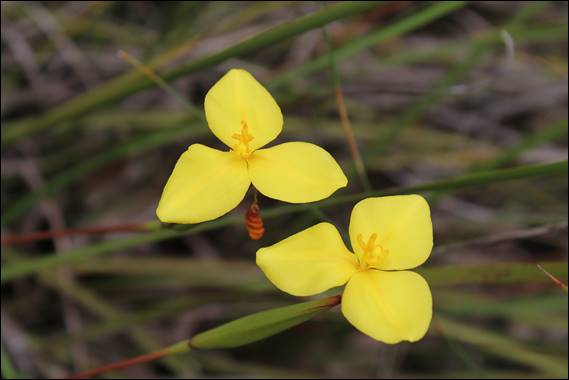
The above flower has a close cousin that we have seen more frequently called the Purple Flag, and when we first saw it I felt it looked out of place and may have been a weed. They are however native and indeed endemic to Western Australia. A perennial herbaceous plant from the iridaceae family and they certainly seem different to most that we have come across. The name iridaceae comes from irises that means rainbow, which makes sense due to the many brightly coloured variety. Part way round the walk is a creek and we sat here and watched a Nankeen Night Heron, that Lisa spotted fly from the water’s edge up into the trees. Too high and too far away to capture an image, so all you get is this picture:
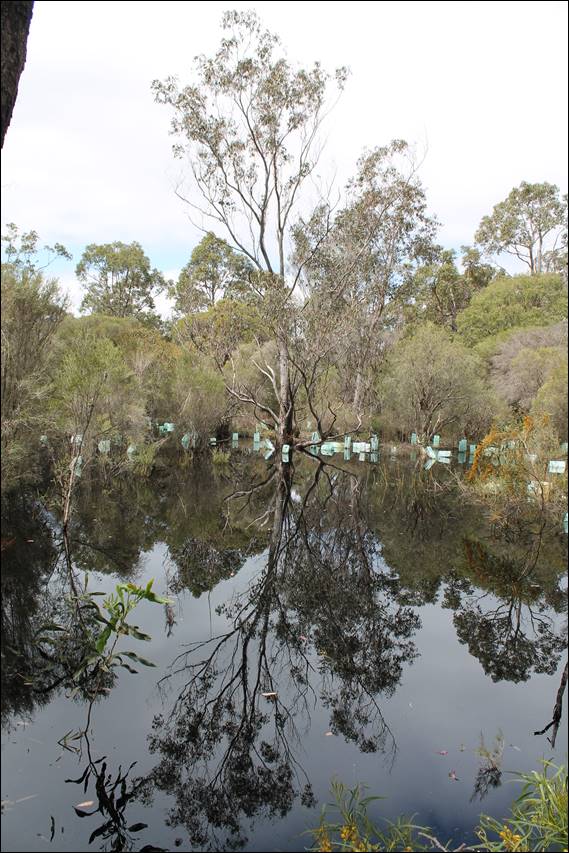
The area was littered with tree guards, some upright and still pegged in the position they were placed to provide protection for a seedling. But many had been dislodged and were scattered about, as if someone had been littering. This area had a lot of bare ground with no under storey, allowing pasture grasses and weeds to take hold. There had been a concerted effort to revegetated the area with natives, and the number of tree guards were testament to that. Granted it would be a hugely difficult task without very persistent and labour intensive weed control. This didn’t seem to have been happening enough and that, along with foraging kangaroos and rabbits, had resulted in what seemed to be a poor success rate in plants surviving:
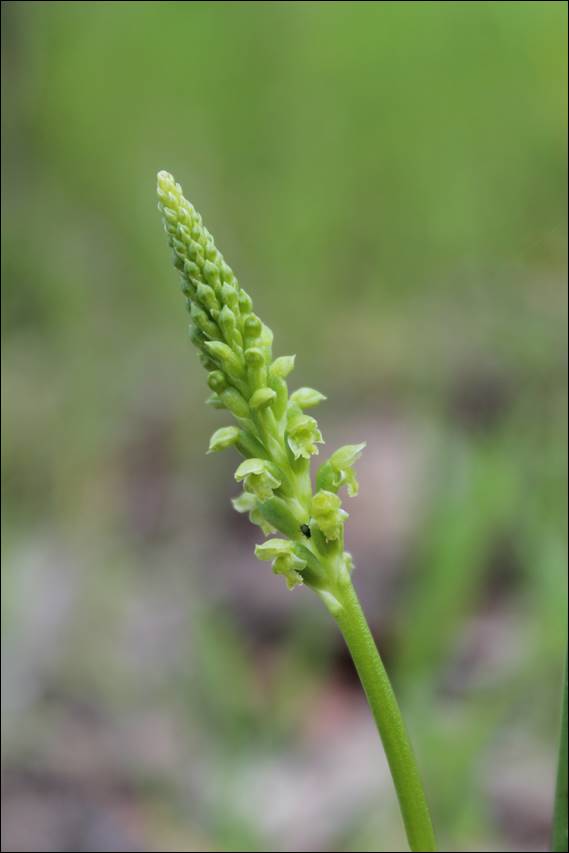
As we continued our walk we soon left the area that was sadly still being hijacked by the agricultural plants, that were been so successfully used on all four sides of this little nature reserve. Back in the native habitat we spotted a couple of Common Mignonette Orchids, above. When looking for orchids many people might just walk by these plants, with flowers literally only millimetres high. Indeed Lisa struggled a little with the variety of shapes and sizes of the orchids we were finding. As well as those shown in this post there were also Rattle Beaks, Purple Enamels and Cowslips but you will have to look at the post from last spring, linked above:
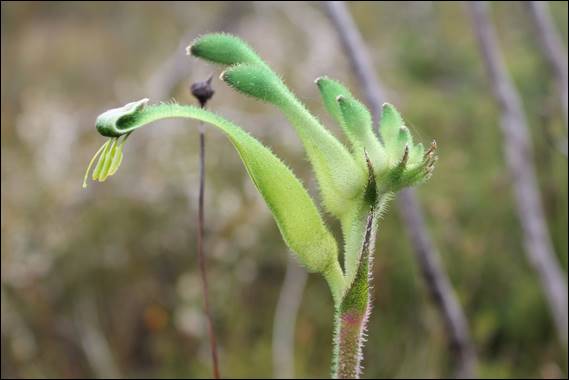
The other non-orchid that will get a mention is the Kangaroo Paw. Another plant endemic to Western Australia of which there are eleven species, this one being the green. The most revered is the red and green, so much so it was made the state floral emblem in 1960. While many people have them in their gardens native Kangaroo Paws are very hard to cultivate and have evolved to specific soils and conditions. For this reason hybrids have been specially breed for the purpose of gardens. I can’t recall seeing any other than the green, so will have to keep an eye out for them next time:
Lisa was getting pretty good at spotting the orchids as we went along, and on occasion out came her phone to try to identify them. Ironically, this is something I mentioned in my last post as a path I didn’t want to go down. This is the plant that started it and she wasn’t able to identify it. I’m not surprised at that for a couple of reasons. Firstly, and I only noticed this as I looked at the images back home, the clubs of the petals and sepals and also the apex of the labellum have been removed. If it had been an animal I’m sure they would have eaten the whole plant, so I find this very strange and as such possibly a deliberate act:
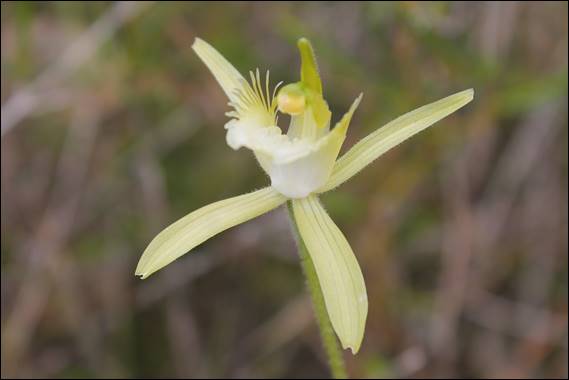
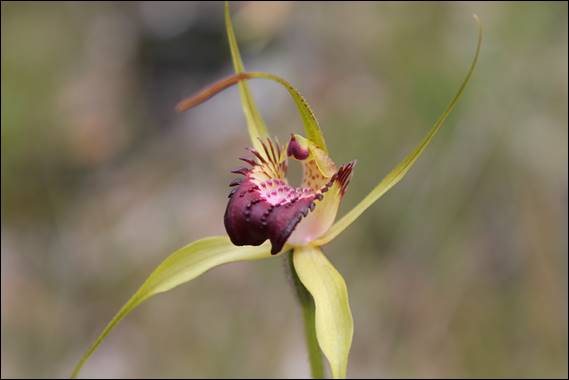
Secondly it is an unusually variant called a Lutea form, which means yellowish in colour or having parts or marks that are yellowish. The next difficult question of course is which spider orchid is this a Lutea form of. I feel confident in saying that we had observed both the Karri and King Spider Orchids, the former shown earlier and the latter shown below. So my guess is that this was a Lutea (yellow) form King Spider, and by all accounts it seems that these variants are quite unusual to find. It is just a shame that something or more likely someone had to deface it. There is one last image after this one and again it may be an unusual find, this one however has had me sitting on the fence and still does:
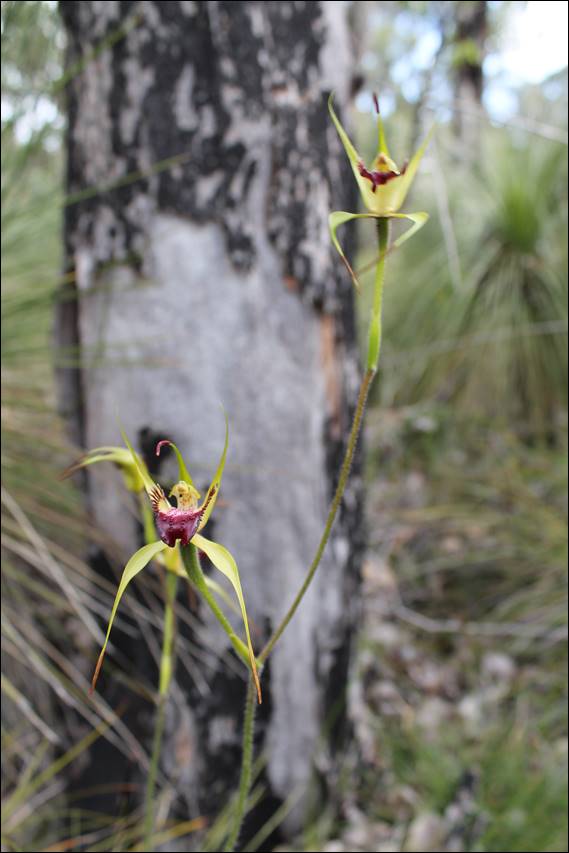
What struck me about this plant, and this one only, was that the plant was close to a meter high. In addition the petals were being held so strikingly upright and rigid and the labellum underside was green and not the white, both aspects unlike the King specimen above. I’m not sure if these observations are enough for me to be able to say this is a Carbunup King Spider, which is one of the tallest spider orchids with the largest flower. Last spring I identified one of my finds as a Carbunup King Spider, but now I’m sure it was a King Spider and you’ll have to go to my previous post to check it out yourself. If today’s find is a Carbunup King Spider I’m pretty happy as these are declared as Rare Flora under the Western Australian Wildlife Conservation Act 1950 and Critically Endangered under the Environment Protection and Biodiversity Conservation Act 1999. Either way shortly after this find it was then time for a well-deserved feed at the Shelter:
 Sandbagged