It was obvious what trees we might see today on our walk, when Lisa and I set off to check out the Bridgetown Jarrah Park, and they get a bit more of a mention in this post that previous ones. This place has a series of loop walks that it is possible to link together, and the information provided wasn’t all that clear making us think that if we walked all fours sections it would be a 12km hike. As it was it was only a 6km ramble but still very worthwhile and being a bit shorter it allowed us to slow down and look about a bit more:

There were certainly more Jarrah trees than others when we started, but both Marri and Karri trees soon started to creep into the landscape. And at various stages each of them took turns to dominate the landscape. The understorey was rich with species way beyond my knowledge, but what was heartening was the amount of healthy Banksia. During our walk in Collie and Ambergate the Banksia we saw was mostly in a dire state, and even at the Warren National Park it wasn’t looking that crash hot. Here however, it was in great condition:
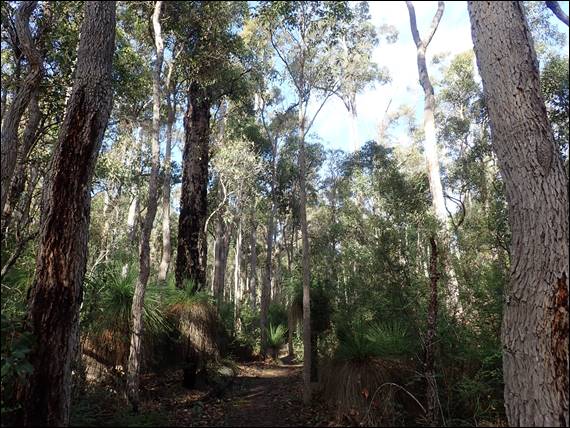
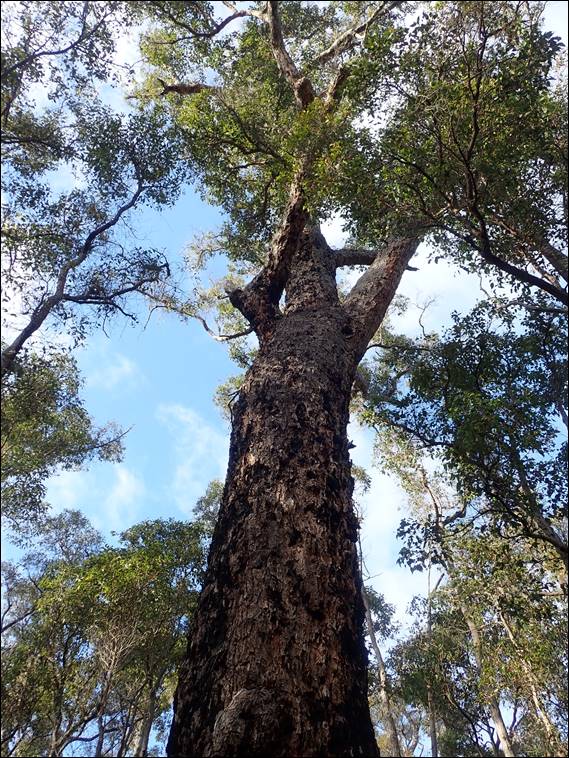
In my last post I promised you an image of a Marri tree so here it is, it is more akin to a Jarrah than a Karri from a visual perspective. I’ve only been using the bark as an indicator so far, but it is of course possible to tease them apart when you look at other elements such as the gumnuts they produce. The bark of the Marri is rough and splotchy, and it often has a dark sap oozing from the trunk. More on that later. The Jarrah has a dark, stringy bark and to my untrained eye a giveaway being the vertical groves making it look very different:
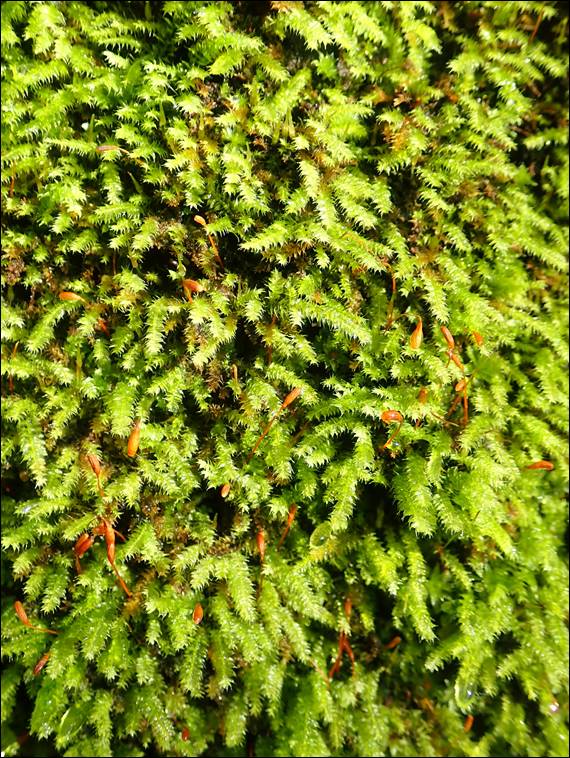
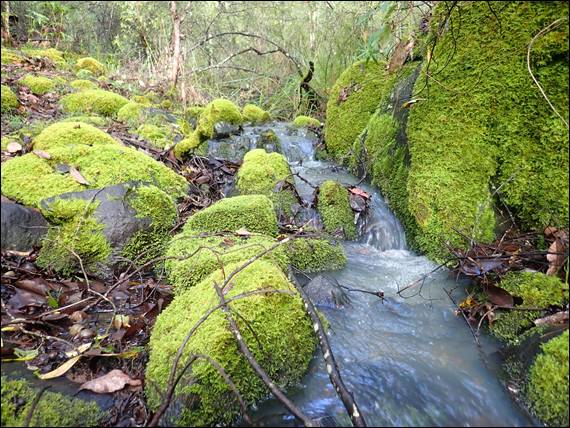
While these trees towering above us were amazing to walk through, something that really stood out today was all the lichen and moss. Not only on fallen trees, but also at the base of trunks and coating rocks. Bright creams through to vibrant greens littered the area on most ground surfaces that were not covered in leaf litter. The textures varied immensely, and it gave the appearance of a rain forest floor in some areas. Looking up close the intricate leaves of the moss was great to see, and in the image below you may get an idea of scale by checking out the water droplets:
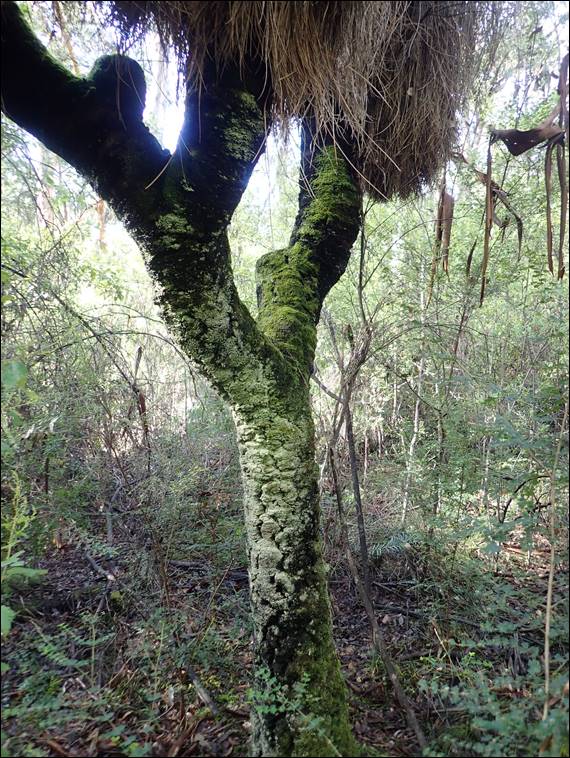
The moisture in this area was such that even the grass tree trunks where blackened and covered in lichen and moss. In the walks to date these have mostly had clean and dry dark brown trunks, but here it almost looked like they were mouldy and were being adversely impacted. This obviously wasn’t the case with the plants as a whole looking in healthy condition, it was just the trunks that exhibited this poorly look:
For all types of eucalyptus the bark dies each year, and it depends on the type of bark as to how this comes off. There are over 700 species of eucalypts in Australia, but roughly speaking there are only two types of bark. These could be described as persistent rough and smooth barks, for the former due to the thicker more ridged nature the bark doesn’t fall off as easily and it tends to accumulate in a stringy mass on the tree itself or can flake off in large sections. While the smooth bark tends to peel off and tumbles down to the base of the trees and litters the floor, such as these Karri trees:
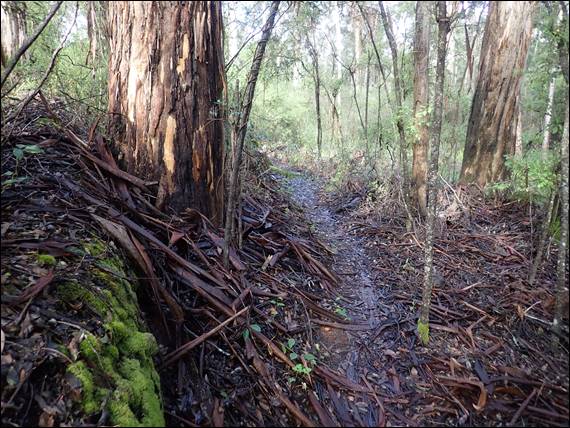
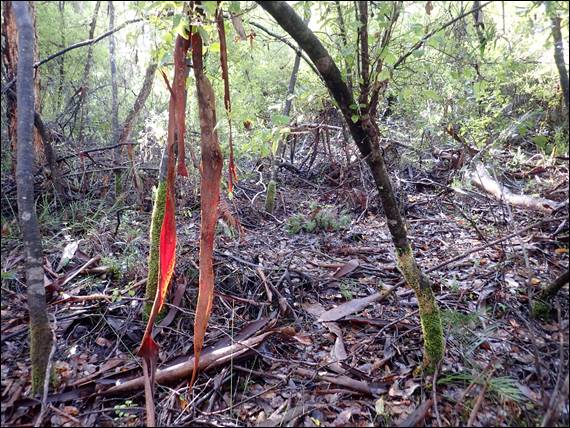
Karri trees bark can be grey to cream coloured or pale orange, and comes off in long strips like ribbons. As it falls not only does it litter the floor, seemingly smothering any growth, but it also gets caught in any understorey and it looks like someone has come along and toilet-papered the place. Being thin when the light catches these natural hanging ornaments their colours come to life. Today the sun was mostly out and when you caught the angle right the strips lit up beautifully:
There was of course plenty of fungi to find, many we have seen before and so we could be a bit more selective of which ones I would stop and spend more time examining. These red mushrooms really stood out. Many of the ones we find have different coloured stems, caps and/or gills. But every part of these ones were completely red and I’m going to take a stab that because of this they may be Red Brick Laccaria:

The four loops of this walk followed a creek line. This based on our walk last weekend, with creek crossings fully submersed, made Lisa was a little nervous. Even more so when she read that sections of this creek would include water cascading over rocks in winter. Images of needing to wade through the water on slippery rock was in her mind, but she needn’t have worried as the creek was tiny in comparison, and at each crossing it would have been possible to simply step over it:
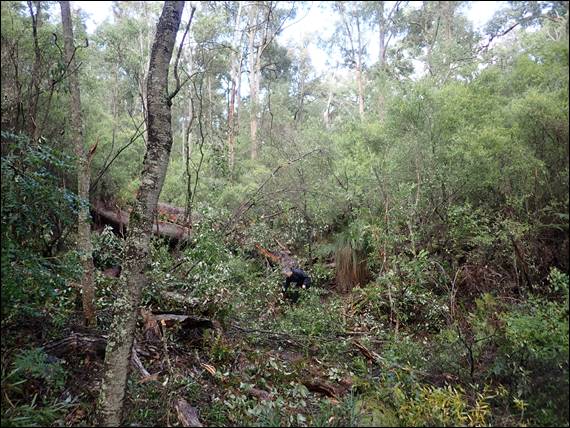
This was to our benefit at one crossing, where the path had been completely engulfed by a huge fallen tree. The area was completely covered in large broken branches, obscuring our vision of what lay beneath. The extent of the debris was so far that it wasn’t possible to see where the path continued until you had worked your way part way through the fallen timber. We managed to get through this section with no incidents and no wet feet:
Even though it had dawned on us early on that the walk would only be half of what we expected, we still stopped for a cuppa several times. Afterall there’s no point in lugging all the food and a hot flask of tea along if we weren’t going to occasional stop and enjoy it. This gave us a chance to sit peacefully under the canopy above us with the creek gurgling over the rocks nearby. And while the forest here wasn’t alive with bird song the all the time, we were on occasion serenaded not only by the birds but also the frogs:
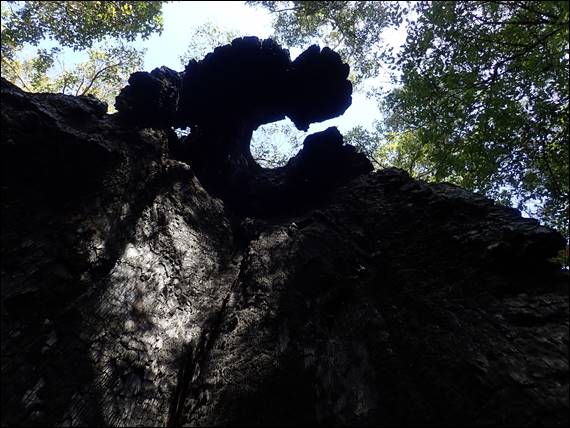
Taking a slow pace was important to not only appreciate the big stuff but also to look for the little things. The track was just that, a goat track being narrow and windy, and we were often ducking or weaving to avoid low, fallen or broken branches. Walking single file, we attempted to keep one eye looking for obstacles, one watching all the trees and scenery, and a third on the ground. Well seeing that isn’t possible for one person, between us we managed to observe all three:
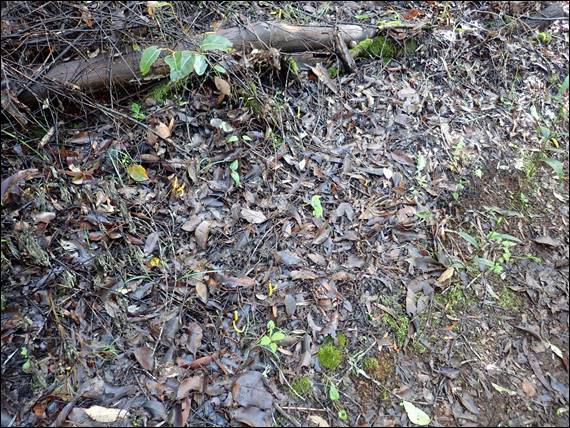
As an example, in the image above Lisa had noticed the flecks of yellow but had passed them thinking they were more recently fallen leaves starting to yellow. I however thought they looked strange, stopped to check them out and found them to be a small and unusual looking fungi. A brilliant yellow single strand standing up to 50mm high, and they were in clusters of no more than three strands. That made me think this wasn’t a Coral fungus, which will usually have multiple branched strands tightly clumped. Nor was it likely to be Earth Tongues, as I wasn’t aware of them being brightly coloured:
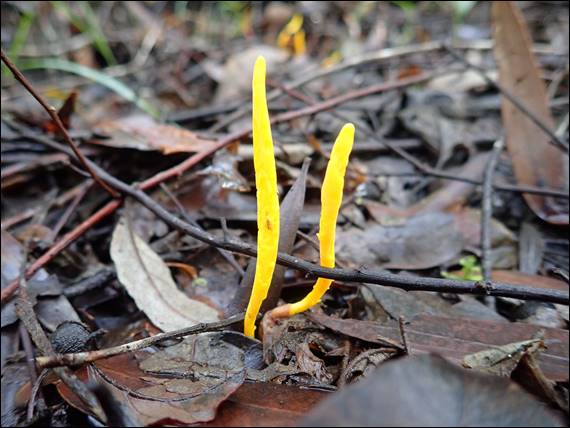
So I’m going with Scotsman Beard, but I’m not one hundred percent sure of that as in doing my research I feel like they are mostly found on trunks and not growing straight out of the ground like this. We were not only puzzled by some of our small finds but also the trees. On this track many of them had signs to let you know what they were. The one Lisa is admiring was labelled as a Blackbutt, whereas with my very untrained eye and only looking at the bark I would have gone with a Marri. I became even more confused later when Howsie told me that Blackbutts are more alike to Jarrah than Marri trees:
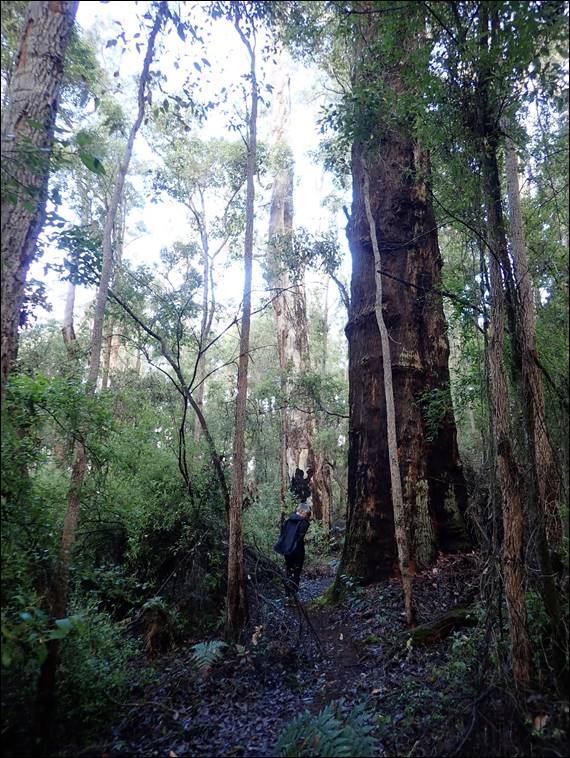
Rather than get bogged down in all that, as I am getting well out of my depth with this we shall move on. And as the sign in the image below rightly says, here is a fine specimen… of a Jarrah tree with it’s rough bark and deep vertical groves. The leaflet from last weekend reliable informs me that these grow up to 40m, whereas Marris can reach 60m and Karris being the big brothers reach a lofty 90m. This one certainly looked to me to be way over 40m, but the leaflet does qualify the height by saying up to 40m in poor soil and lower rainfall areas. And this area had neither of them:
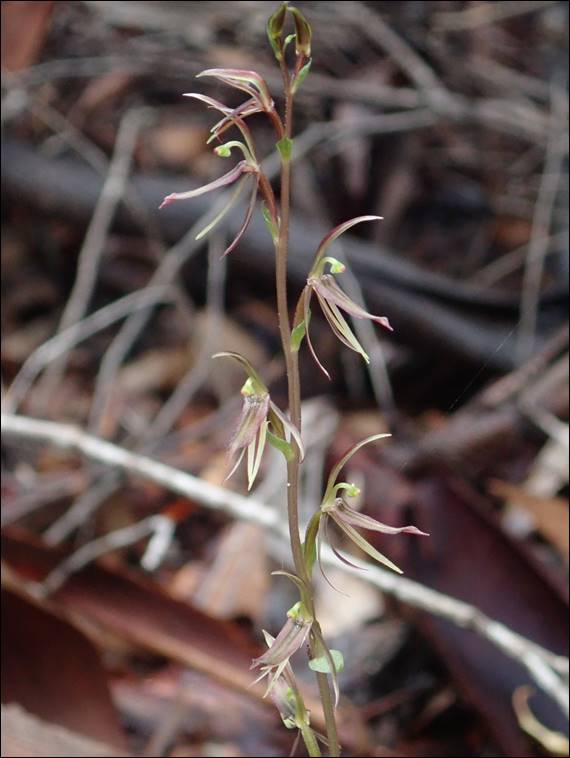
As we strolled along I came across a completely unexpected and new find. I had heard that due to the wet winter some orchids were already starting to come out, several weeks or more earlier than usual. And I’m pleased to say that while I didn’t expect to find any today, I was wrong. The distinct attributes of an orchid flower were evident, but I wasn’t able to identify this one until I got home. It is a Midge Orchid, of the Cyrtostylis genus of which there are five species. Three of which are found in Western Australia, the other two being the Mosquito and Gnat Orchids:
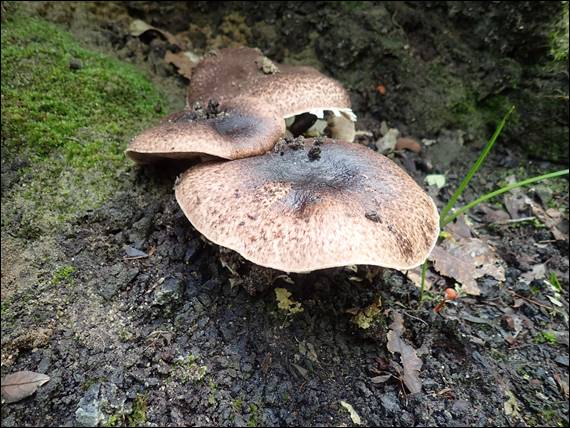
We also found the Banded Greenhood Orchid, which I now know isn’t unusually at this time of year being one of the earliest orchids to flower. It was however pretty to see a small colony of them ground on top of a large fallen trunk, of which there were a great many. Where the root ball of these fallen trees had ripped up the earth it was a great place to spot fungi, with these being some of the biggest mushrooms we found with 15 to 20cm wide caps. I think they may be of the Rhodocollybia genus but that is a bit of a wild stab in the dark:
Not all the fungi specimens we came across were in great condition, and this one in particular I liked. Most of the ones that looked in poor condition were either due to age or damage from being trampled on or have had branches fall on them. This one however had been partially eaten, and we can only assume that the juicy part was the top of the cap as the gills had been left exposed round most of the edge:

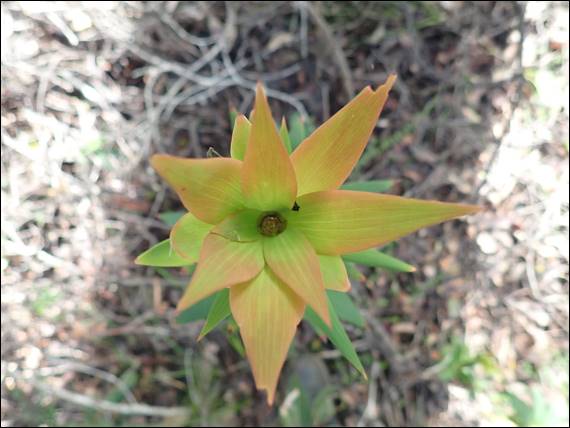
There was one plant that we saw that just didn’t look right in this landscape, and we pondered if it was a type of protea that had been introduced. However, from this single image Howsie reckons it is a Tassel Flower or as he called it Leucopogon verticillatus. The fleshier appearance of the leaf just looked out of place to us, but I have read that it is often found in gravelly lateritic or granitic soils and in wetter areas, which summed up this area perfectly. We’ll have to come back in a month or so to see it in flower, as it is supposed to be beautiful:
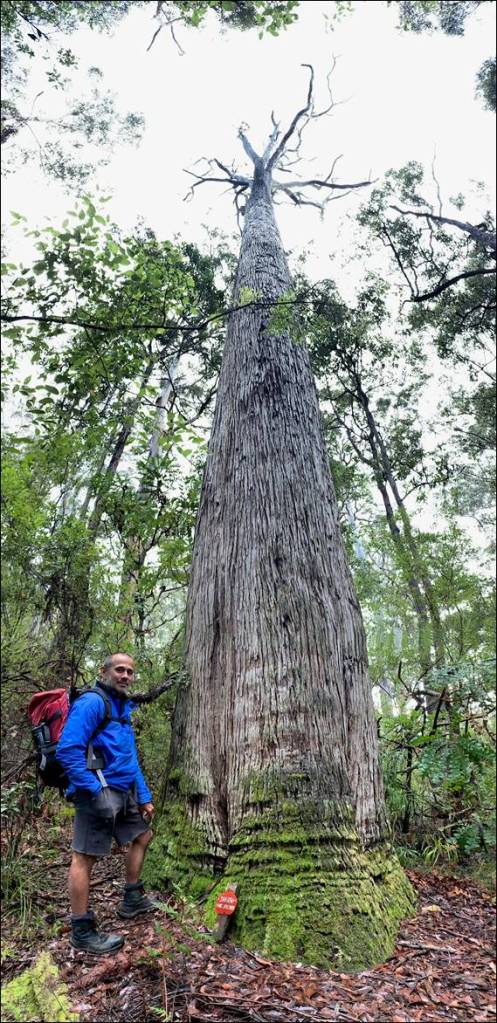
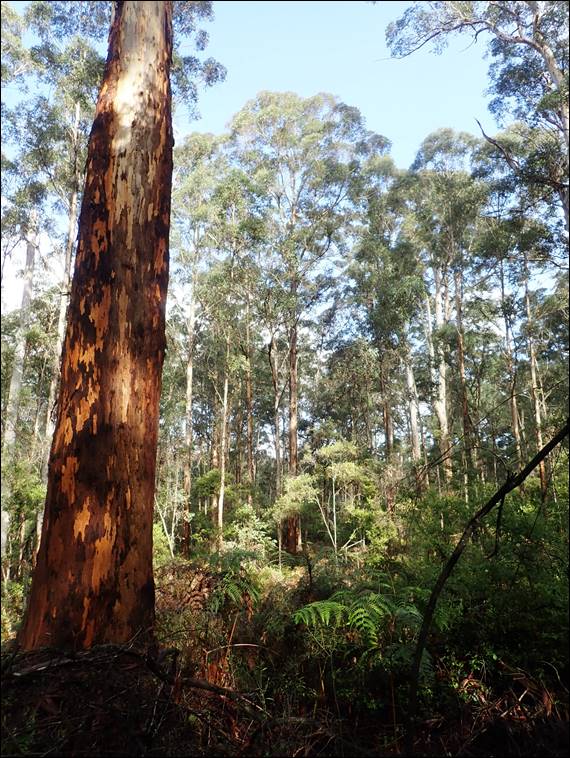
The real stars of today’s walk were however the trees, the track meandered past some huge ancient trees. I’ve read some can be up to 400 and over years old, one Jarrah tree in Armadale near Perth is estimated to be between 400 and 800 years old. The track had initially followed the small creekline in the valley floor before then traversing up the side of the shallow valley allowing us the spectacle from both below and then above. I liked this image because the sun came out and lit up the stripy bark on the Karri giving a hint of those grey to cream and pale orange colours:
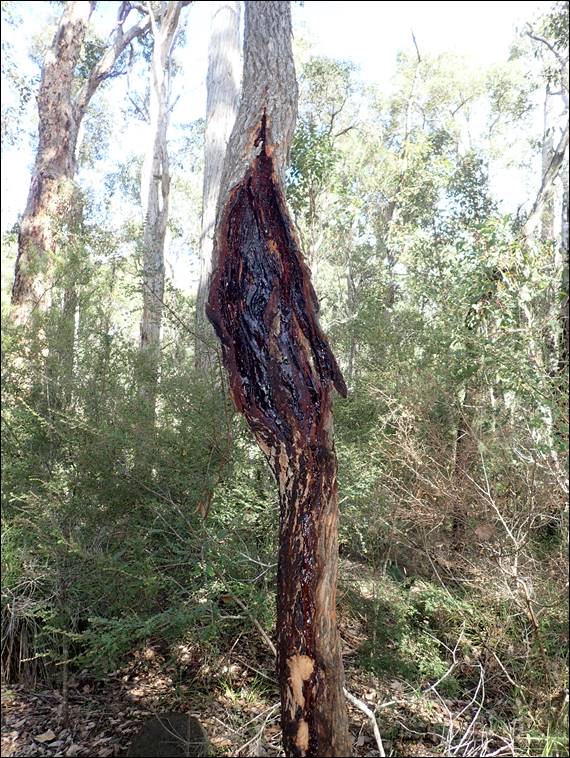
Now it is time to go back to the Marri trees and as I mentioned before they often ooze a dark sap, Lisa said to me that it made the trees look sad. This red sap is called kino and contains tannin. Kino has been used for medicinal purposes by aboriginal people, and also for dye and as a preserve for animal skins by Europeans in the early 1900s. The tree however uses it just like we use blood, exuding it as a protective response against any physical wounds where the bark has been damaged, including by insects:

One last image from our walk, and this looks a bit gross so sorry. It looks like someone has literally ripped this small trunk open. No amount of kino is likely to heal this injury. The injury on this tree bears the hallmarks of a canker disease that is known in the South West to be contributing to the decline in Marri trees in some areas. It is caused by a pathogen called Quambalaria coyrecup, and sadly once symptoms of canker are visible the tree is unlikely to recover. Like before I am however struggling with my tree identification, as the bark on this one indicates it is a Jarrah not a Marri:
 Sandbagged