Friday the rain came down in torrents and it was all very uninviting, and they reckon Monday there will be a bigger front coming. But the weekend promised two reasonable days between the big storms that have been bashing the south west of Western Australia. So Lisa and I decided we would head out while we could to give her hiking boots a more robust test. Today we headed up to Wellington National Park, with the intention of heading to a lookout that we had not been able to get to last time due to controlled burns that were being undertaken:
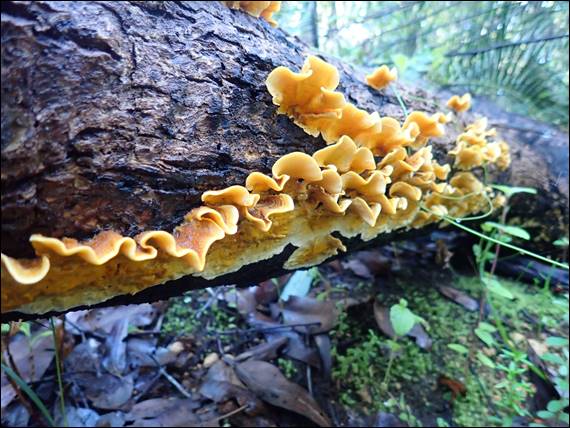
We parked up and were on the track by midmorning, I had promised Lisa to keep a steady pace and not get too distracted. With all the rain this place would no doubt provide a bounty of fungi for me to check out, and we were not to be disappointed. Almost immediately they were jumping out at me and I was on my knees checking out the colours, textures, shapes and sizes. After my post last weekend Verity had sent me a field book of the Fungi of the Perth Region and Beyond, so this time it felt like I was armed ready to be able to identify a few:
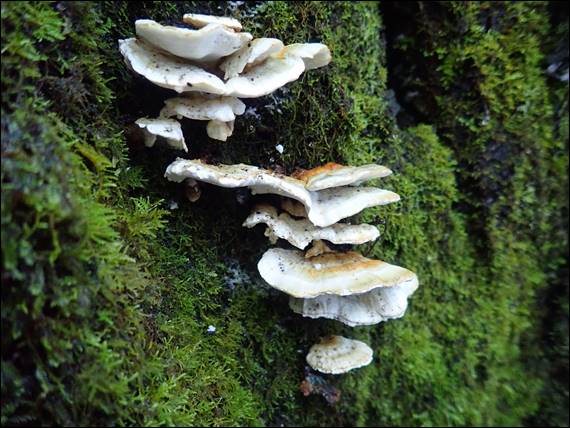
I hadn’t taken the field guide with me, that would have been a big mistake and we wouldn’t have got more than a few kilometres. I did however endeavour to keep in mind the important features, ready for when I got home to start my research. However, despite my best endeavours I can safely say that identifying fungi, compared to fish is a complete nightmare. I have done my best but am sure I have got some if not most wrong, with so many similar looking fungi out there it is hard:
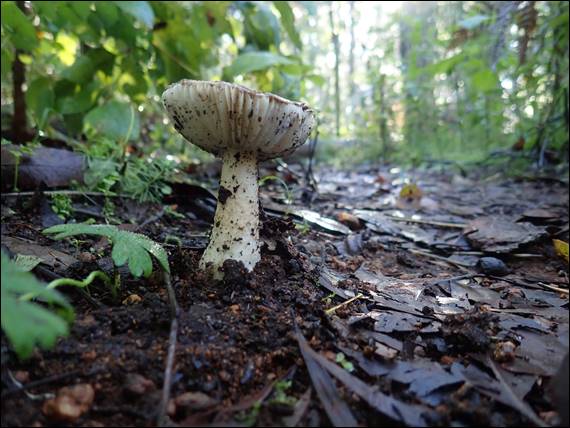
It was also hard to not stop every few steps, so many variety were out and I took way too many images. Conscious of not taking too long I often rushed and there were a few fungi in particular that looked amazing, for which the images sadly didn’t come out. While this post will have lots of images of the fungi, there are also a few of plants, birds, flowers and scenery slotted in as well. Lisa told me sometimes you have to stop looking at the detail and take in the bigger picture, and she is of course right:
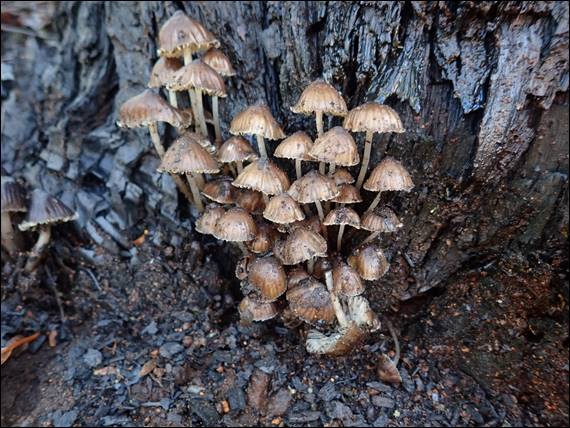
Starting with the first image of this post I think I found the Australian Umber Amanita, Hairy Stereum, a variety of Bracket fungus, maybe a type of Oyster fungus (above). The only one I can say with any certainty is the Hairy Stereum, the field guide has sadly not been all but useful in identify the others one. Then there is the image below, and I struggle to know whether it is a collection of Ink or Pixie Cap mushrooms. The similarity of so many species is incredible and I’ve failed to find out how to distinguish them:
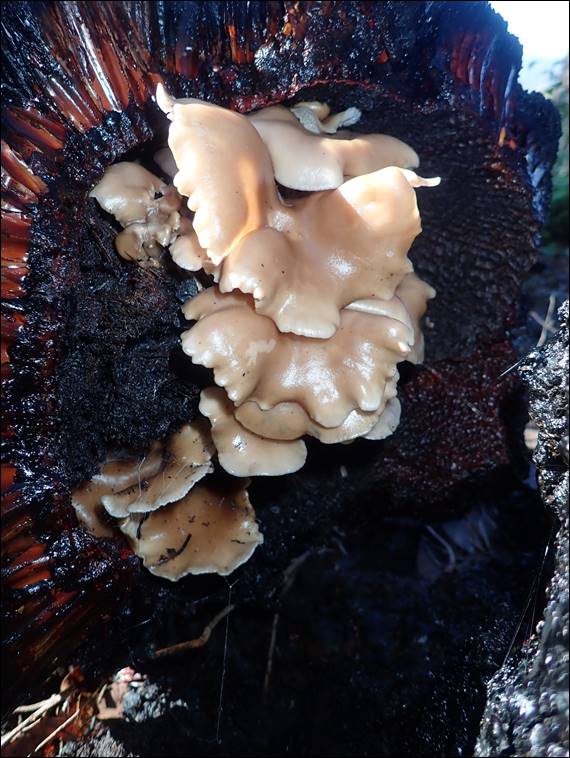
As we approached the lookout, which was only a few kilometres into the hike I spied a fallen grass tree. It had some jelly like goo oozing out of the fallen trunk, and I wonder if the goo was a residue leaking out of the dead plant or an infection that had killed it. Instead of providing you with an image of the goo, I have included what I found growing inside the broken trunk. Any amazing delicate looking fungus that was wafer thin, and I assume may be another type of oyster fungus due to the look and how slender it was:
The hike up to the lookout was the steepest and longest incline we were to encounter on our walk. At the top we rewarded ourselves with a small cup of tea and snack. Lisa made use of the bench nestled in amongst the trees, while I scampered round to take in the unobscured views. Finding a granite slab I simply had to check it out to see if it was worth considering from a climbing perspective. I’m not convinced with what I saw but I didn’t get too close to the edge as it was running with water a little slippery:
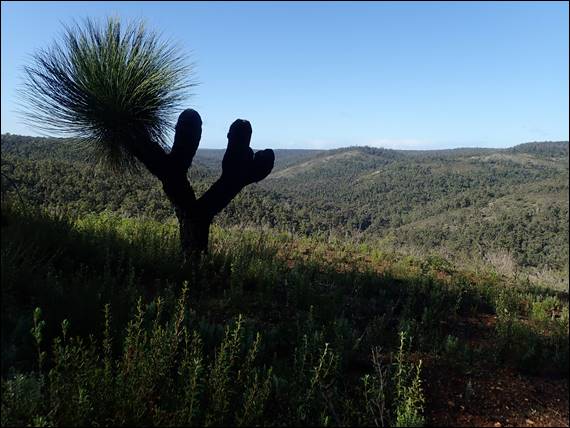
After a short break we hit the track, and the narrow path we had been following widened out into an access track. I tried my best not to keep looking down, and we kept up a bit more of a steady pace. The ground on either side comprised a relatively clear understorey with the occasionally grass trees, the taller trees overhead all looked charred and blackened from recent wild fires or was it from controlled burns. The evidence of the fires went high up the trees, in some cases tens of meters, which gave the indication the fire wasn’t so controlled:
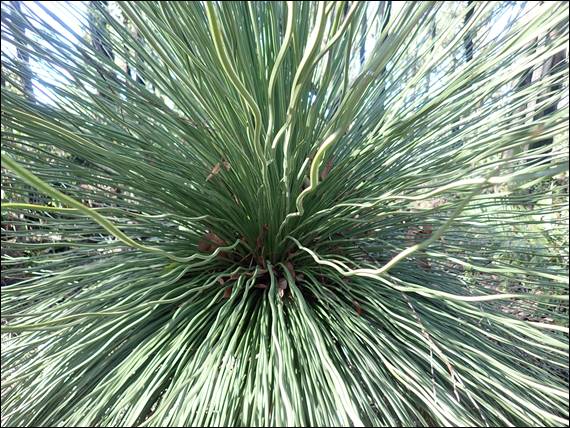
I included the above image as the leaves of this grass tree were all wavy. I can’t recall seeing a grass tree like this before, they have all had straight leaves even the smaller or younger grass trees. This one was a reasonable size the leaves stretched out a good half a meter in length, and I was unable to find a single straight strand. While the pace was kept up for a while I had to stop when I came across this strange fungus, like so many today it was the only one of this sort I found and it was very different:
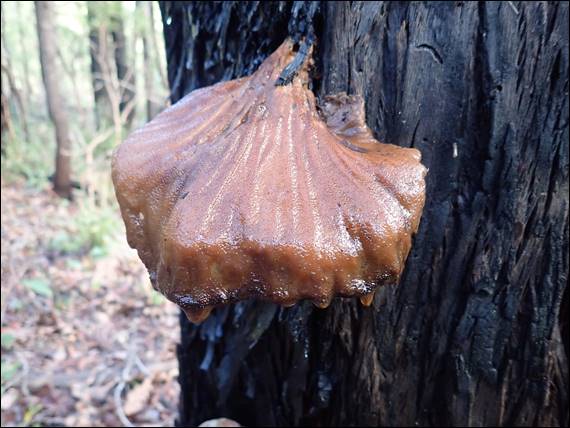
You’d think it would be easy to get a name for this one. Not only due to the very distinctive patterning on the upper side, but also when you see the incredible underside. It looks like it is rotten and dissolving, was it all the rain that was deforming it or is this how it naturally looks? It has to go down as one of the most disgusting looking fungi I came across, but at the same time it was fascinating to see and I think I spent more time checking this one out that any other one:
We carried on with our hike and despite being high on the hill we came across large flooded areas. Due to the open nature of the track and understorey, these were easy to avoid. I kept encouraging Lisa to test her boots, as they are reputed to be waterproof. But she was never keen and instead went to every effort to get round these areas, even after I splashed through them. I might add I was wearing my snow boots today not my sandals, and they held up just fine against all the water:

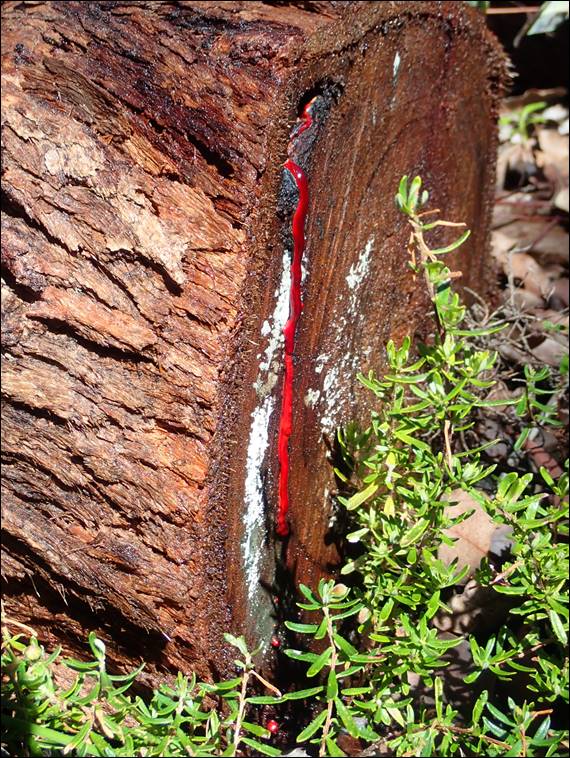
We came to a junction and had a choice, to complete the lookout circuit or to extend the walk and take in part of the trail we had done last spring. We were both feeling okay to keep going, and it was so peaceful in the forest that we decided to extend the hike. My stops were way less frequent now and as we got closer the reservoir and more well-trodden paths we came across many fallen trees, and just as many that had been felled. This large tree that had been cut down looked like it was crying brilliant red blood:
All the fallen and felled trunks provided the ideal habitat for fungi to grow or should I say fester. Lots of bracket fungi as well as colourful moulds grew on them, and when you looked underneath many cap and oyster fungi. This one was a really cool find, again like so many others I only one of this type. The perfect button cap making it look like a cultivated button mushroom found on the shelves of a supermarket. However, this one wasn’t smooth skinned and the slightly pink cap looked to have a woven fibrous coating:
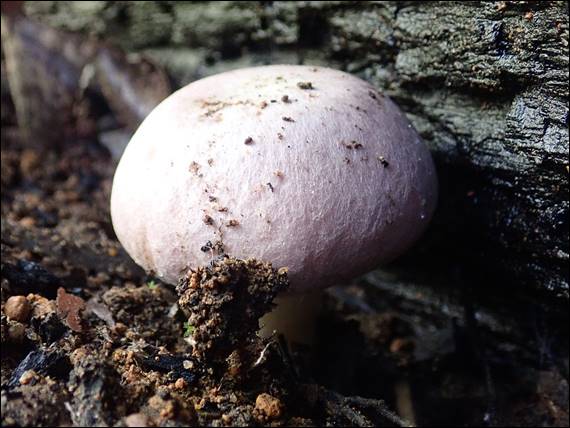
You’d think I could identify the above, but no chance! We marched on as it wasn’t time to stop for lunch, or whatever the time might dictate the meal should be called. I should say it wasn’t the place, as oppose to time. We had set our sights on getting to Potter Gorge campsite for out next cup of tea and feed, and eventually we got there. My estimated time of five to ten minutes was more like half an hour, and before we got there Lisa couldn’t hold out so she munged on a banana to keep her going:
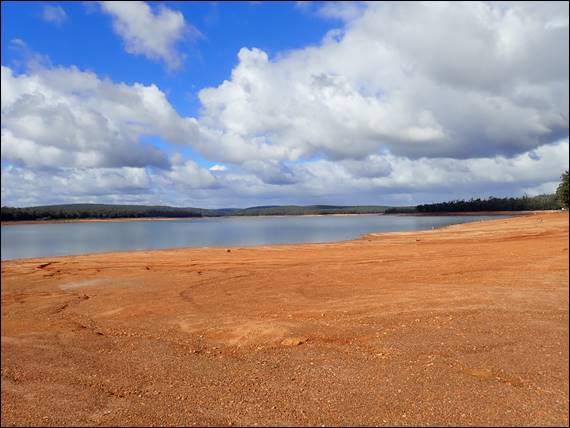
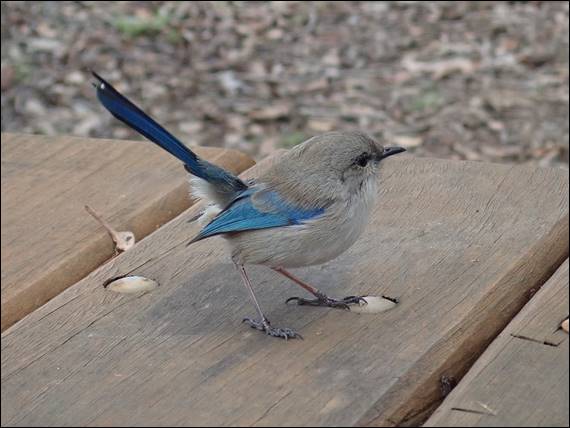
We again had a bench on which to dine, next to the reservoir of Wellington Dam. Despite all the rain we have had the water level was still very low, proving that we really weren’t getting that much. We just aren’t used to proper wet winters anymore. After we had finished feeding ourselves a magpie and then ten or so fairy wrens descended upon us, looking for tasty leftovers. Obviously very used to humans they joined us at the table, hopping about keeping one beady eye on the table for food and the other on us in case we made any sudden movements:
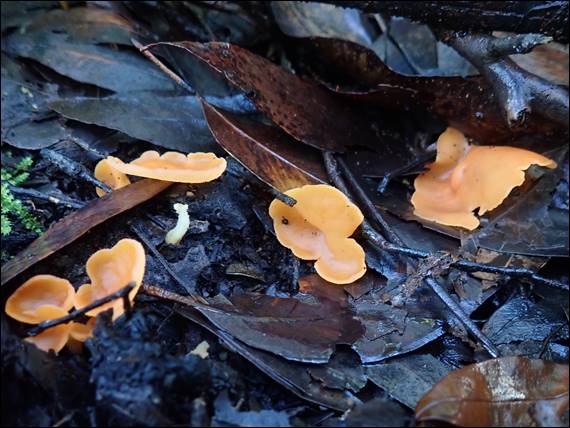
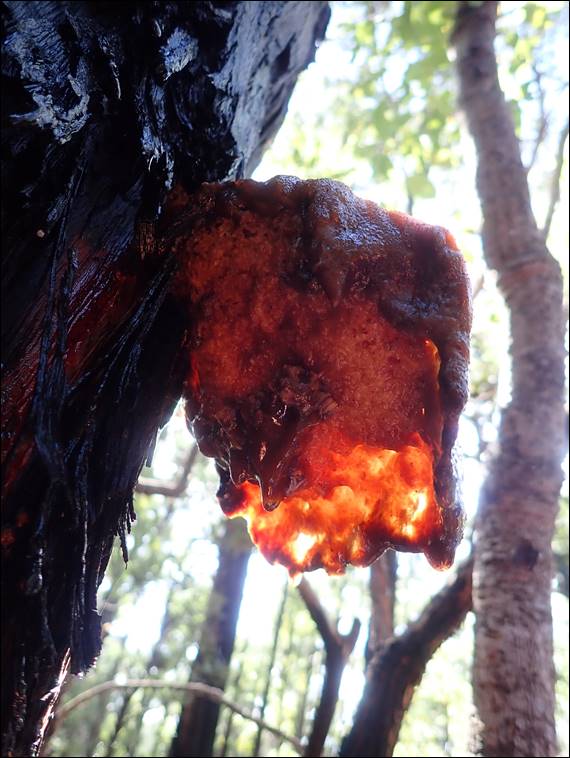
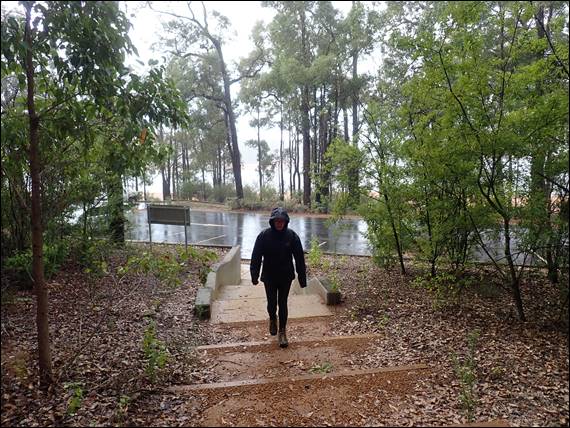
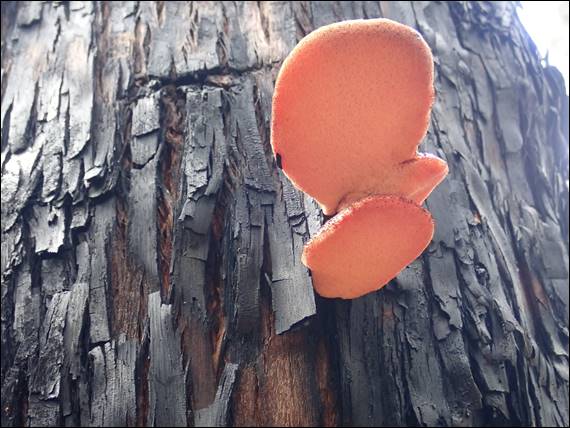
It was time for the next stage of our journey, which took us past the café near the quarry where I often climb. As we left Potters Gorge the rain came in, but we had a good six kilometres to walk still, so we didn’t look for shelter and just carried on. As we walked my eyes started to drift again, but the rain made me pass by many of would be treasures. The only one I really stopped for was the groovy Beefsteak fungus in the second image below, looking from below a little like a light and fluffy orange sponge cake:
The carpark at the café was heaving and people were milling about all over, which felt kind of strange after all the quiet solitude we had been lucky to have enjoyed. We didn’t hang about there and walked on to get to the next stretch of peacefulness. We trudged on as the rain lifted but made a slight detour before getting back to the walking track. Lisa had not yet seen the mural on the dam wall and seeing it was a mere hundred yards off our course I suggested we have a look:
The blue sky was once more upon us as we looked at the mural. It was bathed in sunlight, unlike all my previous images taken in the early morning as I made my way to the quarry for a climb. People were parking up and walking along the bridge to take it in, take a photo, and then carry on with their vehicular tour of the area. We didn’t join the crowd, instead looking at it from a far before returning back to the track to walk along the side of the Collie River back to where our car would be waiting:

We had walked this track before, last spring. This time the water in the river looked cloudy and green proving that there had been more flow as sediments were mobilised. However, despite all the water everywhere the river wasn’t flowing very fast, this is partly due to the dam regulating how much water goes down it. It’s only when the dam overflows that the river will act in a natural way, and that rarely happens. We have only seen that occur once in the fifteen plus years we have lived here:
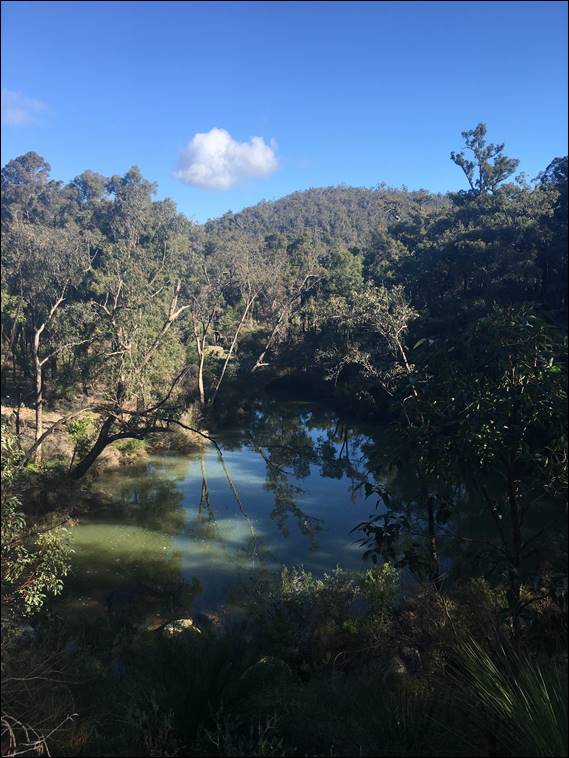
The track follows the river like a rollercoaster as it goes up and down over the valley sides, the river is ever present on your left and where is cascades over rocks to form rapids the sound rises up to greet you. Then in the open long pools silence fills the air again. This silence was only broken on the occasional time we came across birds, we mostly saw fantails and red breasted robins. In the distance the ever present red tailed cockatoos could be heard, and earlier in our walk before Potters Gorge we had come across them in the trees. Providing a stop that wasn’t instigated by fungi:
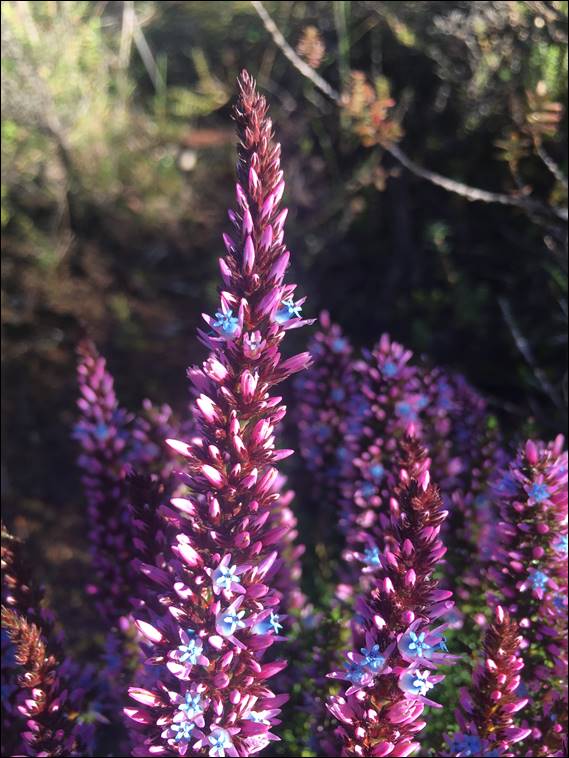
In the valley there seemed to be more flowers out. These purple flowers resembled the heather that Lisa and I were so used to in England. Interestingly when we got up close and where the purple petals had opened up there was a small blue flower inside. There were more flowers to observe and marvel at, even though it is winter, but I’ll wait for another time to include images of them. For now back to the fungi, and here is an image looking up at a great collection that were in burnt out grass tree:
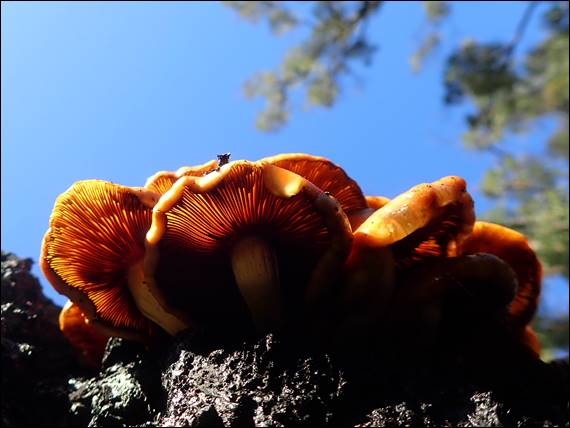
I’ve looked in a few guides and on the web and they could have been a few variety including Golden Tuart Cortinar or Marbled Death Cap, very different indeed! You may be pleased to know that I kept a safe distance from all of my finds, I didn’t fancy touching any of them especially the gooey and dripping ones. The valley felt more green and lush that the higher country we had been through, and in places looked to be glowing. Even more so when the sun came out:

All this greenery was possibly being kept so vibrant by the continual supply of water. The track was cut into the hillside and quite often we came across water pouring out of the steep sides. The hillside was saturated with groundwater, and it flowed fast and freely. There were also locations where surface water cascaded down the depressions in the steep valley sides, like little creeks forming waterfalls. What a contrast to the last time we walked this track on a dry and hot spring day:
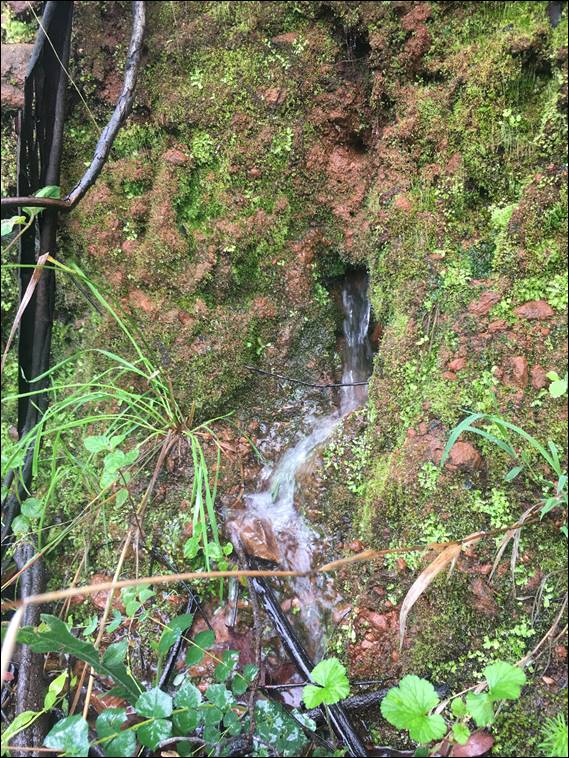
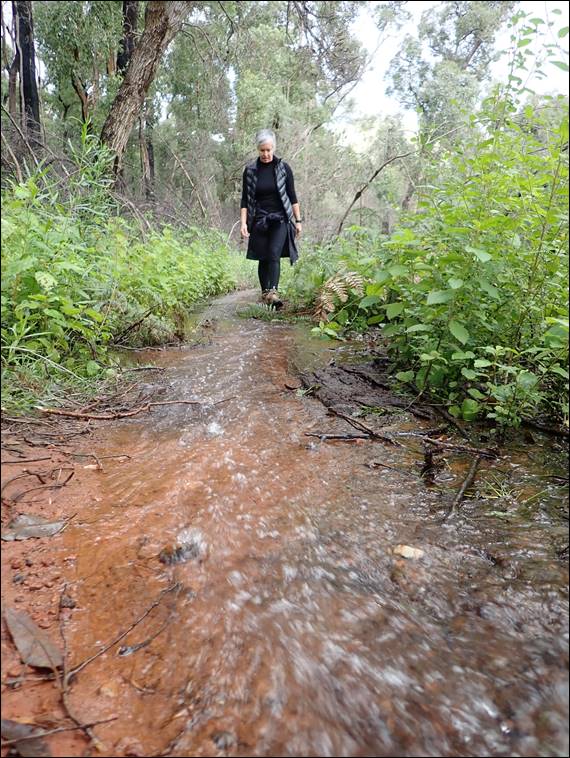
On the last leg of our hike the water was often running down the path of least resistance, the track itself. Pouring from the hillside onto the open ground and then flowing until it reached a low point to allow it to flow down towards the river. Some of these continued for a hundred meters or more, forcing Lisa to test the boots to see if they were waterproof, and they were. In this image you may also notice the broadleaf saplings on the side of the track, they certainly didn’t seem native and it was good to see they were only in isolated areas:
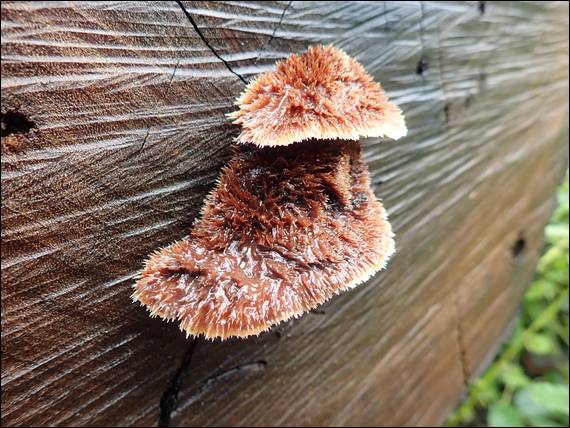
I have to include one more image of a fungi, this one was a bit bizarre and I’ve sadly not been able to identify it. The spikey upper side is so distinctive, so hopefully I’ll get a positive identification using QuestaGame. I’ve flooded the app with fungi images, but as yet none of the ones I found last week have been verified. They may get sick of me when I load the next ten to fifteen from this trip. Equally if I carry on like this you may too get over it, but based on comments received on my post from last week I don’t think that will happen:
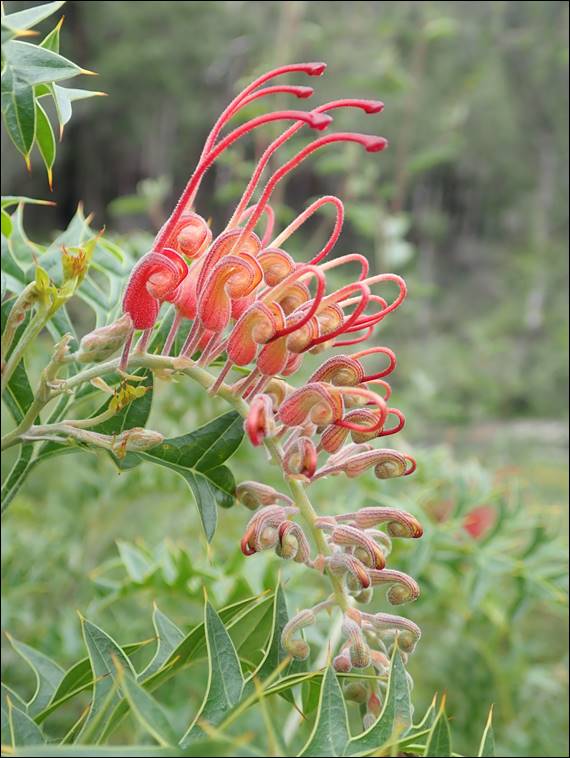
I was going to include a Dusky Helmet mushroom but decided instead on finishing with this Grevillia to shake things up. Also to get you excited about the next instalment of Lisa and my walks, when I’ll focus on the flowers. I do need to report that Lisa’s boots passed the test with flying colours. Being both comfy for her fused big toe and waterproof. Our walk today was just short of twenty kilometres so not too tardy and took in all the things that would aggravate her toe including a long steep incline, rocky terrain and steps so a real good test:
 Sandbagged