In case you were wondering why I had not written up a post last weekend, it wasn’t intentional. What was intentional was not getting out for a climb, but I had hoped for one last snorkel near Castle Rock. The water would probably have been OK there, unlike at our local beach where the water is turning blue-grey. For many reasons the snorkel didn’t happen, and now it is probably fair to say that my snorkelling season is over until later in the year when summer starts to return. While Autumn maybe the time when my snorkelling ceases, it is however the best time to head down to the Stirling Ranges to climb:
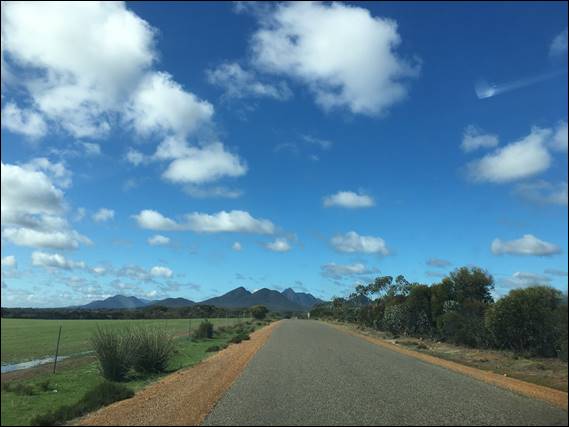
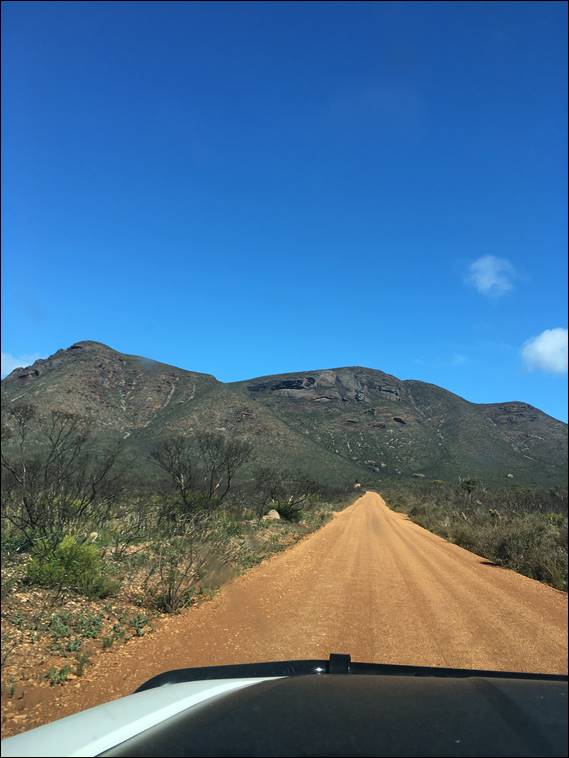
Howsie and I had been talking about a trip here in Autumn since last year, and the weekend was finally upon us. This was one of the reasons I had not been out climbing last weekend. As the Stirling Range trip approached we nervously watched the forecast I often wondered if I should have climbed last weekend. It was looking wet and as we drove down the roads were showing signs of recent rain and the salt lakes that should be dry this time of year were filled with water. All those negative thoughts were put to one side as we drove up the final gravel road to the carpark at the base of Mount Trio under a clear blue sky:
Our big day was to be on Saturday, but if you are going to drive all this way you might as well make a bit more use of the time here. So we had organised to meet Kym at Mount Trio at midday Friday, and he rolled into the carpark no more than minute ahead of us. We had a quick bite to eat before we hauled the packs up the access track. The track is steep with steps that feel to high leading up the side of a gully. You then cross the saddle and to get to the crag you need to climb almost to the top of Mount Trio. It’s exhausting work with a climbing pack and we were all feeling our relatively low levels of cardio fitness:
Our aim was to climb at the Mount Trio crag proper. I say that as low down near the carpark there is a boulder that has a number of sport routes on it. Fun but a bit short and the rock is also very flaky, so flaky that the routes seems to be different every time I have climbed there. The real crag sits high up and I have only been here once before, with Dan. But I can’t find any images of that trip and maybe it was before I had been documenting all my adventures. As a result of that previous trip I wasn’t holding out much hope for this crag, Kym was however psyched but then I thought to myself when isn’t he:
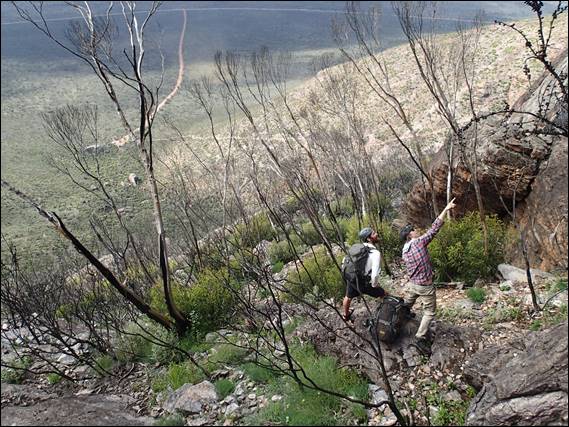
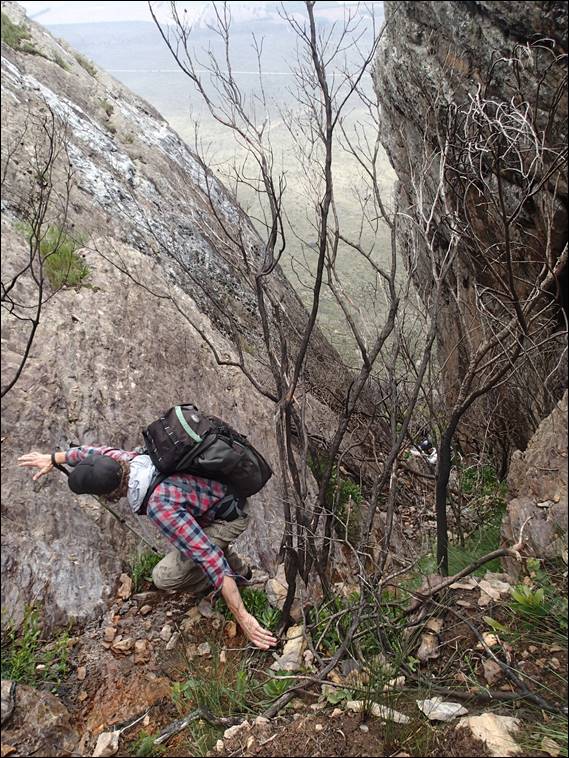
Dan and I had rapped in from the top and only climbed on the upper tier, the reason being that the climbs there were lower grades. And the grade 19 and 20 we had done were OK but nothing special. If anything they were a little inconsistent and even scrappy, so might thoughts were still on the less excited side. Today we didn’t rap down, Kym took us down the gully. As we scrambled down we had to be careful to avoid the wetter rock and slippery mud, as water trickled down the same way we were heading. We stopped part way down, and from here you could see the right-hand end of the upper tier:
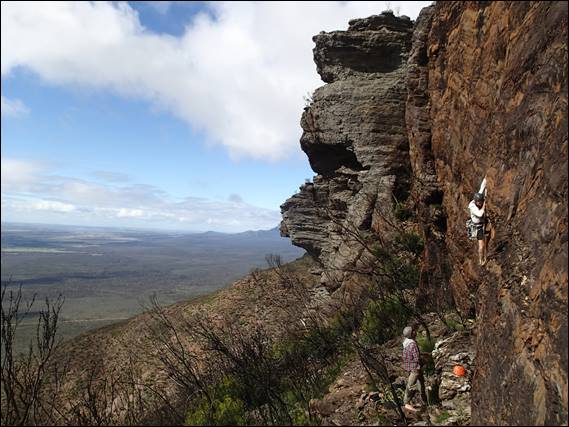
There Kym pointed to two new lines and they did look good, far better than the two lines at the far left-hand end that Dan and I had climbed. After pondering about those routes we continued down and finally found ourselves at the base of the lower tier. The bush was still recovering from the fires just over a year back, and our clothes were blackened from remains of the former scrub. Underfoot we trod carefully to avoid the new scrub that was starting to sprout, small and delicate patches of green slowly bringing a spot of colour back to the landscape. It is sad to see what has happened, but amazing to see what is coming:
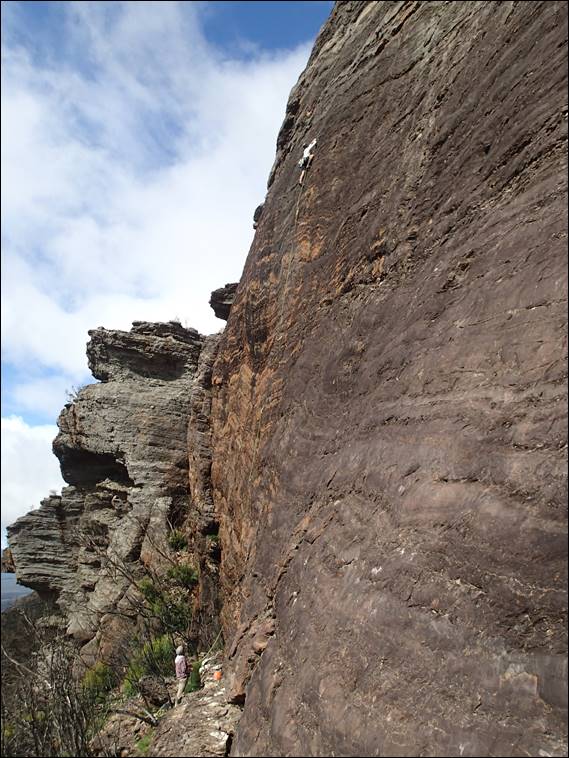
Climbing with Kym is infectious, Howsie and I had considered what routes to tackle as we drove down. Not surprisingly we had looked at the lower grade lines mostly on the upper tier, but Kym has a way of bringing out the best in your abilities like no one else I know. He isn’t over the top with it, but gentle yet extremely positive in his approach. That is how Howsie found himself tied in and leading Carpe Diem, a long 30m three star grade 21. For those who have tracked his grade 20 and 21 challenge over 2020 and 2021, will know that this is pushing his limits:

Yet Kym somehow convinced him it was a good idea, and I’m super pleased he did as Howsie on sighted the route. Climbing it in a controlled and smooth manner, even making it look easier than I found it as I led it. The rock offers small edges, some fingernail narrow, so you feel like you are in tension most of the time and unable to fully relax except for the one no hand rest I found (above). Kym decided to top rope it, as he hadn’t climbed on rope in ages, and we had to laugh and become inventive when it was obvious the 50m twin ropes weren’t quite long enough here:
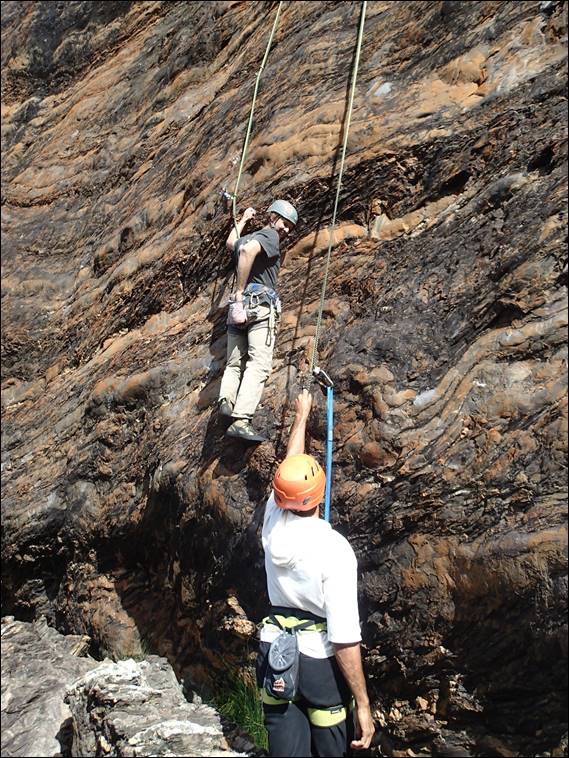
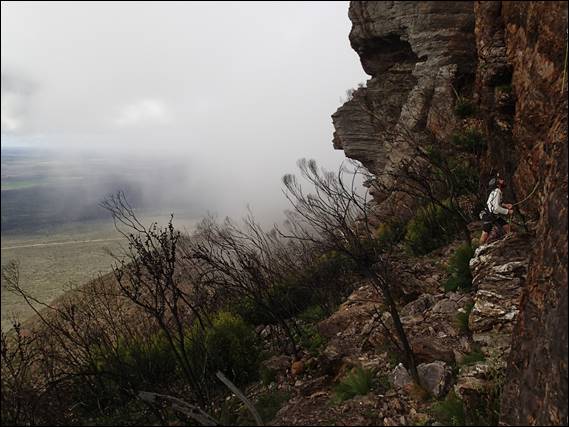
It was a great route, and super tricky at the crux. Very deserving of the grade, but the routes on the lower tier only got harder. No problem, and Howsie and I were happy or was it relieved, when Kym came back down of the first line declaring he was all revved up for leading Fuelling the Dancing Bear. Grade 22 and again three stars. Howsie belayed allowing me to run round the crag getting a few different images. As Kym climbed low clouds started to drift over the saddle we had crossed to the east. A few droplets came down as he approached the steepening section that had looked so imposing to Howsie and I:
We are still not sure if Kym was aware of the weather, he was fully focused and seemed to be working hard. Looking tired and fighting to keep any strength he could muster flowing to his arms, forearms and finger tips. Finally managing to surmount the off-vertical wall. Even then he seemed to be having to work hard. Eventually as the angle looked to ease he slowed down putting his head against the rock. Willing himself to keep composed and get up without falling, which he managed. Only to then ask if we were going to lead or second the route. Howsie and I stuttered an stumbled over our words, 30m below him, unsure of what to say:
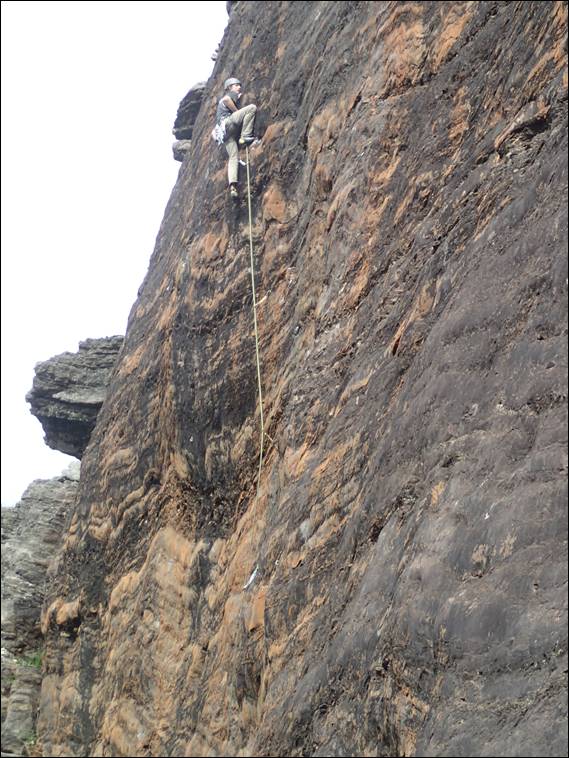
Kym whooped and raved about the climb, claiming we would be disappointed if we didn’t lead it, it’s a classic, you can get this one, and many more words of encouragement… so we both lead it. I went second and it was only just as I was starting that Kym began to hint at some of the tricky moments where he had only just managed to get through, without giving away any details. It was on from the start, blank sections with the tiniest of edges on near vertical walls led the slightly overhanging wall. Jugs Kym had mentioned and here they were until the top when they disappeared, making the exit powerful and long:
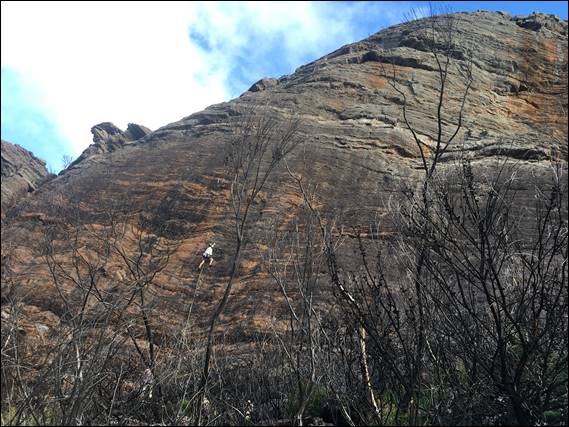
I almost fell off as I exited the steepest part, I could only just reach the small edges that you had to bear down on to haul yourself over. It was epic and continued like that for the full 30m. Like Kym I came down raving that it would get the full five stars in the Blue Mountains. Howsie also loved it, he looked to be moving faster than Kym and I had, making it look easy. It wasn’t till the crux move that Kym and I had almost not made that he stumbled. Finally getting up and super happy with the lead, also beaming with the quality of the route. Great varied climbing that really kept you on edge and guessing and working hard the whole way:
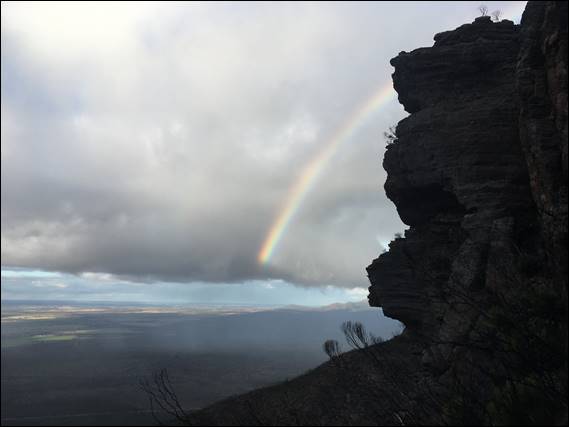
All my reservations about the quality of the climbing at Mount Trio had been well and truly dispelled. Kym started to encourage me to attempt the equally good looking grade 23 but while we had only climbed two stunning routes, time had caught up with us. The days are getting shorter, allowing for less daylight hours, and today it was easy to make the call and head down. But it was something that Howsie and I needed to factor in for our next day out. The image above was taken a mere 15min before the one below, it was a sign of how quickly the weather can change here and that was also something on our minds for tomorrow:
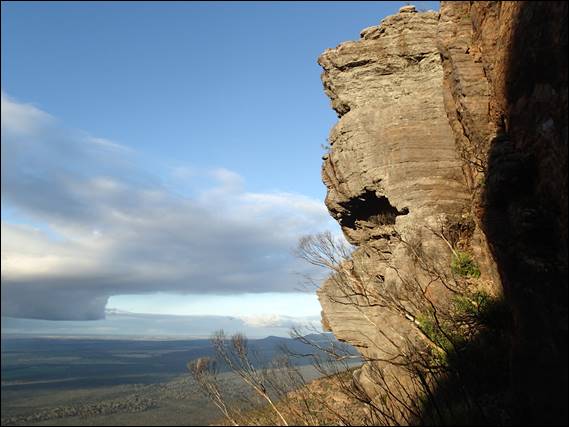
It was, as it always is, such fun catching up with Kym and while the climbing was done with for the day, we still had the walk out. Scrambling below towering walls from which water flowed over or seeped out of high above, showering down on us, all the while looking out at the magnificent views. Ahead we could see the track with its countless high steeps that our legs, or more importantly knees would have to endure. There is no rushing in the big hills, and it is certainly not all about the climbing. The walk in and out is equally part of the adventure and this trip had certainly started with a very big bang:
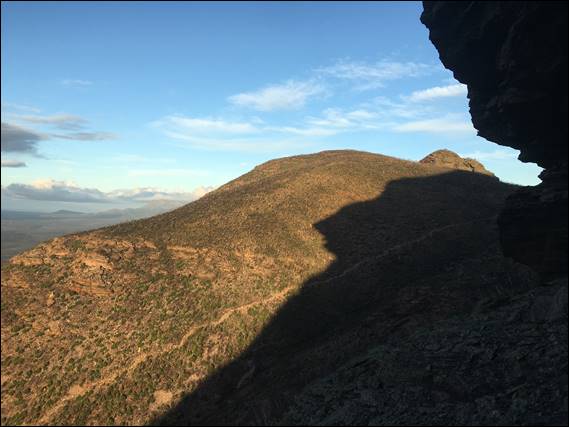
On most if not all of my climbing trips to the Stirling Ranges I have camped at the Mount Trio bush camp, and I can’t talk this place up enough. This time however we didn’t, and I can only hope that John and Margot forgive me for not even popping in to say hello. Instead we stayed at The Lilly, which is owned and run by Howsie’s wife Nadia’s grandparents. Not only owned but built by them, quite literally brick by brick. It has been a place I have wanted to check out for a long time so the offer of a bed, hot meal and shower was just the icing on the cake:

I’ll tell you a little bit more about Pleun and Hennie’s stunning place at the end of this post. For now all I will say is that we rocked up there as light was fading and we were warmly greeted, had a beer thrust into our hands and hot food placed on the table in front of us. There we sat chatting as I took in the amazing collections all over the place until the beds were calling us, or more so me. Howsie and I still had to sort the gear for the next day so we didn’t hit the sack until 9:30, with the alarm set for 4:45. We both had a restless night’s sleep, possibly due to the task that lay ahead:
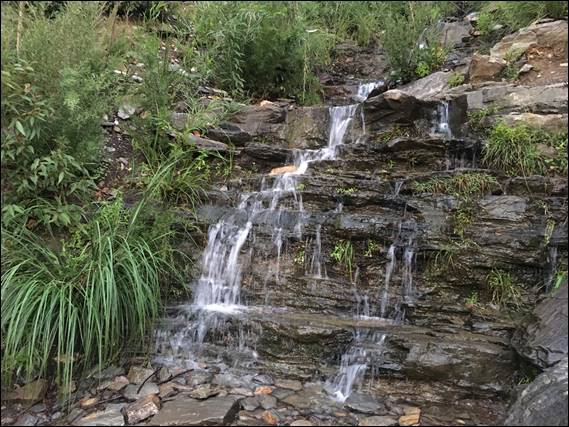
We rose, got a brew on, made breakfast, made another brew and then got ready to head out. The early wake up was to allow me a couple of cuppas before heading out, it was only a 20min drive to the carpark of the mighty Bluff Knoll, the tallest peak in the Stirling Ranges. We arrived soon after 6am and there were heaps of cars already there. We had been told that over the last year this place had become very popular, not only in the daytime but also for people to hike up to watch the sunrise. As we approached we could see the beams of torchlights, as people plodded up the 3.1km trail to the summit:
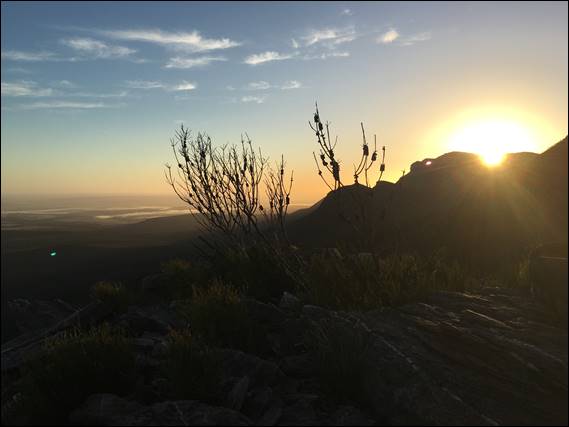
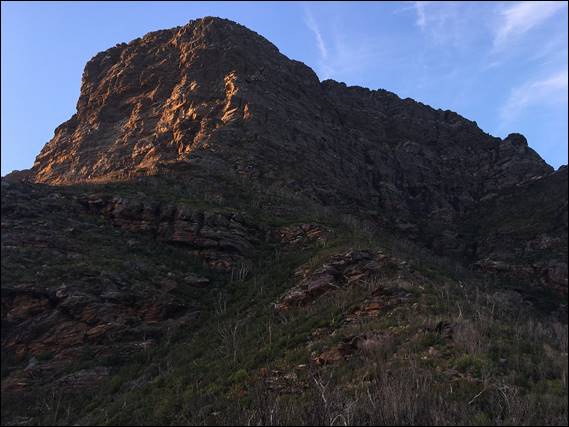
We started up the summit trail as first light hit but only followed it for a sort period. Once at the gully, which was flowing with water from the recent weeks of rain we headed up a goat track. This took us steeply up the ridge towards the towering north face. Our legs were feeling yesterday’s hike up Mount Trio, the summit trail had felt hard but once we hit the goat track it got steeper and harder. The sun crept over the horizon and the impressive face lit up, while we continued our upward trudge on ever tiring legs:
We had donned our harnesses and helmets, and had worn our warmer clothes. While it had been cold when we started, we were now far from cold. Sweat dripping off us, but we continued as we were. There was no room in the rope bag I had, nor the small rucksack Howsie carried. We had to take everything we took with us up the climb, so had packed light with the heaviest items other than ropes and climbing gear was the three litres of water. Despite that the bags felt heavy, puling us down as we worked our way up:
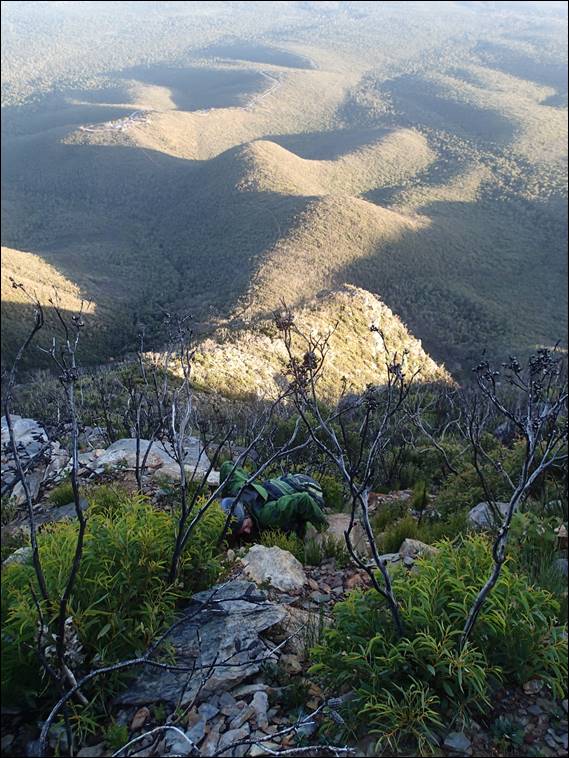
Finally we were at the base of the cliff, looking back down the last remnants of fog on the land below us could be seen. The rising sun had been burning it off gradually, and now only pockets remained. As we had driven in the dark we had encountered a lot of mist making it hard to see what lay ahead. We had intensified our stare, as if that would make us see better and allow us to spot any roos that might jump out. We also wondered if the face would be shrouded in mist making the conditions damp:
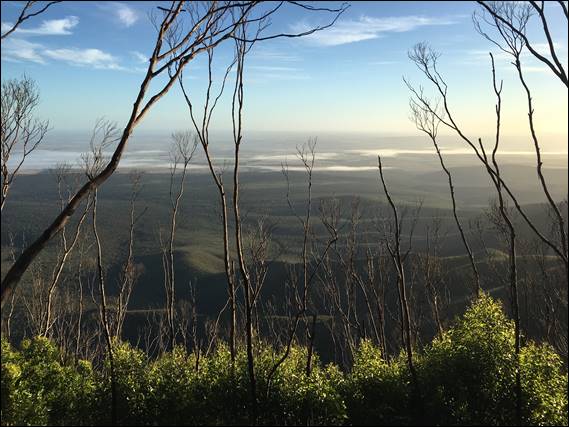
As we ascended the road leading up to carpark the mist was left below us and we were happy to see a clear sky. Standing below this mighty wall, it was pretty intimidating looking up. High up the face the path seemed to be blocked with huge roofs, making the thought of a grade 14 route seem highly unlikely. Howsie, knew otherwise. He had climbed Hell Fire Gully many years back with Dazza, and this helped with route finding which can be challenging here. At least we knew we were at the right place with the initials HFG etched into the rock to tell us so:
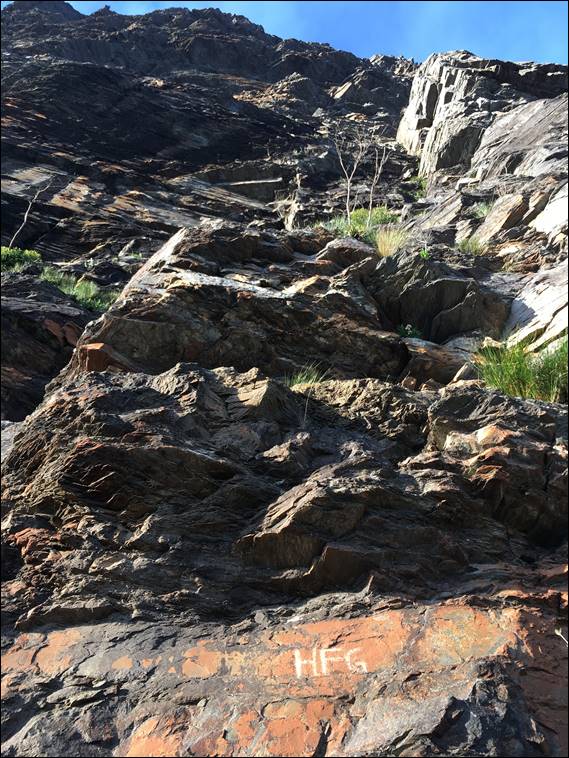
Six pitches and 250m of climbing lay ahead. I’ve attempted this route twice before, once in 2006 when my climbing buddy from the UK came to visit. Gareth and I loved the big mountains and weren’t afraid of epic days, but as I said route finding can be challenging here and with no prior knowledge we got off route and bailed. I’m not even sure if we ever got on route to be honest. The next time was with Dan, the day after we had climbed on Mount Trio, on that trip the crag was shrouded in mist and the wind was howling. The rock was dripping wet and while we found the line we got less that ten metres up it before we knew it was a crazy idea to continue and backed off:
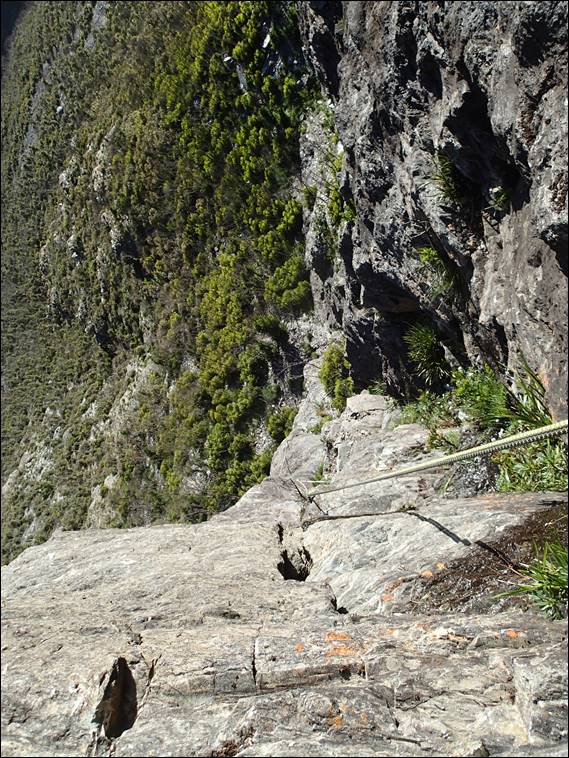
Today we basked in the sunlight. Howsie reckoned pitch five was the primo pitch, one he led the last time he climbed it. So this time I would have that pitch, meaning I would kick off proceedings on pitch one. That would allow us to leapfrog as we worked our way upwards, I’d lead the odd pitches and Howsie would take the even numbers. The rock was dry and felt great but the gear was small and spaced, similar to what I recalled from my one and only time of making it up Bluff Knoll which was with Rongy when we climbed Right Anti-Climax. To add to the excitement there is a high chance of coming across loose rock on the Bluff:
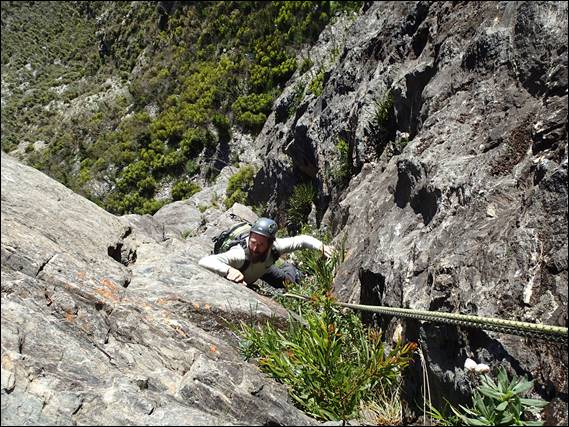
As such every move was made with purpose, careful and calculated with slow movements well thought out. It had me on edge and I was definitely feeling nervous about what lay ahead. It’s only a grade 14 route, but when the gear is so spaced and the consequence of a fall is so high things change. You climb in a more intense way, being ever conscious of the risk. This in turn slows you down, makes you check things with a lot more care and ultimately makes a grade 14 feel harder than it really is. The only way to avoid this is to climb these routes more often, get used to the rock and become familiar with what to expect:

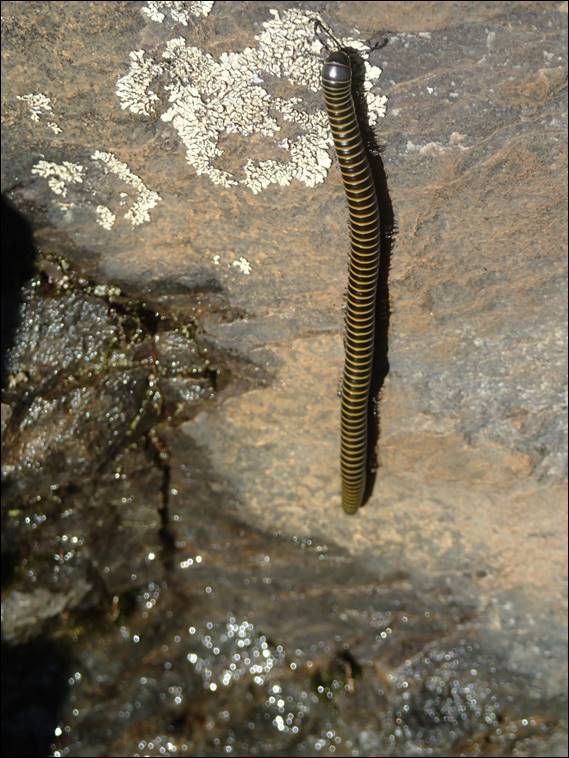
The belay perch was OK but felt a little insecure, or was it my nerves and that I just needed to settle into and relax a bit more. At each belay we had a routine. It was set up so the second could easily tie in and take off the rucksack, which was heavier bag due to the food and water in it. Next we sorted the gear and finally the light rope bag was handed over so the second who would then become the leader. We were efficient and organised, which on long routes where escape while possible is not so straight forward, is important. Howsie set off up pitch two, the crux pitch, while I watched a millipede solo the rock next to me:
In hindsight a 60m rope would have been better. Two pitches were recorded as 50m long and they were rope stretchers, with one being more than 50m. However, the twin 50m ropes were also extremely useful. Especially for pitch two on which Howsie traversed a fair way left to avoid wet rock, before coming back into the crux corner. Having two ropes allowed this to be done without creating huge amounts of rope drag. With one rope protecting him as he went leftwards and the other as he climbed on the right, such that the ropes ran in a straighter line:
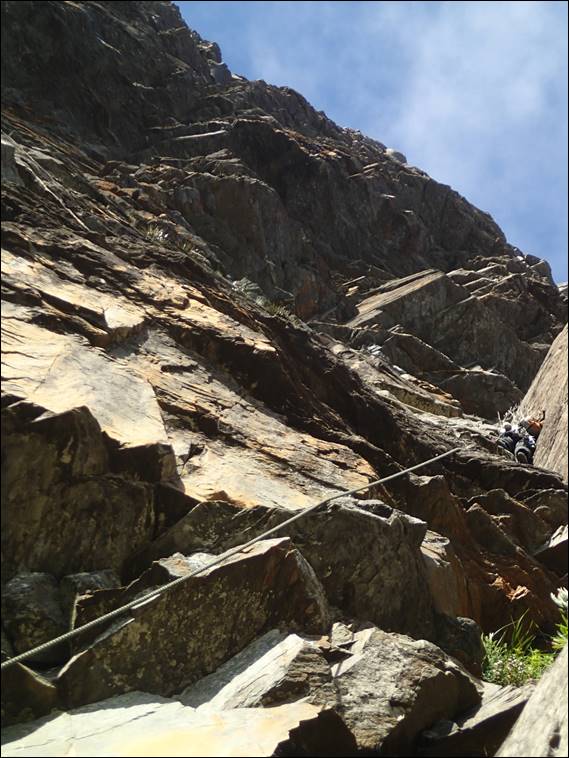
Following Howsie up the crux pitch, I felt like I eased into the route a bit more. Having the rope above helped for sure, but also the familiarity with the rock was now increasing. There were only a few areas with seepage and we managed to avoid those, and we also didn’t encounter all that much loose rock. I found him sat on top of Prickle Traverse, from here it is possible to walk off but we had no intention of doing that. With a large terrace at our disposal we had a break and got out some snacks and had a drink. I then set off up pitch three, with Howsie below camouflaged in his green waterproof:
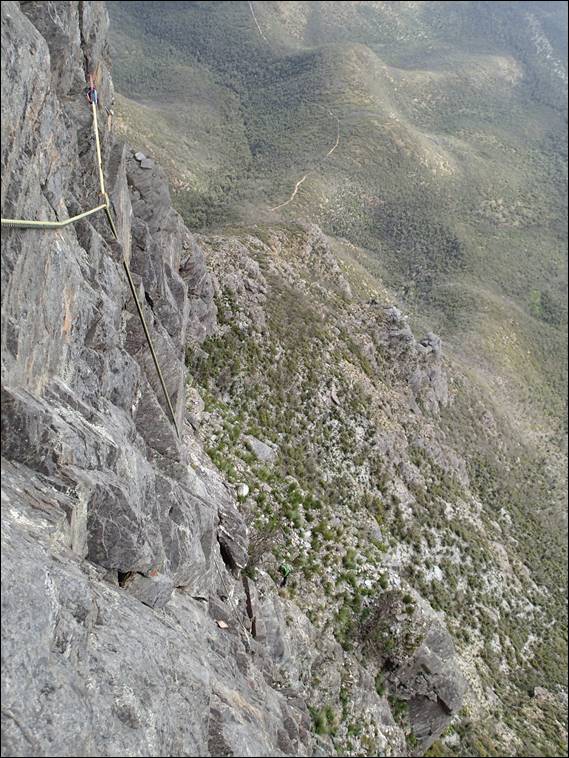
Cloud had come over the top of the ranges, it comes from the south and you don’t know it is upon you until it hits you. Another aspects that makes climbing this wall a more serious proposition. While the cloud came, no rain fell but the temperature dropped and the bite of the wind was more noticeable. That was why Howsie put his waterproof on, making use of it as a wind cheater. I sat on a narrow but very comfortable belay ledge as he followed me up what was a brilliant pitch. We both agreed it was the best yet being consistent, steep and having enough gear to make it sane:
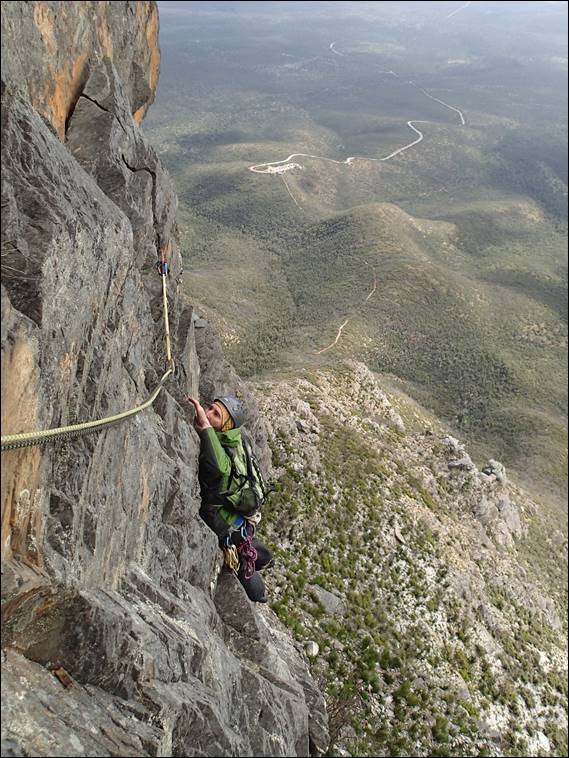
We had a quick change over and soon Howsie was heading up pitch four, the second rope stretcher. And we hoped this time that the rope was long enough, as the chances of simul-climbing like we had done on the previous rope stretcher, were reduced. For those who haven’t heard of the term before, it is when both climbers are climbing at the same time. Not a normal rock climbing technique but I have used it in the big mountains in the UK. The moves off my ledge while not crazy were certainly tricky and if I slipped I would have fallen into space and pulled Howsie off with me:
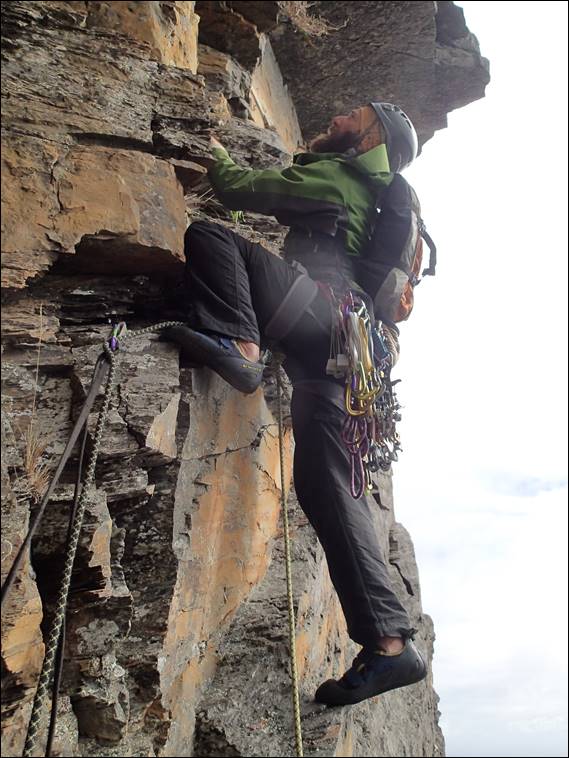
Howsie disappeared past the roof and went onwards out of sight. I shouted out as he approached the halfway mark on the rope and then expected to have to shout out and hope he could hear me, as I guessed there were 10m, 5m, 3m and finally 1m of rope left. But he stopped at about 40m and didn’t go any further, unable to see him I wasn’t sure if he was in trouble, had hit a wet area or was at the belay. Based on the route description the last was unlikely, but all I could do was wait as the building wind making it impossible for us to communicate:
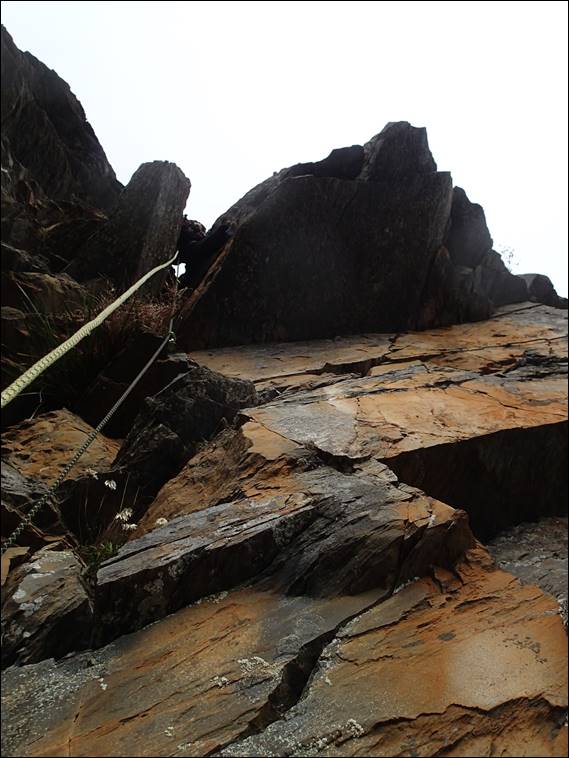
We had accounted for the lack of communication, making sure we both understood what to do. As it was in this instance he had reached the belay, and as the wind lulled I heard him shout safe. After checking I heard correct and getting him to repeat his call I took him off, waited for the ropes to go tight and only when I heard on belay and could feel the ropes go tight did I start to dismantle my belay. It was another fine pitch, great moves past the roof and up the steep wall. It eased a little towards the top and I found him sat on a large sloping ledge, where we decided it was time for another snack and drink:
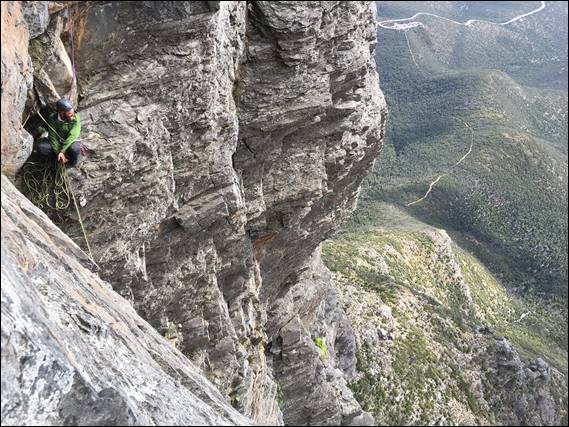
Pitch five, the supposed best pitch of the route. It is hard to see how this one could trump pitch three, but there was only one way to find out. I set off and established myself on the famous traverse, with nothing but space below me. I was now traversing above the lip of one of those huge overhangs that we had seen from below. It was an amazing position, nothing but 140m below me and the ground. The traverse goes for about 8m with no gear for protection but it is never hard, so feels fine:
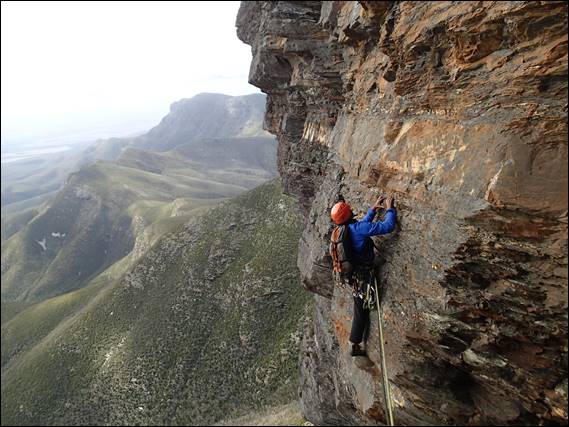
At the end of the traverse came a bottomless chimney, a great bit of back and footing up this while looking down into emptiness. Good rock with spaced but great gear made this so much fun, eventually popping out the top of it with another large roof looming above me creating a cave. The description of the pitch was embedded in my brain, exit the cave left up a steep wall. Up to a gully and move left to an airy stance, on and on it went and getting to the airy stance felt more exposed than the traverse. It was an absolutely stunning pitch full of variation, exposure and length and I loved every inch of it:
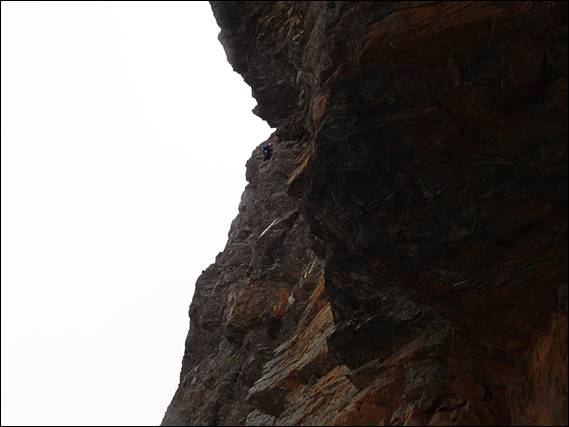
There was but one pitch left, and Howsie set off after absorbing the belay stance I was on. It was totally brilliant, small but secure with magnificent exposure and great gear to keep me safe. He then started upwards, it was supposed to be a 45m pitch and again he stopped short, maybe 30 or 35m tops by my reckoning. I heard the faint call of safe, waited for it to be repeated and the same sequence as six times before followed. As I neared his belays stance the rock got wet. It was clear that it had only recently been like this as no slim had formed, this meant that while wet the holds were still positive enough and soon I was stood next to him:
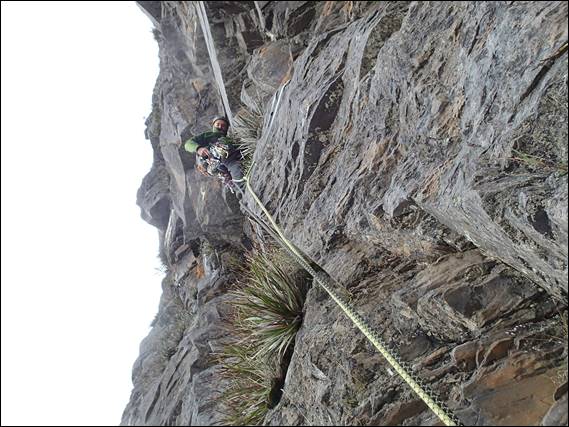
We could hear voices above us, but with the wind they were unaware of us. From here it was a scramble up a vegetated ramp just below the summit. We passed hats, water bottles, cans, beer bottle, plastic bags and other assorted rubbish, all of which the vegetation on the ramp had prevented from continuing it’s downwards journey. We were both gobsmacked and disheartened at the sight, while the people above and no doubt countless people before were oblivious of the litter that was being left behind in an otherwise pristine environment:
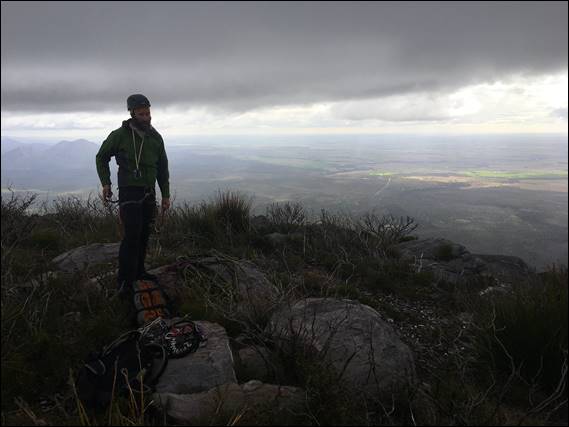
Sorry that may have seemed a bit like an anticlimax, but both of us were really shocked at what we saw. On the plus side the route was amazing and it felt great to have finally, on the third attempt, bagged it. Every pitch had its own unique element making the route both engaging and varied. We topped out at 2:30 approximately 7 hours after we had started to climb, which may sound like a long time. We checked the log book as we were about to leave the park and the last group to have climbed the route was in October last year and car to car it had taken them 14 hours:
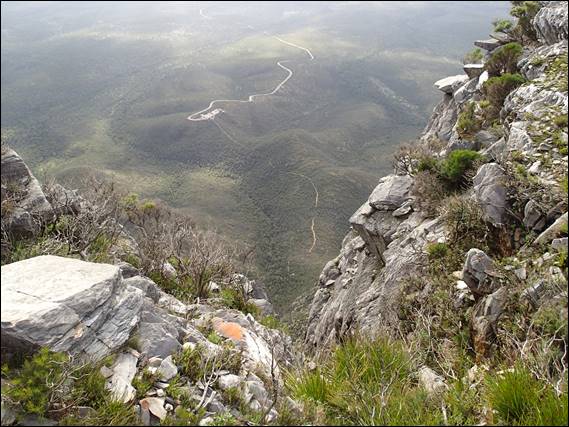
We had another bite to eat and drank some more water to lighten the load before the walk down. It wasn’t overly busy and we only passed a handful of people as we made our way down. While we had never felt tried climbing, our legs once again started to tire as we made our way back down. About three quarters of the way along the trail we could hear music, and as we got closer an unmistakable sound filled the air. There stood in the carpark facing Bluff Knoll and with no one else about, a soul man was giving it all on his bagpipes:
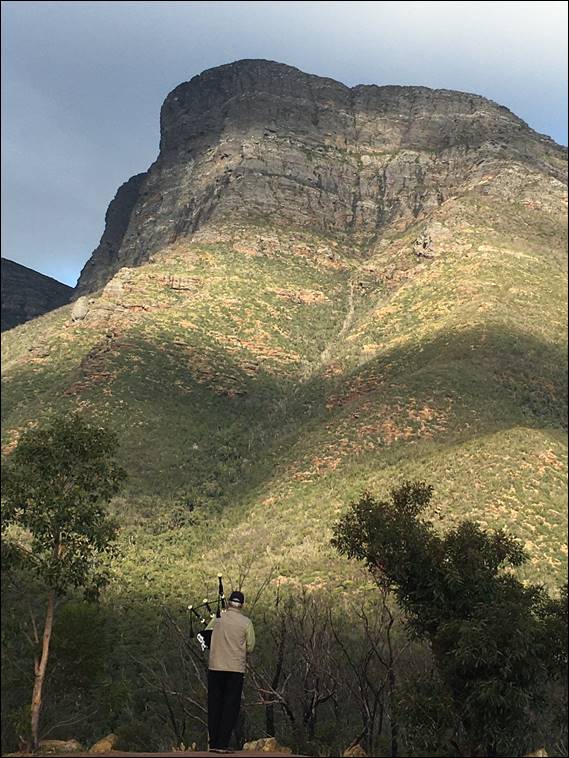
We were back at the car by 3:30 making it a 9 hour round trip, one we hadn’t rushed and had thoroughly enjoyed. It was then only a short trip back to The Lilly to chill out, but before then we drove past the log book and signed out and also checked who had been climbing here last. In pages and pages of people doing the ridge walk we only came across two parties who had logged that they were climbing. One in October as mentioned above and one in February who had climbed Right Anti-Climax, and they had taken 12 hours. As we were about to finally leave the park we came across a part of five looking perplexed at their car:
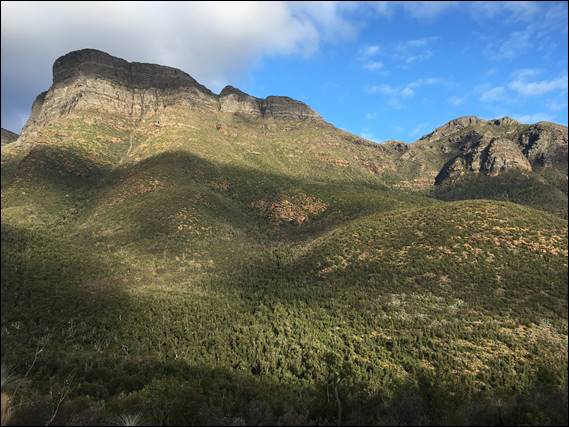
They stared at their new looking Toyota Hilux with the front left-side tyre touching the wheel arch, somehow the suspension had suddenly failed. With no phone reception they were in a predicament, so we stopped and Howsie allowed them to use his phone to organise a RAC call out and arrange transport from friends all the way back to Katanning. This chewed up close to 45mins and we felt a little bad leaving them to wait another 1-2 hours for the tow truck to arrive. We did however top up their water bottle and give them the last of our snacks. Back at The Lilly we were once again handed a beer, and caught up with Pleun and Hennie before they had to head out for dinner with friends:
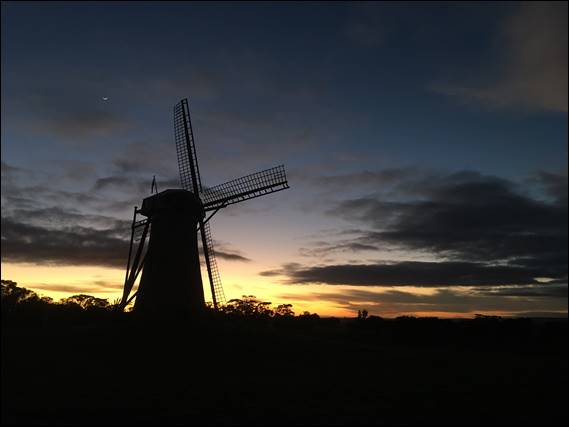
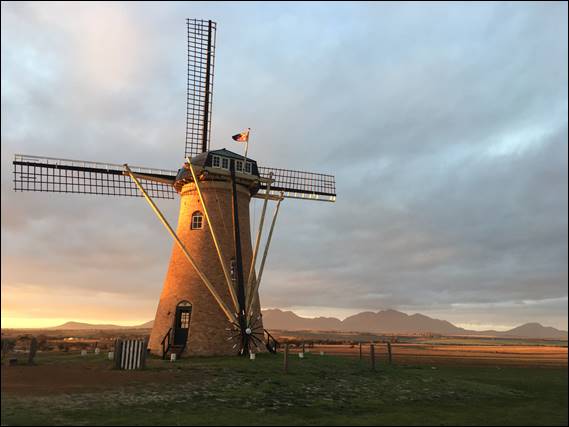
Hennie had prepared a mountain of food to make sure we didn’t go hungry and we were looked after by Václav when they left. He has previously climbed and was very keen when Howsie discussed the possibility of taking him for a climb in a few weeks when he would be down with the family. We crashed early that night, after packing up most of the gear, and in the morning we aimed to get away at 7. This allowed us have some breakfast and a couple of cuppas, as well as watch first light come in. The rays of a new day were being cast across the land to light up the Stirling Ranges, and also the Dutch Windmill that Pleun had built. During our discussions I found out that the top of the Windmill had come from Limburg in the Netherlands, which is where my uncle Chris lives, it really is a small world. I could ramble on for ages about The Lilly, including the windmill, cottages, Daktota DC-3, and more, but will instead leave you to check out their website http://www.thelily.com.au/:
 Sandbagged