Almost a year in the making and Rongy and I were ready to hit the road, the reason for such a long period of planning being that this five day trip was to celebrate a soon to arrive major birthday of his. But also it had started off with grand plans to head to Arapiles with a bit of a group. Then for one reason or another just Rongy and I heading to Tasmania for a road trip, which would of course have had to include a stop over to visit, and hopefully climb with, Chris and Sirja who had very kindly put us up and looked after us during our trip to the Blue Mountains in 2016. And then the reasons for the more recent indecisions is pretty obvious and so it was that finally we were on our way:
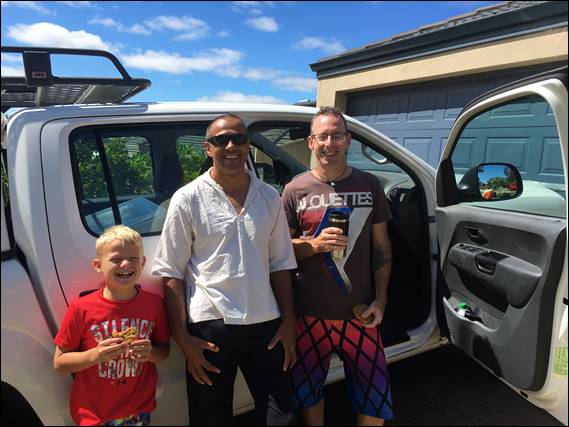
As we prepared to leave Alana, Katie and Ben were out waving us off, and it seemed that Ben was hoping to smuggle himself into the car. The car journey south was however way to quiet for him to have managed to sneak in, and so we started the near 5 hour drive to Cheyenne’s Beach. You may recall the name from our recent South Coast Revisited trip, when the two of us along with Andrew and Howsie stayed here. And it was some of those crags that had drawn Rongy’s interest in coming back down this way, seeing any interstate travel could not be relied on with any certainty. This time we did not go glamping in cabins, but stayed under canvas and were the only ones in the whole park to do so:
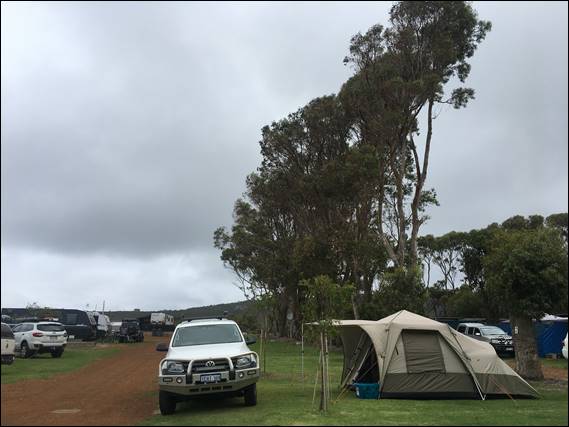
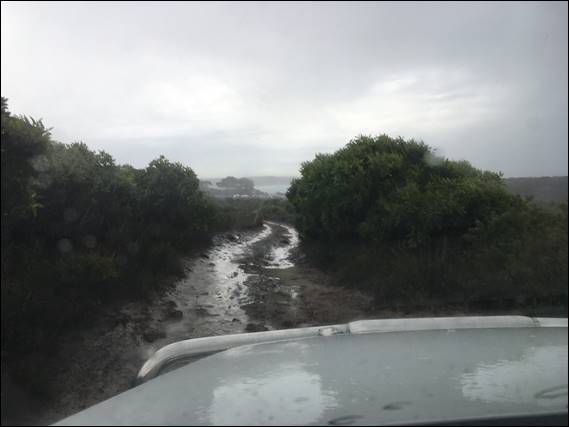
The week before had been pretty average down this way and as we drove south we checked the conditions. As we expected it was average on our arrival, it was however predicted to clear up the next day. The clouds hung heavy in the sky the next morning but we were confident it would be OK and had already packed our gear the night before. So after a quick but tasty breakfast we drove up the sandy 4WD track out to Lost World. The track was a bit more cut up than last time and there was also a third washout forming. Taking it easy we got through ok and parked up at the slabs, only for it to start drizzling:
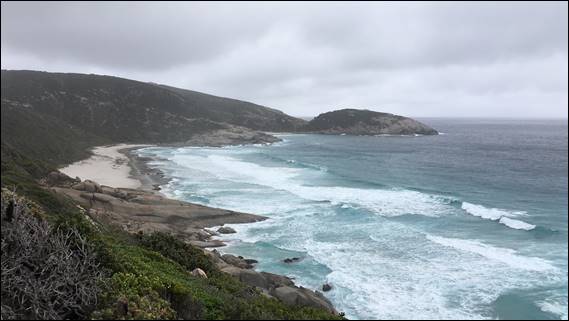
Instead of heading back down we decided to walk the rest of the track to scope out Mermaid Point. A place we were aiming to get too during the trip, but didn’t manage. Before our South Coast trip last year I had asked Kym if he knew what the track was like out that way, and he said it was supposed to be pretty bad. Sure enough as we walked out we came across some pretty big washouts, much more severe than what we had already negotiated so I was pleased to be on foot this time. When we hit the coast we finally realised that we had taken a wrong turn wrong, which was my bad:
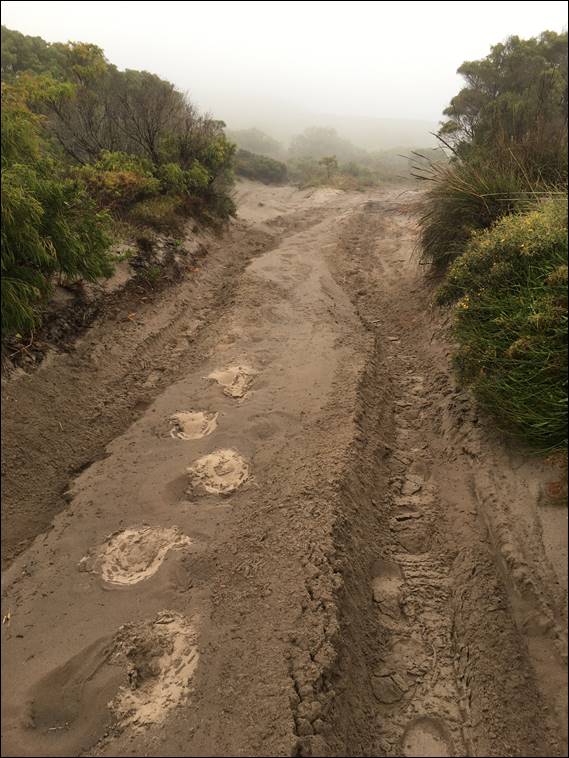
The good news was that we hadn’t taken our packs, as being ever hopeful we assumed the clouds would lift and allow us to climb the slabs at Lost World. Only the top of the sand was wet and underneath it was dry, sadly however as we neared the car it was very clear that we wouldn’t have a hope on the slabs. The drizzle and mist was a sure sign they would be wet if not running with water making them impossible. So we had a decision to make… head back or shoulder our packs and walk out to Mermaid Point. The latter was what we chose, again walking in case the right track was equally washed out. It was a long walk, which we didn’t mind but we could have avoided it as the track was in great condition all the way:
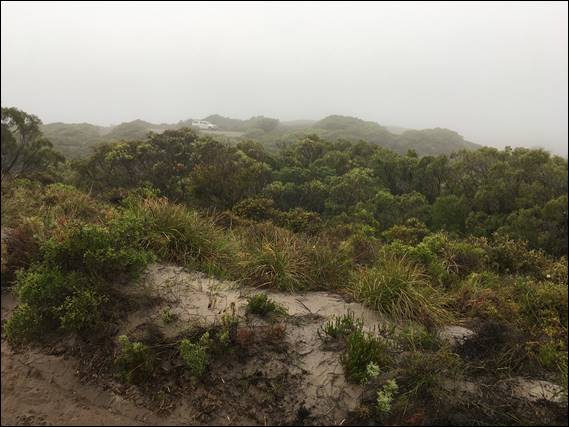
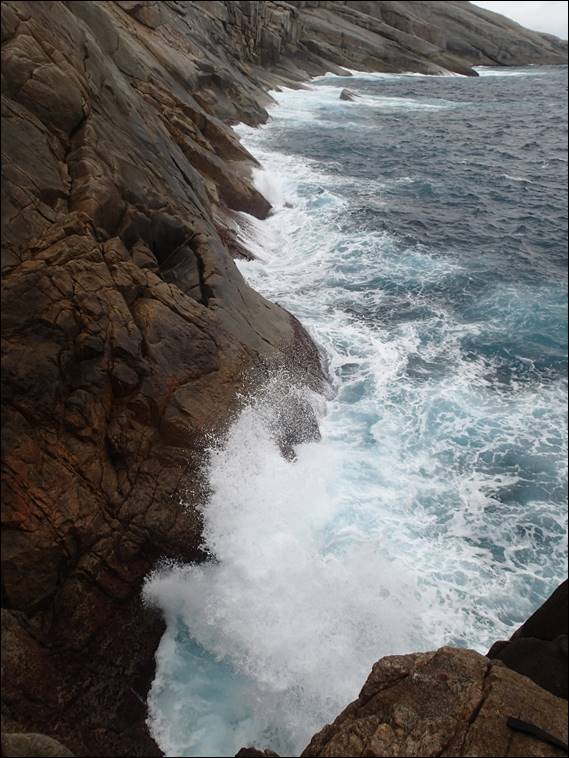
On arrival we stood in awe and fright as we looked at the cliff. The rain, wind and waves were not helping with our nerves. It was time to sit down for a while and just take the location, situation and atmosphere in, while having a snack and drink. We then decided to scramble up the cliffs and have a closer inspection. The hard granite was clean but soaking wet, and even the scramble to get up the cliffs was a little unnerving. The scramble was necessary as to access this cliff you need to abseil in from above:
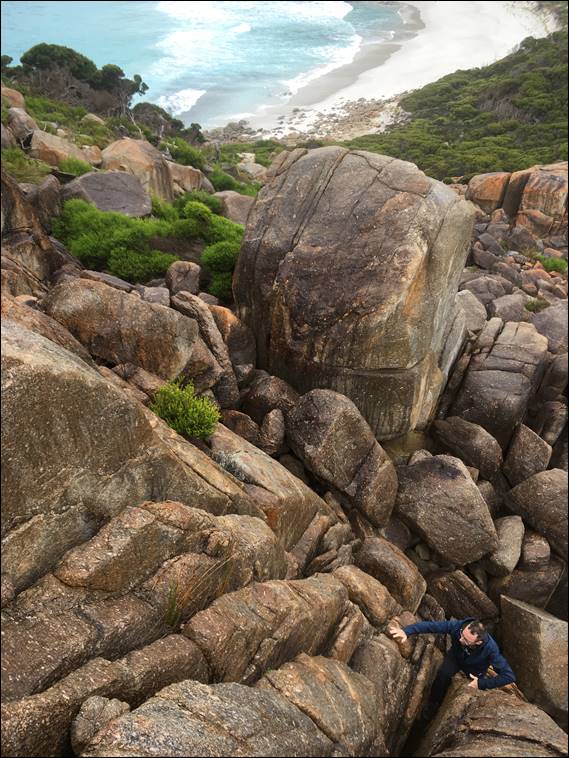
The sheer cliffs dropped straight into the ocean. It’s the sort of place that would normally fill us with excitement, finding it hard to decide who gets first lead as we would both be chomping at the bit. Today however weary from the walk, being cautious due to the conditions and taking into account the extreme remoteness of our location we were apprehensive. The forint face was also very steep and the occasional wave ran up the wall as if reaching out and saying do you dare. We had however made all this effort so decided to see how the rock climbed by starting on a couple of easy looking cracks up the slab:
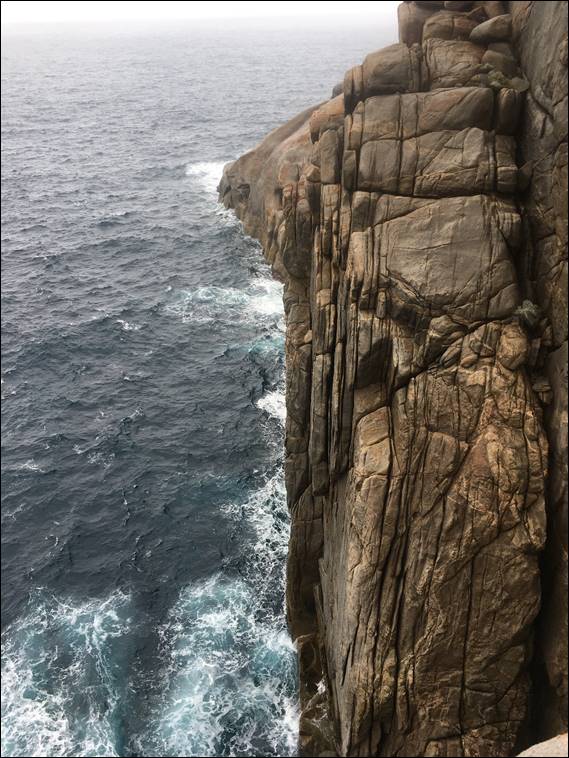
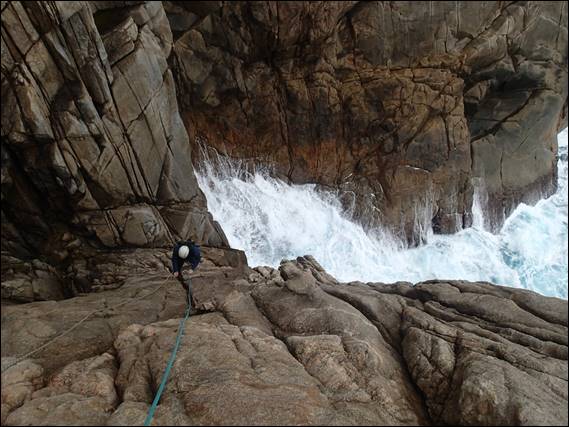
Back down we scrambled to rack up and settle our nerves, before going back up to rig up an abseil and drop down. Rongy went first lead, picking the left hand route called Lauries coming in at an impressive grade 8. Like I said we were treating this place with the respect it demanded, and even at this lowly grade the route still felt like it had exposure and a sense of seriousness. We checked and double checked everything as we got ready on the belay ledge and finally he was off, taking his time and checking every hold once, twice and then a third time:
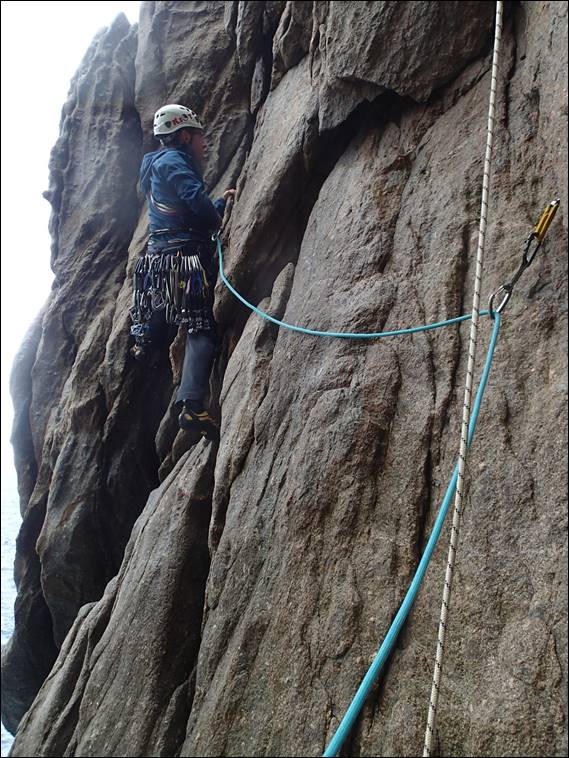
This is not a place that gets lots of attention and I dare say it is rarely visited by climbers, as it is an effort to get to. As such we were very prepared to come across loose rock and slowed our progress to take account of this, but we never did pull anything off. As Rongy worked his way up the route I sat there taking in the view, while the swell wasn’t crazy today it was still enough to make you pay attention. Each set that came in had one or two waves that would send a thundering crash of water that raged below my lofty perch. Needless to say I was securely tied in:
I followed up the first route of the trip, the rounded granite and flared cracks took a little getting used to and while the route was never too hard it was good fun and in a great position. We had already planned to rap back down to the same ledge from where I would tackle the line to the right up the middle of the slab. This one was called Ariel and was supposed to be harder at grade 10, but we both felt that the first route had more meat to it. We sat atop the slab and looked at the corners across from us, Rongy was showing signs of interest:
Those corners would have required double or triple sets of large cams due to the wide cracks, something we hadn’t brought. So his eye was instead drawn to Schämi Egge, a grade 18 open book corner. Yes it looked clean and impressive but it also look wet and the side walls were devoid of edges or features or worth. Indeed it proved to be a mighty challenge, and while we both got up it the style we sued was questionable at times. We were not put out by this and happy to have got up seeing it started to rain again, which made smearing on the wet smooth walls impossible. Sat above we pondered how it would climb in the dry, we both thought it would still be hard at the grade:
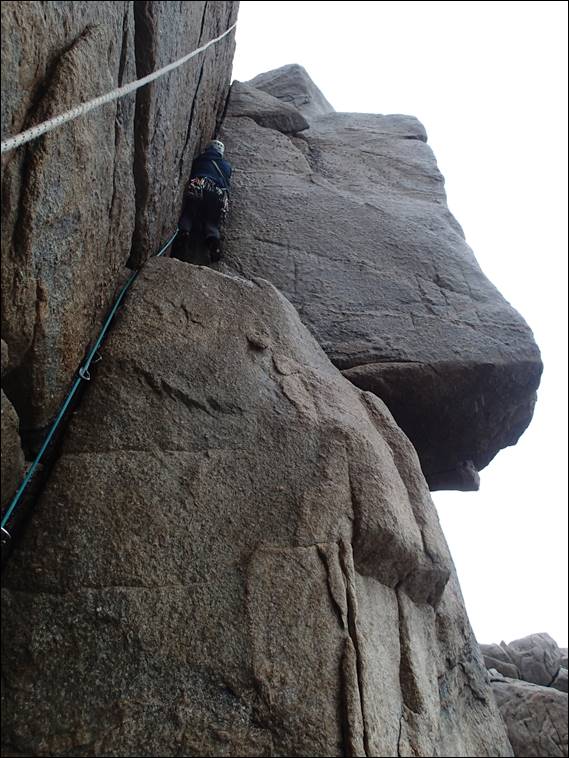
Being shattered from the physical nature of the last route we went back for more sustenance, and sat at our bags looking at the mighty wall. While we had both enjoyed the last climb in a masochistic kind of way, it didn’t feel like we should end on a route that had made us resort to methods neither of us would normally stoop. So it was my turn and I had the choice of a squeeze chimney or a route up the front face. Neither of us fancied a thrutch up some tight spots in these conditions, decision made and I went with the face. Rongy went down first to set up the belay and man was it exposed:
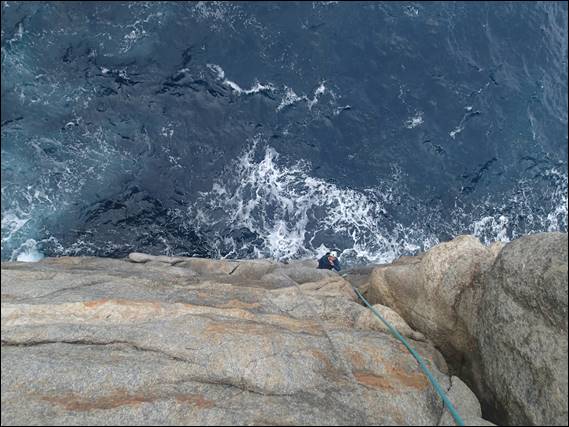
The wall loomed ominously above, slightly overhung making it hard to see what was coming our way. The ledge Rongy had found was in fact slightly offline but with the ocean and rock conditions it seemed the sensible place to start. The first steep wall was super exciting and adrenaline kicked in. The use of each hold, move and piece of gear was very deliberate and focused. Halfway up I reached a huge ledge that gave my arms a rest, while I pondered the original line. Again we didn’t have the gear required so I took an alternate crack, one seemingly unclimbed until today:
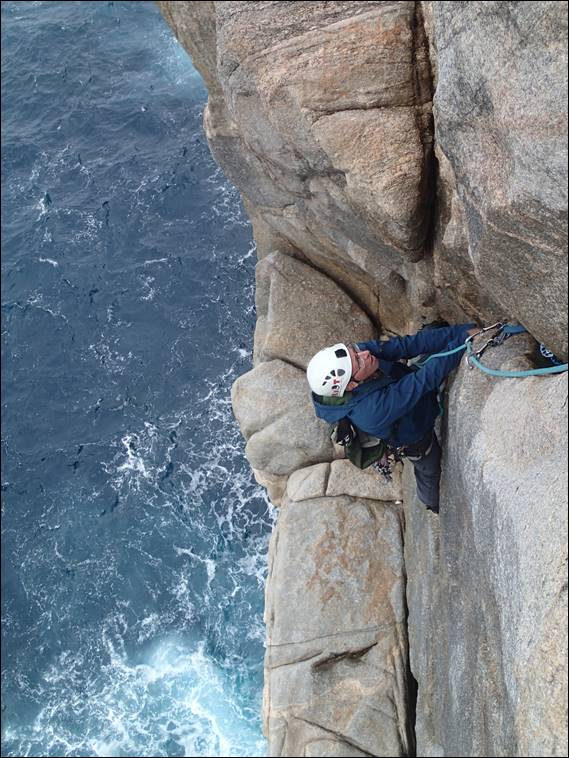
It was epic and we both got up it clean, making for a much better ending to the session. I had intended to climb Rat Tomago at grade 17 but due to the belay ledge chosen we climbed a line more to the left, or so the topo in the guide indicates. Reflecting on the route I would give it a grade of 15 or 16, in calm dry conditions and as for a name maybe Electric Avenue. You’ll have to read on to find out why. We both agreed that it was time to haul the packs again, but not before sitting on the perfect spectators ledge to take in this impressive place one last time:
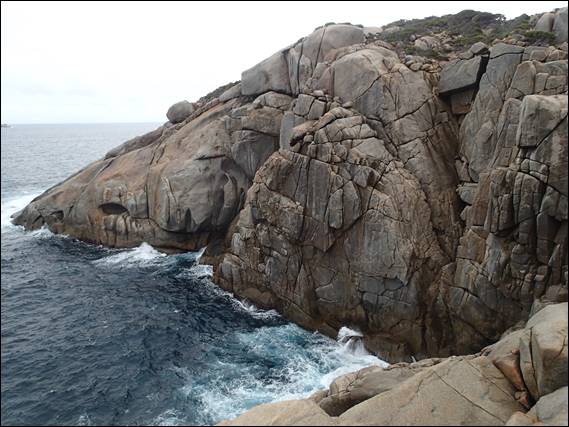
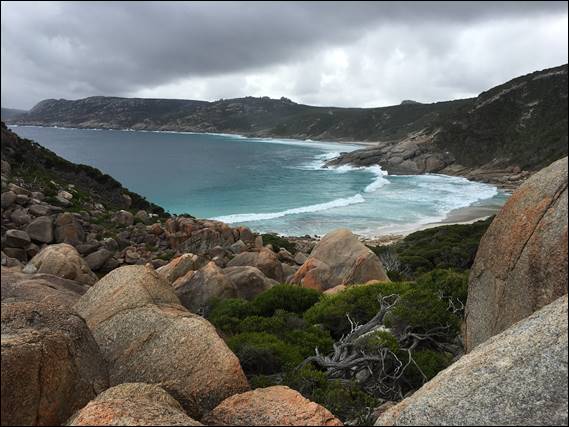
There are a heap of lines that really looked so good and are very worthy a return trip. Quite a few are in the twenties, so we would need to come armed with appropriate gear, more stamina and strength, improved jamming techniques and/or practice, and hopefully better conditions. As we started to walk out we looked across the bay, and I wonder if anyone is game to guess where we had walked too when we had taken the wrong turning in the morning. The third image in this post may help in working it out, and needless to say we went a considerable way off track:
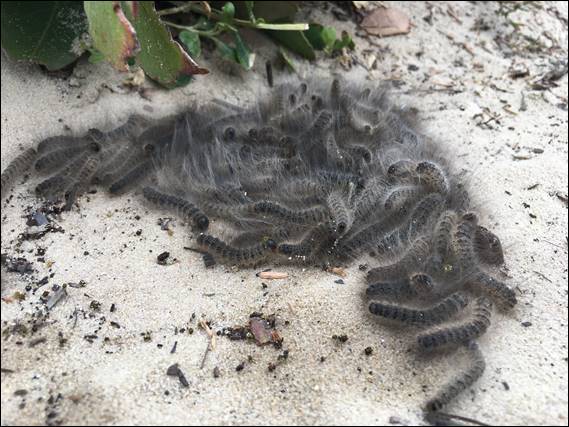
On the walk out we came across a few groups of what I believe are the caterpillars that will eventually become Bag-Shelter Moths. They are called Processionary Caterpillars and are often found walking in a long straight line nose to tail, but can also be found in these seemingly disorganised masses of squirming bodies. However, as you watch them they do move in a deliberate direction leaving any stragglers or wounded behind to the mercy of any prey daring enough to attempt to eat the very hairy things:
Well our first day had certainly not turned out as we had expected, and back at camp our legs were weary. Not surprising as we had walked at least 12km and quite possibly more, and while we hadn’t climbed a heap of routes it involved a lot of scrambling and mucking about. We were however hopeful tomorrow would turn out better, and the forecast was indicating a mostly sunny day. We had a choice of Lost World or Tombstones, and seeing the forecast hinted that Wednesday afternoon may become wet we decided on the latter. Packing the bags in readiness we were under the watchful eye of a friendly Bronze Wing Pigeon, who came across every time we sorted our gear:
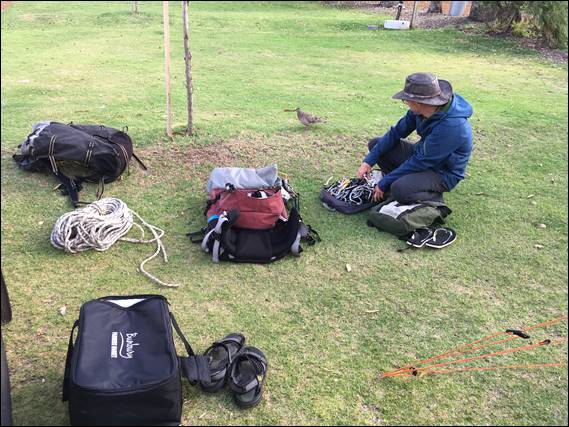
Our rationale for using the better day for Tombstone was that this place also had a reasonable hike and on the last trip we walked out in the rain and got soaked to the skin. Literally everything was wet, and this time being under canvas we aimed to avoid that. Rongy had organised the meals on this trip and we ate well. A hearty meal was required after the long days out and we got into a routine when we got back to camp: a tea and Anzac biscuit, unpack, repack, shower, food and then hit the sack. Each evening it seemed to pass quickly and then up at 5:30 to make a cuppa, have a feed and hit the road:

Tombstone is amazing, which in part is why we came back here. It also offered some routes that could be sensibly climbed when wet, and these were the trad lines on the front or south facing slabs. When we arrived it was windy and cold so we headed for Heuco Gully, a steep overhanging west facing wall. Our thinking being that we would be protected from the easterly winds, sheltered from any rain that might come and more importantly to try the new routes Kym had established here. I started on Boomshakalaka a fun grade 17, and as I topped out and looked south my heart sank:
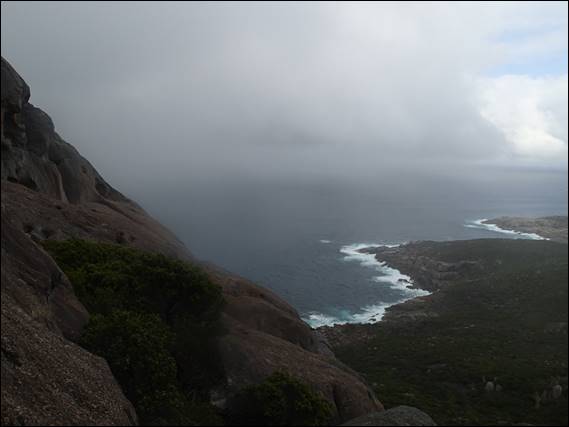
I got down and we pulled the rope so Rongy could lead the route, when the first drops fell. Getting heavier and heavier, so much so that water started to flow down the massive granite dome above us and cascade over the edge of the crag right down onto us. There was no escaping it and it felt like we were trapped in a waterfall. There was only one thing to do and that was to wait until it abated enough to make climbing a reasonable proposition, which eventually it did. Rongy headed up the route before cleaning it and then leading the next line:
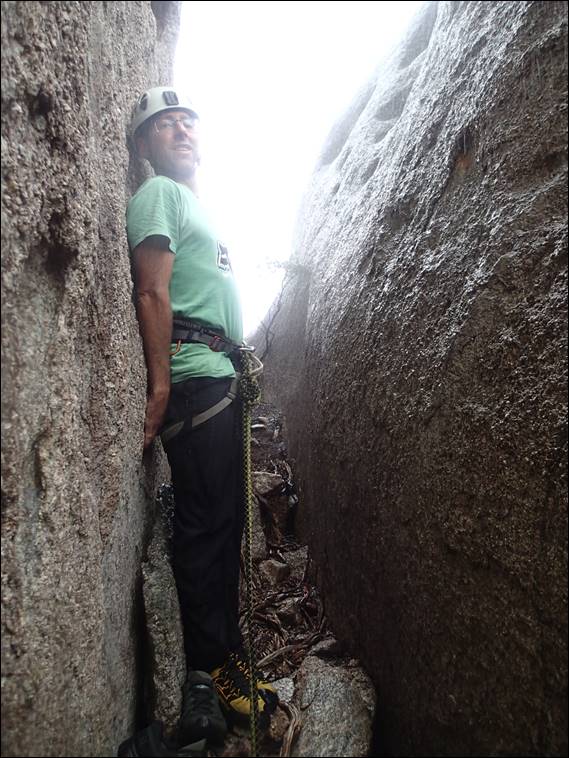
Rip-it-up Ronnie was graded 18 and while never any harder technically, it was steeper and had some great flaky holds that you could sink your hands behind. Then as you bear down and out on them you hope that they stay put, and they do. Two lines in and we were keen for more, these routes were more like the climbing style we are used to making them more achievable in these conditions. Unlike the rounded flared cracks from yesterday. However the grades then take a sharp turn upwards, and the line that drew my attention was High n’Mighty at grade 23:
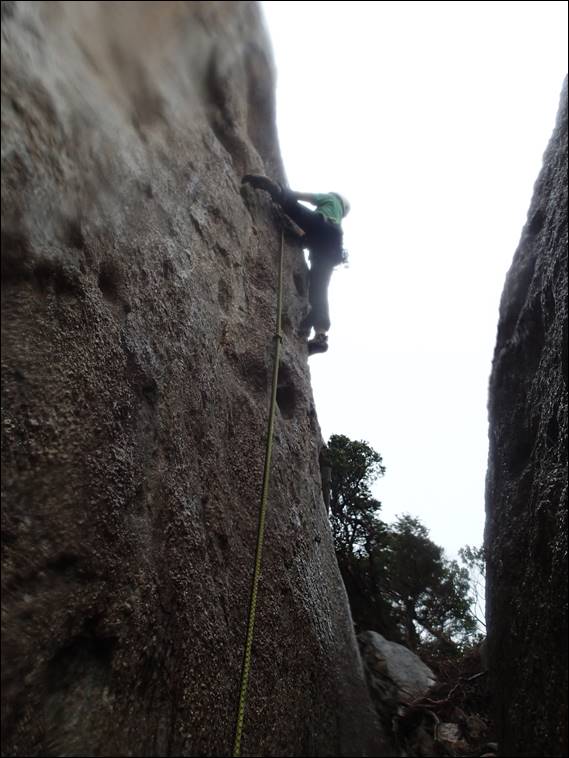
The line just looked like it wanted to be climbed, but with wet rock it may have been a little overoptimistic. While there were small, sharp and positive holds for your hands, which is something I really enjoy, the feet below at the start were smeary, which again I don’t mind. Granite sadly doesn’t soak up water and with the wet stuff being plentiful these small smears became slippery. I tried several times but the crux had me stumped, so I pulled past to a better hold, again like yesterday on the 18 stooping to tactics that I would normally frown upon. I was however pleased to manage the rest of route clean on lead, a solid line and very cool:
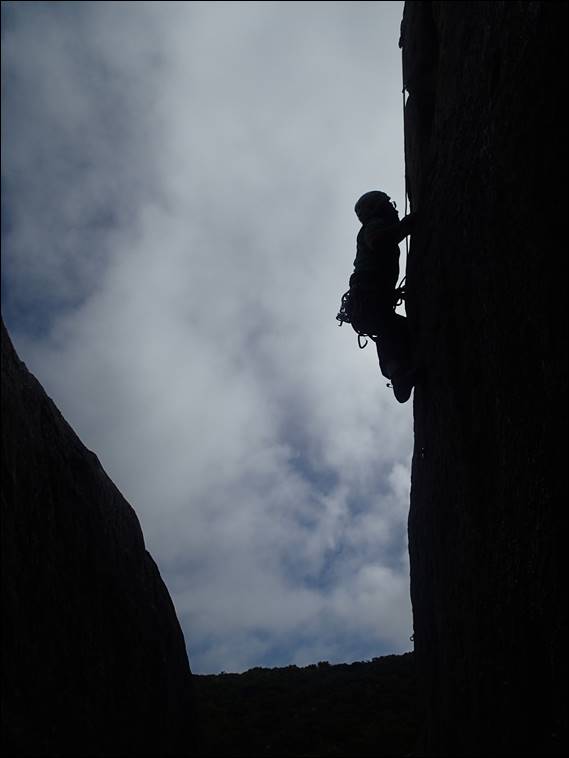
Rongy had watched me and decided he would rather have the rope above him, and equally found the crux in these conditions impossible but then also thoroughly rating the route. Nice work Kym! What next, well before coming back down Rongy had moved the rope to above Crash Bandicoot at grade 22. This allowed him to inspect the line and while he was tempted to lead it he decided on a top rope, only to find the crux on this line also had him stumped. Sharp, painful finger ripping holds needed to be fully weighed and hauled on, it was stinging but brilliant:

I decided to be sensible after watching and also top roped it, managing a clean ascent straight off the bat leaving me wondering… should I have led it? There was one route left but I had looked at the improbable crux sequence, and at a lofty grade 24 we left that for another day and headed back to the main west face where all the original routes are located. The lower wall here is shrouded in trees and gets no sun, and after the rain of the last few days and hours it was wet and slippery. But there was a route that I had talked up so much that Rongy felt he needed to give it a go:
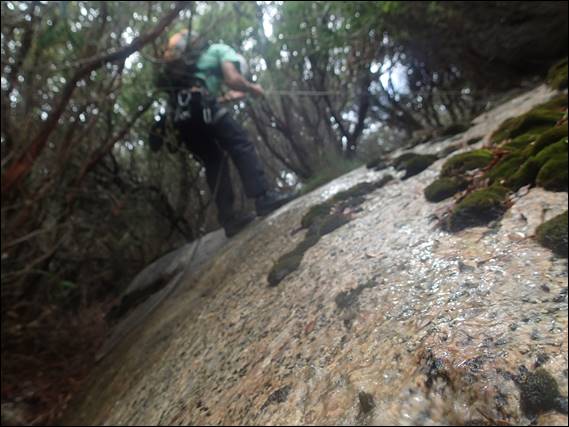
Rodeos and Roughnecks, grade 21, was the last line Kym steered me toward after two days or hard climbing here some time back. The first traverse is pumpy and worse in these conditions as the smearing foot holds are all but useless to start with. Rongy was however not put off and while those smears temporarily halted him managed a great ascent, getting through the upper water runnel above the trees clean, while bathed in sunlight. I followed in similar style, but faltered on the runnel when one of the millimetre thin edges I was using popped resulting in me falling off and onto the safety of the rope above me:
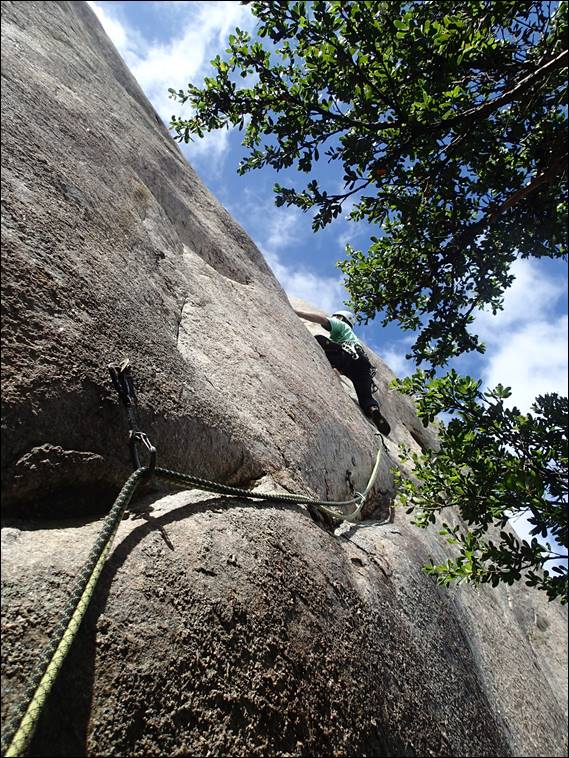
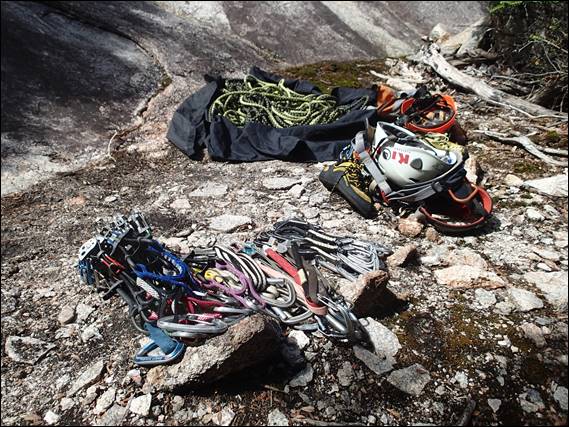
I had a bash at starting a grade 20 called El Gringos burro, but the first bolt at 4-5m demanded the use of small soaking wet hand and foot holds that made it simply too dangerous. The good news was that the sky was now looking like the forecast had promised, mostly sunny. Time for a feed and relax before I sent Rongy up lead after lead on the south face. Having lead all of these routes before I was sure he would appreciate the opportunity to witness them with the rope below him. The first two pitches were also full trad so it was time to pull out the gear and decide what would be taken:
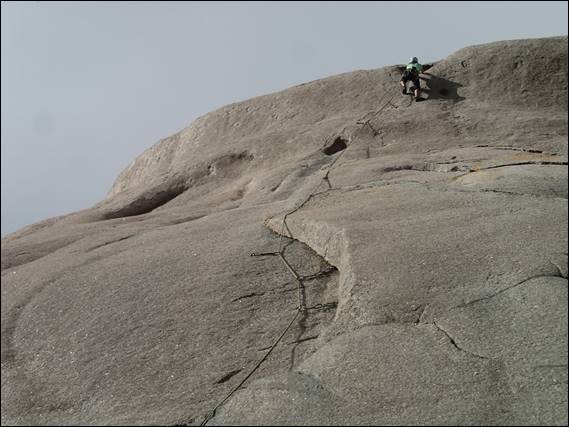
The first two pitches of Salvation are really good a solid grade 15 followed by a another fine grade 18 pitch. The day felt so much different now the rock was dry and the sun was not just warm but felt hot, so as Rongy worked his way up I hid under the shade of the trees. The initial flakes led to the rounded crack up and to the right of where he is. Getting into this is a little nervous and then you simply wedge yourself into it. Hands buried deep jamming and feet are awkwardly walked up behind also jammed into the crack. It’s quite a sight but the images just don’t do it justice:
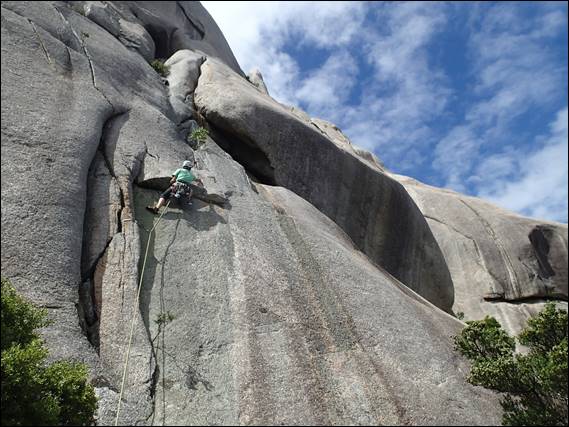
Rongy loves jamming so ate the first pitch up and was beaming when I got to him, graciously offering me the next lead. Whether he was quietly hoping I’d say no I don’t know, but I also knew what was to come and so was happy for him to go first. A lovely finger crack leads right across the open slabs in a beautifully exposed position, but with all that friction is feels super secure. Then it heads up over weird jumbled flakes until the final corner soars above, I scared myself up it on lead but I never heard Rongy wince once:
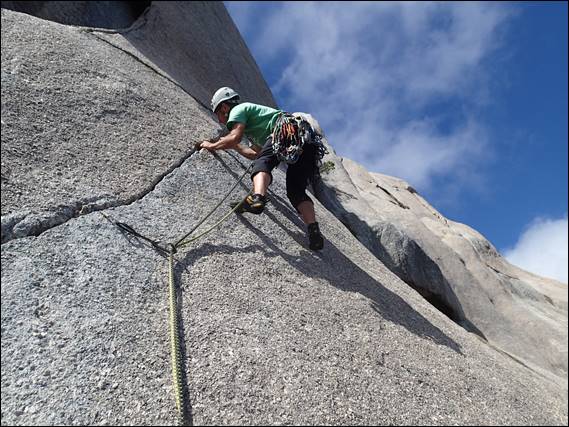
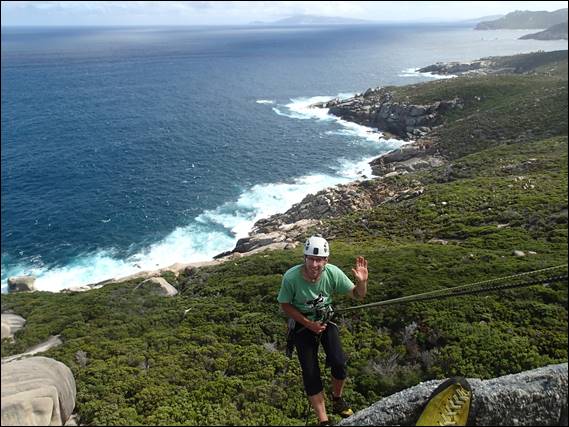
He did at one point look over saying that he wished he had jamming gloves for the last part, something I had used when I led it. He then however romped up it, and as I followed he suggested laybacking the final section of the crack. More strenuous and harder to place gear but it did feel better than the sharp and awkward jams I had previously used. We sat atop for a while soaking up the glorious views, this crag has one of the most spectacular backdrops of all the crags I have climbed in Australia and I won’t ever tire of seeing it:
The last line for the day was a mixed route so required a bit of trad but most of it was bolted. Rongy had led the first half on our trip last year, and on that ascent was when the rain had started to come in. So he was keen to try it in better conditions today, that plus there is an equally impressive second half to the long 40m first pitch of Trident at grade 19. Our finger tips were starting to feel that tingling that indicated the skin could be pierced at any moment, while super grippy the granite crystals, flakes and edges from today had all been sharp:
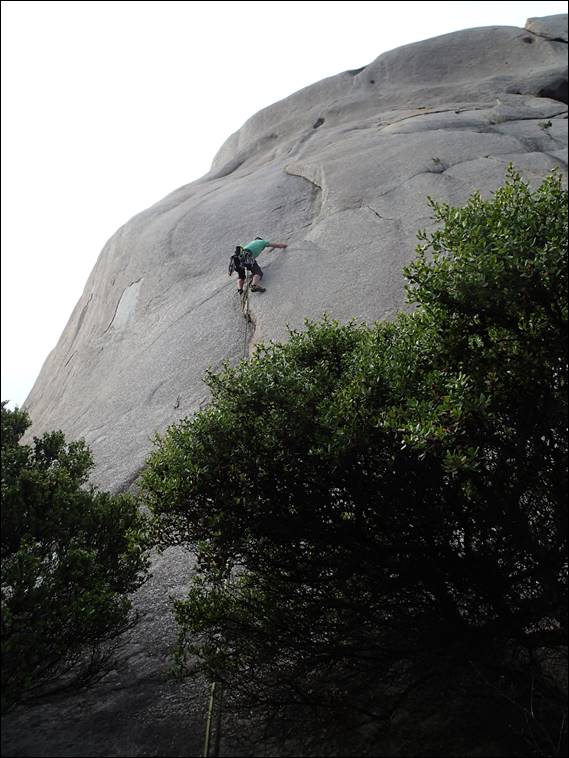
This didn’t stop Rongy has he worked his way up all 40m, as I watched the clouds that blew over the top of this massive granite monolith, become increasingly darker. The air temperature also dropped and as Rongy battled against the weight of the twin ropes stretched below him, it wasn’t until he got to the belay that he noticed it. Regardless of what may come I was keen to follow up this line, it’s a pearler! This time with a rope above me it felt more sane and easier, but that is also why leading it more fun and it had been a top lead today:
Rapping back down it was time for more food before the walk out, and while the clouds came and went we were fortunate to get back without any rain. Better still since the mornings torrential downpour the vegetation was also dry, so we remained dry except for sweat as we trudged back up and down the gently undulated landscape. Back at camp and after checking the forecast we clicked into the routine and the evening was soon a distance memory, as our legs feeling the two days of hiking and climbing were grateful for being in a prone position:

Wednesday morning arrived and the sky was mostly clear, a welcome first. The kangaroos were grazing on the lush green grass of the new powered sites at the campground. This place like so many others has done well out of the hard boarders over the last year. With a steady stream of people “wandering out yonder” just as the state government had encouraged, while interstate or overseas travel was not an option. It has resulted in the place growing which can be good and bad in such a fragile environment, but I guess that is what they call progress:
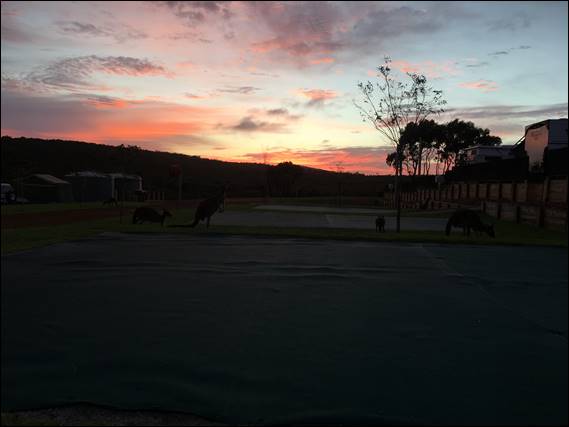
Now while clear skies abound to the south, in the north dark clouds were looming much earlier in the day than we had anticipated. We had already discussed that this morning would be decision time, we had another night booked here and also a planned bush camp at a yet to be decided location. But Thursday and Friday didn’t look any better and in fact Thursday looked worse. A quick check of the weather radar showed big storms heading our way, so it was an easy decision and we packed the tent away while it was dry. We then loaded the car and decided we would still chance a climb or two at Lost World:
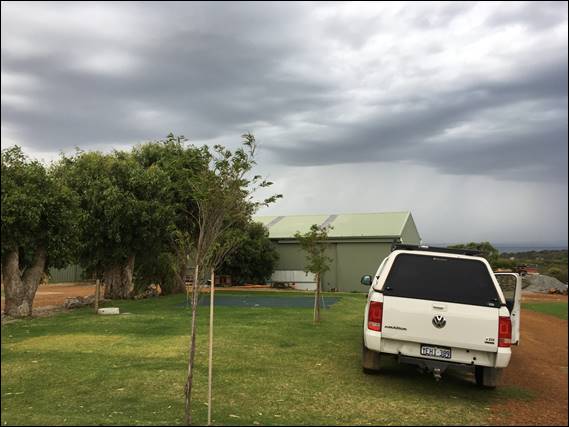
After negotiating the track again we watched the radar and monitored the clouds for a while, it seemed that the rain would head both east and west of us as they tracked on their southerly journey. On both sides of us bolts of lightning could be seen, but we never heard the clap of thunder indicating any thunderstorms were sufficiently far away. So we shoulders the prepacked rucksacks and walked in hopeful we might get four pitches in, and already had a game plan of lines in mind. We negotiated the maze of slabs and vegetated gullies to find the top of Whaling Wall:
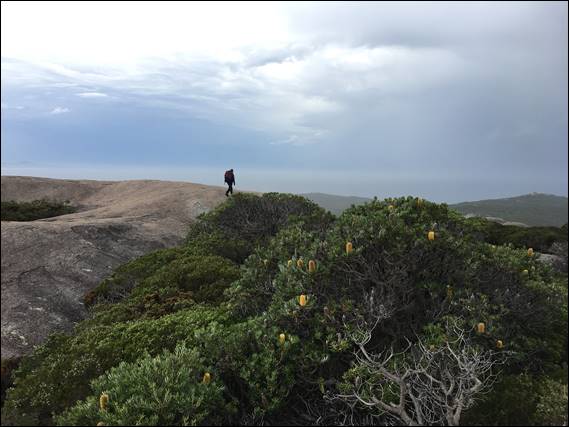
Our intention was to start gently and then hit two harder pitches to round the trip off, two days earlier than expected. It took us a while to work out the right bolts to abseil off to get to the base of Could Street, the first time establishing off and starting to go down the wrong line. It’s all part of being out here, the climbing is just a small part of the journey and experience. So we had to pull the rope and set up on the right anchors, I went down first and found the bolts at the top of the first pitch uncertain whether a 50m rope would get me down to the next belay station:
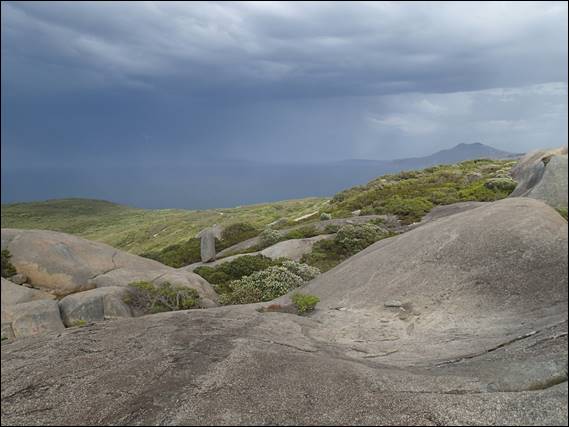
Rongy joined me and went down a short way for a quick inspection, when the sky seemed to suddenly darken above us and rain started to fall. He came back up and I quickly got ready to climb out, the rain got heavier and heavier as I made my way up. I made use of the areas where larger crystals allowed some purchase. The friction on the finer grained areas was a hopeless cause, it was soaking wet. In the last half of the climb water started to run down the slabs and all friction seemed lost. The only way I would make it was to pull on a bolt to get a fingertip hold and from then on there were enough edges to allow me to get up:
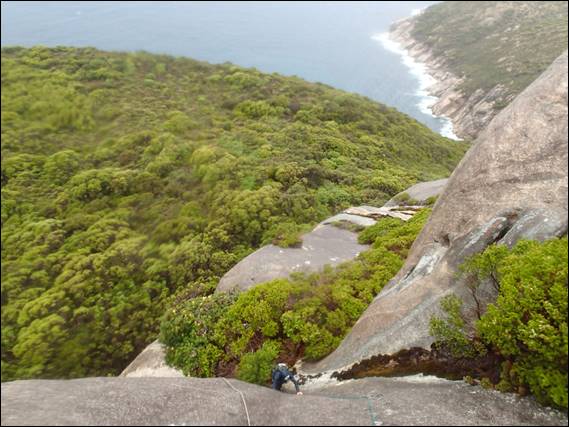
Two thirds of the way up the rain was belting down so hard I couldn’t look upwards. A blinding flash came down instantly followed by a booming crack… the air sizzled. I quickly ran up the last section and set up the top belay. Rongy followed up as water streamed over the slabs and in the water runnel where the moss grew, a mini waterfall was in full flow. He too had to use just that one point of aid, it just seemed to be the way that this trip was going to be. So it was that we got to climb The Silver Lining, a fun grade 16 slab in probably some of the most electrifying conditions ever:
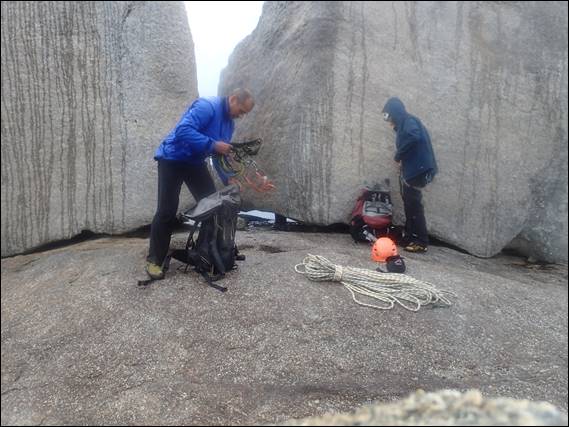
Everything was soaked to the point it was dripping. We stuffed it, along with all that dripping water, into our sacs. As we weaved back along the slabs to avoid the vegetation as much as possible the rain abated, and while the sky still looked dark and threatening we didn’t see or hear any more lightening or thunder. The sky was an amazing palette of greys with the distinct streaks of rain falling in the distance. The slabs were running with water and all hope of any more climbing was washed away:
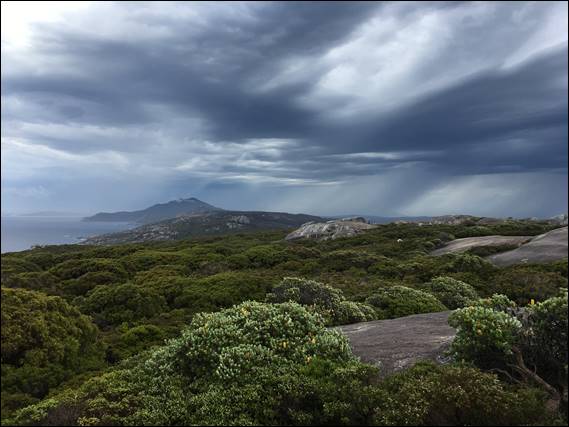
At the car the rain had stopped overhead allowing us to get into some dry clothes. We took our time while the rain held off, taking in the dramatic, wild landscape and all water around us. Then it was time to negotiate the track one last time to descend back to the campsite, as we did so the rain came back and the track started to flow with water. Despite the damp conditions, wet gear and lack of climbing achieved we were both still buzzing from our experience that morning. We also reflected on the fact that this is the only trip the two of us have been on together, which we have had to bail early on due to the weather. Not a bad record really:
Back at the camp we parked near the kitchen, time to pump the tyres back up during another well timed break in the rain. We also made a brew and got a bunch of snacks out to keep us going for the first leg out our journey home. Loaded up we hit the road and felt reassured we had made the right decision in leaving. Especially when we drove for over an hour through belts of heavy rain with the occasional bolt of lightning, making its brief and dramatic appearance in the distance. In terms of climbing we may not have achieved much but in terms of taking on the elements we certainly gave it a good crack:
 Sandbagged