It is the last weekend of the summer school holidays, which also happens to coincide with the Australia day weekend. It is a day when everyone feels there is a need to get to the beach, especially on the big day itself which this year fell on Sunday. As such we were expecting it to get busy, and so I took a day off on the Friday when it would be a bit quieter:
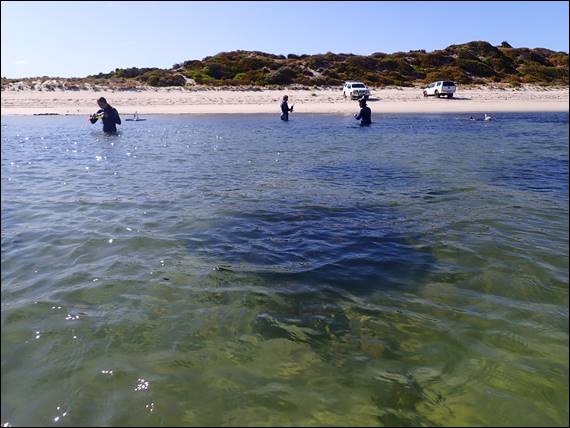
The reason was in part to have less people around but also as I intended to drive down myself. While I’ve driven off road and on sand before, it has been on rare occasions I will confess that I’m not the most confident at it, and don’t really enjoy it. However, now we have a real reason for doing it and that is to get to places like this:

It is also only a short drive in the grand scheme of things, so on Friday we went down and Esky drove out too. We went to the next bay along from where Geoff and Nana took me, and with a very low tide this area was so shallow in parts Lisa got beached. Above the Western Pomfrey, which are a bit of a regular now, but as the image was photobombed by a Western Striped Trumpeter I had to include it:

I’m getting behind here and in the above image is a shoal of Weeping Toado, which is part of the Pufferfish family and often called a blowflish or blowie. These remind me of my dad, as they are the fish that were in the water when we got him to have a go at snorkelling in extremely shallow water. However, as he is afraid of being in the water I don’t think he got to see them in his panic:
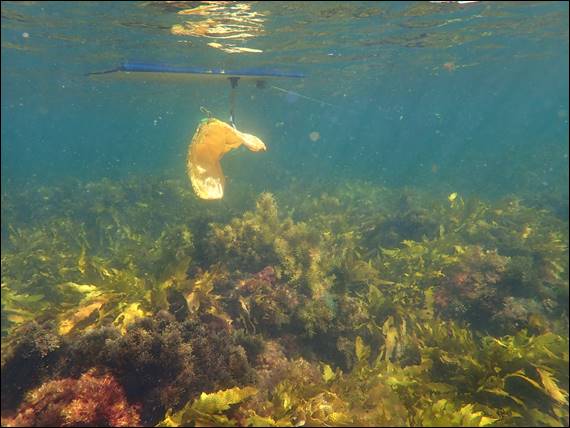
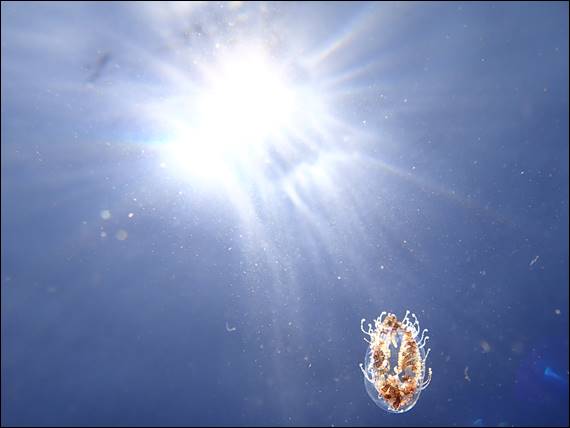
Esky came out with Megan, and they were trawling the reef looking for fish but also crays. Above his catch bag is floating behind them as they are lost in the distance. It is not always the big stuff that is worth seeing. Occasionally it is the very small things that catch your attention, such as this jellyfish that is no more than a centimetre in size. We also saw what looked like spiders floating about that were much smaller:
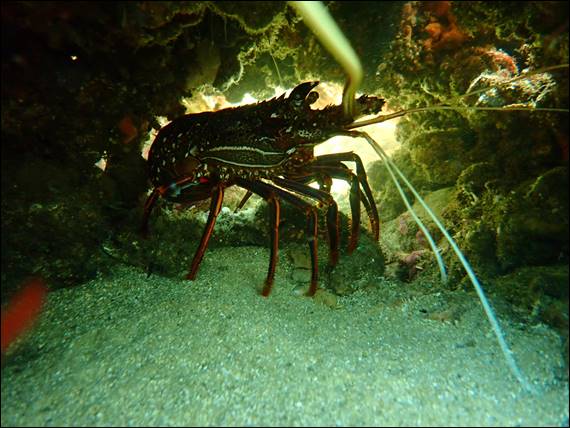
Nana was taking the place of Geoff, who couldn’t make it. She was up and down like a yoyo checking out any nooks and crannies she could find. She scored and found a Rock Lobster, or crayfish as they are commonly called, and better still one that had nowhere to hide unlike last time. It was tucked under a little tunnel and stayed put allowing me to get a few snaps before leaving it in piece:
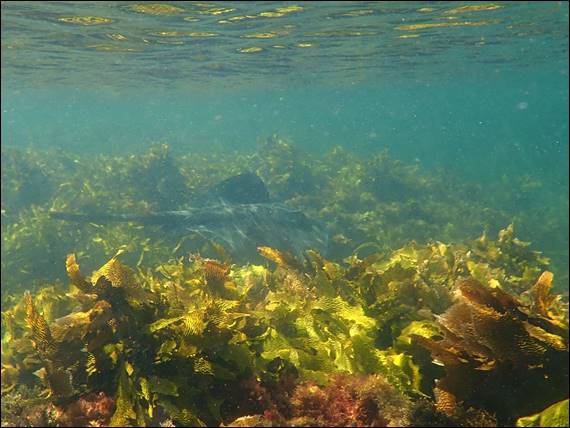
At one point Lisa was shouting out, with her snorkel in her mouth, Eksy called Megan to his side in case it was something not too friendly that she had spotted. I looked round just in time to see a big Smooth Ray glide effortlessly, and too fast to keep up, over the kelp. While they get much bigger, this is the biggest we’ve been lucky to see this year:
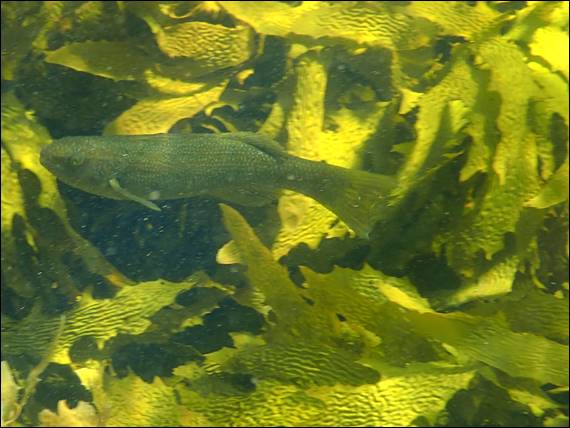
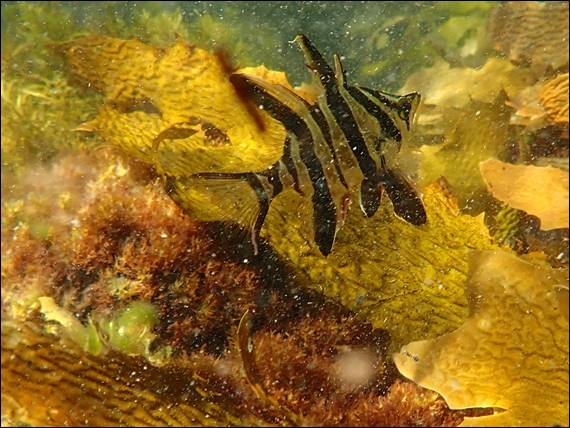
Below is a fish that I’ve spied a bit in the last few dives. It seems to potter about in the kelp and is not one to sit around, a bit like Wrasse do but I was sure it was not a Wrasse. Once seen it moves on pretty quickly, and this is the best image I managed to get. Based on the shape, colouration and section of the dorsal and anal fins being clear I’m going to guess at a juvenile male Herring Cale, which funnily enough is part of the wrasse family:
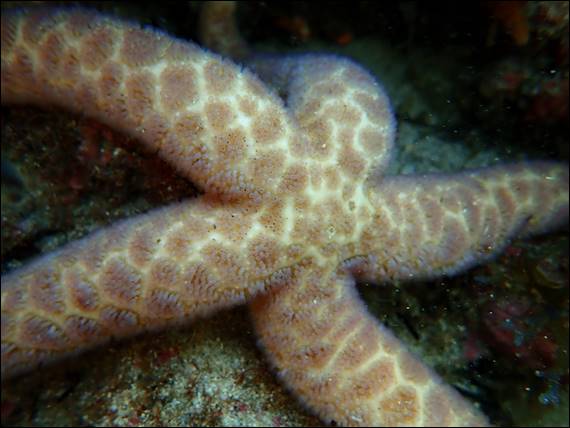
As I carried on my way I found a sea star that I have seen once before many years back. I’ve checked as much as I can and am pretty sure it is an Echinsaster Arcystatus. The technical name is a bit of a mouthful but I can’t find any information that alludes to a common name for it. It looked like it was covered in fluffy fur that created a blue hue:
After all my efforts on the other reefs to snap the Horseshoe Leatherjacket, in this area there was an abundance of them. They were not shy and hung about, it seemed on this dive that there was an abundance of many variety of fish where ever you looked. Over each dividing ridge of coral there was something new to spy:
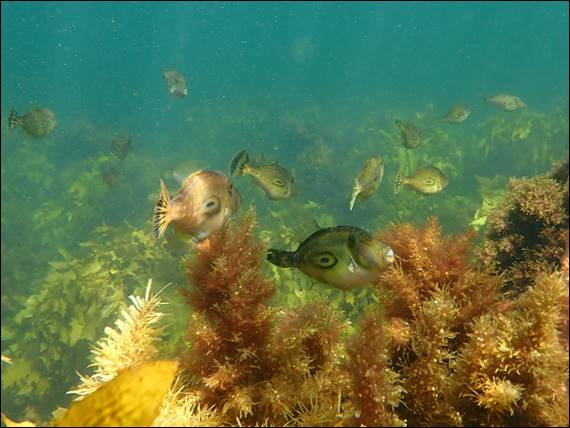
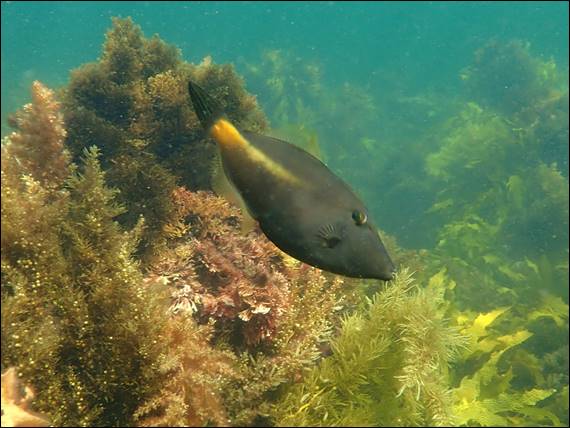
In amongst the shoal of Horseshoe Leatherjacket there was one that was very different, and I followed it about. It didn’t seem to mind my presence and eventually broke free of the pack allowing me this solo shot. When I got home I was at first excited to think I’d found a Barred Filefish, but now I realise that I got it wrong and it is in fact a Yellow Stripe Leatherjacket:
Speaking of getting things wrong, I have heard there are species of Catshark that live in the more shallow waters. During recent dives we’ve come across them five times, but am still excited when I see them. I can also confirm that I was on the money with the small colourful fish in my last post and they were in fact Yellowhead Hulafish, but can also go by the name Prettyfins:
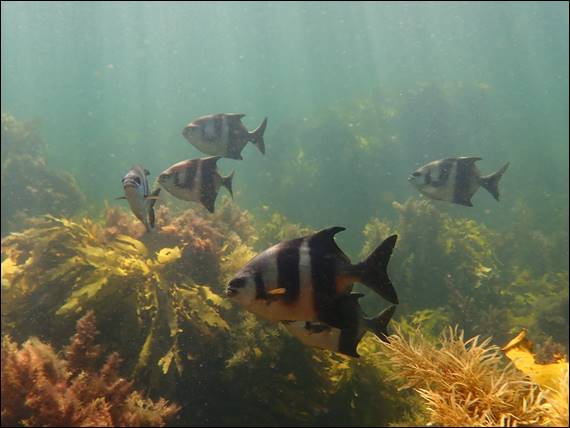
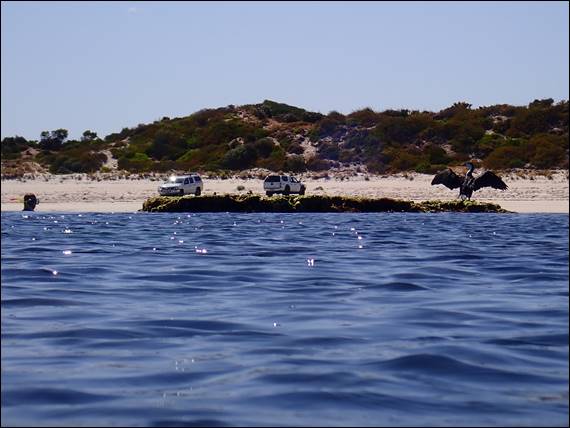
The Banded Sweeps, above, are present on every dive no matter the conditions. Even when all other life hides away these fish come out to say hello, so it seemed only right to include them at least once. Back on the beach Lisa was getting ready to make a cup of tea, yes we had come prepared, and as I drifted back in Megan was watching a Cormarant dry it’s wings:
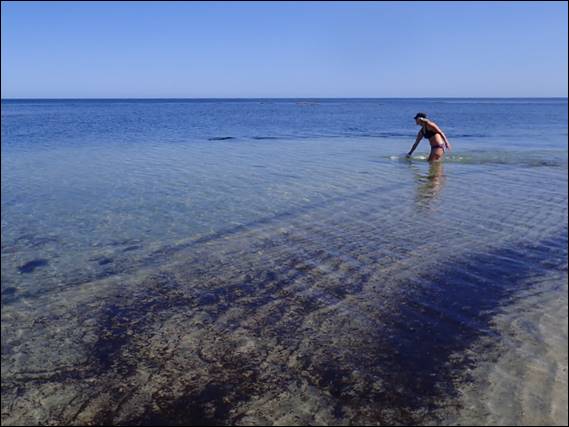
Almost as soon as I got out of the water a dolphin cruised past just metres off the beach, we tried to coax it to stay about but it kept going. It was then time to warm up and catch-up of what everyone had seen. In addition to Catsharks and Wobbegongs, which I hadn’t spied, the one that I was most jealous of was Monica coming across a Cuttlefish! I’ve seen one before but would love to see them again:
Esky and Megan drove off leaving us to some decadence of a fresh brewed tea to warm us up. I however was keen to get back in so left the girls to have a brew while I went to see what else lurked below. In the first dive I had worn my short wetsuit and also a weight belt, which I had only just bought. It certainly helped me with staying down and not floating back up, but this time I went in without it:
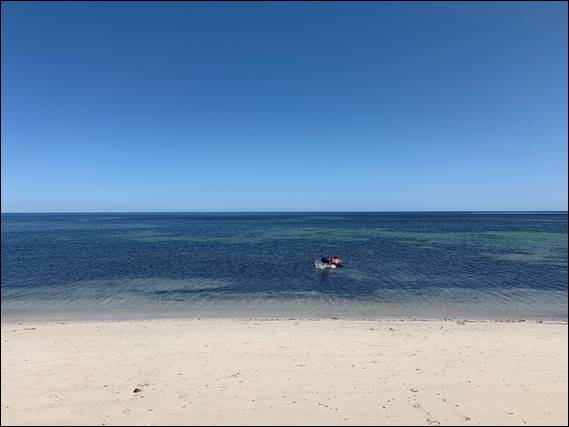
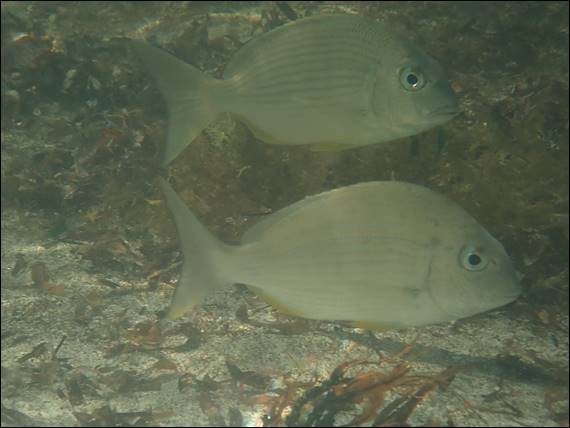
This time I did get to see a Catshark, but no Cuttlefish. The water was just starting to turn as I was out there, but the conditions held enough for me to have another god dive. Almost immediately off the beach I snapped a couple of Tarwhine, very similar to the bream family but with a more rounded forehead and slightly different pattern. These were little ones and they can grow to close to half a meter:
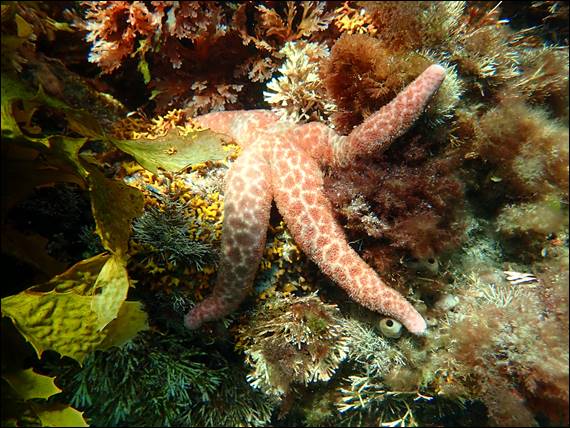
I also found a second Echinsaster Arcystatus, this time is much shallower water allowing me to take a better image of it. I’ve read that it resembles Plectaster Decanus (the Mosaic Sea Star) but is bigger in size, less brightly coloured, has a pattern that comes across as more mottled and has arms that are thicker and more round. Um I’m not sure how it resembles a Mosaic Sea Star it at all:
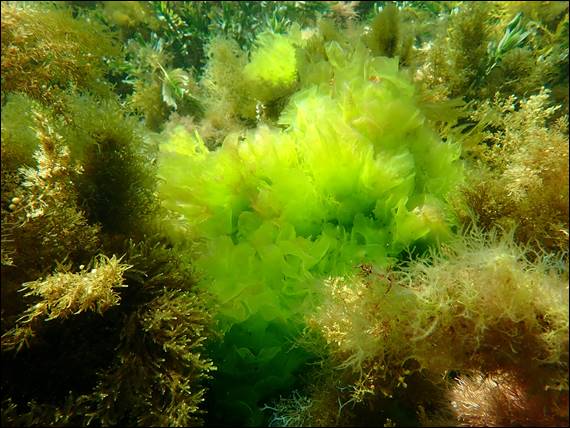
I’ve also seen a fair bit of what I believe to be Sea Lettuce. You may recall the post in which I had lots of photos of various sand gobblers, often call sea cucumbers. Well like them I’ve read sea lettuce is edible not just to sea creatures but also humans. If it is, then I could in theory harvest it not just for use in salads and soups but also make ice cream and medicine:
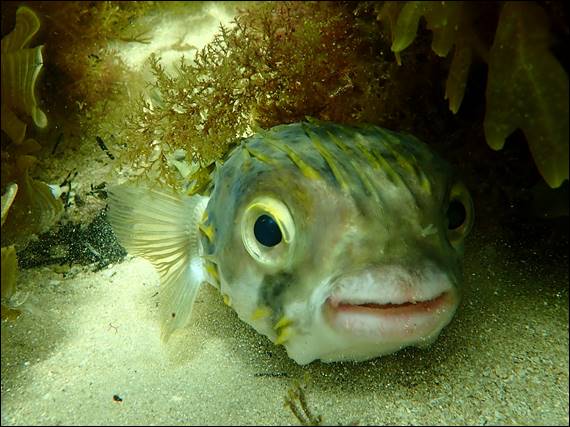
During the first dive Nana had found a Globefish in a nook, one that it could not escape from. While I have seen loads of these fish, I rarely get to see them face on. It was however a bit deep and so the light wasn’t that good. This time I lucked upon one that was not trapped and seemed happy to say hello. It didn’t even swim away when I got this close, so I left in it piece before finally getting out:
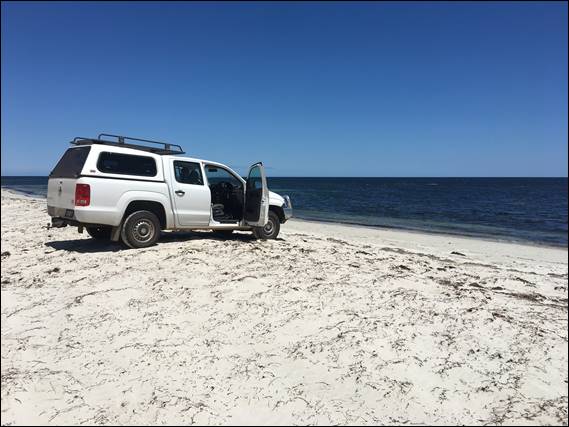
There was a cuppa waiting for me, which was very welcome. The wind had started to turn and the glassy flat water was gone. We packed up and drove out, being a Friday there were very few people on the beach and it was an easy drive out on the more compact sand. It got a bit soft at the end but we sailed over that. Back home the gear was cleaned and prepared for the next trip, which happened to be the very next day:
Come Saturday we had a bigger convoy, starting with four cars and ending up with seven. We ventured a bit further along the coast, and as we drove out Lisa and I were wondering how far we had gone and at what point we had passed the bay from the day before. The coast goes on and on like this for some 6km like this and there is reef the whole way:
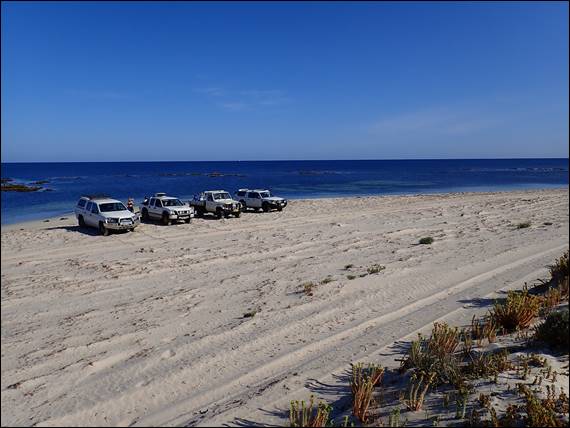
With yet another very low tide there was lots of reef sticking out of the water. These created labyrinths to explore but at times they led to dead ends and you had to reverse out. If there had been a swell I image you could get knocked about a bit, and possibly also cut up. Today I had my wetsuit on offering a bit of protection in the narrower parts I venture. I also had the weight belt on allowing me to sink and float along the bottom, sneaking up on fish:

Hidden amongst the weed there are so many different fish. Often you just get to see them out of the corner of your eye, as they dash for cover. But today these Brownfield Wrasse above were not quick enough to hide. They are usually very fast to go under the weed. I also spotted the follow fish, and I am stumped with this one. I was hoping the body shape and large eyes would give it away but I’ve had no luck:
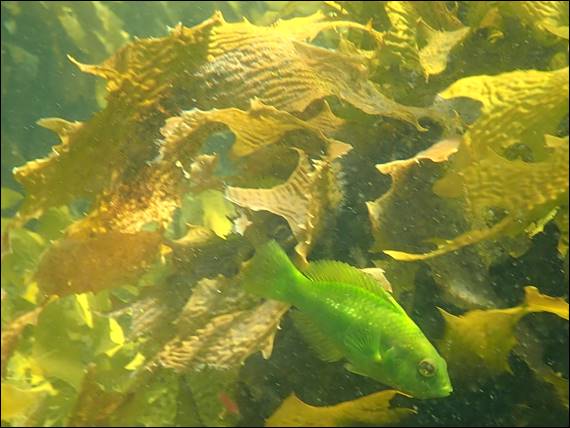
Here is another fish that is usually quick to hide, an Old Wife. Something I didn’t know was that the dorsal and maybe the other fins have a spine that has venom in them, and they have also been known to set up “cleaning stations” where they remove parasites from other fish. So you could say the film Shark Tale, in which fish set up a cleaning business was loosely based on real events (ha ha):
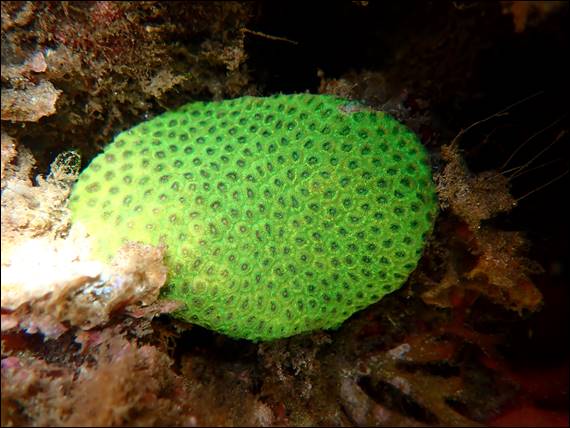
There is only so much sitting on a beach that I am capable off, and it seemed like no one was in a hurry to leave. So like the day before, after warming up on the beach, I went out for a second snorkel. I again found something green, this time it was a fluorescent green coral. I’ll take a punt and suggest that it may be a Diploastrea Heliopora, or more commonly called Brain or Honeycomb Coral. If correct these corals can become enormous, but this one was only ten centimetres long at best:
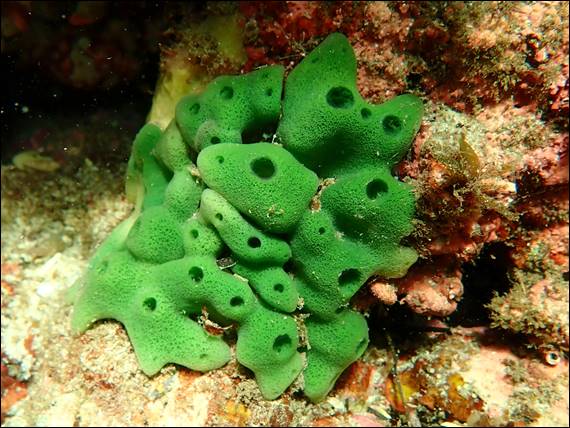
The green theme continued, as I found what I can say with more certainty is from the Chalinidae family of sea sponges. It is a Haliclona but breaking it down any further is impossible, as there are over 400 species. Sea sponges are very complex, created by a cluster of cells each organized to perform specific functions. If the cluster of cells is split up it can be possible for them to reorganise to create a new sponge:
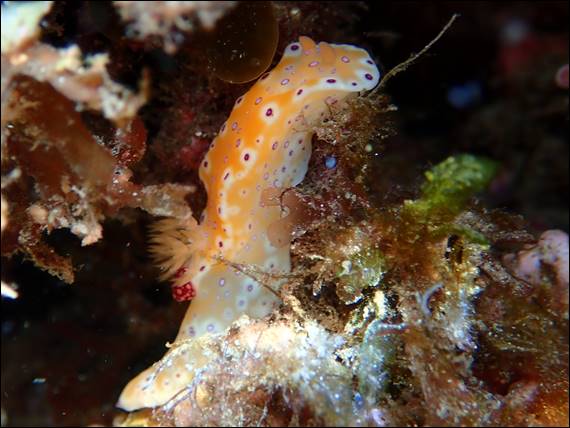
My next find was the best of the two days. This is a Short Tailed Nudibranch named due to the strawberry looking tail behind the gills. Whilst these may be common it is the first nudibranch I’ve seen this season. They feed on sponges and the tail is actually a gland in which the toxic chemicals extracted from the sponges are stored. The brightness of the tail lures any predators and hopefully deters them due to tasting really bad:
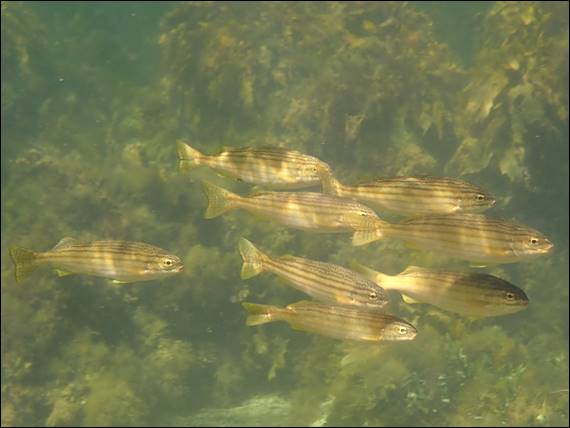
As I started to head back in for the second time a small shoal of Western Striped Trumpeters circled me. So in view that they put on such a good show I had to include an image of them. They are part of the grunter family, a name that comes from the croaking sound it makes when stressed, a sound created by expanding and contracting muscles attached to the back of the skull:
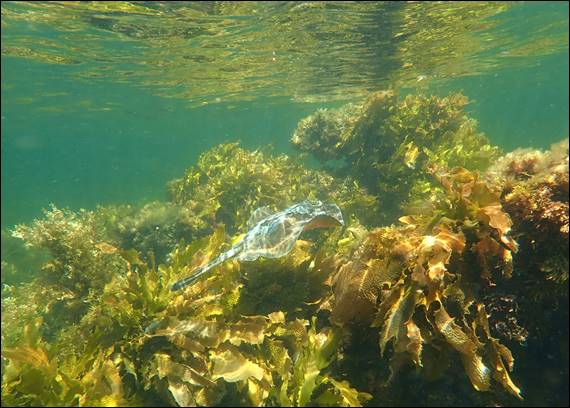
One final image. Yet another smooth ray, which swam past me on the final leg of my four snorkels in two days. I was in no great rush to get out so followed him for a bit, and he seemed fine with that allowing me to swim next to him instead of behind as usually happens. While I got very close I particularly like this image just because of all the colours and how the light is dancing on the rays back:
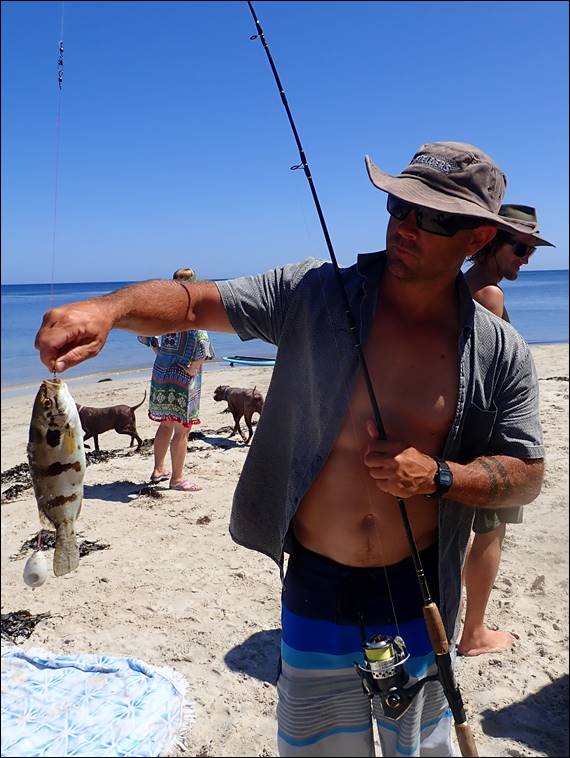
Back on the beach, I found Gav still trying to catch a feed. He hadn’t been too successful having caught a Blowie and this fish, both destined to be put back in the ocean. We were not sure what this one was, so I said I’d try and identify it. However, despite the distinct pattern I’ve not managed it name it so will put it out there, if anyone can help:
As Lisa and I drove out, and me being a bit of a rookie to beach driving, I made a few basic mistakes at the last section. There were heaps more cars on the beach and the last section had been churned up, making the sand much softer. With just ten or so meters of soft sand to go I managed to get bogged, fortunately the crew were not far behind so with some helpful tips and support from Gav I got out. It was my turn to feel a bit green.
 Sandbagged