Important update as of May 2022 for anyone intending to climb in Central Australia:
Access is an ongoing issue at many of the climbs around Alice Springs. Some consultations have occurred in the past for climbs but there is a lack of clarity around the status of many places. Rock climbers of Central Australia (RoCA) was a climbing club formed in part to clarify which places are culturally approved to climb at via consultation with the traditional owners. It is unclear if RoCA is still in existence, as such it is recommended to contact local climbers to find out the current situation regarding access. This can be done via the Alice Springs climbers Facebook group.
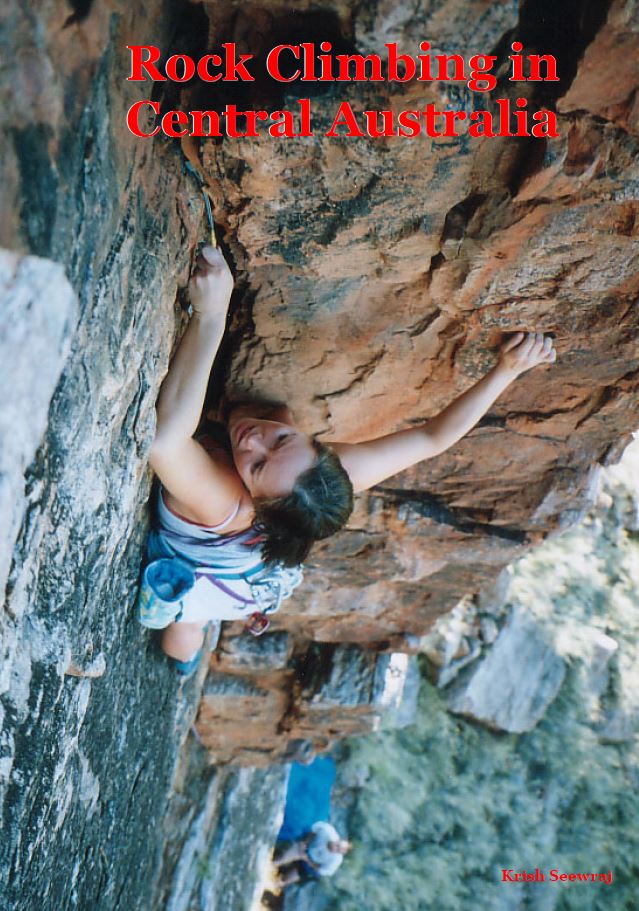
I published Rock Climbing in Central Australia in March 2005, which is now sold out. If you are keen you can download a copy from my post that includes Alice Springs newsletters and guides (note that this is a large file at approx 100MB). If you do not want to download the full document, but are interested, below is a full copy of the history section:
The history of Rock Climbing in Central Australia up till 2005
The history given in this section comprises extracts from old records and snippets from more recent events. These are historical records and some of the routes mentioned here are in areas where climbing is currently banned and therefore, the route and often crag descriptions have not been recorded, see Section 4.
Climbing in Central Australia has been a bit like the rock of the area, erratic. Many climbers have passed through, some stayed a few days and others years. With no consistent core and ever changing faces there have been many small groups of climbers, some active at the same time but unaware of what others have been doing. The area is vast and offers an abundance of rock, much of which looks good from afar but after battling with spinifex ridden, rocky approaches are disappointing. There are however some great climbing areas that have been found since climbing activities have been recorded in the area, with the earliest recorded events occurring in 1968.
The following extract is taken from the “Guide to Rock Climbs in the Northern Territory” written by Helen and John Griffiths in September 1973. It is recounted in its entirety with occasional editors notes made in bold.
“The earliest recorded climbs in the Northern Territory date back to 1968-1969 when Gordon and Pam Oates were living in Alice Springs. An English girl Pauline Mason also climbed with them during this period. All their climbing was in the immediate vicinity of Alice Springs, Honeymoon Gap, Wigleys Waterhole and Standley Chasm. Apart from the one climb at Standley Chasm, all the routes were free climbs. As accurate route details are not available, these climbs have not been included in the main text of the guide (the records were very scant and of little use, and have not been included).
After 1969, no more climbs were recorded until July 1972 when Garth Powell and Keith Seddon put up “Sunday Morning” (grade 5) a climb at Robin Falls in the Top End of the Northern Territory. This year marked the start of concentrated climbing in Central Australia, the next event being an attempt on “Kangaroo Tail” (Ngaltawaddi – Digging Stick) at Ayers Rock (Uluru) in July, by Andrew Thomson and Keith Lockwood. They succeeded in climbing about 140m before one of the park rangers ordered them down and made them leave the park (climbing at Uluru (Ayres Rock), Kata Tjuta (the Olgas) and Watarrka (Kings Canyon) is now banned).
Climbs began to be recorded with some regularity when Helen and John Griffiths moved to Alice Springs in August 1972. Their first climbs were in the MacDonnell Ranges close to town: Heavitree Gap; Emily Gap; Jessie Gap and Burt Bluff. During this time Fergus Hughes also began climbing with them and the three attempted to climb Chambers Pillar, a fantastic monolith that rises 68m from the plain on the edge of the Simpson Desert. Lack of necessary equipment and psychological problems (caused by extremely poor rock) forced a retreat (climbing at Chambers Pillar is now banned).
At the beginning of 1973 Keith Seddon arrived in Alice Springs and teamed up with John Griffiths (Helen Griffiths being absent for nearly three months). Together they investigated Serpentine Gorge, putting up “Terrapin” (grade 15 M1), and then spent time doing climbs in Jessie Gap. When Helen Griffiths returned to Alice Springs, the three climbers opened up many new areas: North Face of Mt Gillen, Ooraminna Pinnacle, Corroboree rock, Trephina Gorge and Glen Helen. These three also did the first ascent of Chambers Pillar (grade 14) in June 1973 a few weeks after the completion of “Kangaroo Tail” (grade 16) in May by Lockwood & Thompson. These last two climbs are the most serious undertakings, so far in the Northern Territory.”
Between 1973 and 1989 there are no written records of climbing in Central Australia, however the following extract is taken from an account given by Bill Delano for the period of June 1974 to December 1976.
“I learned to rock climb thanks to some climbers passing through the Alice with whom I no longer have contact. We survived the brittle sandstone and lurking snakes, and did numerous climbs, including ascents at Heavitree Gap (beside the tracks), Emily Gap, Trephina Gorge, Simpson’s Bluff, and one particular climb to the East of Alice on a prominent pinnacle that was quite a showpiece. We were devout followers of Chouinard clean climbing dogma – placed no bolts, and didn’t use chalk. The group of climbers active in Alice Springs at the time were: Ken Jones, Jill Watkinson, Ted Malthouse, John Hart, Tom Moore and Peter Walton.”
Any climbing that was carried out between 1976 and 1989 now only exists in the memories of those who made the ascents. Rick White, Doug Scott and Sharu Prabhu visited the centre in 1989 and were known to have done two lines in Watarrka (Kings Canyon). They also wrote up another route on Mt Conner but the description was somewhat vague. About the same time a small group of young school leavers including Danny Brennan, Danny Priester and Shane who was known as Snowy, started climbing. Between 1989 and 1992 they visited local areas including Charles Creek, the Quarry Wall, Emily Hills, Jessie Hills and Benstead Creek. They top roped and soloed most routes until they met a local tree surgeon known only as Mike, who introduced them to lead climbing and bolting. Together in 1990 they probably placed all the bolts at Charles Creek and later on placed the “D” shackle bolts that used to exist on the climb now known as “Lord of the D Shackles” (21); unfortunately there are no written records of their achievements. In the same year that Charles Creek was bolted two other climbers came to stay in the town, but they are not known to have climbed together. Catherine Fitzpatrick took novices out to the cliffs teaching them as they climbed, there are again no records of these activities. The other was Roark Muhlen-Schulte, an experienced climber with a reputation for putting up hard, bold routes.
It is rumoured that Roark was responsible for placing most of the bolts at Tjilka, Ormiston Bluff and the Quarry Wall. The only published material comes from Simon Mentz’s annual visits coming to the centre to climb with Roark. Together they moved Central Australia climbing into the modern era with the highly controversial first ascent of “Tjilka” (26) in 1992, see Section 14.7. Simon Mentz also climbed with James McIntosh and Jan van der Meulen putting up new routes at the Unknown and Trephina Gorge, including two lines at the Unknown that they part bolted one being the excellent “Superfreak” (20). Roark married and left Alice Springs in 1993 but not before climbing “Pre-Nuptual Adventures” (23).
Kieran Culhane came to town in 1992 and in 1993 joined forces with newcomers Damian Auton and Libby Evans. They repeated local routes and put up many new climbs, old and some new friends joined this small climbing team and they became known as the Yerbas. This group of people was incredibly devoted to climbing and the construction of the YMCA climbing wall in 1994 can be attributed to their enthusiasm, especially Damian Auton who designed the wall and oversaw its construction. In September 1994 a climbing competition/fun day was held at the rock wall. This brought renewed interest from retired climbers and kindled interest from plenty of beginners; as such the climbing community in Alice Springs grew larger than ever before. In March 1995 the Yerbas put out a local climbing rag called ‘Crank It’ of which six issues were produced over 18 months.
Another prominent climber, making annual trips to the centre from 1995, was Goshen Watts who originally completed many new routes by teaming up with the Yerbas. However, Damian, Libby and Kieran left Alice Springs for cooler climates in late 1996 and the era of the Yerbas left with them, but not before Damian and Goshen placed the bolts on the visionary “Non Stop Action Groove” (28) a climb that was not to be ascended until five years later. In 1996, the next significant step in centralian climbing occurred with a whirlwind tour by a group of high profile Victorian climbers including Malcolm Matheson (HB), Glen Tempest, Simon Mentz, Chris Peisker, Michael Hampton and quite a few more. Many new climbs were put up, notably “Downwind of Vomit” (18) and “The Nose” (24). New areas that were opened up during this tour included Kings Canyon, Mt Conner and Ross River.
Between 1996 and 1998 local climbers including Jock Morse, Sam Latz, Dan Ewald, Steve Greig, Paul Cooke, Jo and Nick Isgro continued to climb, repeating many existing climbs and putting a up a few new ones. Sam Latz was the most active climber getting out regularly and putting up a number of good climbs. However, it wasn’t until Mark Rewi arrived in 1998 that climbing was again pushed up a level with some bold climbs being ascended such as “Faceless Enemies” (21) and “Liquid Sky” (24). Mark returned on an almost annual basis. In-between his visits climbing in the Centre continued to be kept alive through the efforts of the small, but keen, local crowd. Not many new areas were developed, but the established areas received many visits and some quality lines were put up. Chris Hogarth and Iain Paterson also left their mark during a short period in the latter half of 1998, concentrating their efforts in putting up new climbs at the Unknown, the most serious being “Little Drum Machine Boy” (24).
In March 2000, interest was renewed when Krish Seewraj came onto the scene. Teaming up with anyone that could get out, the number of recorded climbs in the centre was increased by fifty percent in two years. Old areas were revisited and a few new areas were established with first ascents of old problems like “Oedipus Shmoedipus” (19) and the direct finish to M&M’s (16) called Mee-Gwitch (19). New climbs like “Pure Delight” (19) and “Hidden Courage” (21) are just a few of the worthwhile climbs established. The local climbing area of Stegar Road received an onslaught of visits in 2000 and 2001 including one from Mark Rewi, when he convinced some friends to help drag a generator up to the Quarry Wall and Left Wall to create the hard and sustained “On Seas of Desire” (25) and tricky “One for the Girls” (25).
Members of the local climbing community continued to fluctuate as people came and left. Some of the more significant climbers who graced the area include Justin Harrison, Jason Geres and Pat Spiers. In late 2001 Goshen Watts made another trip to the centre with Richard Lodge and finally completed his long-standing project “Non Stop Action Groove” (28), which remains the hardest climb in the centre. During this trip they also bolted and climbed the fun “Mini Cooper ‘S’” (24) and, unfortunately “Areyonga (Permit Only)” (24) which should never have been done, see Section 14.7.
From mid 2001 until the end of 2002 Mark Rewi, Pat Spiers, Jason Geres and Krish Seewraj were the main driving force of the area with ascents of classic new climbs such as “Gnome Napper” (20) and “Avoiding a Greek Wedding” (23). Unlike Mark, Pat and Krish preferred hand drilling when they put up “Come On Face!” (24) and “Spooked” (23) on Left Wall, which also gained the brilliant “Fight to be Free” (23) and possibly the hardest natural line in the centre “Git Face” (25). This completed the development of the Stegar Road area and has made it the perfect location for visiting climbers, being close to Alice Springs and sporting a wide variety of grades and climbing styles.
Climbing activity in the centre slowed down significantly at the end of 2002 when Mark, Pat and Jason left town. Karl Godden and Claire Helm came to town for six months from the end of 2002 and repeated and confirmed the grades of many of the recently established harder lines. Krish kept the climbing community going by introducing a number of locals to outdoor climbing and helping new comers find the best areas. Some of the longer term climbers included Steve Warren, Warwick Beever, Steve Thornton (who originally starting climbing in the area when the Yerba’s were going strong) and Garn Cooper.
Garn, a seasoned Tasmanian climber who had previously worked in the area for short durations, arrived for a longer stay in early 2003. During the next couple of years, with the help of Dave Koskuba and various friends who came to visit, he repeated many existing routes and put up some good lines. Unafraid of long walks and keen to find new locations he established several crags around Serpentine Chalet, Serpentine Gorge, the Davenport Ranges and most significantly Boggy Hole. Of the many new climbs established some of the best are “Come Back to the Light” (17), “The Fateful Lightening” (18), “Projective Space” (17) and the gothic line of “Hammer” (17).The Northern Territory bouldering championships were held at the YMCA climbing wall on Saturday 21st August 2004. This was the first time the competition had been held in Alice Springs and Mark Baker came to set the routes and judge the competition. Eleven people entered, with ten of them coming from Alice Springs. The only entrant from out of town was a Singaporean called Johann Annuar. He just happened to be in town for a few days on a break from his mammoth round the world cycle trip.
 Sandbagged