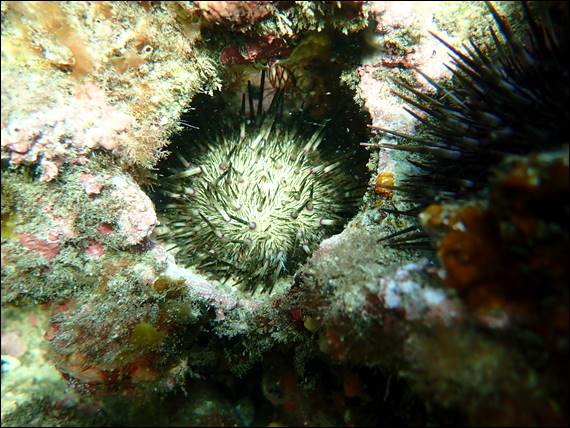
Not put off by my last venture off Peppy I went back in yesterday. While the ocean looked deceptively calm, there was still a underlying swell, resulting in the water being swished back and forth. All that turbulence brings with it a stirring of the pot and as such any loose weed, and of course the fine sediments, get mobilised in the water. That said it wasn’t too bad visibility wise so I persisted. I scanned the pocketed limestone reef, which provide a haven for the Purple Urchin. This is the most common urchin in the area, yet strangely they are not all purple:
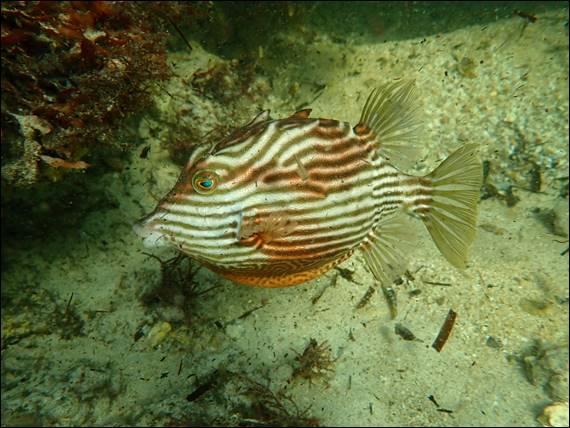
There are a few favourite spots for me to go, as I know where fish like to hide away in caves in the reef. At one I found a Shaw’s Cowfish, after a couple of duck dives this one didn’t swim off to the safety of the nooks and crannies. It did however turn it’s body to look you in the eye, with just one of its eyes. This results in it being hard to get a nice side on image, but eventually it obliged resulting in me being able to leave it alone. At this location there is another fish I see regularly that darts for cover, one day I hope to get an image of that one so I can identify it:
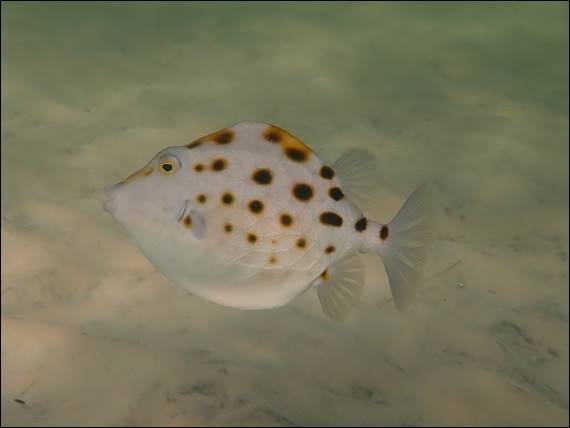
On this dive I finally sussed out a trick to keeping my googles from misting up that works (for me). I’ve tried many approaches, and have finally realised that toothpaste is the go… as long as you don’t wipe it on or off with your fingers. The grease on your fingers for some reason results in the mask misting up. So with clear goggles the slightly disturbed conditions didn’t put me off as much as usual. Eventually however it was time to head back in, as I was cooling down, and it was in the wide open sandy area that I came across this Western Smooth Boxfish:
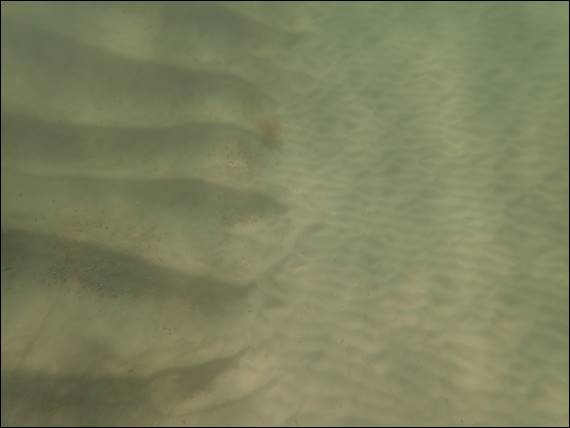
I make an effort to spend some time in the wide sandy patches between the reef and beach, you never know what you’ll come across and have seen some amazing sights. Today other than the boxfish there was not much to see. However, as I swam along the shoreline I noticed how the wavy pattern in the sand, which usually runs or near parallel to the shore, changed. There was a distinct patch some 20-30m wide where the wavy pattern was much larger and more pronounced. There was any obvious reason for this that I could figure out:
Today instead of a morning snorkel I spent half the day in the garden clearing the passion fruit off the shed. Sounds like a small job, but it was not and it took us the whole morning. I’m glad it was an early start as we avoided the heat of the day, and by midday I was ready to jump in the water regardless of what it was like out there. The ocean looked a little wavy but that was fine I just needed to cool off. Once out over the reef I was very pleasantly surprised to find clear waters and great visibility:
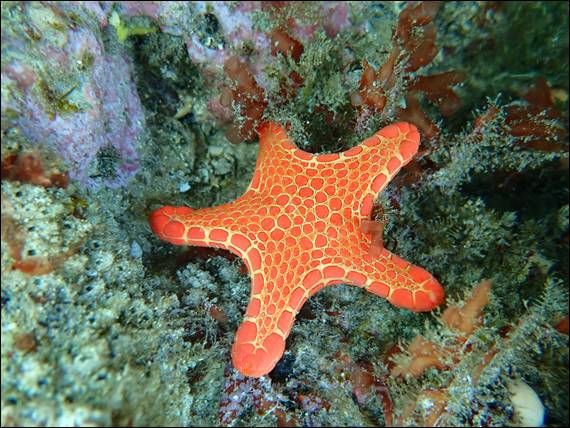
When the visibility is like this I’m more comfortable going out further and checking new places. I scoured the reef and found stacks of sea stars but my favourite one has to be the Biscuit Sea Star, shown above. As well as reef the coast has healthy patches of sea grass and I scoured that too. Sea grass is an important barometer of the condition of the bay, supporting a vast array of sea life such as this Shore Crab. While the clarity of this image is not great, belying my claim of clear conditions, it is a rare sight for me to see crabs feasting like this so I had to include it:

As I checked out the unfamiliar territory, with a mask that wasn’t misting up and clear waters, I spied what is commonly referred to as a Sea Cucumber. They are in fact Sand Gobblers, for the very obvious reason. A bit like a worm, as they crawl around on the sea floor, they take in the soil that lies in front of them digesting the rich organic film that coats the sand. I often see the characteristic trail of deposited sand in the smaller sandy patches in-between reefs and weed, but rarely do I see these fells out in the open as they feast:
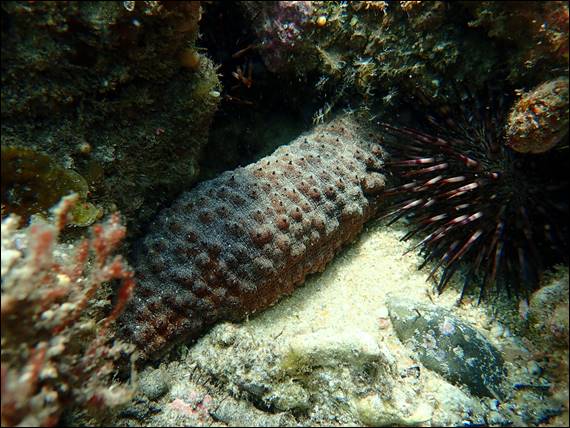
As I bobbed about in the increasingly rough surface, the waters remained clear below and I spied another Sea Cucumber tucking against an open crevice. I’m going to take a stab in the dark, well a guess informed by Google, and say that these were Herrmann’s Sea Cucumber’s. I had an incline that some species are a delicacy in various countries, and assuming I have identified it correctly this species is also referred to as curryfish. Being harvested commercially in some areas such as Indonesia and used for soups:
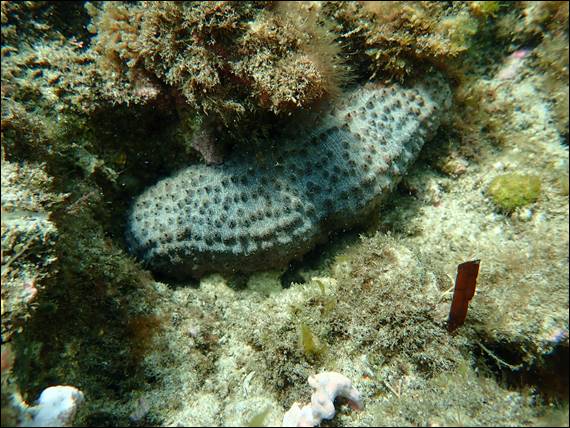
Google also tells me that this species was originally not harvested because the flesh would easily disintegrate, but modern processing methods have overcome that making them a high value product. The field guide, which I check out these finds in, suggests further that the leathery skin is transformed into a gelatinous concoction during cooking. Sounds delightful! I kept finding more and more Sea Cucumbers, but am pleased to say that I took only photos leaving them in place. So if we do offer you as summer salad it won’t contain these cucumbers:

 Sandbagged