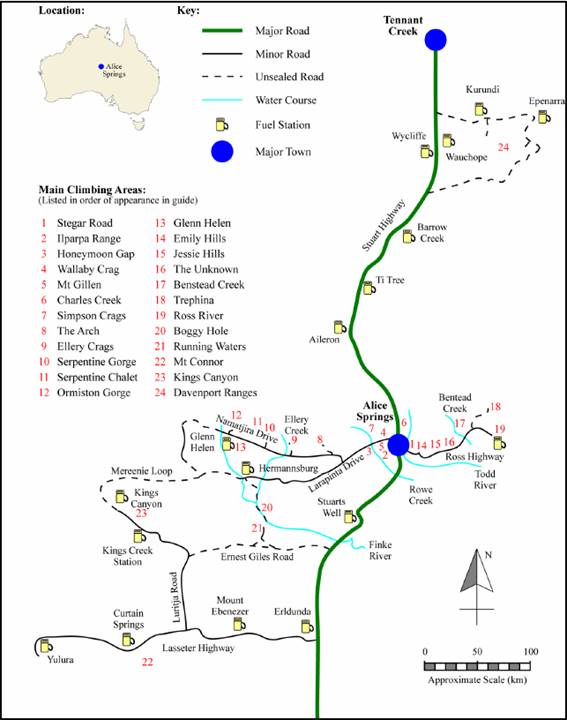
This is the last email and covers my five years of fun exploring the amazing playground that the Red Centre has to offer. In previous emails I focused on one area and pulled together snippets of my climbing exploits in each. For this email I am covering a heap of places and I was a bit stumped as to how to start. Then delving through my files I came across a document detailing my time in Alice that I had prepared in 2005, after I had published the guidebook of Rock Climbing in Central Australia. As such this little ditty is based on that write-up combined with other memories brought back while going through our photo albums and typing. This email, unlike the others, has not been driven by the images but the images have been added to the text. While it may read a bit differently to the previous emails, probably jumps about a little bit and is certainly the longest read I hope you will be equally entertained. To get the ball rolling below is the crag location map from the guidebook, I will however not mention all the locations as I didn’t climb at all of them:
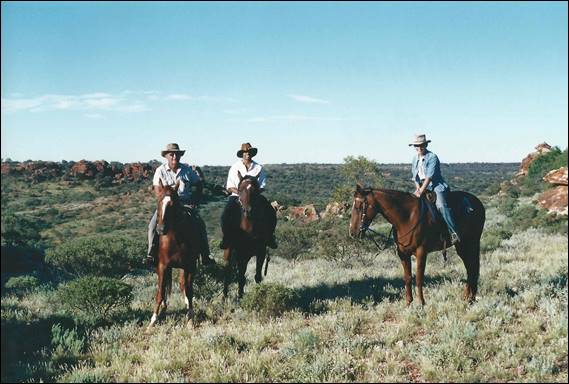
In March 2000 all the belongings I thought necessary for my new life in the Red Centre of Australia were crammed into one suitcase and a rucksack. This of course included my boots, harness and a few essential bits of hardware (in truth nearly all of my rack). I was taking a gamble by leaving the life that had provided me free weekends to scour the UK countryside in search of rock; and leaping into a small tour business that had the potential to devour every hour I was awake. To help nail down the coffin lid on my climbing activity I was moving to Alice Springs. A place known by most, including myself at the time, as a one horse town in the middle of a desert. It seems appropriate to include the following non-climbing related image of Lisa and I on horseback in the outback with Bill, the owner of the Ooraminna Homestead. Only 30min drive down a very bumpy dirt track on which we though our old campervan would shake to pieces. Lisa and I used to work at this Homestead on weekends helping by cooking, serving, cleaning and taking wildlife tours when bus groups rocked up for that outback experience:
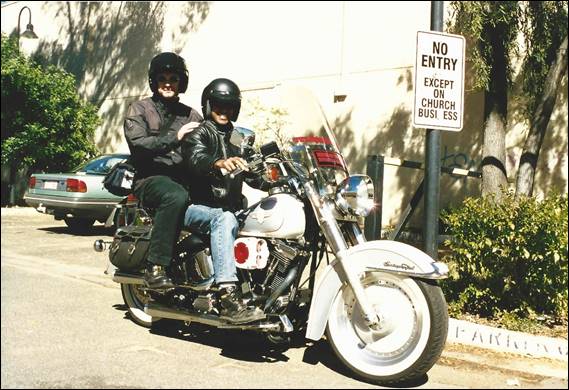
When I travelled to Alice Springs with my suitcase and rucksack I was travelling the cheap way, and that meant a two day bus journey from Melbourne to the centre. After passing Adelaide it didn’t take long for the scenery to change to a flat and almost featureless landscape. This continued for some 1,200km, and the lack of anything of a rocky nature helped conjure up images of my boots gathering plenty of dust. As we approached Alice Springs, in the last 30km or so, there were signs of land features that were significant and this raised my hopes. In the last few kilometres we passed through two sets of ranges that were up to 100m high. The second seemed to stretch east and west as far as the eye could see. More importantly for me I could see signs of small crags, so there was hope for my boots yet. So you may be wondering why I was moving here, well back in 1994 when I travelled round Australia for three months I made contact with a guy who owned a tour company. I kept in touch with him and after my two years in Africa had difficulty adjusting to life in the UK so looked for an alternative, and for better or worse I became a partner in his company. Yes this is me in jeans and a leather jacket riding one of the most impractical motorbikes on the market:
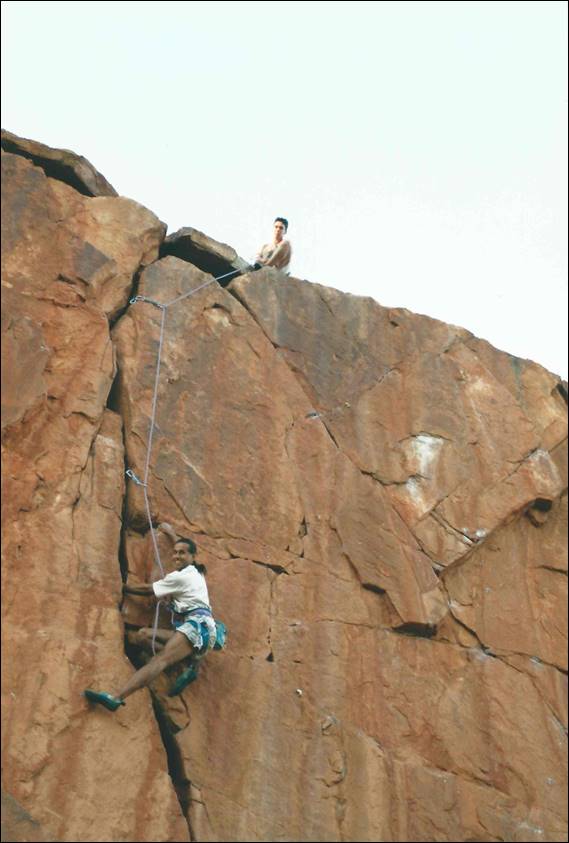
My first outdoor climbing experience in the Alice, since I travelled through the are during my 94 holiday (mentioned in my write up about Italy), was at a crag known as the Quarry. This wall provided an uncharacteristically steep and clean face, which happens to be located on the side of a road that leads to an old quarry. Even more unusual for the area is the fact that this 15m crag has a significant number of bolted routes. Left Foot Screaming looked for all intent and purposes a doable traditional line, although it did have one carrot at what I guessed would be the crux. Doable it was not and I ended up having to top rope the route, something that was out of character for me. Even with a top rope up I had to step even further into, what I felt to be, the dark side by hang dogging and piece-mealing my way up the climb. While muscle memory built up from many attempts over the years helped me to be able to lead it cleanly, it continued to prove a mental and physical challenge for me. Below is an image of me seconding Mark up the awesome Hyber Berger that is on that same wall at the Quarry, this climb will get mentioned again later as will Mark:
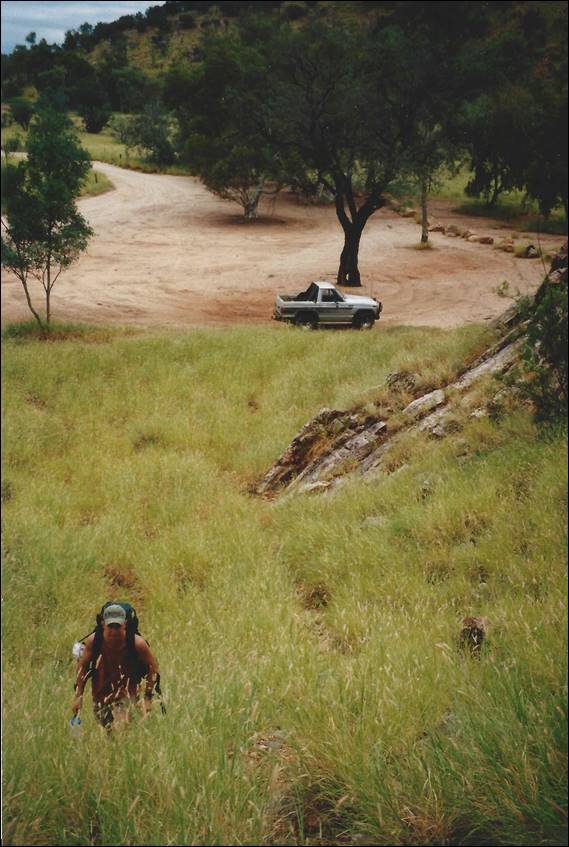
After this initiation of centralian rock I was very keen to step back to my preferred style of climbing, traditional ground up. It didn’t take long to meet up with local climbers and in a town of less than 30,000 people I was amazed to find groups of climbers who knew nothing of the others around. The fragmented climbing scene had also led to an assortment of climbing records floating round. All up there were about 200 routes listed. I was immediately immersed in the local climbing scene and was encouraged to help set up a climbing club, not so much a club really more of a collective voice to tackle the many access issues that I was to find out about. The climbing club never eventuated to anything, in fact after I put together a local newsletter people realised I was serious about it and most of them seemed to lose interest in the idea. Similarly the tour business turned out to be a lemon, it made no money and didn’t keep me that busy other than sitting round waiting for work. This meant that there was time to climb and I soon gained a reputation for being the person who would be available to climb at the drop of a hat, and with all the contacts I had made I was never short of finding a keen partner to get out with. Doug was one of the people that I first started to head out with, he worked at the US base called Pine Gap that has recently hit the news as being a spy base. We had regular trips out to Emily Gap during those early days, when the grass was tall and green:
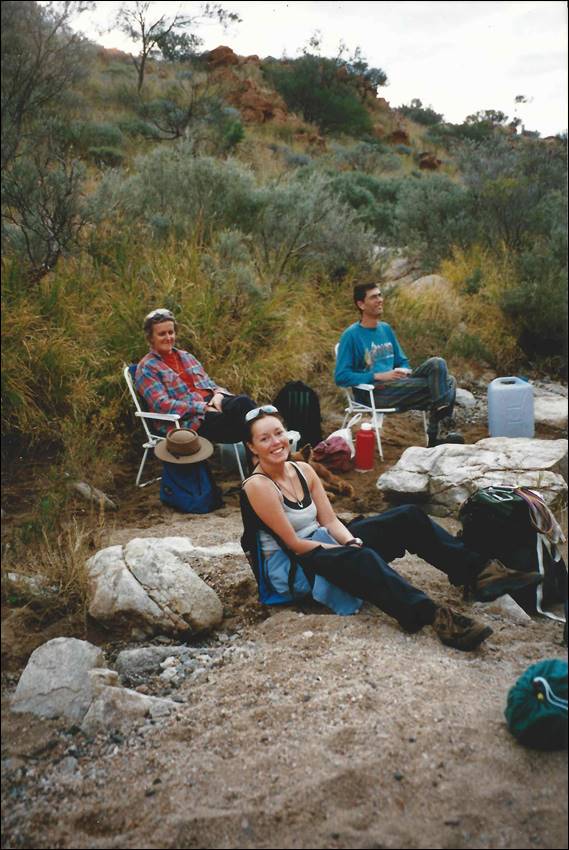
Alice Springs is a very long way from the nearest major town. Being so isolated it needs to be, and is, very well serviced. It is a pleasant surprise to most who venture this way to find that Alice Springs has just about everything they need. I was amazed to even find a decent sized indoor climbing wall, for which we need to thank a small group of very enthusiastic climbers. They secured funding and supervised the building of this wall back in 1996, which was run by the local YMCA when I got there and it seems that it is still in use today (according to their website). It was an amazing wall some 10m high with overhangs, vertical walls, corners and slabs. To boot there was also a 25m low level boulder wall made up of rocks stuck to a breeze block wall. It was the perfect place to train and meet potential climbers. During the first six months of my stay Lisa came out for a four week stint, to see if she liked Alice (and me) enough to move out here. During that visit she was introduced to the climbing crew and we had a social get together at a local crag called Charles Creek:
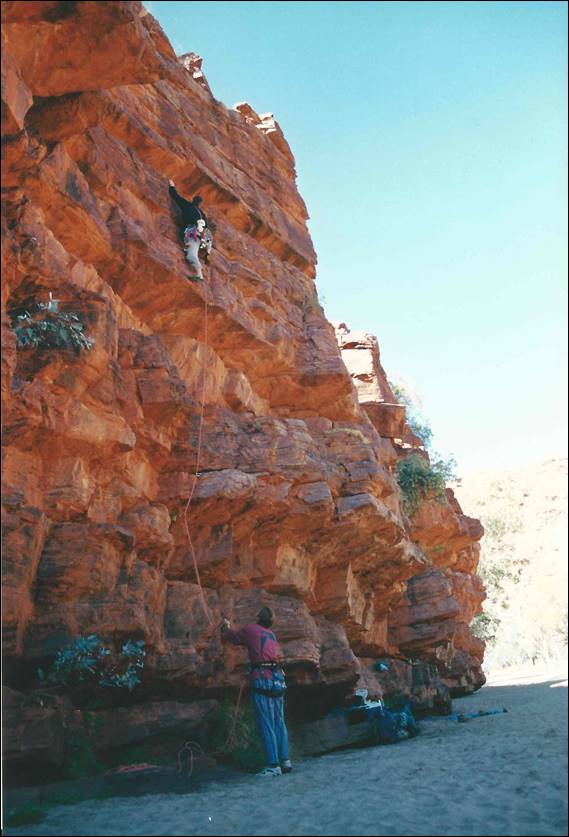
Within a month of living here I was invited out to Trephina for a weekend. Only 80km from town this National Park offers great walks, peaceful camping and not only a pleasant gorge but also a towering 120m bluff. My memories of this early trip are not so much of the climbing, where we managed to put up about ten new routes, but the stars at night. It was a dark night and moon was out late, allowing us the chance to see the myriad of stars and impressive Milky Way in a way I had never seen them before. To be able to drive for less than an hour out of town and camp under such a glorious canopy is something I never tired of and never took for granted. Below Dan is leading Café Negro, and this image shows the undercut nature of the walls. The sandy river bed made this a great place to boulder, but the bottom sections tended to be very smooth, made so by the action of water which would come roaring down these places. Most of the time however they were dry:
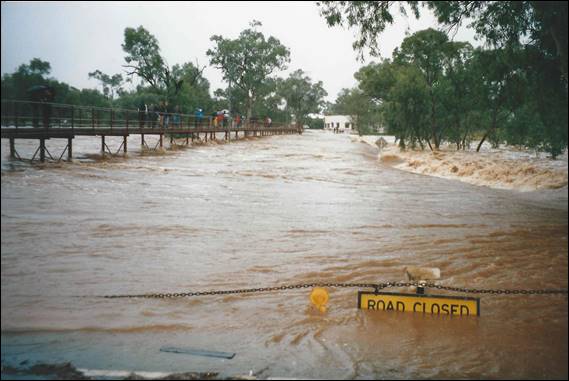
On this first trip to Trephina I also remember having the opportunity to climb in weather I was more accustomed to. I had arrived in the centre at an unusual time when the rainfall was three times the annual average. There was a low mist and dampness on the rock, and even more strange for the area there was water flowing through the usually bone dry gorge for an extended period, as shown a couple of images down in which Sam makes the first ascent of Mortal Thoughts. In the first two years of living in Alice Springs we were fortunate to witness two very wet years. I’ve slipped in this image of the usually dry Todd River that runs through Alice Springs, we got to see this kind of sight a heap of times in those early years. Across the water you can see Casa Nostra the Italian where Lisa got her first job, we used to call it the Cosy Nostril:
All of the rain ensured water holes were full of crystal clear water and the usually dry and dusty landscape was transformed into a floral haven (hence the previous image of Doug wading through the high green grass). Birds, reptiles and mammals were all plentiful and it was a great time to see and learn about the hugely diverse flora and fauna of the area. This helped me, seeing I was taking nature tours down at Ooraminna Homestead, and didn’t really want to bluff my way through too many of the questions. On one trip with Jock to Trephina we were walking round a big waterhole and we both sunk to almost waist deep in the sand. It was a pretty scary experience and we were not sure if we would get sucked in any deeper, just managing to get hold of some roots and gently and slowly pull ourselves out:
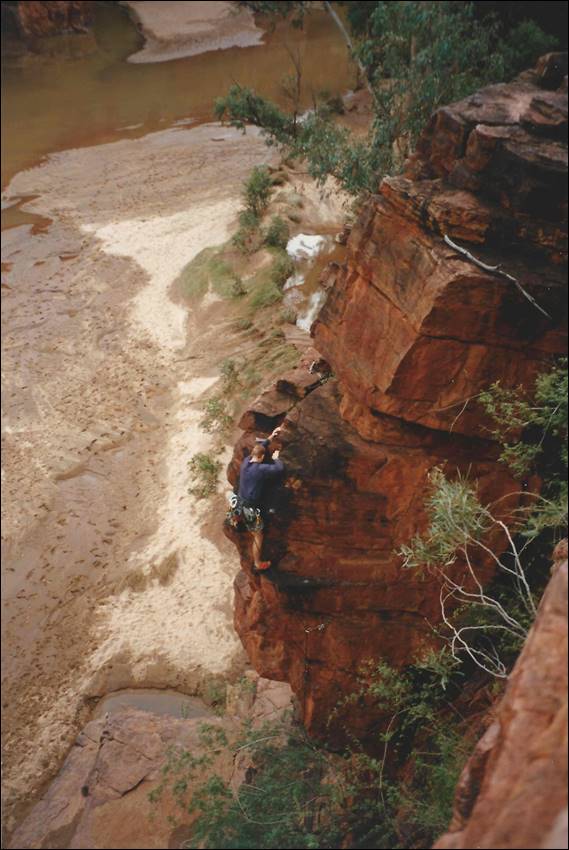
I went out to Trephina several times and on one occasion with Dan we climbed the mighty bluff all 120 glorious meters, and not just one route but two. The first was a direct line in three glorious 40m equally graded and nicely sustained pitches that we boringly called Direct Crack Line, a route I repeated with Lisa one time. The other route we attempted to climb was a wide chimney, that had been climbed many years back, and after the first pitch I had to get into the chimney proper and found it was littered with humongous teetering boulders. It was very, very scary and I backed off much to Dan’s relief. Instead we went up an easy ramp (in the middle of the picture below) and then another crack line that got a mention in my recount of Swanage. The last pitch looked tricky up the steep curving crack, so Dan sent me up and it was on this route that I have dropped more rock on my belayer than I had in all the routes I have ever climbed collectively. So came to be Boulder Ruckle, a memorable route but probably one that will never have a repeat ascent.
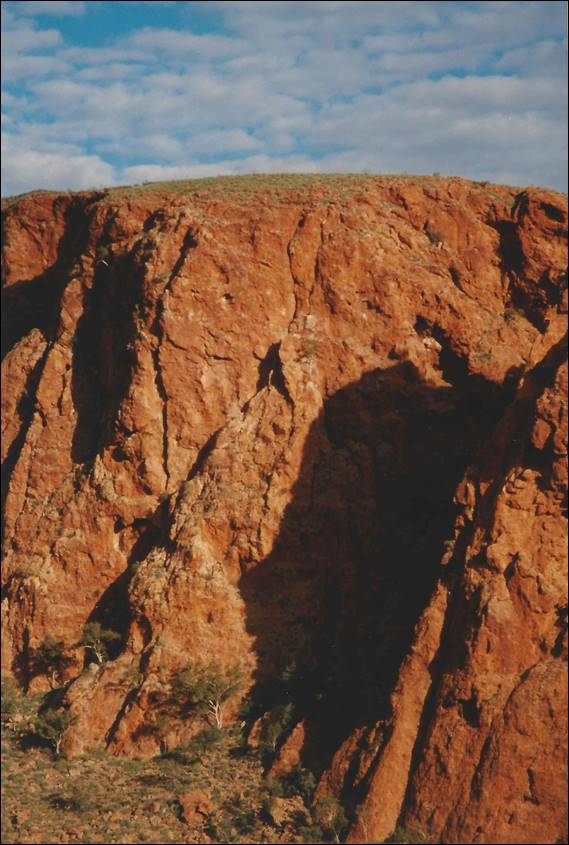
Trephina was a favourite place for Lisa and I to camp at and we would head here to climb, hike, have socials, take foster kids to, and play many a game of scrabble. We would always attempt to get campsite number 6 next to the dry river bed and underneath the bluff, which was on most occasions. The time that Lisa and I climbed Direct Crack Line it was a hot weekend but we were not put off and made our way up this stupendous line. This is all the more impressive as Lisa had never climbed a multi pitch route and was, and still is, afraid of heights:
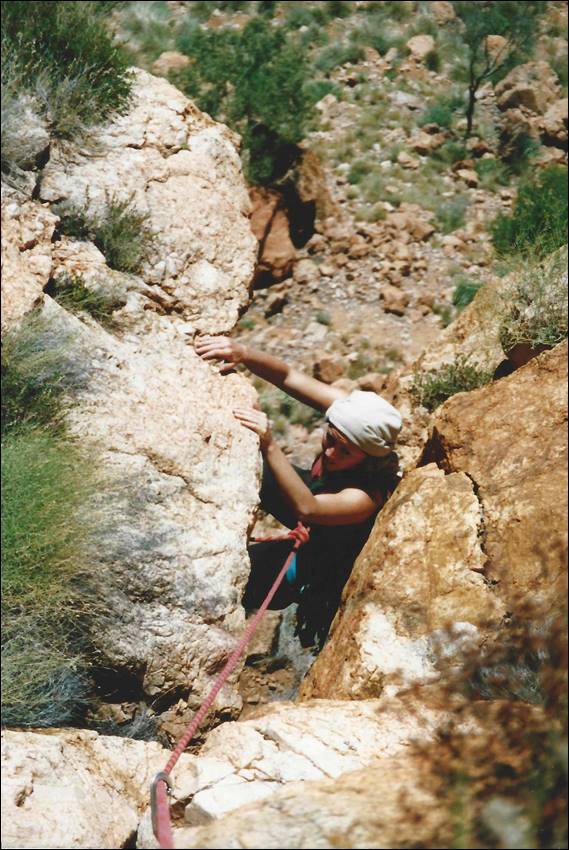
By the time of this trip Lisa and I had bought our campervan (Kermit), which we happened to be buy of a musician who played at Ooraminna Homestead. We got Kermit at a steal and had many amazing adventures exploring the area in him, including trips down south to the Flinders Ranges and across to the east coast and Townsville. He was equipped with a sink and fridge and on this trip friends from town happened to be out at Trephina and asked if they could store some beer in our fridge. There was room, so I guess we must have drunk all ours the night before. By the time we got up and down the climb our mates had gone, leaving for us wonderfully chilled beers which we had no issue with necking to celebrate a great climb:
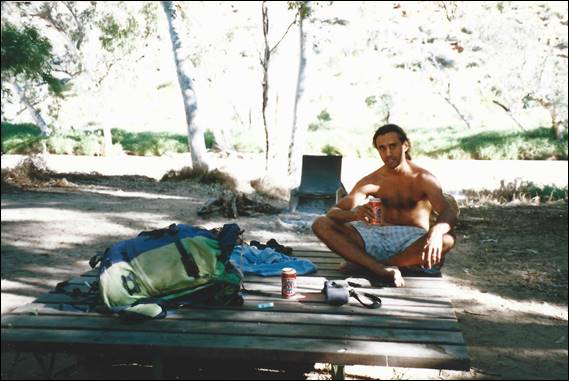
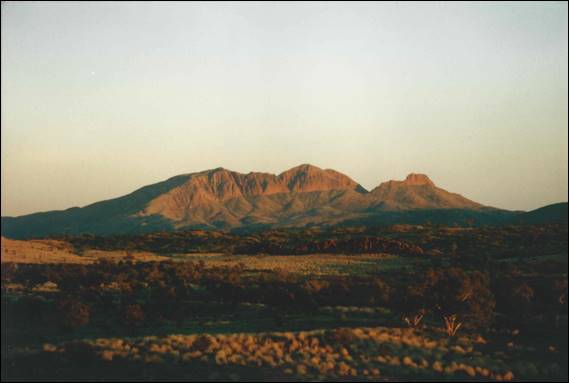
I got ahead of myself a bit above so going back to when Lisa came out to live in October 2000 I had already decided to throw the towel in on the business. So when she came out the first thing we did was move into a one bedroom apartment, then I left the business and was very glad to have that behind me. Alice is an amazing place for work, there were always heaps of jobs and you could diversify into so many different roles. This meant we were both soon employed and could find free time to explore the awesome countryside. Such as the very western end of the ranges where Mount Sonder the highest peak sits (below). We have been here heaps as it is near Glen Helen and 2-Mile another stonking place to set up for outdoor adventures. For our first New Year’s we hiked up this lofty peak leaving at first light and getting down by early afternoon in a stinking 44 degrees heat. When we got down we found a waterhole and immersed ourselves in it. We drank a welcome beer as we also savoured the well-deserved cool soak:
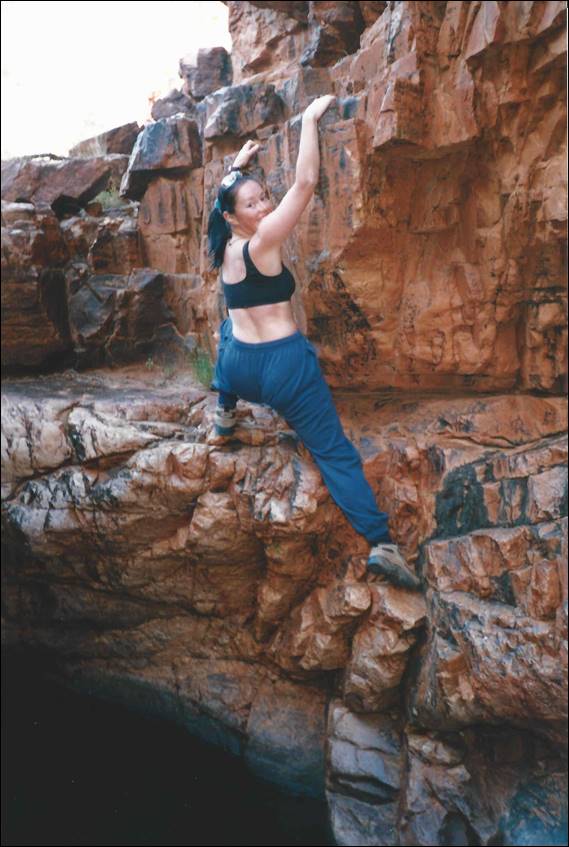
The ranges that stretch both east and west of Alice are called the MacDonald Ranges, and keep going for 200km in both directions. The rock is predominately Heavytree Quartzite, an ancient and very hard rock. With annual and daily variation in temperature of up to 50 and 30 degrees, respectively much of the rock unfortunately had a shattered or broken nature. Still there are some very good quality crags to be found, and quite a few were within 20 minutes’ drive from town. Most of the climbing exists on this Heavytree Quartzite but there is climbing to be found on limestone, Alice Springs granite and Merinee Sandstone. Below on our first trip to Trephina together, Lisa is bouldering on the Heavytree Quartzite as we explored some creek systems, and you may be able to see the polished look of the rock where the water has smoothed the edges and also removed any loose rock:
With plentiful rock near town regular trips out were easy to arrange. One of the areas we concentrated a lot of time in the first few years was Steager Road. This small range was the home of the infamous Quarry Wall, the outdoor climbing wall of Alice Springs. For many years people had climbed on the Quarry Wall, but records indicated that no one had bothered to explore the many other outcrops that were littered along this ridge. The main crag that we established was called Horseyard Crag. The climbing on this broken and not very steep wall is fun but certainly not outstanding. It was a good place to get people out and have a social, many of the people we climbed with didn’t go hard so it was the perfect crag:
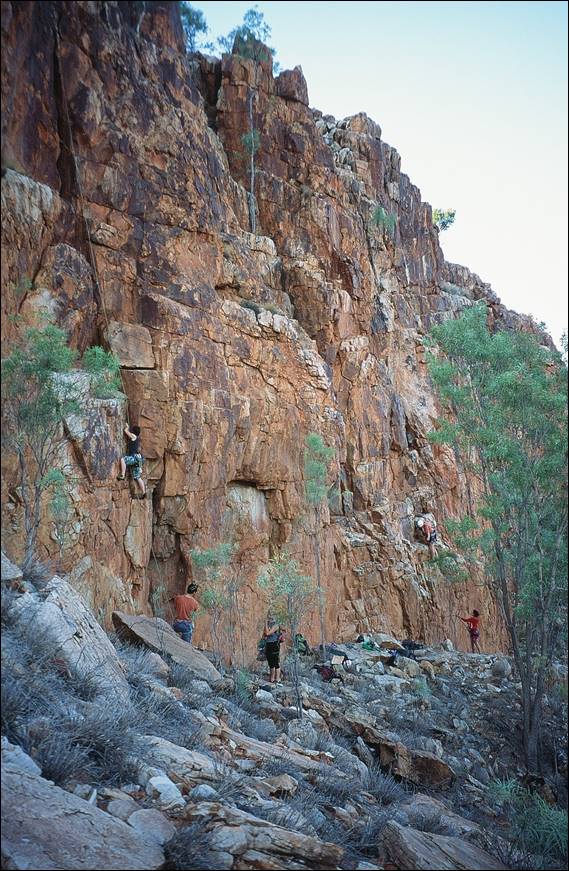
I have fond memories of the abundant wildlife we saw during our many visits here, they did not seem to mind our presence. It would be uncommon for us not to see large flocks of the majestic Red Tailed Black Cockatoo, who would graze in the paddocks behind the Horse Stables that lay directly opposite the crag. Wedge-tailed Eagles would soar high above with Black and Whistling Kites below them. We would climb with these large birds above us and have small Dusky Wood Swallows whistling past our heads as they moved in and out of the security of the crag. Belayers would sit and watch us while they were watched by Variegated Fairy Wrens and the many other small birds hopping around in the trees and shrubs. Big Red Kangaroos and Euros seemed to show no signs of being intimidated by us or our antics, occasionally they have wandered over to our packs to see what treats we may have for them. Left Wall was a great place for them with a sandy clear area where they would hide from the beating sun, while literally tem meters away we would be climbing and falling:
Another common visitor to Horseyard Crag was a young and energetic dog, who lived at the Horse Stables. We never did find out his name but due to his at times overly affectionate nature we called him Tongue. The sound of our approaching car would make him spring into action and he would come lopping out onto the road making a bee line for us, happy and full of beans. The owners had an older dog, this one would treat us more cautiously and sit on the side of the road watching us as we would ramble up the hill side with Tongue bounding about scaring any kangaroos and euros that may have been resting or grazing in the foothills. Eventually the owner, not too impressed with our presence, would soon come out and yell blue murder and more often than not give poor Tongue an unnecessary whack. As the years went on Tongue got older and stopped getting so excited by our presence, and no longer came out to play:
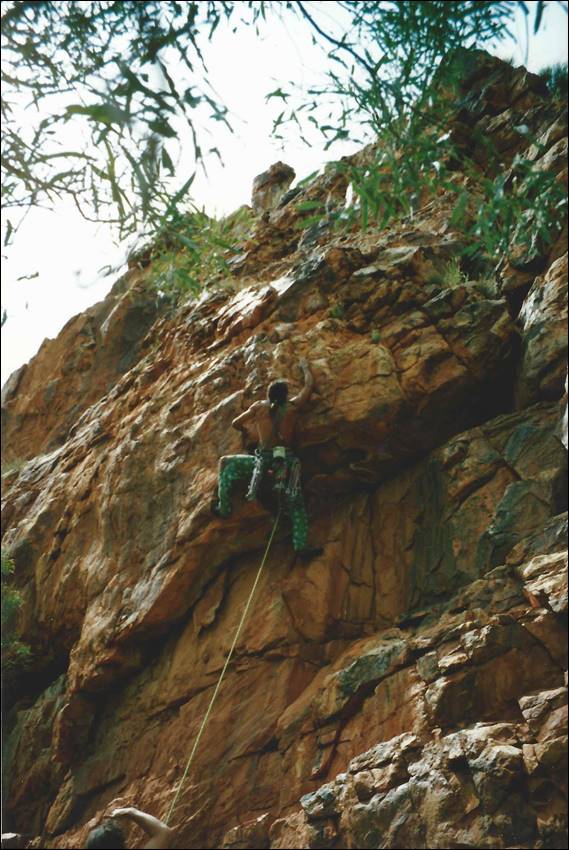
While I’m still pondering about Horseyard Crag one climb that will get a mention is Glitter and Gold (see above), a stiff line that we sieged with four people climbing it with different styles (full and partial dynos through to full static moves). Horseyard was definitely a great place to play. The frequency of our climbing trips allowed us to become accustomed to the nature of the rock. The huge variation in temperatures that occurred in this region could transform the hard, brittle Heavy Tree Quartzite from solid rock into crumbling masses of choss. The rock condition could vary from one extreme to another in the space of a few meters, and having a traditional ground up approach this occasionally provided very exciting times. We named a good number of climbs taking this into account such as Landing Gear below, from which if you fell you would certainly land:
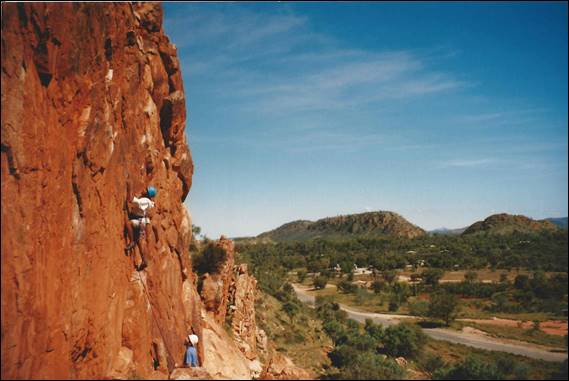
We also got stronger and more confident, starting to occasionally venture to the Quarry Wall to see just how far we had come. Left Foot Screaming was still an onerous proposition but we started to include the direct finish to add that little bit more of a punch. However, another climb on this wall that really must get a mention is by no means the hardest but one of the classics. The brilliant Hyber Berger that I am seconding Mark up early on in this email, comprises a traditional crack that sadly isn’t very long but delivers a challenge on solid rock with gear to boot. This climb is the favourite of number of local climbers past and present and has without doubt seen more ascents than any other route in Central Australia. I have led and seconded it myself probably close to 100 times and never ever got bored on it. It was the traditional way to warm up before trying the more challenging lines on this steep crag. While we were getting stronger Lisa was also climbing really well (even though to this day I am sure she doesn’t think I meant it) and her ascent of Nowhere Left to Turn below was particularly impressive. It was also a tad concerning as it was the route that I reckon she place the worse gear I’ve seen, except for the higher gear which is where it got spicy:
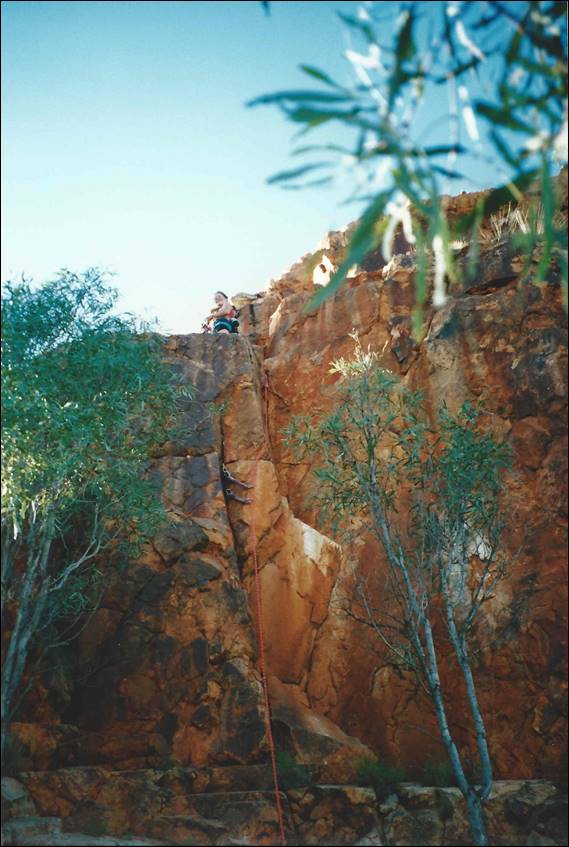
The outcrops along Steager Road gave us a great play ground for exploring, in addition to the Quarry Wall and Horseyard Crag we found a heap of small little spots. Some only had one worthy line and others had a great deal more. We managed to build the place up till there were 75 mixed, sports and traditional routes ranging in grade from 10 to 25. Every so often we manage to squeeze yet another line in, some were on short sharp walls others were meandering lines up broken medium height crags. The little buttress below was great and offered a couple of very fine lines such as Jugs Galore (on which there are not too many jugs!) that Wassa is leading below. It is a route that many a person reckons I have sand bagged them on. The crag is called Pyramid Wall and I first came across it with Jock on a hot day when my feet were burning up in my shoes, particularly as I was mounting the roof on the aptly named Hotfoot. Naming the new routes was a lot of fun and nearly all had a good story behind them but it would take way too long to include them all:
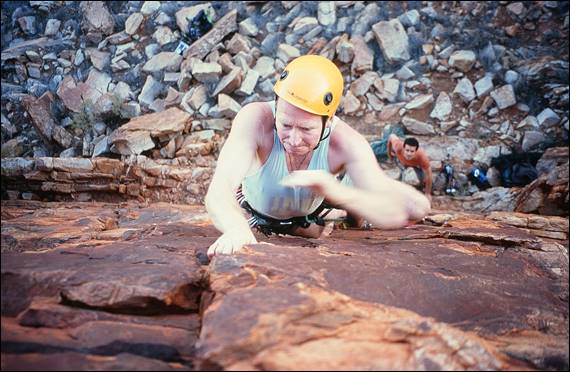
One of the most troublesome of routes to finish off for me was one of the early first ascents I did. UFO typified the way we became accustomed to the changing nature of the routes. I kept trying the ground up ascent of this fun, steep looking line and it proved problematic. On each attempt another hold, usually a crimp or foothold, would crumble and send me flying. There were plenty more options but which one would hold? It wasn’t dangerous due to having solid protection, but it was very frustrating. Still with determination we did eventually lead the line and it was as good as I had hoped, UFO standing for Unexpected Flying ‘Olds took some seven or so ground up ascents and after nailing it I repeated a good number of times and no more holds came away:
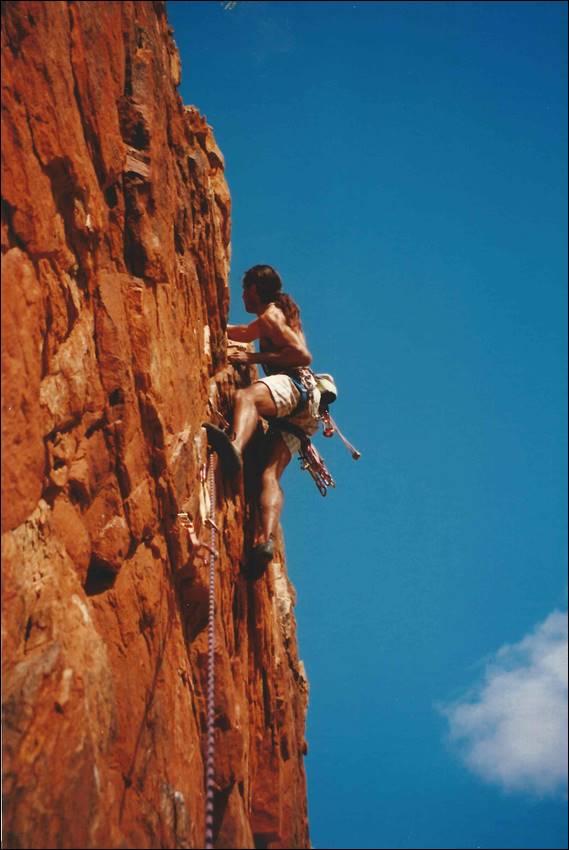
Another crag we started to visit in the early days was located above the car park at Emily Gap, which is where I used to head with Doug. According to some government officials this was deemed to be the only place near to town where climbing was sanctioned. It offers some fun low grade routes but has a tendency to have blank run out sections. So out of all the rock about this was probably one of the lest protectable and hence more dangerous places to lead climb. We tried all the feasible lines knowing only too well that they had probably been ascended numerous times before, so not claiming or naming the routes. It is the corner at the right hand of the slab that I have been back for so many times. I have sent many a budding new climber up Route 9 for their first lead, including Lisa. On one such occasion I solo’d up next to the budding leader and stumbled across a bashed and bent old peg in a very dubious crack, it took some working but I did manage to get it out and that is now one of my mementos from my time in Alice. It has positions, holds and protection that are ideal for beginners and it is also a great climb. The image I was going to include was of that route but if you google the guide I wrote you can see that image as it is the front cover, instead this is what the crag looks like. A tad vegetated and broken but worth a visit:
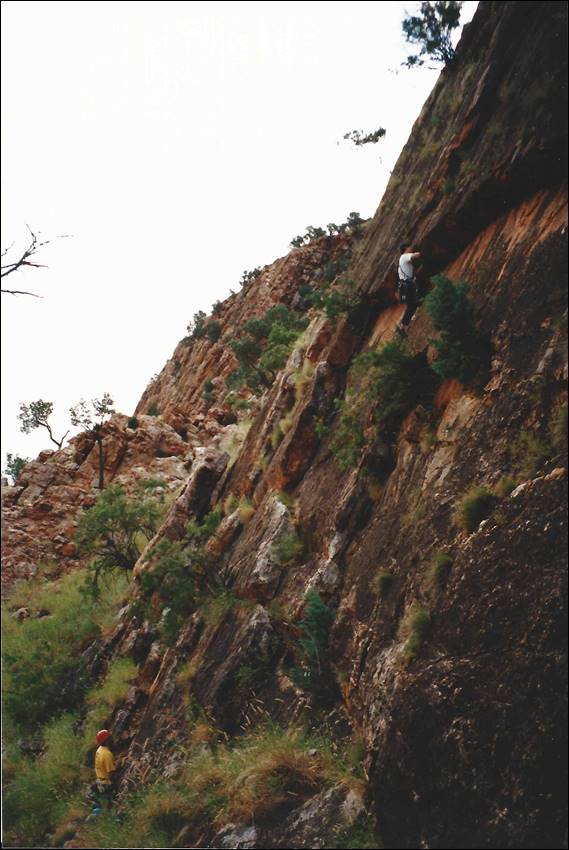
There were other areas that we frequented and this included Blatherskite (Ilparpa) Range, this small range was quite broken and had little scrappy looking buttresses. Again ten minutes from town, how lucky were we! It didn’t take long to bag most of the routes here including some scarily runout ones. There was however one line that alluded us as we had been asked by Jock not to touch it as it was his project, and we respected that. Well we did for a few years and then as time went on and on and on, and he came out less and less and less, we decided that maybe we should just climb it. So after four years of Jock spying Mental Block we climbed it and renamed it A Matter of Time. I guess the motto of the story is that if you leave it… eventually we will climb it and dam it was a storming route (check out Wassa on it below). This area sat above an open plain in which the sewerage plant evaporation ponds sat, why is this relevant . Well it was a haven for many creatures that seemed to attract many other predators and often we would have heaps of kites and eagles circling above us and below us at this crag. Also there was what seemed to be an old tip site near the road and one day I stumbled across an old bottle, that had Alice Springs emboldened into the glass, a second great memento:
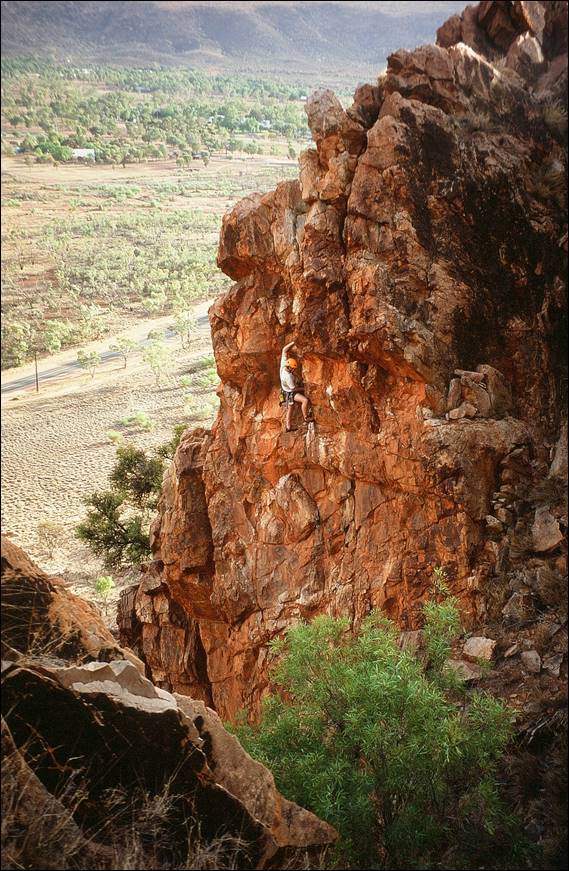
My eagerness to ensure there was some cohesion in the climbing community continued, and soon I was getting involved with access issues. Keen to make sure that the scrappy but fun slab at Emily Gap was not the only place that we could legally climb. A new Land Management Plan was being formulated for a stretch of the ranges that went for some 20km west from Heavytree Gap, in Alice Springs. Sure enough the draft indicated the little slab above the Emily Gap car park was earmarked to be the only place where climbing was to be permitted in the specified area. Climbing had occurred in the ranges along this area for over 30 years and access to a great deal of quality lines hung in the balance, such as the great Here Comes the Sun which Wassa is leading below. So a couple of us spent many hours pondering over the best wording for a three page submission to try and open up the areas more than just this one slab. We included the safety issues, quality of rock, non-invasive nature of climbing and everything else we could think of:
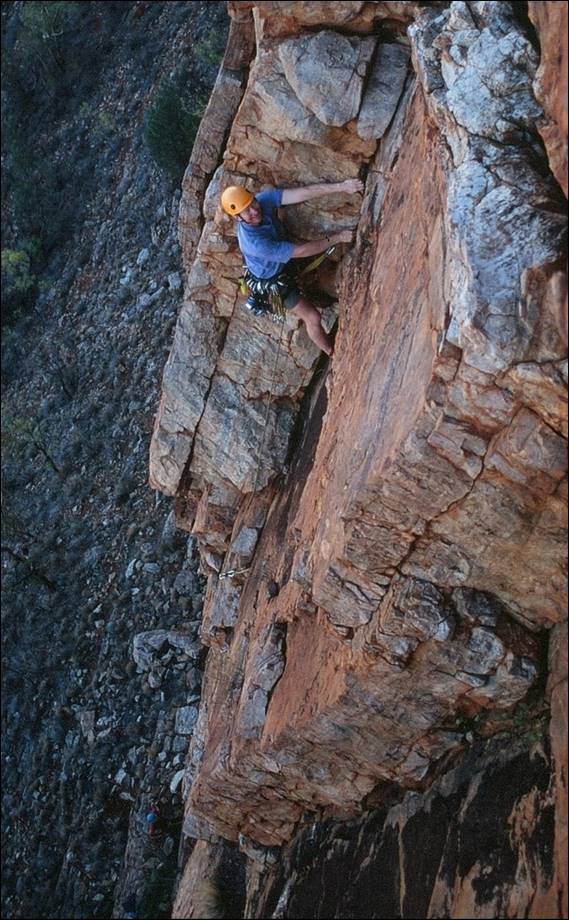
Our efforts were all in vain and our submission simply got lost in a bureaucratic process, with not even an acknowledgement being made of its receipt. Fortunately this process dragged out and to this day I’m not sure whether the plan was implemented. From this frustrating experience I came to learn that climbing was seen very much as a minority sport in the area, and one that was viewed by most as an obscure and pointless activity. In later years when I was compiling the guide a government official, who managed the local Crown Lands, reinforced my view. He openly stated to me on the phone that climbers were illiterate so even the placing of signs to specify that no climbing was permitted was pointless. We eventually put all that to one side and simply continued to explore these ranges and find many a new routes such as this first ascent by Pat of Opening me Lunch-Box. When I tried to repeat this climb I did a superman dive from the low crux moves and swung back and forth with my head a mere few inches away from the boulders at the base of the climb. Jason was not too impressed with me and we backed off this route:
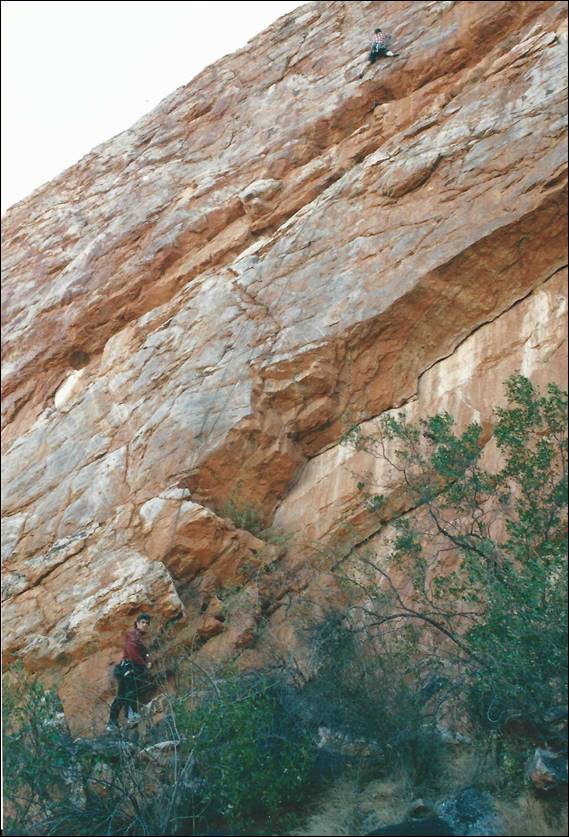
The wall above is called M&M wall and is one of the best pieces of rock in the centre, there are some epic and massively classic lines on it. The first two lines were put up in 1997 and in our time we added another four or so great routes. Mark is another person who has done much for climbing in this region. I met Mark within the first few months of arriving in Alice. He would come to the Alice to work hard for a few months pay off debts and then head back to Tassie to lead expeditions. Mark is somewhat of a machine and would appear not stop the whole time he was here. His energy, drive and lack of sympathy for weakness on rock was unyielding. For these very reasons it was with Mark that most of my early trips to the Quarry Wall happened, he would push me up routes I wouldn’t normally dare attempt. Due to only being here for short periods the strength and stamina I built up during these sessions never lasted. We did also get out and simply have fun and one such time sticks in my mind. Below Mark is following me up the first pitch of A Most Unlikely Journey, yet another first ascent we bagged:
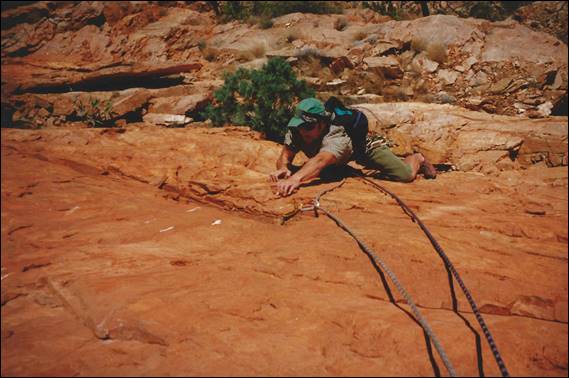
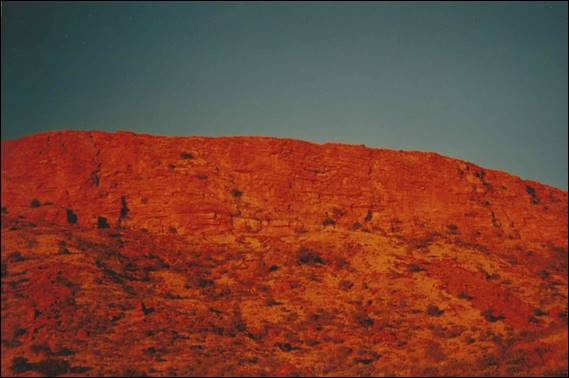
The night before we led the climb above there was no moon and we were late leaving, so when we were dropped off at the road side and began our walk to find what had looked like a good bivvy site somewhere near the base of Mount Gillen there was no light. Mount Gillen is the highest peak next to Alice Springs and offers great towering orange walls of a mix of good rock to choss. Walking through long buffle grass in the dark wasn’t easy and we stumbled into unseen ditches and over treacherously unstable rocks and boulders. Miraculously we found the very site that Mark had seen, and it was in fact a good spot so we settled down to a night under the stars. In the morning the cold winter air woke us before the sun had risen, so time for some food and drink, before we headed up to the cliff. Soon the sun tipped over the horizon and bathed everything in sight in a magnificent orange glow (below). I have yet to witness another morning like this and it is this sight that sticks in my mind. We had a really good day and put up three fun lines, none of which will probably never be repeated:
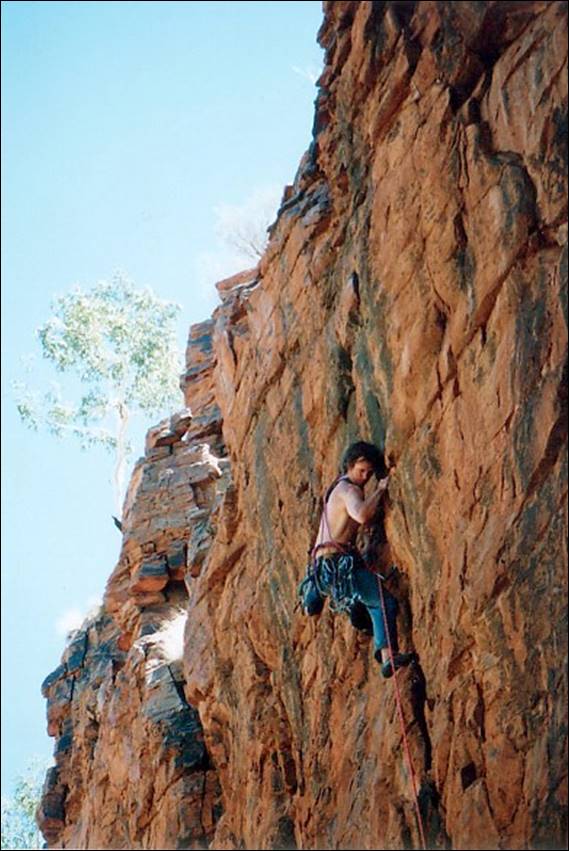
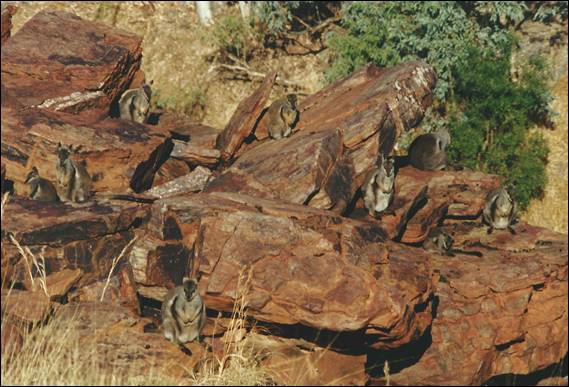
While we did a lot of climbing close to town, the place that holds one of the closest concentrations of quality lines is Ormiston Bluff and Glen Helen. Ormiston is also one of the many homes of the true Central Australian rock legends, the Black Footed Rock wallabies. A number of them live in the rocks at the top of Ormiston Bluff, one of the few places out of town where Park Rangers have informally permitted climbing. Before I carry on talking about the Wallabies, I am amazed at how few images I have of Ormiston. Every line was epic and worthy, and Tranquillity is one of the very fine routes which Dave is leading below. Amazingly it was a top rope problem for three years until Mark led it. There was another long term top rope problem called Oedipus Shmoedipus, and on one trip with Lisa and Dave I decided to lead it. The route was great a steep slab followed by a looming roof section. But the gear was sketchy at best and very, very spaced for the first two thirds of the route. I read the description after leading it and sure enough it was all there in black and white that there is no gear for most of the route, no matter we survived and another first ascent was in the bag:
Back to the wallabies… We have spent many hours watching these elegant and graceful animals while lying in the sandy river bed. Watching them jump around high up above the ground seemingly oblivious of their precarious perches and airy antics, this could so easily end in disaster but never seems to. On occasion the roles have swapped, as I have watched the wallabies watching us get engrossed in our own form of rock antics. Are they worried about us or are they simply after new tricks to scare us even more? Who knows, but it is strange how they will watch until the person leading is safely on top, and then slipping away to one of their many hiding places. I remember Lisa taking on one of her early leads. Maybe because she was quite nervous, a wallaby took particular care to keep an eye on her. As Lisa weaved her way up the line she moved in and out of sight of the wallaby. The wallaby would in turn shuffle this way and that to make sure they could watch the whole charade. I would like to think that he simply wanted to make sure she was safe, and once she topped out the wallaby went away:
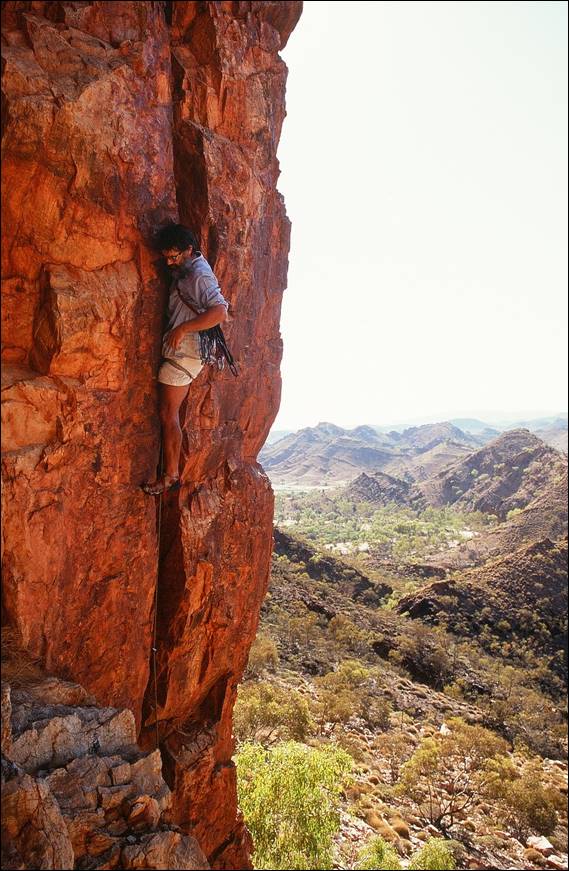
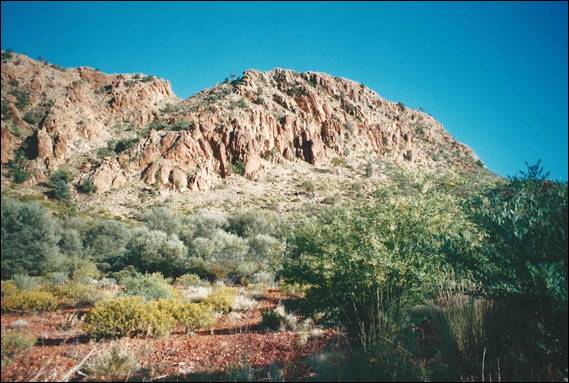
There are many other creatures here that some people would lead you to believe mean you nothing but harm. I would not agree with them, and would go so far as to say most of these creatures would rather stay out of sight and lead a peaceful life. I actively searched out the many reptiles but never saw a single snake in the wild, plenty of lizards of all sizes including a Perentie (the largest monitor lizard or goanna native to Australia) one of which that was some six foot long. When Jason Geres came to work in town we both felt that work should not take over life, so while he was here we broke up the working week with a Wednesday morning climb. On one occasion we bivvied out the night before, and it was then that he had a less than friendly encounter. We camped at the base of The Unknown, a broken set of crags that had some classics on them such as After a Little Spanking, which Garn in his homemade harness (constructed from an old car seatbelt) made very short work of due to his amazing ability to jam any size or shaped crack:
When Jason and I were camping out (me snug in the campervan and he in his swag next to the fire) it was about midnight and the full moon lit up the land as if we were surrounded by street lights. It was not the light that woke Jason, but the sound of snarls and growls coming from a dingo only a few meters away. The dingo obviously didn’t appreciate our presence. The use of words didn’t deter it, so a few small stones and eventually sticks were thrown in the dingo’s general direction. Still the dingo stood his ground, then for some reason he must have simply got bored and he turned and trotted off. Possibly he came to his senses and realised Jason was way too big (and ugly!) to eat. While Jason didn’t get much sleep after that little encounter, I have to say it was an isolated experience and we have since got pretty close to dingos who have seemed much more relaxed. The only other similar experience was when in the Flinders Ranges camping at the base of Moonarie Dave had to beat off a dingo as it attempted to steal the remains of dinner that was in a pan next the fire:
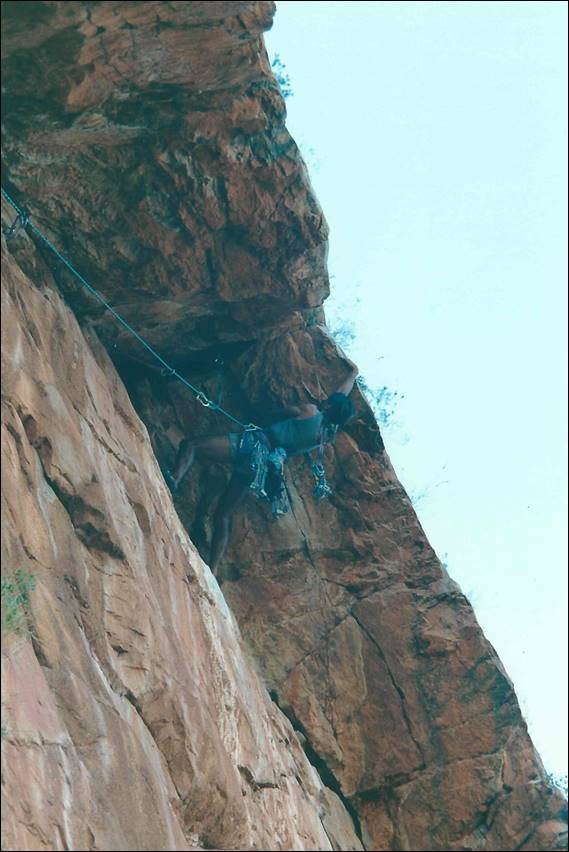
It was with Jason that I made many visits to M&M wall near Emily Gap, and bagged a good few lines. This wall has two sections the bottom one has a mix of brilliant to slightly dubious rock, but the top section comprises a magnificent head wall that seems devoid of holds from below. This of course is not the case and the wall provides great holds and protection when you really need them. It is however very steep, exposed and sustained so really isn’t for the faint hearted. The climb named M&M’s was the first recorded route on the wall, it starts with a traverse under a right tending roof, before breaking out right to by-pass the roof. I still have not climbed it this way, and it was on Jason’s birthday that I first got up this route. The last time I had tried it there was a Kestrel nesting above who was very unhappy about our presence and we backed off rather than risk loose our eyes or worse. On this second occasion as I approached the apex of the roof I decided to climb straight over it, so putting up Mee Gwitch:
I felt this fun variant of the original climb was not complete until a new second pitch had been climbed, as the original second pitch was a bit naff in comparison. Then a few weeks later I was out with Pat, and in his usual casual manner he convinced me to have a bash at a second pitch. A good sized overhang above the belay stance blocked the path to the main headwall, after that we had no idea what we would find. So off I went, encouraged by Pat. I was feeling very nervous when I got to the overhang. I worked my way out and back again three times before I managed to find a friend placement out on the lip, giving me the courage to mantle onto the steep head wall. Once there, I found small delicate holds on steep ground, well at least it wasn’t complete blank. While the headwall did have a couple of ledges that broke up the climbing it was still a very airy and exhilarating line and a good second pitch to Mee Gwitch, so came to be Pear Drop. It is the only climb where I have seen Mark truly take on a serious tone when leading, later claiming that I had sand bagged him. I don’t have any images of that route but have included an image of another great line just to the left of Pear Drop that Jason and I put up in the area. We called this one Lazy Sunday Morning, Mark had his eye on this area but we snuck in first and bagged two great lines:
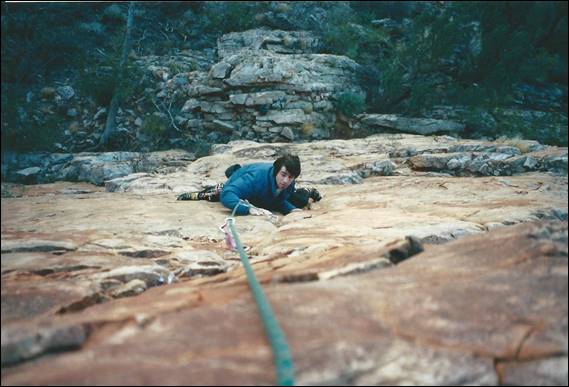
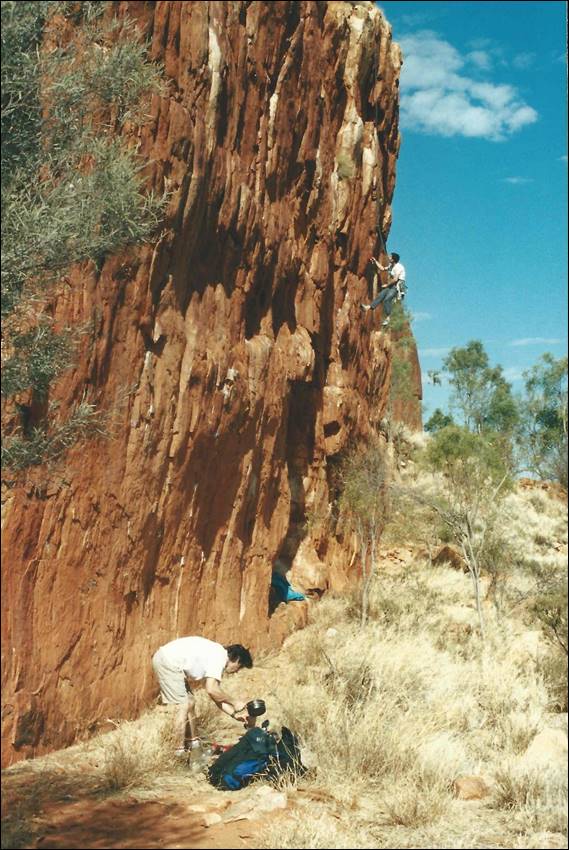
The most prolific climbing activity while I was in Alice happened from mid-2001 till the end of 2002. This is when Jason, Mark and Pat were in Alice Springs at the same time. It was with these three people that I started to train, both at the indoor gym but also at the Quarry Wall. This time round Mark had an extended stay, opting to hang out for almost a year. As time moved on we grew much stronger and more confident than before, so the number of harder lines established increased. I’ve mentioned a few areas above and will touch on some others below but most notably we developed the crag immediately left of the Quarry Wall. It was a wall that obviously had great potential but the slightly overhung start, seemingly devoid of holds, followed by a steep headwall had scared off any previous would be ascentists (note Jason pouring the hot water as the tradition of a crag brew had followed me from the UK):
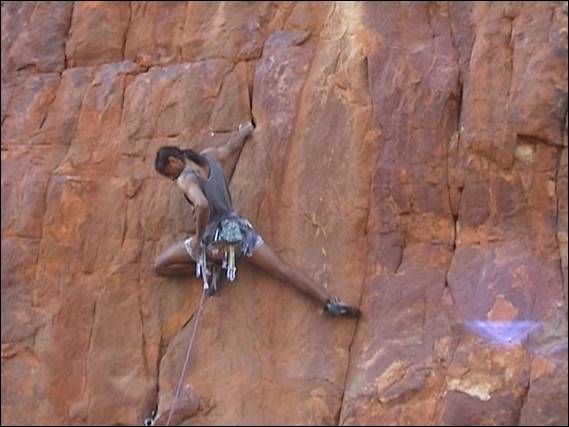
Of the routes established here The Fight To Be Free reminds me of why I am such a fan of traditional climbing. Mark had spied it and worked the moves trying ground up and failing, and when we returned some time later there were bolt holes ready to be filled with steel. Mark was a bit put out so with a fire burning inside he bagged the line and the bolts were never placed. It’s an amazing line and has a hard direct finish that we never managed, and I’ve not heard if anyone has done it. Despite my love for trad I have to admit that we did put a few bolts in some other lines here ourselves, Mark got a gullible bunch of (mostly) girls to drag a generator up to this wall which is no mean feat. He then proceeded to fully bolt One for the Girls, while Pat and I established two mixed routes using what I like to think of a more traditional approach of hand drilling. It was hot work but the hard rock yielded quite easily to the drill and hammer. We created Spooked that I have sadly heard has had bolts added to make it completely sport. I heard this in an article about the area, and the author was whinging (quite a lot) about how he couldn’t even get off the ground on that line. I had said in the guide it may be under-graded and maybe that was an understatement. Pat created Come On Face! Which he is inspecting above and on which he placed two hand drilled bolts. Personally I reckon his route is one of the best and most consistently sustained hard lines in the centre:
While I talk about our escapades on Left Wall as we called it, there was one trad line I spied and had to work a bit to get the start down pat. At the time the heavily pregnant Lisa was being kicked and bullied by the baby growing inside her. We affectionately called our baby to be a little git or gitty for being so abusive to her mother, and hence I named this route Git Face. In many ways it was an appropriate name as the start of this climb was pretty tricky, it suited my style but it always amazed me that not even Pat could manage it. After the initial bouldery start and semi dyno to get the first decent sized hold it eased off by a few grades (as per the image below) but was still a fine line. I climbed it a few times to the point I could take exactly the right gear, already on extenders when needed and that included the belay setup. Another route that I have to mention is one that Mark established back on the Quarry wall, he named it On Seas of Desire and while I managed to second it after the first ascent I never led it cleanly. One day I was climbing really well and smashing it, so when I set off up this route Pat gave the rope a little tug to pull me from the small holds. In a way I was relieved as I was not sure I could get it clean:
Now it was around this time Goshen was attempting to develop a website for climbing in the centre. We was an extremely powerful and talented climber and had established the hardest route in the centre, which will get a mention later. His parents lived here and he would come back regularly, but I never climbed with him. He also unfortunately bolted in areas where climbing was banned, which jeopardised some of the great locations to the east, such as Ormiston and Glen Helen. For this reason I was not keen on sharing my records with him, which didn’t go down too well. We did notice that as our records were not widely available that an Australian climbing guru Malcolm Matheson had attempted Mark’s challenging route (On Seas of Desire) and due to no records being out there lay claim to it. So an idea sparked to write a guidebook. While I mention Glen Helen, I have to say that this is an absolute must visit place due to the many very high quality routes. We did a bit of new routing here and of those lines a couple stick out, one being Avoiding A Greek Wedding. On this trip out the back of Glen Helen we didn’t intend to do anything particularly hard. As we rapped down from a couple of new mid-grade lines high above the waterhole I spied a section that looked to have holds and (just enough) gear so I went up it. I returned a few times after that and couldn’t even start the damn climb:
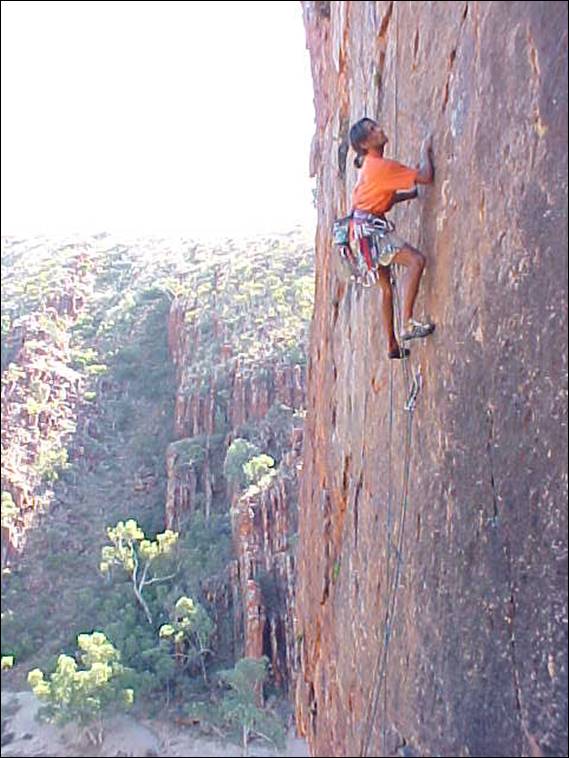
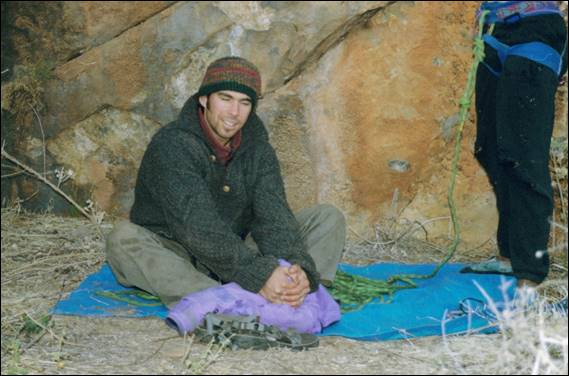
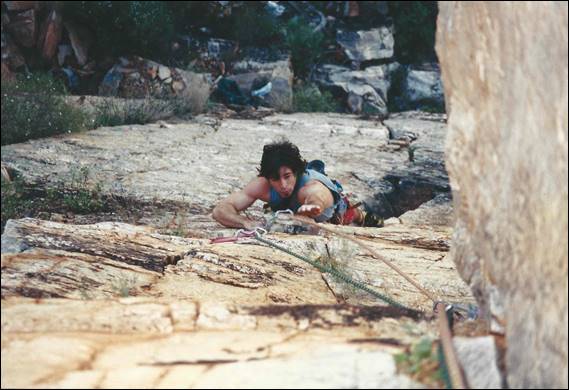
The reason for the following image is that amazingly this is the only one I can find from our visits to Benstead Creek. From a sport climbing perspective this place is the most spectacular cliff, a 50m limestone cliff full of steepness and potential for great quality lines. It had two bolted routes and one trad line when we were there, and below is Mark warming up his toes which are wrapped in my buffalo as I prepare to head up. This crag had the hardest route in the centre (at the time) and we had a bash at it failing miserably not even finishing the first pitch. However, the climbing is not what I remember about this place. One night we were camped out, Lisa and I in our campervan Kermit and Mark and Ellie swaging it by the fire. Late at night Mark was banging on the window yelling get ready to rumble. Soon he and I were stood in the river bed with a shovel and machete in our hands ready to strike. There was a 4WD, two quads and a number of dirt bikes facing us down with full-beams dazzling our sight. Every so often one or more would rush at us and then swerve back at the last minute, I swear I would have hacked at one of them if they got close enough. The girls frantically threw everything in the campervan and once ready we jumped in the back and we drove out. We went to Trephina Gorge and slept out the rest of the night restlessly. The next morning we simply sat in the gorge in a daze, I was the only one to climb, well boulder. With a sift sandy landing I found a fun new line, which I solo’d and so became the route with the longest name I have ever used: If it Wasn’t for the Quads this Would Never Have Happened. We spoke to the land owners on which Benstead Creek resides and found out that they had been having issues with cattle rustlers and we can only assume that it was them who had chased us out:
Towards the end of 2002 Mark, Jason and then finally Pat left town. Climbing activity slowed down in terms of new routing and going hard but it was kept ticking over by a local crew and a few new faces that came, and left, the area. Most of the local climbers left in town were new or relatively so to outdoor climbing and as such the pace was much more subdued. Lisa was due to give birth in early 2003 so for me it was a good time to slow down. I have to admit also that my body after a year of climbing hard stuff was feeling pretty wrecked, and I’m not sure I could have sustained that pace. With all the involvement I had had in the local climbing scene with learning about local issues, new routing and trying to get a newsletter up and running the natural progression was to sit down and write a guide for the area. Just as a quick sideline below Jason is following me up during the first ascent of what I regard as one of the best routes I established, Where’s the Gardener. This crag was hard to get off with a horrible, long and lose scramble so we made abseil anchors using some old slings held in place by pebbles wedged in a crack. A very traditional approach that added that bit of extra spice to this already very trad crag. This great strong line is one of a number of epic routes we put up on the Garden Wall, and Pink Flamingo by Pat was another route that was attacked by the author of the article I mentioned before. Needless to say the author didn’t manage to climb that route either (what a dag):
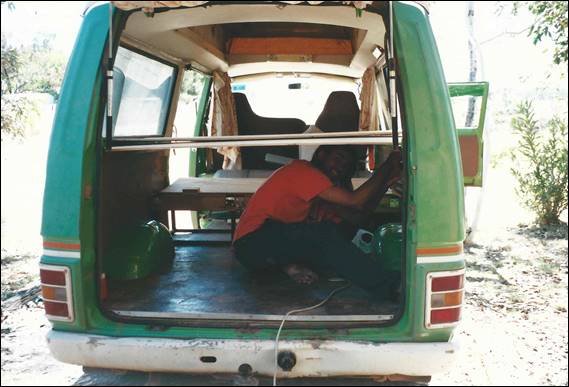
I had kept a record of the 150 plus routes I had been involved in putting up, as well as countless new routes by others. In addition there were also many historical records that had been kept by a few motivated individuals over the ages and rather than retype them and miss anything I contacted as many people as I could to get info. There was one key issue with collating the previous records of climbing activities. Not Goshen, he had his website so that was easy. It was Jock, who I had nabbed that route from at Blatherskite (Ilparpa) Range. Views about the need or not and risks associated with publishing a guide were greatly varied. Some people were strongly against it, saying it would bring the sort of attention that would end in access being denied to climbers and Jock was one of those. They had a point as there are a great many local issues and there is also an absence of policies to ensure continued access. Others, including myself, thought the guide would set a bench mark for future discussions on access. Another benefit would be to allow both local and visiting people to learn more of the issues peculiar to the area, and hopefully be respectful of these. I eventually managed to convince Jock to part with his digital record, which meant I didn’t have to retype everything and that was partly helped (I’d like to think) when we gave him the fridge from our campervan. I gutted the van and rebuilt it in a way that was more practical for Lisa and I. When the heat really turned up in the centre the gas fridge couldn’t keep up, so we decided to ditch it. I might add at this point that I also contacted several eastern states climbers who had graced the area but I never got a response from any of them except Glenn Tempest who even provided a few images:
Now I keep on talking about access issues and a big one was related to Aboriginal land and/or heritage sites. I had decided not publish detailed route information of climbing in these areas but did detail the areas and names, indicating they were off limits, to discourage people from repeating these routes. Some climbers have lived and worked on Aboriginal land over the years, and in so doing have had the chance to build up trusting relationships with the Traditional Owners. Subsequently, they have been able to get permission to climb in areas that others can only dream of going to. Some of the images I have seen of these areas are gob-smacking. I have also been a bit guilty at times of doing the wrong thing, which I didn’t realise until after the event hence the routes didn’t even get in the guide. On two such occasions, both with Dave, were out the back of Glen Helen. Dave was a bush doctor and would often be out in the river bed sharing a handbag (i.e. cask of cheap red wine) with the locals. He was told about and given permission to go to places and on occasion took us with him. Below is one place and on arriving we got a good feeling and it seemed to welcome us, it may sound a strange thing to say but I’ll stand by that. We attempted the route below but failed in cleaning it, an epic line and sooooo good but we never returned to this spot:

Below is the second place that Dave took us and a few others, it was a hike in and there was a huge waterhole and a splattering of broken crags. We didn’t name the route he is climbing but I can say that he is being belayed by The Object of Dave’s Desire… The Beautiful Ragni (sorry that was an in-crowd joke but I simply couldn’t resist). When we got there and both Lisa and I felt uneasy. We stayed the night but didn’t sleep well and were pleased to see the back of that place. Lisa and I strongly believe a place will let you know when you are not welcome and this place made our skin crawl. For the guide I spent a lot of effort ensuring I had current and accurate information about access to each location. I made contact with relevant land managers including station owners; the Department of Lands, Planning and Environment; Parks and Wildlife; Aboriginal Areas Protection Authority and the Central Land Council. It would seem that no one was prepared to allow open access for any activity, let alone climbing. There was an obvious risk in publishing the guide, but still I felt it was the right thing to do. In view of the majority of recorded climbs being in National Parks I offered assistance to Parks and Wildlife to help draft a Northern Territory policy on climbing. The person in charge of Parks in the Northern Territory had no issues with climbing, in fact said he felt it was a healthy and worthwhile sport. While we discussed how I could assist it unfortunately never eventuated to anything, but not through lack of trying on my part:
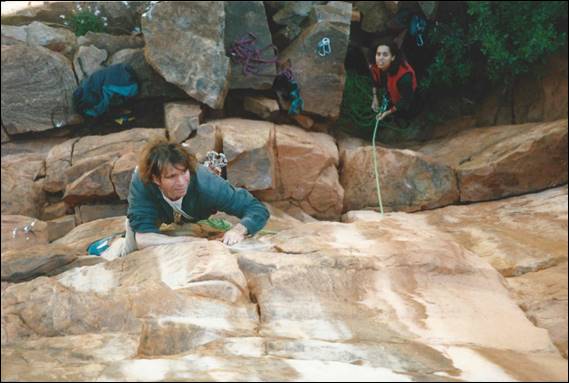
Writing the guide was easy; back then a blank page would usually hold me in apprehension and my fingers would refuse to start the task in hand. Ha ha… not that you would think that with my prolific emails nowadays! However, back then this was the case but when I sat down to type the guide my thoughts poured through my fingers and into the keyboard. It probably helped that it had been a passion of mine for so long, the writing was in fact fun and not arduous at all. While numerous records existed and I had digital copies, they had been written by different people and so styles and the amount of detail varied considerably. The task of working through route descriptions, to ensure some uniformity and to prevent duplications, was not as easy as I thought it would be. Some routes such as Blue Thunder at Glen Helen (below) had been recorded as a new climb by three different parties. I managed to visit most of the climbing areas to check locations and descriptions, but I didn’t get to some of the more remote locations and some of the older climbs alluded me despite attempts to find them:
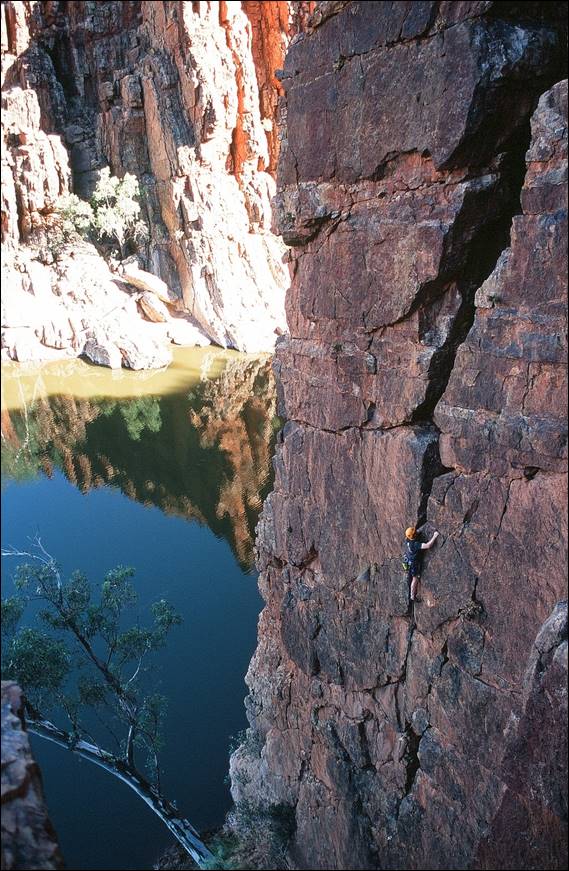
Elseya was born in February 2003 and so my sights were firmly set on finishing the guide before she came into the world. The first edition of the guide came out as a CD book in January 2003 just in time. With Elseya around to distract my attentions I climbed on a very much reduced scale. I no longer spent days searching out undiscovered gems; instead being content to cram a few routes into the early hours of the day so as not to miss out on the new discoveries to be made at home. We still got out and Lisa was very tolerant as I played on rock while she was literally left holding the baby! Trips were mostly confined to the more local crags and we started to, what I call, bumble climb. Basically just enjoying being out there not climbing as strong, simply repeating the many great climbs we had discovered. Elseya was initiated to camping from an early age, at the tender age of six weeks old, when we went camping at Trephina. Below is a quick morning trip out to Emily Gap when she was only two months old, when we headed out there with Steve and Bron:
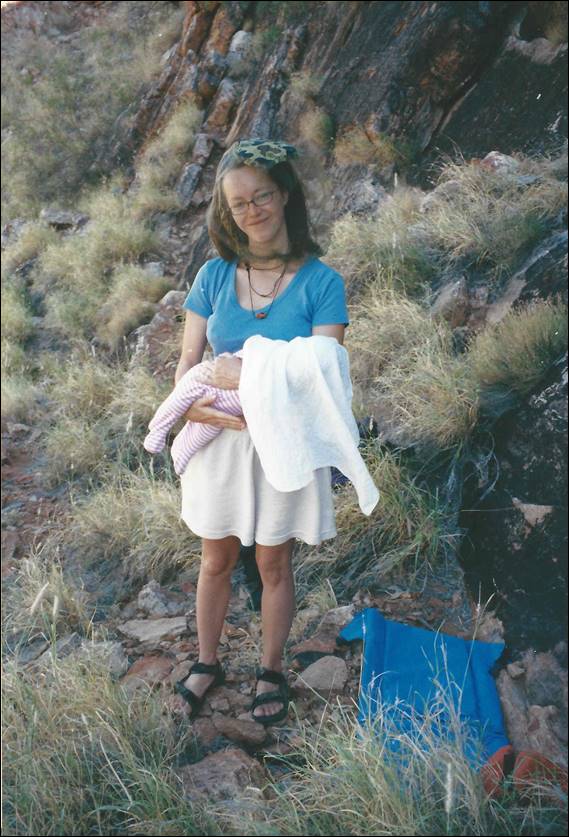
I had first bumped into Steve and Wazza at the YMCA climbing wall, they were new to the sport and Wassa climbing in volleys while Steve had sneakers. So one night I offered them an old pair of my climbing shoes. They were mad enough to make use of them risking all kinds of fungal infections. From that time I would take them out and introduced them to the true reason we climb, to play on real rock. They were hooked and soon had gear on order and we had many great times out. Steve and Bron worked in the hospital in which Elseya was born and as such they were the first of our friends to meet her. It was Bron who called Elseya a “right missy moo”, and the name Moo has stuck ever since. We had many trips out with them camping and climbing and on one trip to Trephina they managed to get Lisa to put a harness back on. So only three months after giving birth she was back on rock. I’m not convinced that her head was really into it and while she enjoyed Jason’s creation of It Wasn’t Me she didn’t climb much again, and by the way Jason it was you(!):
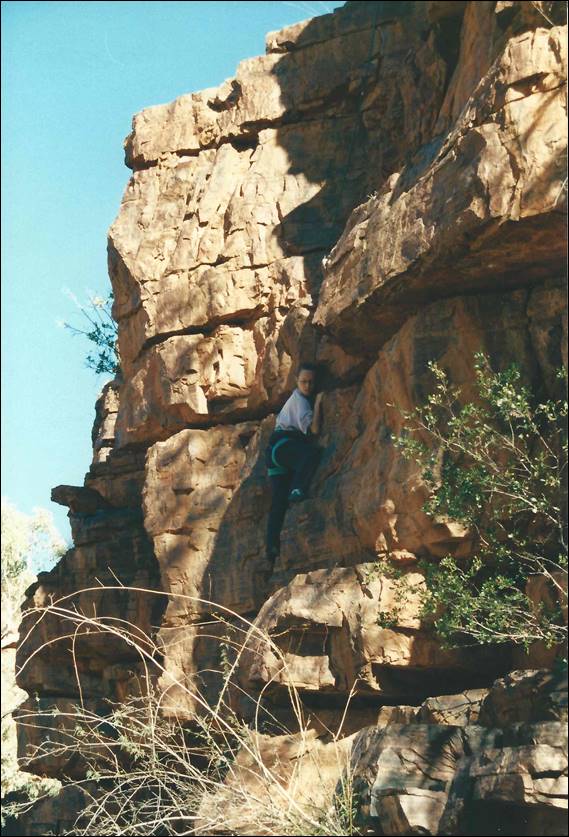
When Elseya was four months old, we headed out with Steve and Bron on a bit of a trip out towards Boggy Hole and beyond. Now this was a very brave move on their part, as Elseya hated travelling by car and would very noisily contest being strapped into a car seat. But they were keen and we had a three day trip and that went really well, during this trip there was a fair bit of 4WDing to be done and some of it was pretty serious stuff. So on occasion Lisa and I walked sections (with Elseya) and caught them up later down the track. Elseya was also a terrible sleeper, she would wake every few hours and one night I went for a walk with her in the middle of nowhere. As I shone my head torch round the eyes of dingos reflected back way too often and way to closely, but they never got any closer. It was on this trip that we went on to camp at Running Waters and there we found an epic buttress in the middle of nowhere that had a few bolted lines on it. The clean face can be seen in the background and we ran up the easier line, which provided a great two pitch route that we aptly named Rough Ride. The front face proved way too fearsome for me and I couldn’t even blame that on the lack of sleep. I haven’t heard of anyone talking on this awesome face:
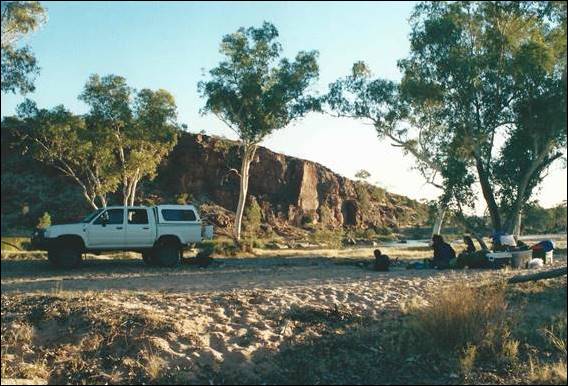
Two other climbers who turned up in late 2002 that are worth a mention were Karl and Claire, they hung about for about six’ish months. Just in case this email gets round they were not a couple! They climbed well and were keen, so I made use of their talents and got them to repeat a mob of the new lines that didn’t get too many ascent. This helped refine a few grades and provided a bit more confidence for when I finished the guide. In their short six months they got a great tour of the area including all the main crags and a few other places. Claire wasn’t afraid of air time and she would often push herself to the edge. Karl was more cautious and didn’t go as hard but had a cool head and kept calm in dangerous situations. I have horrible memories of belaying him as he attempted Stitching Time, which will get a mention later. He took his time and it was getting dark, the mossies were coming out and I was standing on an ant infested ledge. One of the most uncomfortable belay spots I’ve ever had but I daren’t fidget too much as he was very focused on this line. I’d sent Garn up it once and he took a massive backward fall. Karl didn’t have as big a fall, and I wonder if it has had a clean second ascent. I hope so as it is a wicked line. Karl loved Glen Helen and we spent a few days there. Below he is belaying me as I did the second ascent of another one of my creations, Long Drop. Guess what I did before this route from the ledge high above the ground:
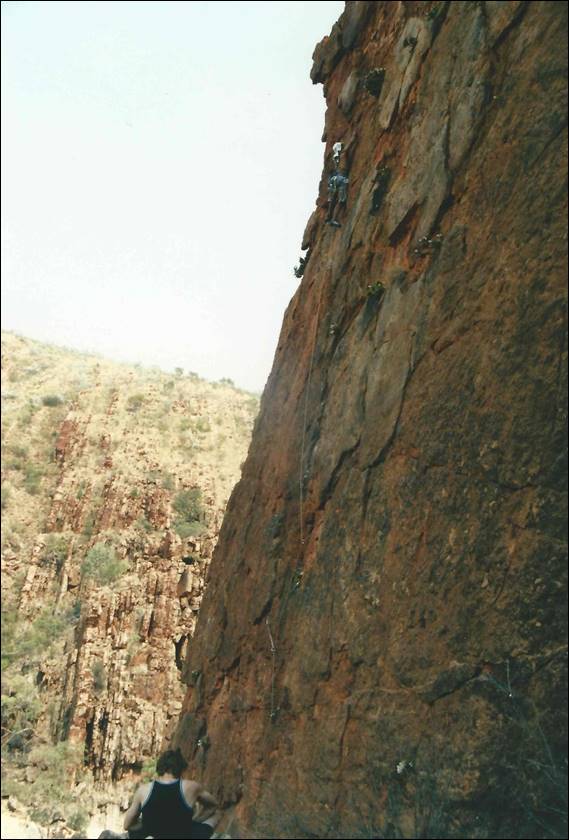
Two other people to mention are Steve (just to clarify it is not the same Steve as above) and Garn. Steve originally starting climbing in the area when the Yerba’s were going strong, they were responsible for building the YMCA climbing wall way back in the early 1990s. Climbing with Steve was so relaxing, he has to be the calmest person I have had the pleasure of climbing with. That is not to say he was not a good climber as he was and we had some great days out. We also had one shocker when we were attempting a new line at Emily Gap, the route was good but we didn’t finish it. Half way up we came across a ledge and there were three camp dogs stuck on it looking like they hadn’t eaten or drunk anything in weeks. It was a sickly sight and we were not able to get close to them for fear of being attacked, and they seemed to have no way of getting off. It was grim but we ended up leaving them and calling it a day. The next time we did venture that way there was no sign of the dogs either on the ledge or at the base of the cliff. Below Wassa is climbing Cerebral Vortex, which is kind of near the climb that I attempted with Steve. I did end up finishing that line off but will get to that later:
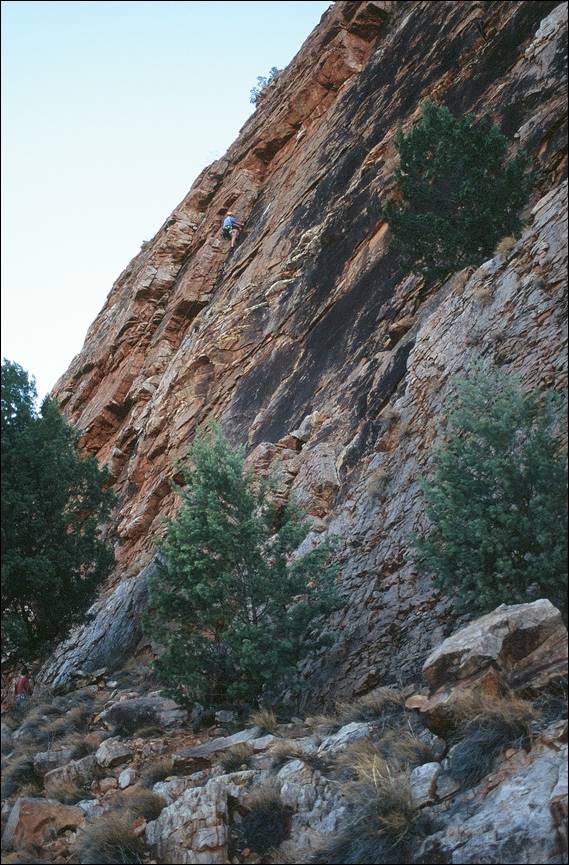
Garn is a seasoned Tasmanian climber who had previously worked in the area for short durations, and then arrived for a longer stay in early 2003. During the next couple of years, with the help of various friends who came to visit, he explored the most remote and in some instances pointless crags. He was never afraid of long walk-ins and unperturbed when all there was at the end was a scrappy little crag. He did however discover and help set up some of the most dramatic routes in the centre, strangely enough at a place I had almost been too. Boggy Hole, which we had been to with Steve and Bron. The hidden gem was a little walk from the campsite and comprised a massive clean 60m high cliff that had striking cracks, corners, roofs and more. I never experienced the climbing here but those who have tell me it is epic. I did get to climb with Gran and it was a very humbling experience, he could jam like no other climber I have met. I’ve seen him turn well established grades 21 routes into a bumbly grade 14 by jamming up inverted V flared cracks. On second and despite me hanging of the rope I was still unable to get any traction in with a jam. On one trip out we headed to the highest point of the range between Simpson Gap and Alice Springs. Here we established two gothic lines called Hammer and Sickle. Watching Garn climb you may consider he was reckless as the gear was spaced alarmingly far apart but he was simply a very confident and secure climber. I hear that he still heads back to Alice and has been seen out in these remote spots still enjoying himself:
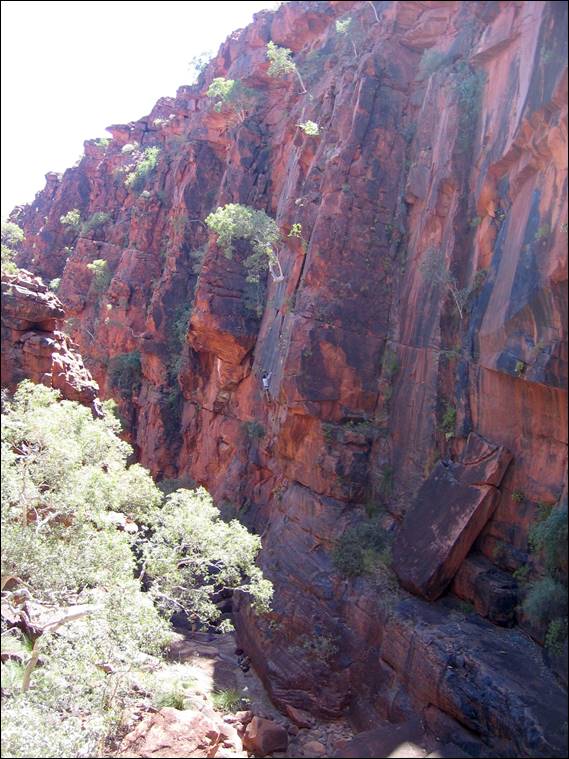
When Elseya was six months old we headed back to the UK to show her off to the family. We flew out via Perth and heard of a quaint and beautiful place just to the south called Albany. So on the way back from the UK we changed our flights and spent a week in Albany checking it out. We were pretty serious and checked out rentals, cars and I even had an interview for work. It looked like we may be moving, but on our return to Alice Springs the dirt was red, the sky was blue it was a wonderful 25 degrees. Within a week of returning I had several job offers and better still Bron was expecting. So it was decided we were staying, and soon after Wassa and Margie were also expecting. I soon secure full time work, the first full time job I had since moving out to Australia. At this new job I met new people and introduced more newbies to the delights of climbing. Then a year or so later Warwick an eastern states climber bought a copy of my CD guide and started to build up my enthusiasm for taking the next step of publishing the guide as a book. I might as well mention the following climb now… Stitching Time, which Garn had epically fallen from. This was used as the rear cover image, and I had a lot of images to choose from. I climbed this with Dan and Jock, while Lisa was lounging in a rock armchair below and all three of them had cameras. From memory there were over 40 images of me on this route and I reckon I could have made an olden day style motion picture of that first ascent:
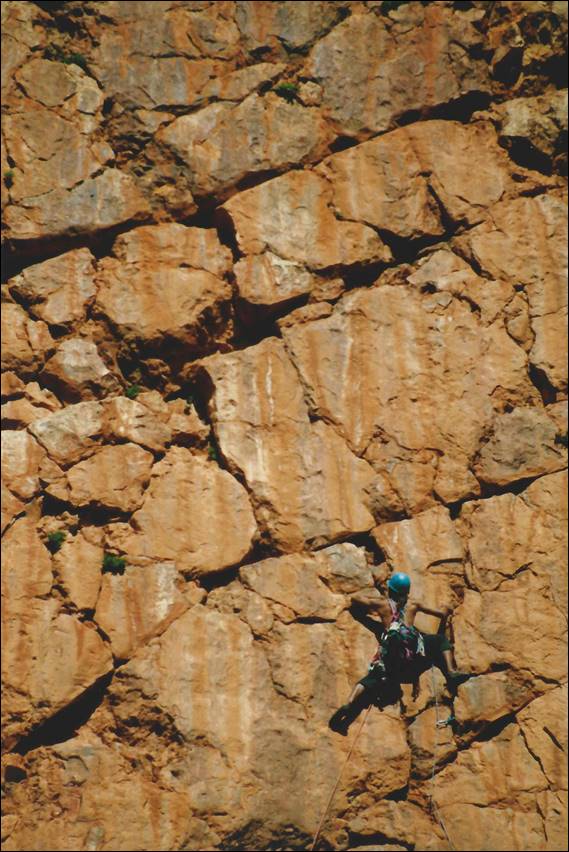
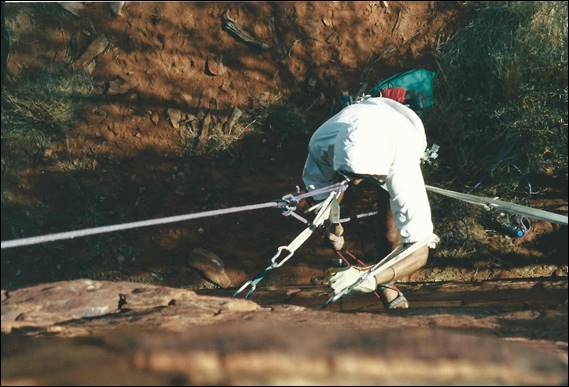
Seeing I was going to publish a book I thought I’d go a bit harder and contacted the Australian climbing magazine Rock and see what new route info they may have. The miserable buggers wanted me to buy all the back copies and refused to give me any of the information, needless to say I didn’t bother. Updating the guide wasn’t that big a deal really, but I did want to verify some of the older routes that I hadn’t tried too hard to check out or locate before. Most of these were at Emily on the bigger cliffs that provide two and three pitch routes. So with Steve’s help we had regular trips here and try to find the historic routes, most times failing miserably and putting up numerous new lines in the process. We had a lot of fun and at time got into trouble for staying out longer than we had advised our good lady wives. Our excuses were always the same that the route was harder then we realised and so we got caught out, but it was never accepted. Um… maybe taking the tea kit up with us on those routes didn’t help matters (as can be seen below). The temptation to have a brew after finishing a route and take in the magnificent view was always so great. It can’t have been that bad as a few weeks later we would head back out and again fail to find an old route but then find one or maybe two new routes and get back late:
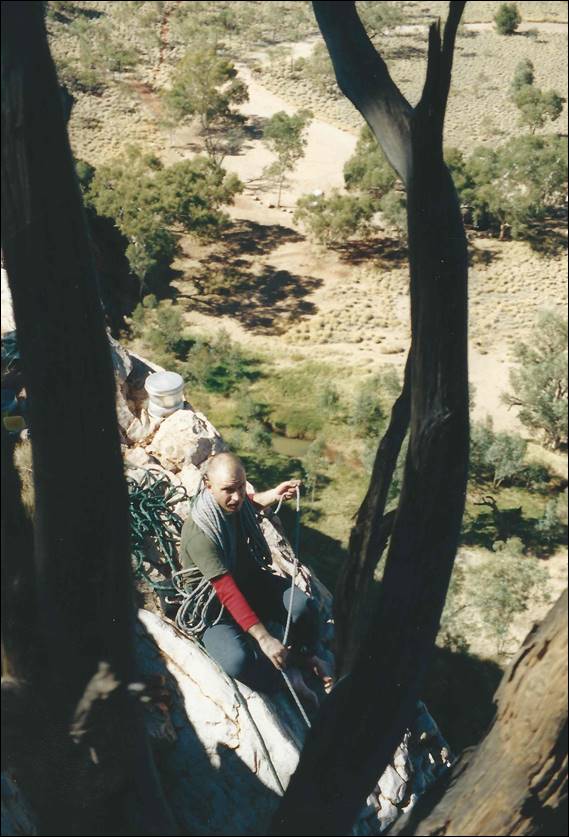
My name and contact details were getting splattered about a bit while we were in Alice and this led to the occasional contact from overseas and interstates climbers. We had a pretty social and friendly crew and would make an effort to take visitors out. It was always interesting to see their reaction to the place, some would walk away whooping and hollering about what an amazing playground we had, and Eric and May were one couple who did that. Below Eric is following me up Life’s Worth Cancer at Horseyard Crag. I’m still in touch with these two and they lead an amazing life filled with travel, climbing, hiking, and now also paragliding (check out www.verticaltrotters.com). Another visitor that sticks in my mind was Sandra from the eastern states of Australia. We took her out to the longer multi-pitch routes of Emily Gap and it was with her that I polished off that route Steve and I had failed to complete. We called it Left for Dead, after the camp dogs but it is also reflective of how, when she followed me up the route her face was white as a ghost. Declining the opportunity to sample any more of our unique centralian rock. I guess we got used to the conditions and loose rock was something we worked round rather than walked away from:
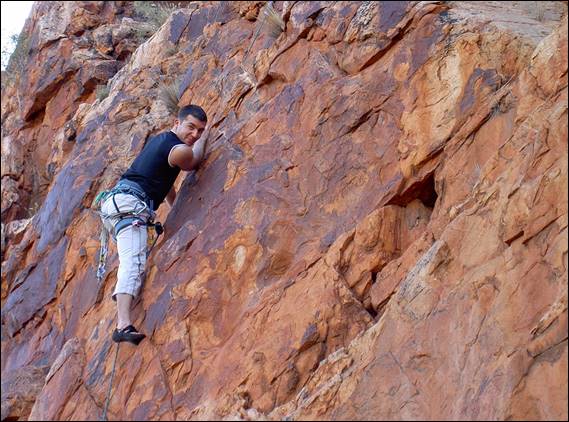
Now as I was starting to finish of the publication Wassa was inspired to attempt to rekindle a newsletter for the climbers. We considered long and hard about a name and came up with the RACK, which stood for Rock and Crag Knowledge. Around the same time a local couple took a brave step and opened up a good quality outdoor shop called Lone Dingo, and they supplied an article about gear for each newsletter. Steve (the one of Yerba fame) wrote a rock tapas article that never did end, I had a section called Krish’s corner in which I would pick a climb or topic and ramble on, and there was a new route section and a heaps of other bits that would fill four pages. The first newsletter came out in April 2015 and Wassa managed to keep it going until late 2016 producing four editions. In addition to this activity another long term Alice climber called Liam, who mostly worked remotely out bush, was also keen to write an article for the Australian climbing magazine Rock (the article can be found here: www.tootable.com/rock-climbing-in-central-australia). I helped by adding info of the more recent activity and also started taking images on slide film for possible use in the magazine, my favourite has to be of Garn on Superfreak at the Unknown (where Jason had his close encounter with a dingo). We got out there early and Sinead (the person who used to say she was climbing like a cabbage, which is where I got that saying from) belayed Garn while I rock hopped about getting some wicked images in the great early morning light:
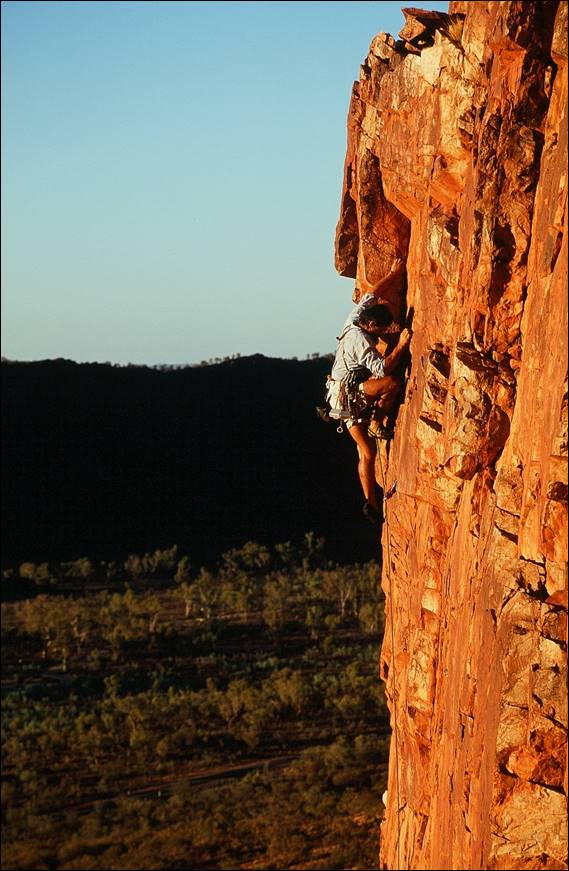
Eventually in 2005 the guide was published, I couldn’t convince any publishers to take it on and no climbing associations were interested so Lisa and I self-funded it. Only printing 500 copies, of which there are now only a handful left. I have to say I’m still pretty chuffed with that guide, it got a bit slated by some hot-shot eastern states climber who reviewed it for Rock. But considering the remoteness and lack of people that visit the place for climbing, plus the fact that we were unlikely to even make the money that we paid to have it published I reckon it was pretty damned good. That was reinforced when I sent a sample to Glenn Tempest to see if he would sell it on his online shop, Open Spaces (http://osp.com.au/). He sounded dubious to start with but when I sent him a copy he jumped at the chance. After the publication was out I got called to the front desk at work on day to find a couple of guys who were from the eastern states. They were keen to find a particular climb that was in the guide. It is the very first climb in the guide and is call On-sight 29? and given 3¼ stars, in a guide that specifically says it does not include stars. The description is massively and obviously hyped up and yet they didn’t seem to twig that maybe it was a spoof climb. So I gave them direction and sent them on their way, I didn’t hear back from them. That climb was put up by Mark and I when we were feeling like bumbling about and found some low grade lines on a short, obscure crag. I seem to remember this was after we had been smashed attempting the hardest line at Benstead Creek and maybe we were feeling a little bitter. That said all good guides should have a spoof climb shouldn’t they:
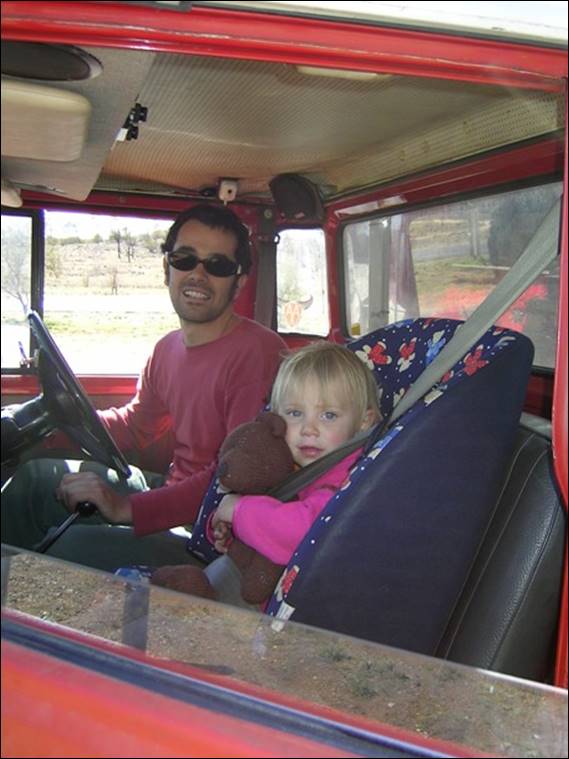
So with the guide published, Liam’s article out and Wassa managing the newsletters during the last six or so months of our time in Alice I kicked back and did a bit of climbing here and there. Nothing amazing but still finding the occasional new gem. We headed out with Ben, one of the guys from work that I convinced to get into climbing, a few times and Elseya was obsessed with being allowed to drive in his big red truck hence the image above. That was during a trip out to a local crag that we would normally cycle to called Wallaby Crag. There were some fun lines here but most of the routes were pretty easy, my zest for bagging those harder lines was failing me although one route I did end up top roping and subsequently called it Too Hard For Me. It was a pretty bold but a great line, another one that I wonder if anyone has got round to leading. It was with Ben in those last few months that we put up on the only route at Gravestone Crag, the route was aptly named Almost One More Carcass. It was next to a watering hole in which there were many dead kangaroos and it wasn’t a pleasant place. Ben led the one and only route and at the crux managed to dislodge some microwave sized blocks that missed my head by feet. Fortunately the blocks also missed him but he did stuff his knee up in the process and he had a progressively more painful walk out as the effects of the adrenaline eased:
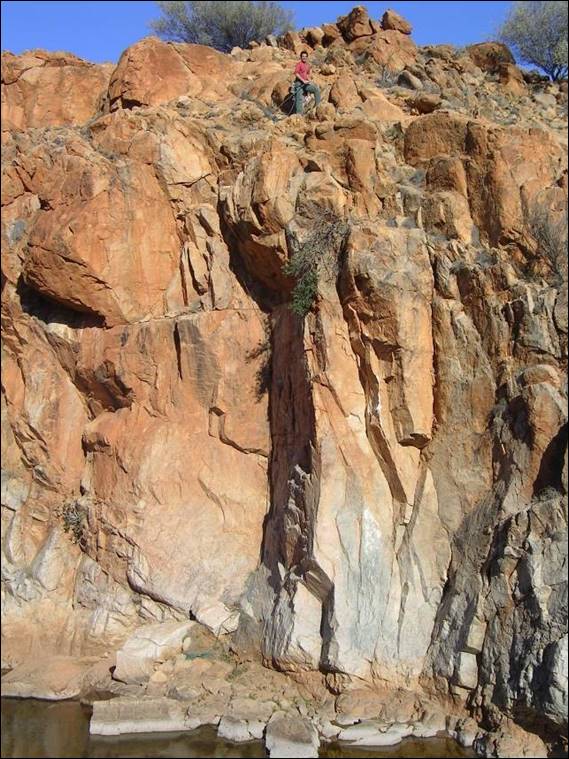
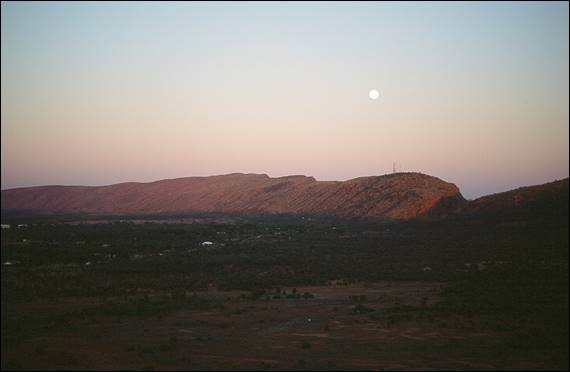
My last climb in Alice was with Wassa and that was appropriately a new route that we called Old Man of the Crag, in late November 2005. Another little line that we snuck in at a place we had spent so much of our time due to being so close to town, Horseyard Crag. So with a handful of new climbs, including a few that Gran had out up out at Boggy Hole I decided to write a quick addendum to the guide. It hardly seemed worth it for a few low’ish grade routes but Central Australia is the sort of place where egos and numbers go out the window and you simply get out and have fun. So I guess I wrote the addendum just because we climbed these routes and it seemed a shame to lose that little bit of extra history. Then in early December 2005 Lisa, Elseya and I left Alice and headed to the south west of Western Australia. We have often said that we should return to Alice for a visit, but as yet it hasn’t happened. I have to say I do miss those early morning jaunts out to Horseyard Crag and the Quarry Wall, just ten minutes’ drive from town and with a view that makes it feel like you are in the middle of nowhere. As Mark wrote even where you are getting smashed, it’s a great place to put a brew on and to watch the world wake up from:
Well if you made it to the end of this one I have to say I’m impressed, so will end with a big thank you for reading.
 Sandbagged
4 thoughts on “Part 11 – Alice Springs – rock, rock and more rock!”