During my stint in the Lakes, Finton came to visit and we hatched a plan to have a bit of a climbing trip to Ireland. I don’t recall all the thinking behind it other than it seemed like a good idea. So one day I picked Finton and Tim up from the railway station, after they had come up from London, and we headed northwards to Cairnryan in Scotland. There we caught the ferry across to Belfast in Northern Ireland. From memory we planned an eight day trip including travel, and decided to start where we landed and then work our way north and round the west coast. We arrived in Belfast late in the day and were not sure where we would camp, the streets were barren, dark, grim and scary. As we drove past the police station it didn’t fill us with confidence, the place was surrounded by cyclone wire fencing topped with coils of razor wire, and to boot spotlights and cameras were placed at every corner. Not sure what to do or where to go we parked up on the street popped into a pub to ask someone and the landlord said we could camp in the pub courtyard. This was located behind two heavy wooden doors in which we could also park the car. The pub wasn’t too busy and we had a few beers to ease our nerves. There was a good crew to chat to, and we soon hit the sack sleeping in what felt like a barn. The next morning we thanked the landlord and headed out:
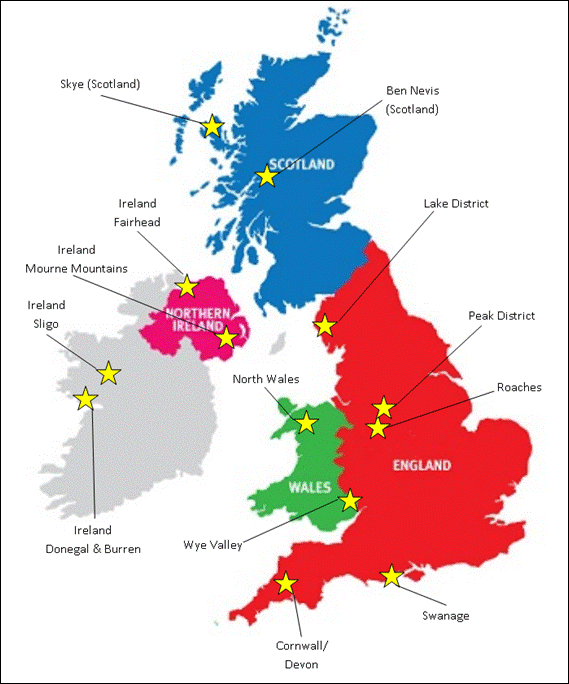
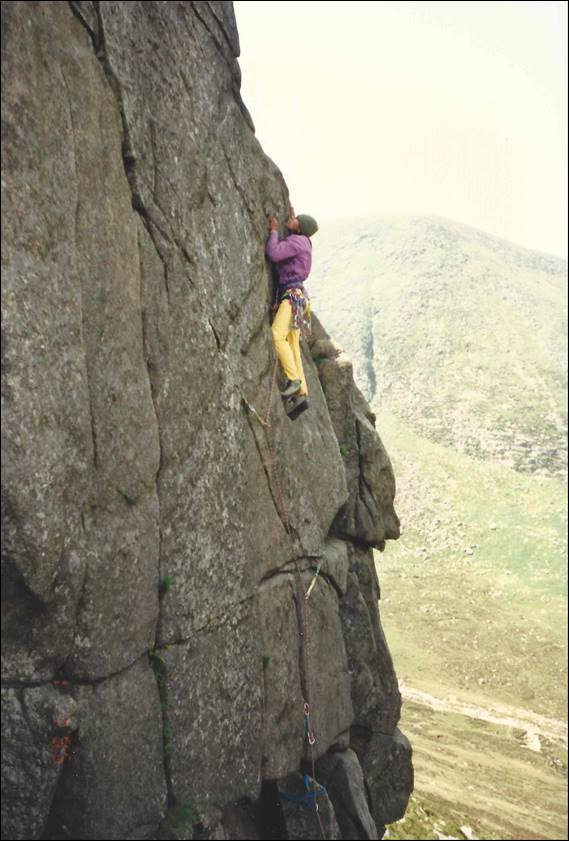
Our first destination was a bit south of Belfast to Newcastle, which is the closest town to the Mourne Mountains. The name Mourne originates from a Gaelic clann or sept called the Múghdhorna, and the mountains comprise tall granite monoliths with craggy outcrops. They are the highest mountains in Northern Ireland and have been made famous in numerous songs including The Mountains of Mourne by Percy French in 1896, but also more recently in songs by Don McLean (who did a cover version of the 1896 song), Thin Lizzy’s (Roisin Dubh (Black Rose): A Rock Legend) and John Lennon (The Luck of the Irish). It was also the place that inspired Clive Staples Lewis to write The Lion, the Witch and the Wardrobe and in the last decade has been used for backdrops in Game of Thrones. There is also another reason you may have known of this area, which I will mention soon. For our first taste of Irish rock we walked steeply up to Eagle Rock, a strenuous one hour walk in due to the slope. The approach puts some people off from coming to this relatively short crag, but it may also be the reputation it has for looseness. I don’t recall any poor rock on the lines we did and they were steep, technical and worthy. The granite on this crag had a weird flow like feature that looked like folds. For our climbs at least this made for a different style of granite climbing to what I have done before needing to use underclings and layaways. The climb of the visit has to be Thieving Magpie, a good 30m climb that was pretty stiff. Finton spied it and jumped on first but backed off due to the, at times, shallow gear placements. It was a team assault on this feisty number and this set the scene for a number of locations on the trip, when we would pick the occasional tacking climb that with our combined strengths managed to work out:
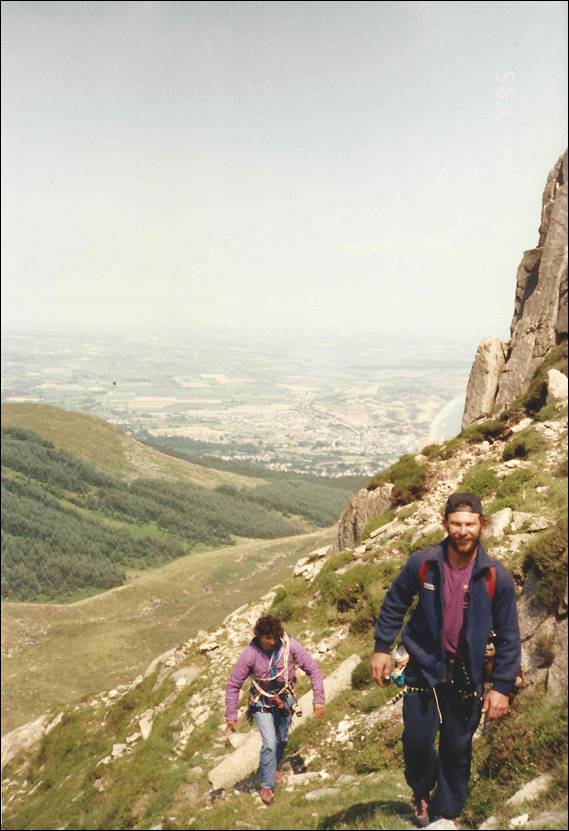
That night we camped in Newcastle. We felt more comfortable being away from Belfast, it really didn’t feel an inviting place and being in this small town felt so much better. We stayed next to a brook in which we washed that evening. It was freezing cold and that was the last wash we attempted in the creeks of Ireland. The next day we packed up our tents and headed back into the Mourne Mountains. It was another one hour walk in but this time up gentle valley sides, with amazing scenes back down to the coast line. Our destination was Lower Cove, but on the way we passed another crag by the name of Buzzard’s Roost. On the central buttress back in 1994, which was only a year before our visit John Dunn had finally managed his project on a massive 55m tall overhanging prow, a single pitch going at what he claimed to be E10 7a. It was regarded as one of the UK’s most striking and famous hard trad routes. Since this time there have been a few repeats and the grade has been the subject of discussion, some saying E8, while the UK online guide gives in E9 6c. Dave MacLeod made the third ascent of this mighty route in 2006 a significant twelve years after the first ascent. He placed the gear after top roping it, and then afterwards said “If I had been sure the route was only 8a and so safe I would have tried it ground up, but I was still looking at a potential E10 and 8b/+ which I could never on-sight”. Regardless of grade we stopped here for a while looking up in awe, needless to say we then carried on walking:
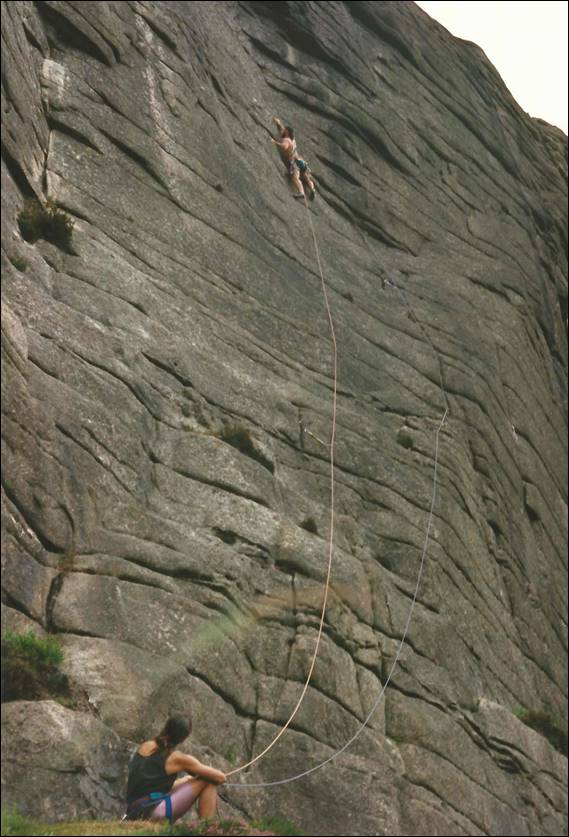
Our chosen place to climb was much more sedate and we picked a beauty, the lines we climbed stretched the rope and provided fabulous sustained routes. The immaculate rounded granite here was layered like a cake with each horizontal providing great smear holds. We bagged a good number of routes and were all climbing well, below Tim is leading Dot’s Delight which was the first line of the day. A beautifully arching climb that got steeper the higher he went and provided great exposure despite being mostly slabby. For me the first climb I did was the best, Gynocrat followed an impressive steep crack line. Jamming, smearing and trusting the holds all the way up a wonderful sustained system that split the crag. Belaying atop provided great views and I can see why this place has inspired songs, books and films. This day we were all climbing with style and no mob tactics were required:
Tim was a bit of a character, I hadn’t met him before but Finton swore he was a good guy. He was right and Tim was fun, safe and at times quirky. He spied a line up one of the gully walls and for the sheer hell of it carried all the gear up and asked me to get up the gully to take an image, as below. It was nothing too hard but fun, better still there was no record of any routes on this wall so he got naming rights and called it Thuggery, Buggery and Beer. It was worthy of writing up but I am not sure if he ever submitted the description to anyone and I can’t find any record of it online. There was still time for one last line so we warmed down on the fun First Corner, which was in fact an arête. Then it was time to hit the road again and this time we headed north up to the Bally Castle, ripping through Belfast and not daring to stop:

This next spot looked stunning and we simply had to make a stop in here before we moved along the west coast. Fairhead is considered by many as one of the best crags in Britain and Ireland providing both a big cliff and a big atmosphere. It sits high on a steep hillside above the ocean and provides awesome views to Rathlin Island and Scotland. The 5km long cliff has routes at every grade up to a maximum height of 100m. The dolerite provides a mixture of steep cracked walls and corners. In many places, including the one we plumped for, the rock resembled organ-pipes. Despite how much I talk this place up it seems that it doesn’t get the attention it deserves, some say it is due to its relative remote location while others say it is the powerful nature of many of the climbs. Being so long there are extensive areas where there is still plenty of first ascent opportunities, what I would do to spend a weekend or longer here! We drove in and parked on a low hill (if you can spy it in the image below) and then tackled the huge blocky scree slope. Well over an hour for the walk-in today and even more due to our constant stopping to check the guide and look up in awe. We had a fairly big drive ahead of us so we only really had time for one line and we wanted to pick a rated route that offered three pitches and found Burn Up with three pitches of 5a, perfect:
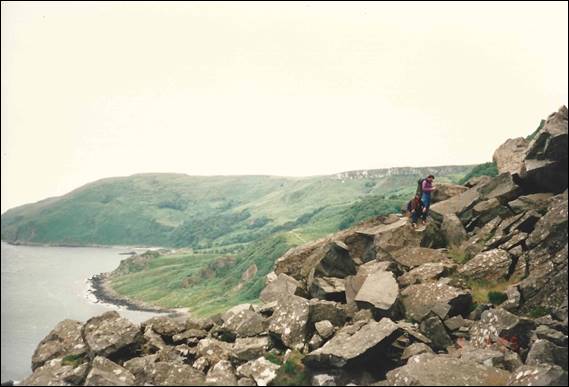
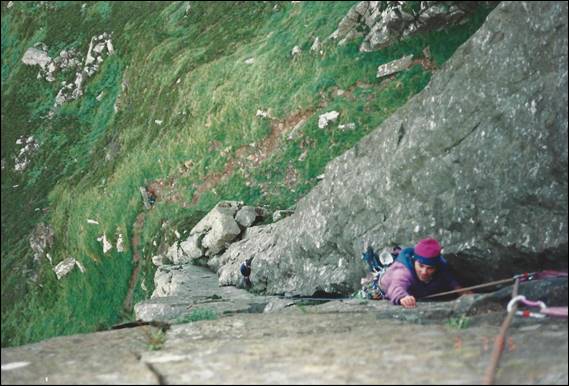
We climbed in rotation from day one so it was Finton who got to touch the rock on lead first. The route followed a 80m crack and corner that was direct and sustained. The first pitch was mega with the need to layback past tricky sections, do technical bridging and also jam. I took the second pitch which was equally good, and Finton is following up after me in the image below. Climbing with three did slow things down but that didn’t worry us and having three proved to be a good thing towards the end of this trip. Tim took the glory pitch at the end taking us to the top where we sat for a good while to take in the view across the ocean and to Scotland. We scrambled down a gully back to the pack but not before finding a tenuous bridge created by one of the dolerite pillars that had fallen and was now wedged across the gully walls. We of course had to do the tourist thing and get image of us standing on it, I look very nervous in the image of me standing there and can remember wondering whether this was in fact a good idea. I was very relieved to get off the thing. We hoicked out to the car and drove off along the northern coast to another famous piece of Irish rock:
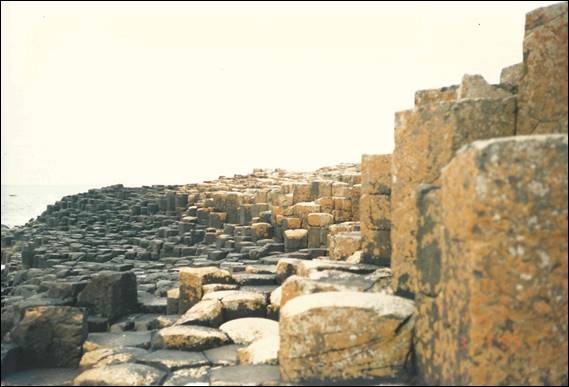
We simply couldn’t drive past the Giant’s Causeway, an incredible sight of about 40,000 interlocking basalt columns. For those interested, these columns are a result of an ancient volcanic eruption. The highest of these columns was 12 metres high and despite the place being a World Heritage Site and National Nature Reserve how could we not climb them, so we did when no one was looking. The place felt old and sitting there was quite an amazing experience and as such I can’t avoid getting stuck into a bit of history about this formation. I have unashamedly lifted the following text from Wikipedia: According to legend, the columns are the remains of a causeway built by a giant. The story goes that the Irish giant Fionn mac Cumhaill (Finn MacCool), from the Fenian Cycle of Gaelic mythology, was challenged to a fight by the Scottish giant Benandonner. Fionn accepted the challenge and built the causeway across the North Channel so that the two giants could meet. In one version of the story, Fionn defeats Benandonner. In another, Fionn hides from Benandonner when he realises that his foe is much bigger than he. Fionn’s wife, Oonagh, disguises Fionn as a baby and tucks him in a cradle. When Benandonner sees the size of the ‘baby’, he reckons that its father, Fionn, must be a giant among giants. He flees back to Scotland in fright, destroying the causeway behind him so that Fionn could not follow. Across the sea, there are identical basalt columns (a part of the same ancient lava flow) at Fingal’s Cave on the Scottish isle of Staffa:
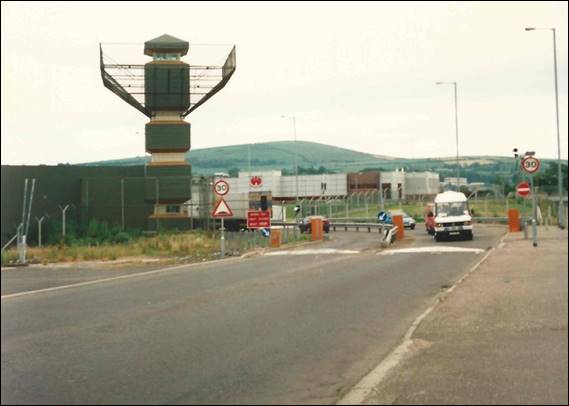
We now had a couple of hour’s drive which was to take us out of Northern Ireland and into Ireland, and that meant crossing the border. Like our first experience in Belfast this was equally disturbing, and I probably was not supposed to take the image below. Once through the border check point we didn’t look back, strangely also once on the other side things seemed to change. Kids were sat on the stone walls, that lined the roads, waving at the cars and smiling. The place seemed to have a more relaxed, and dare I say it, happy feel to it. The roads narrowed up and were lined with stunning rock walls made from round rocks, so you could see daylight through them. All of these things made it feel like we had stepped back in time. Our destination was a town called Donegal and we got there as the light was fading, parking up in the centre of town and going for a wander. The streets were alive, people were milling about and from every pub (and there were quite a few) music blared out and there was the sound of laughter an merry making. Such a stark contrasts to the towns we had been to in Northern Ireland. We listened out for the music that most appealed and went in, even better live music. We had a beer and got chatting to people, so we had another and then a third:
The place was catching and made us feel very welcome. After a feed and another beer, or was it two we headed back to the car. There was no way I could drive anywhere so we took our tents out and pitched them on the verge, just as a police car rolled past and came to a stop right next to us. A cheery police officer leant out and said sleep well lads and just make sure you don’t leave a mess when you pack up. Not what we expected but it was very welcome. The morning started slowly as we had breakfast chatting to the locals, we then gave an elderly man a lift to his favourite church (i.e. pub), and then helped a lady with bags fully of grocery shopping who happened to be hitchhiking her way home. It seemed that here everyone liked a chat and everyone helped each other out, and the world simply slowed down. Eventually we made it to our chosen playground, Muckros Head. The steep layered sandstone crag oozed personality with daunting overhanging lines intersperse with corners and cracks. It sat atop a huge rock shelf with salt crusts in the pools, and it was only a five minute walk-in! Despite the fearful sight there were many lines in the mid-grades and the formations gave no end of opportunities to place gear:
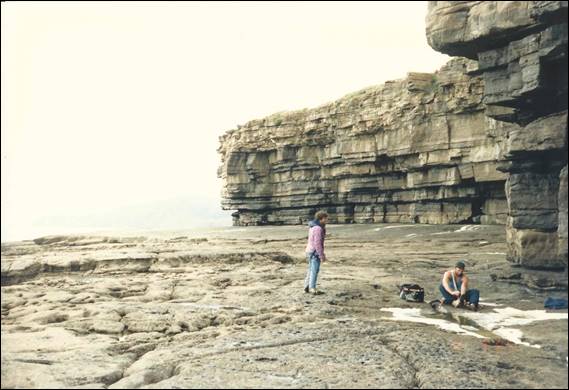
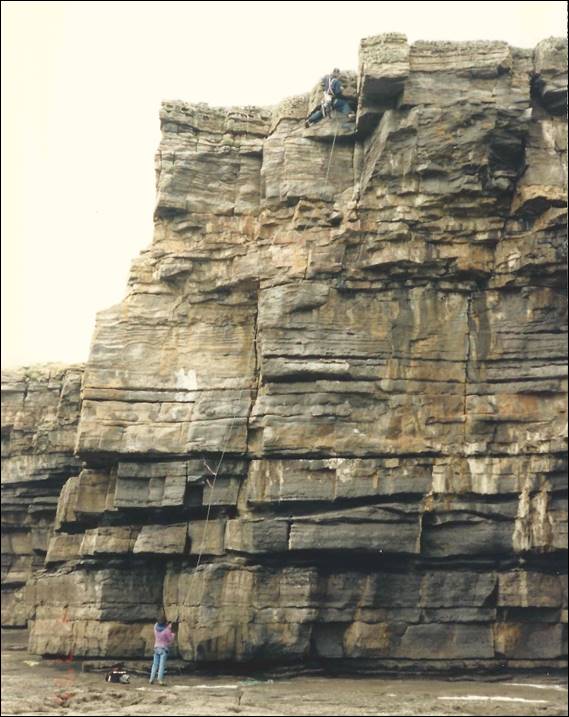
We spent the rest of the day here and hit some brilliant lines, the steepness wasn’t as bad as it first appeared. Helped by the mob of great holds and solid gear. Below Tim is topping out on Primula, and as all the climbs had been it was a nicely balanced route. Great corners weaving through the overhangs and providing airy positions and exposure. The rock was solid, we didn’t come across any loose stuff, and on occasion the smaller holds on the face climbs gave us the odd nervous moment, but it all held. We had the place to ourselves so packed in the climbs, starting at one end of the crag and picking of the lines that appealed to us. We didn’t really take much note of the guidebook and even struggled to identify a few in the guide we had so maybe we did a few first ascents here too:
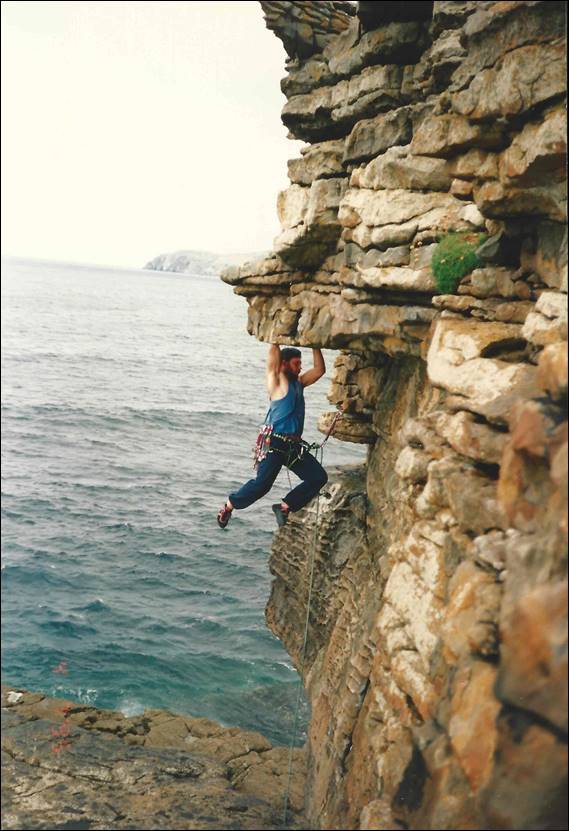
With the steepness this place offered it was hard to not get caught up in photography, and worse still the sort that was a bit posed. Below Tim doing an impressive but completely unnecessary no feet hang before mounting The Nose Climb. There was a route that we had to use mob tactics for and that was The Importance of Being Elvis, and coincidently as I type this email today is the 40th anniversary of that great man passing (for those keen you will be able to work how long ago I typed this email). On this particular climb there was an overhung start that required some technical climbing and bit of grunting to get onto the main face. There a small series of flakes led up to a good horizontal. This part was delicate and you had to place full trust in the flakes for holds and gear, Finton didn’t like them thinking if he took a fall they would pop. When I went up I replaced his cams behind the flakes with wires and made the moves past them. A cool line and he picked another beauty. That night we drove further south and camped near a kind of working man’s club just outside of Sligo. We were in the club having a beer and discussing the day and Finton and I got into a bit of a debate about gear placements. In particular I was convinced that the flakes were more likely to pop with cams than wires, but my engineering logic was lost due to the effects of alcohol and it had the ability to get heated. Tim stepped in, all calm and collected, and defused the situation by diverting us onto another topic:
The morning came and we had decided on another relatively high inland crag, again with ocean views in the distance. This meant we were back to the bigger walk-ins with just over an hour. These crags were giving our all-round fitness a bit of a boost, but I feel that we may have been reducing the benefit a tad with the evening beers. The crag was about 30m high comprising a vertical south facing grey reef limestone wall, which featured mostly cracks, flakes and faces. The rock was generally compact and had both finger pockets and a rough texture that gave great friction. That said the climbing here was pretty technical in nature and the holds were described as often sharp, which could also be said about the grades of the climbs. On this day I only took a couple of images, we were mainly using Tim’s SLR and he was using slide film. Unfortunately this film got lost in the post when he sent it off to be processed, so there are no images of the climbing here which is a real shame, and I was particularly gutted about this. Finton started the proceedings and went for Sparrow which looked inviting with its solid flake and crack system. Nice climbing never too tricky and plenty of gear, which was both a great way to warm up and also fitting for the grade. I was next up and bumped it up a bit liking the look of Leda not only because of the line but the description that indicated it had an acrobatic crux. The holds were much smaller and the forearms could tell, and the crux really did require some contortionist moves a bit above the gear making for an exciting climb. Tim then wandered along and looked up and was drawn towards Last Of The Summer Wine. This route started up a slick corner to reach a horizontal and then continued up a vertical crack, it looked awesome but also hard. The grade indicated likewise but Tim was smitten and wanted to try it, he started well up the corner with great bridging that was sustained and made him work to stay on. At the horizontal he placed a piece at the base of the crack and then try as he did, he just couldn’t mount the break to get established in the crack:
He tried numerous times and eventually looked down and asked if anyone fancied finishing it off. So I went up, the wire he placed above was only half in but the crack was too shallow to take anything else. The crack above was parallel and both inside it and on the face were tiny ribs. This made for excruciatingly painful jamming or face climbing on tiny forearm pumping crimps. I made the hard move to get my feet on the horizontal and tried the crack for size. After ripping the back of my hands I went for face climbing. It was slow going and felt steep, sustained and tricky. One cam went in but the ribs concerned me so I sat on it very slowly and the ribs slowly crumbled allowing the lobs to settle on the rock and the cam to take my full weight. I repeated this with three cams up the crack, all the same size. At the top of the crack it was slopey and smeary, and my arms were burning up, then a foot slipped and I fell. Due to my position I did a superman dive, the rope tensioned and went slack and Tim’s face started to get closer. The rope again tensioned and went slack as I hit the horizontal with my ankle and spun back up, the rope again tensioned and went slack and finally tensioned and held. Tim lowered me the final five or so meters left and it seemed I had fallen 20m and in the process ripped out all three cams, with the half wire having saved me from decking out. My right hand and ankle had hit the horizontal and were cut and sore. As I lay on the ground the boys set up a rap rope to retrieve the gear, and at each cam position they found four groves in the rock where the lobs had sliced thought the limestone. Needless to say we packed up and headed down slowly. The images that we had taken of climbing here had been from a pillar from which we could get a bird’s eye view of the route, as can be seen by Tim lazing in the perfect rock armchair, adding to the frustration of having lost them. The ankle was getting sore but nothing felt broken, and we headed to Galway hospital. After a check-up and being patched up with sutures we decided that tonight we would stay in a hostel:
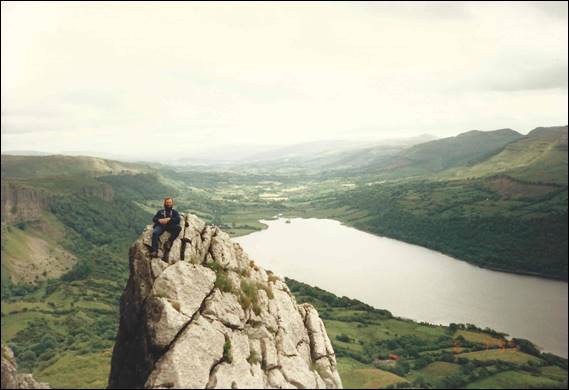
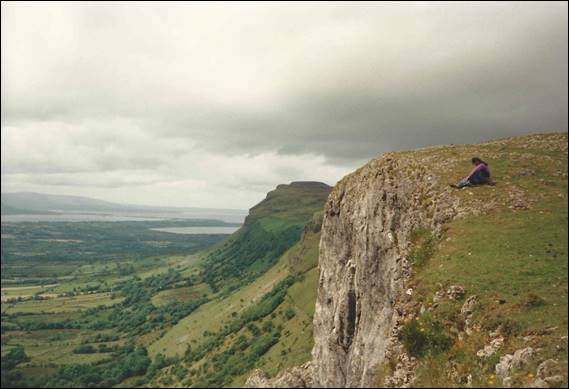
Galway was a big place and lively as, it felt like Donegal on steroids with music and people all over the main street. We found a bar and had a drink before retiring to the comfort of a real bed and in the morning a cooked breakfast. We had two days left and decided to head a bit further south along the coast to the Burren. Here we could camp above the cliff next to the road, there were a few tents already there and people were on the crag. A wide rock shelf protected the face that comprised a grey limestone, which was way more compact and solid. It was the shortest crag of the trip but looked to have a mob of quality lines. I had to however be content with being a spectator and taking images, and occasionally siting down looking out to sea watching the waves. Below Fin was making a song and dance on Nutrocker, as his legs were doing some serious disco moves. This was the way the climbing went here short, sharp and testing. Most routes were pretty constant but a couple seemed to be one move wonders (usually the faces). The cracks and corners looked great fun with technical bridging on good sustained lines and the boys ate up line after line. They did have to accept that when they climbed in the shady corners and under rooves the midges would attack. I never experienced that and had to use all of my self-control to avoid the urge to get my harness and boots. I was bruised but more so on the inside, kicking myself for not topping out the day before:
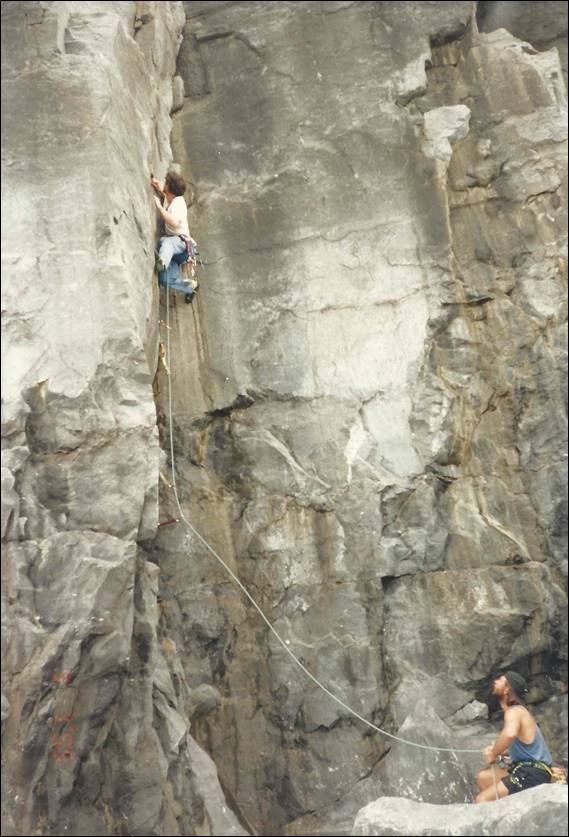
We cooked up a feast and as it got dark Tim and I were ready to hit the sack, but Finton fancied a beer. It was the first night we had camped without a pub in sight. Some of the others camping out were heading in so he jumped in the car with them, I remember hearing them come back but slept well that night and felt better in the morning for not having had a beer. Day two at the Burren and the onslaught continued, while I continued to be sensible. The ankle was sore but I could wander about on it, however there was a risk of opening up the cut on my hand if I tried to climb. With just two they seemed to move quickly and did a good number of very fine lines, and before we knew it they were on their last line Pis Fliuch. Set way off over the water and requiring a scramble to get to it I stayed put. The belay was on a slopey boulder, but the climb certainly looked very good and from all accounts was a fun, steady and safe corner climb and a fitting way to end the trip. We had a ferry to catch, it was the first one in the morning so would leave at 6am but we had to be there two hours before. With needing to cut back across the guts of Ireland that meant driving overnight:

Seeing I would be dropping them back at the train station on the way back into the Lakes we had cleaned up the car, sorted all the gear and repacked it all. Then it was time for a quick posy image of the crew before we started on our journey. After an hour we stopped at a pub (of course, remember this was Ireland) and had some food. It was the usual story and there were a bunch of locals jamming away. So Tim and Finton, after a pint, got a taste for the place and decided to have a few more. It was close to midnight before we left there, and as I drove in the dark they slept. When we got to the border to get back into Northern Ireland they got a rude awakening. I pulled up in the darkness of night at three or so in the morning and this drew the suspicions from the border patrol. I was greeted by a tap on the driver’s window which when lowered allowed the muzzle of an automatic weapon to come into the car. After a brief very direct chat about what we were doing, where we came from, where we are were going and why we were driving so late at night they let us through. Welcome back! We made it in time for the ferry and even managed to get a brew and some food down us before the cars started to roll on, then once we found a good spot with some comfy chairs it was my turn to sleep:
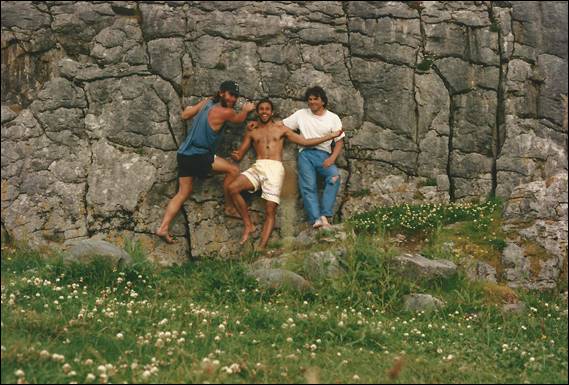
Two weeks later I was back on rock with Gary tackling Triemain Eliminate on Castle Rock of Triermain in the Lakes. The next email will be my last from my climbing in the UK… well kind of as I will be once again be going overseas, this time to Europe.
 Sandbagged