I feel a little bit excited about this one, while every place I went to had its own charm and appeal I’d regard the South West of the UK as being up there and as a close runner up to Swanage. I’ll skip round a few places in both Cornwall and Devon that make up the toe of the UK, so once again a bit of Googling may be required to keep up. My early memories of this area are from family holidays to quint seaside villages, nestled in coves with amazing coastlines. We’d hire a caravan in a big park and go out to the shops, walk along the coast and visits the many great natural tourist spots such as Lands’ End, The Lizard, St Michaels Mount, Dartmoor, etc. Then while at polytechnic (as the now Coventry University was then called) I went back there on both surveying and geology field trips, including one trip in which I visited Lisa’s home town of Torquay. The latter indicates it is a special area and the rock down this way gets both climbers and geologist equally excited:
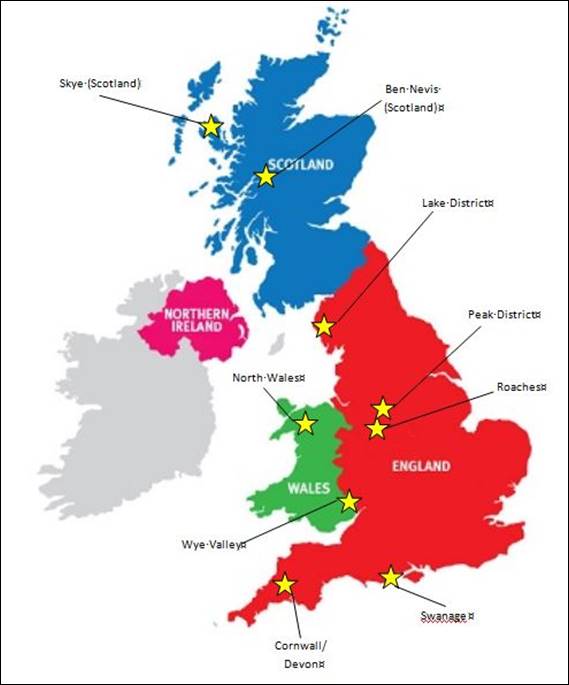
During my move from working in the Lakes to working south of London in Leatherhead I convinced Gareth that we both needed a holiday. So we organised a ten day trip to Cornwall. We hadn’t been here before and there were so many places that appealed, making it hard to know where to go. But we had a few criteria being to try a few places, climb our hearts out, and bag as many classics as possible. On this trip I kept a route log so could real off all the lines we did, but I won’t subject you to that. Unlike where I climb now the classics in the UK tend to be well bedded in with generations of climbers having agreed that those climbs with that lofty status really were worthy, not rating them after the ink on recording the FA hadn’t dried yet. That said on occasion we did wonder if they got it right, and our first port of call made us think twice on that score. Chudleigh was just off the road that took us on our journey west, so it seemed like a good spot to break up the journey. Comprising a 50m limestone crag we had high hopes, but only did two climbs. Below Gareth is starting up Reek, and the other line we did was listed as one of the crag classics called Sarcophagus. It was an epic corner climb that required squirming, bridging, back and footing and all on the slippiest and slimiest limestone I have sampled. It was horrendous in so many ways that it felt epic, and reading about this crag now it says it is highly polished and feels much worse in humid conditions. I can certainly testify to that:

We didn’t hang about but jumped back in the car and headed a bit further along the road to Dewerstone. A much more pleasant place both to camp and to climb. We pitched our tent under cover of the trees and in the early morning we wandered along a babbling creek through the woodlands to find the main buttress of this area that comprised a 50m granite crag. Grippy solid granite, a delight to touch after the slimy limestone. We didn’t muck about and spied a number of lines that appealed, starting with the great Club Climbers Direct (probably the best) for which I’m on the first pitch below. Great jamming to get through the overhung start and then it just kept going in great style. We picked off route after route, alternate leads were the go and it was very rare for us to falter from that pattern. Mostly crack climbing so our jamming was tested, something we usually tried to avoid which in truth could be said about my climbing even today. Our criteria did not have in it the need to seek high grades, it was more about quality lines whether easy or hard (for us):

After a good number of leads we had some lunch and being conscious of the drive ahead to the next destination we decided to pick a couple of the easy lines that looked fun and have a solo. Gareth is coming up Mucky Gully below with full safety gear on, while we had tin pots with us they didn’t come out too often. Usually the tin pots were used when we went to places less frequented or on big mountain routes, and even then we were a bit carefree in our youth. We had picked a great time for the trip, sun every day but not so hot that it became unbearable. So after another long 50m solo it was shaping up to be a great start to our trip. We did however, have to get back on the road and so it was with reluctance that we left this place. There were plenty of other good looking lines and that combined with the great setting in amongst the trees gave it a really calm and tranquil feeling:
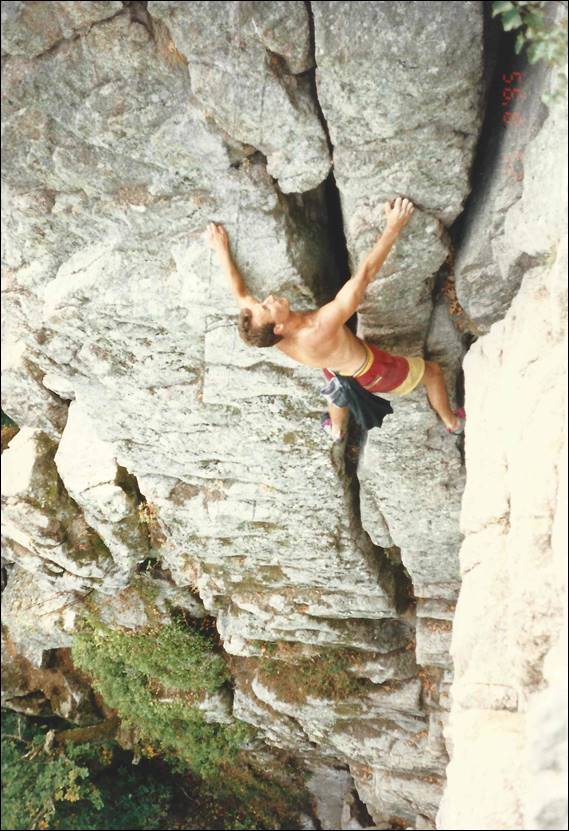
We kept heading west and got there in the dark, checking the maps for where we could camp and being cheapskates we were looking for sneaky spots to camp for free. Porthcurno Beach, which in the Cornish language means ‘port of Cornwall’ provided the perfect spot. It is a popular beach and had the usual no camping signs but we would get there late and leave early, so never had any issues. Some nights others would be on the beach, some stayed late into the night and left others stayed all night and were still sleeping off the woozy heads (they deserved based on how hard they drank the night before) as we left. Porthcurno is not only famous for this beautiful beach but also the Minack Theatre a unique open-air theatre with the mighty Porthcurno Bay as a back drop. It feels like it has been carved out of the rock that makes the headland, but that is not the case. We were also only 4km from Lands’ End the most westerly point in the UK but we didn’t bother going there, firstly you had to pay to get in and secondly it would be overrun with tourists:
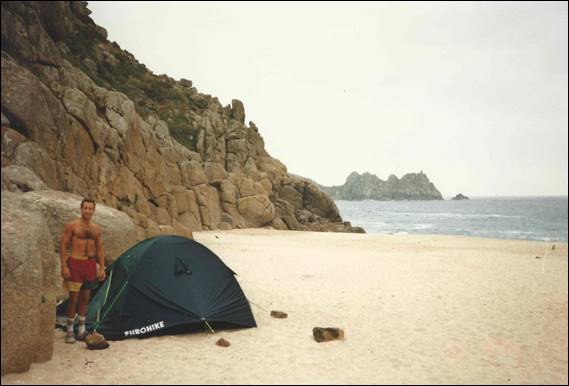
On our first day out we sampled a small’ish 35m crag by the name of St Loy Cliff. We were now well and truly in granite country, the whole coast seemed to have rugged orange tinted granite buttresses that provided incredible scenery and a very rugged and quite dangerous coastline. This crag however sat above the ocean with a grassy and heather base, a good spot to kick back and make a brew and have lunch when we felt like it – well we were on holiday. Some lines were very intimidating with wide rounded cracks that had no other feature other than the crystalline surface of the rock. No crimps, edges, slopers just pure friction with cracks to wide for any gear we had. We tried one such climb and bowed down humbly admitting defeat. There were however plenty of other routes to jump on such as Cress Cendo below, and the best line of the day would have to be Chlorophyll Cluster. This climb had a steep wall that you had to gingerly work your way up to get into the steep slabby grove. Lots of footwork and balance, just my style. The granite also provided awesome flakes for lay-backing, something I really enjoyed but the place also offered good not too painful jamming cracks and airy horizontal traverses. Gear was plentiful as long as you stayed away from the wide cracks, so all in all it was a worthy crag and one described as having flawless granite (something true of many Cornish crags):
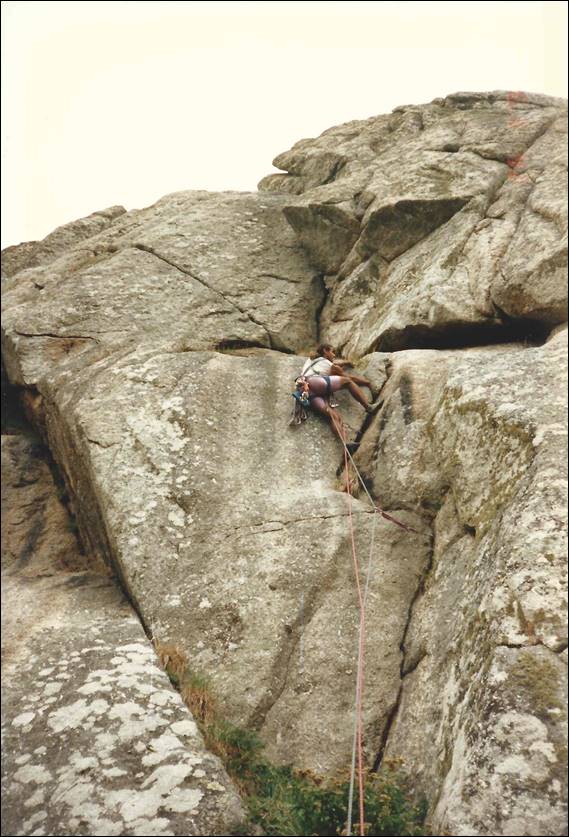
The next day we went truly coastal, for the first time on the trip. No trip to Cornwall would be complete without a stop at Chair Ladder. It’s a revered crag but claimed not to have a heap in the high grades, not that it was a worry to us. At this place you could feel the rush of the water below you, the roar of the crashing waves rang in our ears and the wind on the few times it did pick up would add to the excitement. Up to 70m epics on this solid granite buttress that is amply endowed with cracks and holds. The tides here can be big, 6m plus and as such knowing when it was safe and not safe to go for it was important. Below Gareth, as he followed me up Mitre, is suicide pool a beautiful calm rock pool at one time that can quickly turn into a raging boiling pot of white water. These are the aspects that drew both Gareth and I so much to sea cliff climbing. We hit classic after classic including what was regarded as one of Cornwall’s greatest VS’s Diocese. It is high in the grade and has a very airy technical hand traverse above a roof, the exposure was brilliant and every pitch on every climb at this crag was nothing but fantastic:

To finish the day we had our eye on the very fine Terrier’s Tooth, it started from a platform and we watched as the party ahead of us make their way up the first pitch. The tide was coming in and the belayer kept looking out to sea in case a big wave came in. The water started to lap higher and higher up the sides of the rock platform, but we didn’t go for it until they were both up the first pitch. We dashed out and it was my lead for which I was grateful, as the first pitch looked awesome. A steep but well featured wall, technically the hardest pitch but full of beautiful positive and solid granite holds. I was also grateful to not have to watch the waves, which I left Gareth to do as he also (hopefully) watched me. The water started to lap the top of the platform as I got up and set up a belay. He started to climb just as a wave swept over where he was stood. I doubt he was at risk from being washed off but the rope probably would have. Now with the water below us we could relax into the climb. Better still no one would be following up the popular climb so we really slowed down and savoured yet another good climb. The route was never too hard and a good way to end the day with the light fading and the promise of a good well deserved feed at the pub:

Now I mentioned a good feed at the pub, it was good but the dampener was the slow service. There were not many choices of where to go so we went to the same place each night. You’d think they would recognise us but each night we felt like they looked at us just as blankly as the night before, and then walked past to serve a local seemingly waiting till they absolutely had to serve us. It was almost like they didn’t accept ‘strangers’ too kindly. With no alternative without a descent drive we put up with it. The next target on our list was one that didn’t get a great write up in the guide. Maybe because the north facing wall commonly being damp and slow to dry. The routes however looked good, so we risked it. The image below is from atop Fox Promontory looking west towards Land’s End. The coast simply oozes cliffs some mega and some not that great, but all provide for a very spectacular coastline. It is also a dangerous one with currents ready to pull you out and unexpected big waves on occasion ready to sweep you off the rocks. In some ways the surroundings made every crag good, but I’m pleased to say the guide had downplayed this spot. The guide write up was good in keeping the crowds away and we had the place all to ourselves, unlike the last few places:
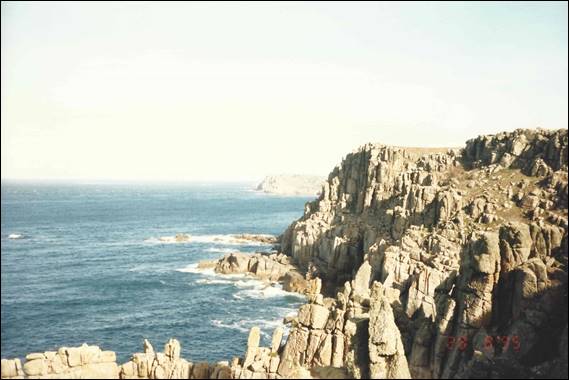
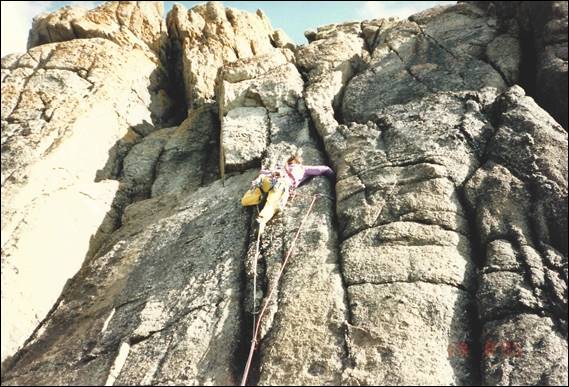
We had a blast and managed seven multi-pitch routes in a long day and everyone was great. They were all pretty sustained and kept you working the whole way up. The relatively steep walls were mostly ascended by vertical cracks, with the occasional need to face climb on large crystals in-between horizontals. With the good weather the rock didn’t feel damp and was super grippy, but for half the day at least we were in the shade and that did make it a tad chilly so unlike the T-shirt clad days before, here the buffalo needed to come out. Below I’m jamming deep into the cracks on Dark Deinzen, the only line we did here that didn’t gain a star but we couldn’t quite understand that as it was just as good as the rest. I wonder if it had been damp whether we may have walked away with a different view point about this place:
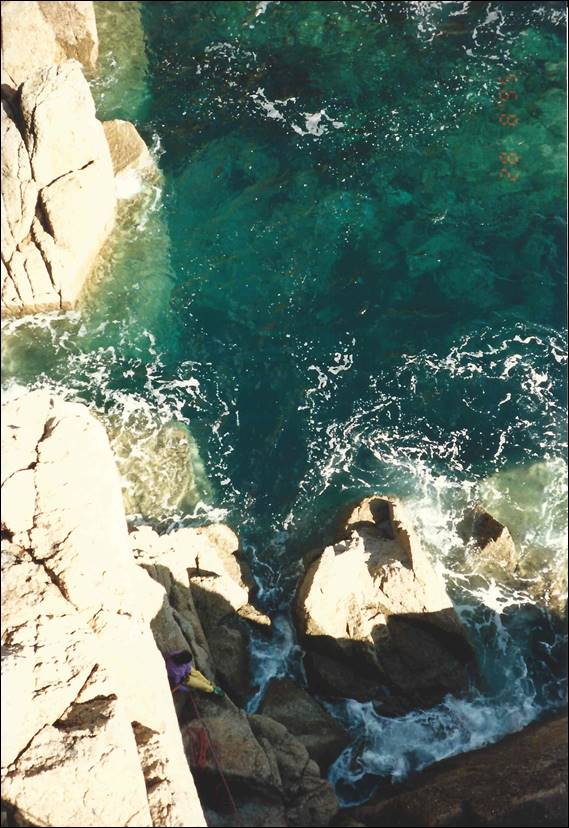
With no one else about the place was super peaceful, the swell was down and the water was crystal clear with that rich aqua colour that seems to invite you to jump in for a swim. I can still recall when I was belaying Gareth up Dark Whisker, below. I kept feeding the rope out as he worked his way up, but all I looked at was the water at my feet. You’ll maybe notice that while we may have been lax about tin pots we did tie in when required and I’m safely anchored to the wall just in case. The line of the crag for us had to be the last route, Gareth liked the look of the crux second pitch of The Muzzle that yields via a steep crack up a clean face to an overhang that is bypassed with an airy exposed sequence. But to get to the second pitch I decided to tackle the crux first pitch of Sports Plan, a thin left tending crack on a slightly overhung wall. Small wires, smears for feet and fingertip crimps up the crack. We left this till last, for better or worse, and my arms were burning as I moved along the crack. That familiar quandary of whether to keep moving or place gear playing on my mind. I did a bit of both and made it up, with Popeye forearms, feeling like they did when I had topped out on Darius on High Tor in the Peaks. The second pitch was equally brilliant, and I was glad to be on second with a rope above me:
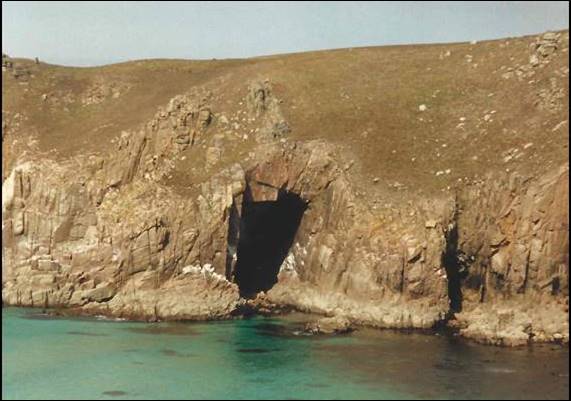
Gareth was keen on a rest day, but I was not that keen so made a deal that we could on the basis that we did only two climbs. Both highly regarded but some distance away from each other so requiring a bit of walking. He agreed and so it was that we spent half a day walking and climbing two mega routes, the first was back at Chair Ladder. I’d spied it when we climbed there and it provided a direct line up from Suicide Pool with varied and absorbing climbing up slabs, an overhang, corner, overlaps, hand traverse and steep vertical jamming crack to finish. Woohoo it was brilliant and I did the three pitches in one, which with twin ropes and some careful use of long extenders worked a treat. I was super happy and this true classic amongst classics rated highly in my mind, but I was still keen on the other route too so we broke tradition and I did two leads back to back. The next line was on Zawn Kellys a bit of a hike but on days like this why head into a town, so we wandered along the coastline to our destination, from atop we had a great view across to Pendower Cove (below). Yet another place that looked inviting, but not for today:
American Dream provided a 40m single pitch up a steep pinnacle via a consistent and sustained rounded flake/crack. To get to it there was some steep territory through overlaps and shallow crack lines. From start to finish this route had class written all over it, untouched for some time I couldn’t avoid the many cobwebs but by the time I was up there were no cobwebs left in my head! It is regarded as being high in its grade but I didn’t notice and was fully absorbed from the moment I touched the rock and floated up this elegant line, almost as if in a dream. This route is most definitely up there with the very best routes I’ve ever done and I couldn’t talk it up enough. Could it get any better you may wonder, well yes it could. When I started up I noticed a couple of seals playing in the water below us, they would both pop up and look up at me and then jump out and slash back down. This continued as I climbed and then as Gareth followed me up, we packed up our gear and they still watched us and then as we walked back a bit they jumped out one more time and headed out to sea. As we walked along the coast we kept an eye out but they didn’t come back, sublime. We were both very happy with the two climbs and ready to head to the surfie town of St Ives expecting a bit of a lively night, but being midweek it was dead quiet and a letdown. Still we got served first up by friendly bar staff and also had a wash:

Sennen is very, very popular. Maybe because it has a rock shelf from which most of the routes go up, they are mostly single pitch and there are a host of sub-E grade lines. We were there early but the place soon filled up with climbers, which included the army. They said it was a regular training place for them to introduce their recruits to rock climbing. They wore black and all their gear was black including the ropes, harnesses, slings, wires, hexes, etc. It was weird but of course made sense, when you are climbing up a mountainside to mount a surprise attack on the enemy you need to be well hidden! Despite being super popular the routes were not as classy, being a bit more broken, less sustained and generally not as engaging. We still had fun and managed to find descents that at times made our hearts beat faster than the routes, such as Church Window which I am coming down below:
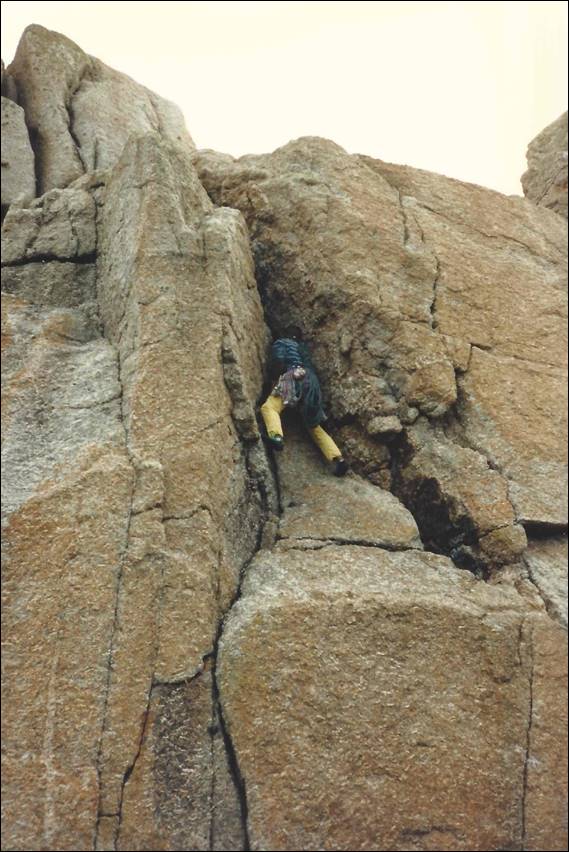
It was a bit of social climb here. People chatted, sat about, and watched each other climb but we motored on while gabbing. I was drawn to one line called Samson Arête, it followed a very fine and steep crack up an arête before another crack ascended the continuation slab. The lower crack was great fun but wet, water was seeping from the midway ledge and while I could see the move I just yo-yoed for what didn’t seem that long before backing off. So what to do but tackle another good looking line called Demolition. I’m not sure what I was thinking but it was a slab and of course I could do it, I got half way up but again while seeing the move struggled to commit. Reading the description online it says a pulse-enhancing and memorable pitch that features an extremely runout crux and gear just above half-height will protect the crux with a swift belayer, so psyche up and go for it. I again bobbed about for ages and backed off, Gareth was super patient with me and I found that the two failed attempts had eaten away just over an hour and a half! Mind you the second line was a lofty E6 6a, and I’m still baffled as to what I was thinking! For one climb we snuck away from the main crowd and went up this wet black slab, it looked alright and at the grade was sure to be fine. As I went up I kept saying that good holds would come, but my mind was still out of kilter and I had gone up the wrong line. At the time Slab Happy was graded E1 5a. It kept me focused and on edge all the way, and I notice it now gets E3 5b, I’m guessing something must have fallen off since:
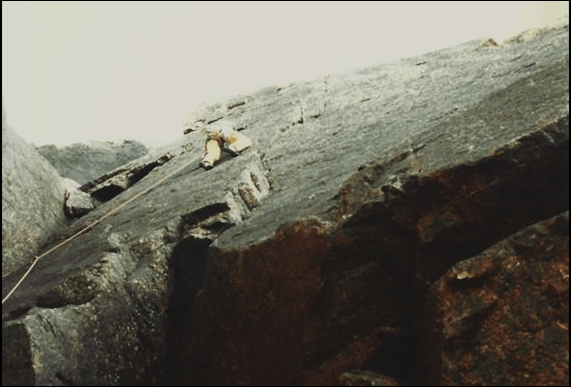
We were heading back east now and making our way along the northern coast of the UK’s boot. On the way to the next crag we decided to drop into Carn Kenidjack that had a highly regarded climb called Saxon. Gareth was up and he set off but his head was not in it so after sometime attempting the first tricky section he backed off, not taking as long as I had the day before to decide on the right course of action. After letting him rest up and ponder what he wanted to do he decided not to go for it. I was of course more than happy to take on this very fine looking rope stretcher, the guide describes it as having equal measures of intimidating and amenable sections. Very true and a shame that Gareth hadn’t gone for it, but you get moments like that. It was a bit of a walk in for one climb but we both regarded it highly and thought it was worthwhile, other lines looked good but the grades stepped up so we headed for another location. So we moved onto a well frequented Cornish must visit crag called Bosigran, unless you are there on a long weekend and then you may find you are queuing for climbs:

We spent a day and half at this very fine crag, not at sea level but it feels like you are climbing over the ocean for much of it. Some routes were up to 70m so a great length and a good range of grades, but being late in the trip we were slowing down a bit. No matter this place has a very fine selection of the lower grade routes and we ate a good number up. As we walked in, the heather was all burnt and soil was smouldering with a watchful fire crew on standby. We had a chat with them and found out that the fire had been going for a week or two. It would burn the vegetation and then go down in the root systems, follow them until it found a patch of soil high in organics and then come back up. Amazing stuff! As we climbed one route here we were greeted by an elderly man with a rack full of cams happily whacking them into the cracks and beaming with a smile that matched the guy I had met in North Wales half way up a climb. We had a good old chat and he carried on his merry way laughing and loving life all the way. It’s moments like that which really stick with me:

With a day and half to play here we had a lot of fun and there was plenty to pick from. You may remember I mentioned that Bob had given me a stopper, well it was on a climb called Anvil Chorus that I found my first stopper as crag booty. It was wedged in the horizontal crack I’m at in the image below, I made sure I could get it out before going past it to make sure Gareth couldn’t claim it as his! Sadly I read that much of Anvil Chorus has fallen so the climb is no more, a shame as it was ripper. We had a bash at Suicide Wall. A climb with a reputation, but we climbed well on that and both of us styled it. It was regarded as a classic but we were left wanting more, it followed a line that moved about a fair bit, became disjointed with way too many pitches to avoid rope drag which meant it was way too stop-starty. For the last climb we came up Ochre Slab Route 1, a fine line that offers two totally contrasting pitches; the first technical and the second super steep. The climbing was great but it was the way the orange granite was glowing in the evening light that made it special. Looking back down the crag to the ocean with the sun getting lower and lower we finally packed our bags to head out:

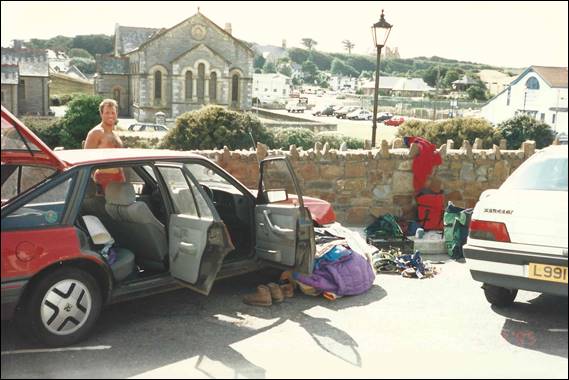
The next morning we had to drive back, but before we did we decided to bag one more route and went to Gurnard’s Head to take on the fun Right Angle. This route is why most people know this place, it is never hard but the three pitches are super exposed and need a high degree of commitment. The first pitch is a traverse toward a zawn in which waves smash and reach high up onto the wall, then the second pitch goes further along into the unknown with a continuation traverse on a steep wall. This seems to take you into the very heart of the cliff and you eventually find a stance below a steep corner hearing nothing but crashing water. The final pitch takes you upwards on a superb 40m pitch ascending the corner in an unbelievable position. A great way to end the climbing on this trip and so worthwhile. Eventually however it was time to head home but before we did that we found a parking spot in town and emptied the pigsty of a car to clear it up a bit:
The South West seemed a place that was worth spending time when we made the effort to get there. So the next trip was also a few days and this time I headed there with Kate, not so far down the boot this time staying in Devon and heading first up to Baggy Point. It is described as a mid-range climber’s slab paradise and provides well protected, consistent climbing in fine positions. The slab on the Promontory goes right into the sink during high tide but there is a window of opportunity when the tide goes out and you can climb from the base of the crag adding about 7m of extra rock. Below Kate is starting off on the well-known Kinky Boots. It’s not a climb for the short as you have to fall into the first holds, which are fortunately good but you don’t know that until you do the move. It’s a great all tide access to this portion of the crag and we did the move a couple of time because it was so much fun. We did a stack of good lines here taking our time and munching after each climb, never going too hard but there was one line that I liked the look of. I was a bit too cocky and rushed into the crux sequence up a narrow and disappearing crack system and stuff it up. I didn’t fall but did have to down climb the sequence and go for it again, which for some reason annoyed me but I soon got over that as I followed the fine slab above to glory:

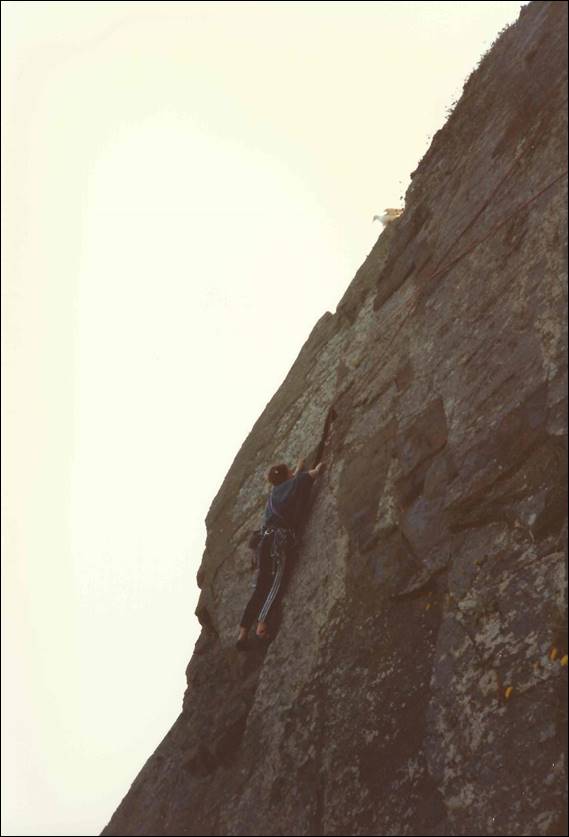
Blackchurch rock is made of the same rock as Baggy Point. The metamorphosed sandstone can be brittle in places but general was pretty good on the popular cliffs, and when we got to this spot the tide was in so we couldn’t get to the bit we wanted and headed instead for the Main Cliff. This tall towering face features many delights that include 100m XS routes that the online guide say features some splendid crumbly rubbish and imaginary protection. Perfect! So with Kate not so sure I plumped for Loose Woman as it offered some of the best rock and protection on the wall. I started up the first pitch, a wide crack with plenty of features and places to pop gear in. Then I heard that familiar cry of a seagull, not in flight but on a nest… yes I really could speak gull. I looked up and sure enough up and to the left, on the belay ledge a head poked out and wasn’t looking too impressed. I assessed the situation and reckoned I could avoid the ledge by linking the first two pitches. So despite veering a bit more right and at the same time singing gently to the gull to calm it down (honestly), the gull was not impressed. A few diving swoops came next and I knew I was on a hiding to nothing, so instead I traversed right and down climbed the route to the right. Kate seemed happy to follow my circular route and did so without the gull swooping but instead the bird just kept a careful eye on her. Um must have been a girl connection going on there, check out the image below. After all that the tide was working its way out so we bailed and left the crumbling pile of choss to the gulls:
We were not too worried about leaving the Main Cliff as where we really wanted to climb was the ultra-magnificent Blackchurch Rock. This cathedral style creation sits proudly on a bed of ribbed sandstone and is only accessible at low tide. It has to be seen to be believed and to top that the rock is solid and the routes are quality being both sustained, interesting and a good rope length high. We walked round the rock a few times taking it in feeling just a little bit in awe. Kate fancied something up the side as it didn’t look so shear and offered more rests, Right of Spring was great corner system up the layered sandstone with good gear awesome position and nice exposure. After that line I was drawn, and why wouldn’t you, to the impressive triangular face and the route description says it all… a majestic pitch of flawless quality. The whole trip would have been worth it if we had only climbed this one route, Sacre Coeur was right up my alley. A series of perfect finger cracks narrowing into nothing all the way up this stunning face. Small wires were the go and like American Dream I floated up this and was in ecstasy. I would love to have bagged another line on this face and had in mind which one but Kate was pretty pooped from a few days of fairly full-on climbing so we headed out, also not wanting to get stranded as the tide was on the way back up again:
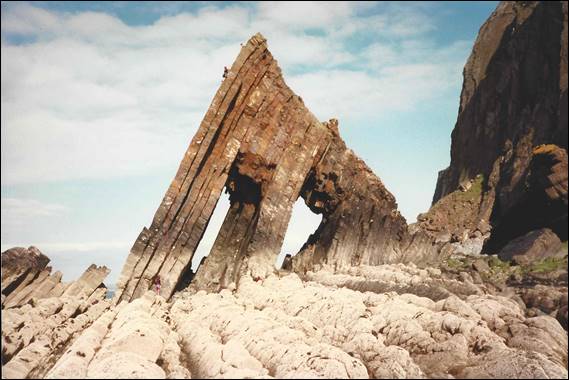
We went to another Devon delight by the name of Gull Rock. These places were at times a bit of the beaten track and required a walk-in, this one took us along Welcome Mouth Beach and navigated past some massive folds and cool rock formations. The landscape seemed to impress age on you and when you walked in places like this you felt very small, humble and privileged. It took well over an hour to get there and while we went here to climb we spent a fair bit of time exploring rock pools that were bursting with colour, checking out the rocks and on one beach there was an amazing waterfall from a cliff high above. This was yet another crag which was tidal and that also included the approach, the way we walked in you get a six hour window of opportunity, which was enough for us seeing it was also the day so we had to hit the road home:
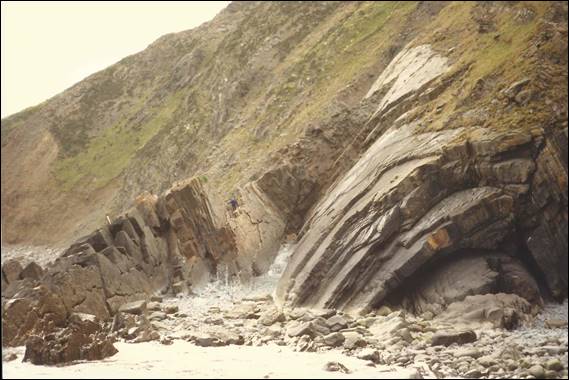
The crag is yet again made of the metamorphosed sandstone, a steep slick slab with small crimpy holds very narrow cracks and not much else. The online guide talks of pegs to rap in and pegs on a couple of lines but I have no recollection of them, and checking through the images I have it seems that my memory is probably right on that score. We got to the base and the tide was going out meaning the occasional wave came pretty close, but soon receded and we racked up some fun climbs. On the slab proper the gear for the most part was small, micro wires and some routes didn’t require anything above a no.2 so some leads were a bit nervous with tiny gear and at times friable rock. Unlike the rock I had climbed in the neighbouring county of Cornwall, Devon had its fair share of ‘exciting’ routes on what some would describe as less than desirable rock quality. That said the lines were good if you had the head for them. We also did one that came out through the cave to the right of the slab, the tiered overlaps offered lots of scary moment as you need to use flakes that you hoped held, with gear behind the same flakes, pulling through onto a thin edges above before the next overlap hit you. It seems many of these lines are now significantly different due to rock falls, which doesn’t come as a surprise:
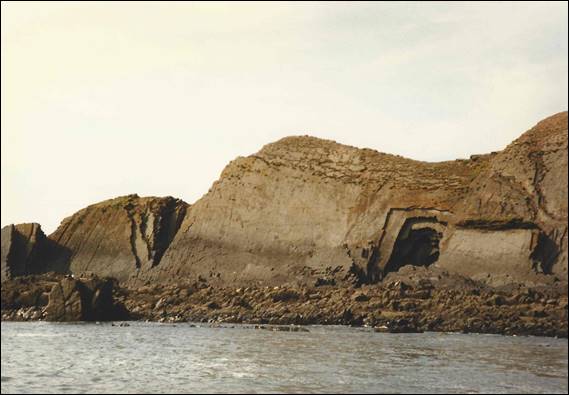
Below Kate following up Crazy Streak, and you can see the rock offered little for holds and gear, but enough for a slab connoisseur. We had a good look at the guide; Kate tacking the corners and more featured climbs which offered a bit more security while I went for the slabs. The classic, or so the guide stated was Lead Boots so we thought we would save that until the end and go out in style. We picked off a few lines but began on Walking on the Moon, it started well and gradually got harder keeping the pace with good delicate moves. The gear was small on this line with nothing greater than a 00 wire and it felt spaced, very exciting stuff and made us wonder what the classic would be like. After bagging a few more lines the tide was turning and heading back in so we jumped on Lead Boots, and was sorely disappointed. Maybe we had grown accustomed to what the crag offered and the spice of first taste had lessened, but whatever it was we both agreed that the first route had been the gem of the day. Funnily enough the online guide that I refer to, as I type away on these emails, says the same thing only now it seems Walking on the Moon has a couple of pegs in it:

Lisa grew up in Torquay Devon. So with each return trip we would head down there and I would get up early and walk along the coastline. It is not quite as rugged, tall and wild as other parts but offers good scrambling, rock hopping and views. There is one cliff at the southern end however that is well known for climbing and that is Berry Head. On our first trip back we happened to be there at the break of the bird season ban and Gareth came down so we could try our hand at The Old Redoubt area. It was summer so an early start was in order, and we arrived a little too early in the dark at the lonely carpark. With no point in heading in on the short walk due to an hour of darkness to go we stayed put, being disturbed only by a passing police car checking in as to why we were suspiciously sat there. At first light we went down to rack up, only to be mobbed by a huge university group who raced ahead of us. Not impressed, we left them to it and went across the water to the Coastguard Cliffs. Higher up above the water and not as spectacular in setting but we found some good lines and had fun:
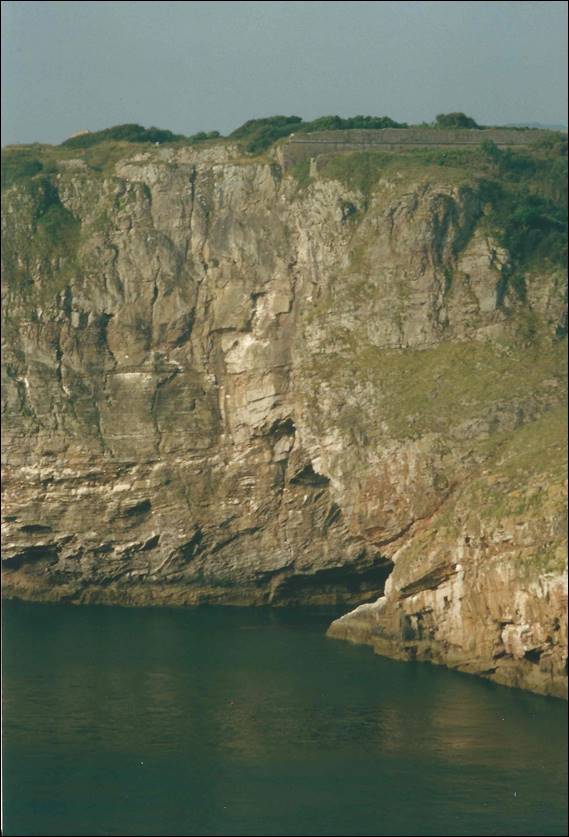
The next day we decided to try again. One reason for our keenness was the guide suggested, as does the online guide, that the crag had the best HVS in the country. We were keen to get onto Moonraker to see if they were right, and obviously the uni group the day before had rushed in before us with some of them intent on that line. To get to the climb is a bit of a mission in its own right, you start from the sloping rock on the right in the image above scramble into the cave and then back out along the steep wall. It was effectively a deep water solo and pretty good fun, and this place has grown in popularity and boasts a high quality 700m solo traverse going at F7a/7a+. It took us a little while to find the belay perch for the first pitch and finally got comfy, three epic pitches awaited and we were excited. Better still we had the place to ourselves, the day was slowly waking up about us with fishing boats heading out to sea or were they already coming back in? The first pitch was OK a bit of a one move wonder but nothing to write home about. The rock was ish and the gear pretty average as the image below shows at times non-existent. Then Gareth headed off and the next pitch improved a bit, the rock was more solid but the line wasn’t grabbing us. The last pitch however was brilliant, up a steep corner that had great positions and exciting moves all the way up. Halfway up this corner we found a gull in its nest with a chick, I took a wide berth and it was luckily happy for me to pass by. Then as I topped out I found someone asleep on a bench, so we kept it quiet as Gareth followed up and we sneaked past him without walking him up. Definitely not the best HVS in the country but it was worth the effort for that top pitch:
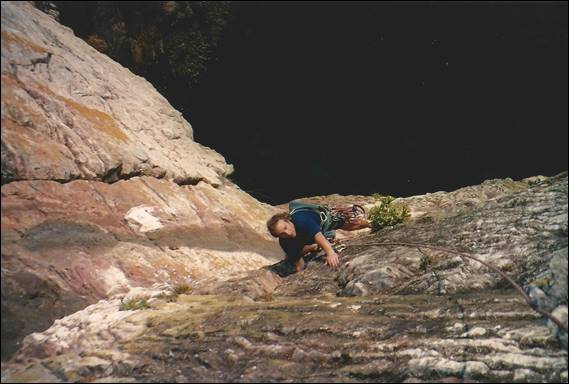
The final place I want to show you is the first crag I visited in this area, Hay Tor. Dartmoor includes the largest area of granite in Britain, much of the rock is under marsh and bog comprising peat. In winter this place can be cold and heartless, it is high up and the wind can run right through you. On a geology field trip from uni we came here and it was impossible stand upright, if you tried and several did the wind picked you up and tossed you back. Today with OSH standards that field trip would never have happened. Dartmoor has a number of rock peaks called Tors, over 160, and the biggest of these is High Tor. It is provides 30m routes of great quality. Solid granite with big coarse crystals ready to take your skin off if you fall. Despite having been here a few times before with uni and family I didn’t climb here until I met Lisa, but I’ll get to that later. On a trip back to the UK I finally got to bag a few lines on this great chunk of rock, but not on the main cliff which was surrounded by tourists. We climbed on Low Man which is a stone throw away and equally good, the rock and climbing was as good as they say. All the climbs were sustained, interesting and lots of fun. Many felt exposed and nervous and the appeal to not fall was very high:
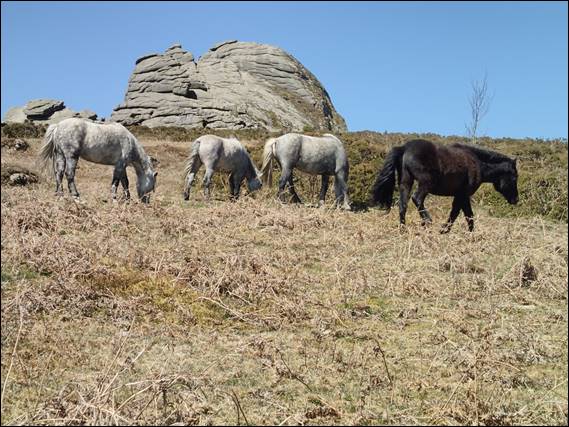
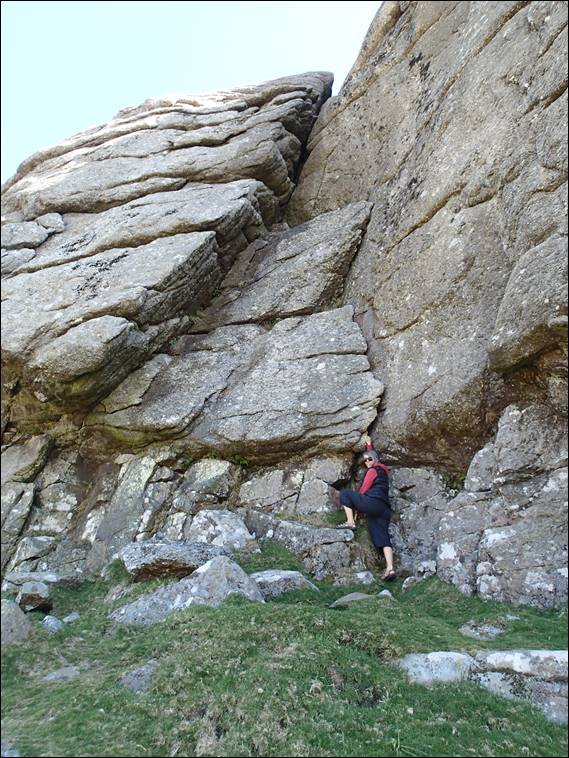
Below however is the route that I will always remember this place for. Raven Gully is a high-moorland classic that features crack-climbing in all of its guises, and what better route than this for Lisa to do her first ever rock climb. Soon after we met she was keen to try climbing and this was the gem that we did that on, we got here when the sun was low down to the east meaning this crag was in shade, not only that but it was cold. Frost was on the grass and the rock was finger numbing bitterly cold. The camera batteries decided it was too cold for them, but Lisa seemed to think that if I thought it was a good idea she would be fine. The route goes in three pitches but I ran them all together and didn’t really think too much about the fact that I had all this experience that made this route not too bad and in fact very, very enjoyable. When it was Lisa’s turn she got up and by the end was smiling, or was it grimacing. There were certainly some testing sections that she managed to pull through with a little help and in truth she did amazingly well to get up. We have been back since and while she is posing with a big smile and fond memories I am not sure she would have been keen to attempt this climb again. Strangely despite this experience we stuck together and she continued to trust my judgement on what climbs she could manage, but that will be another story:
Next time we will head across the channel to the isle or Ireland, we spent a week out there on a climbing holiday and experienced some epic situations.
 Sandbagged