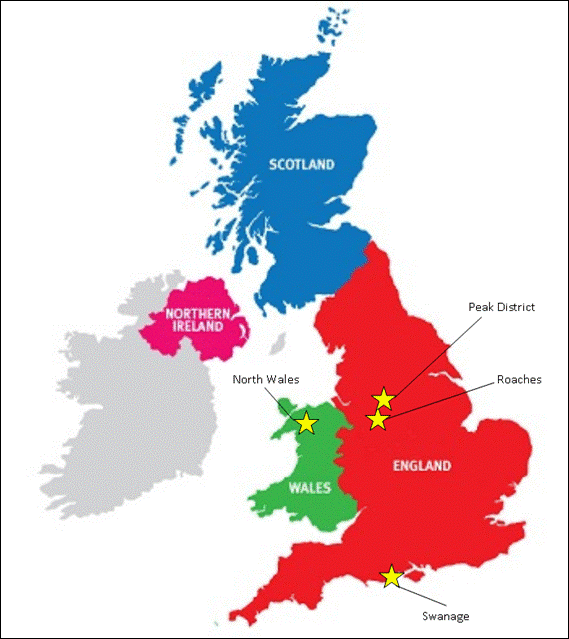
In truth I should have made this part 3 instead of Swanage. The reason being that this is where I really cut my leading teeth; North Wales was where it started, the Roaches was my first lead and the Peaks is where I did most of my early learning. The reason for going out of sync was that I felt giving you back to back gritstone wasn’t the go. Hence now we find ourselves heading back into the heart of Britain, just a bit further north where the Staffordshire gritstone can be found in the Roaches. This email will show you the gritstone that you were probably expecting, but also a couple of the amazing limestone crags the Peaks has on offer. The gritstone crags provide routes in the 5-25m range but mostly about 10m, while the limestone can provide rope stretching lines and even offers some multi-pitching:
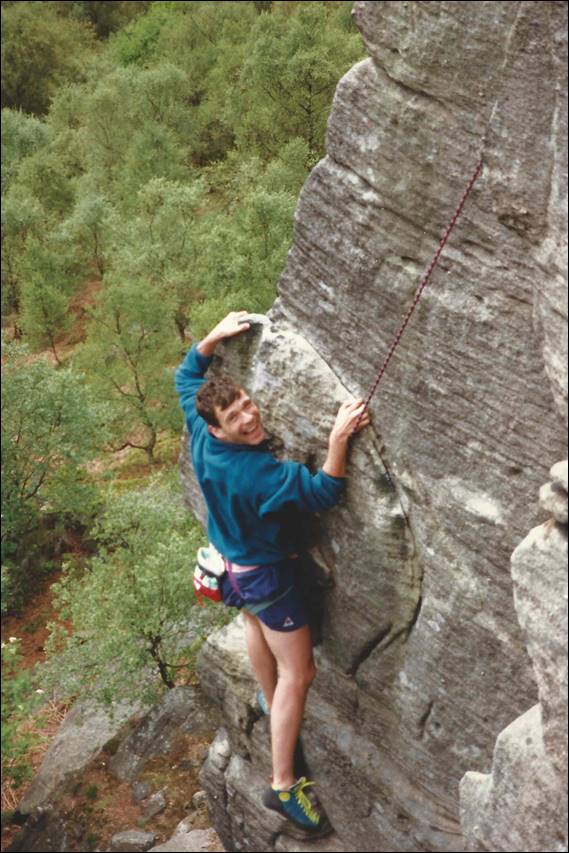
You may remember that my first taste of climbing here was when John took me to Froggatt Edge for my second day of leading outdoors. I remember hitting quite a few routes and finishing up on the hardest lead of the weekend. The line had a loose chockstone at half height that you had to make use off. But the name of that climb escapes me and with 445 climbs on this crag I’ve resided to not try and identify it. Froggatt is one of many stunning edges scattered across the Peaks, which nearly all overlook valleys. This one, after crossing the road to the south, transitions into Curbar Edge (607 climbs) and then Baslow Edge (254 climbs). The Peaks has more climbs than you can poke a stick at and I’ve only touched on three locations so far out of a multitude of possibilities. Unbelievably there are over 10,000 routes in the Peaks. Back to Froggatt and you may be surprised to hear that this crag has both natural and quarried buttresses, which results in a good variety of features. Below is Johnny Sad Man Solo during one of our last climbing trips together, and in this image he is following up The Brain:
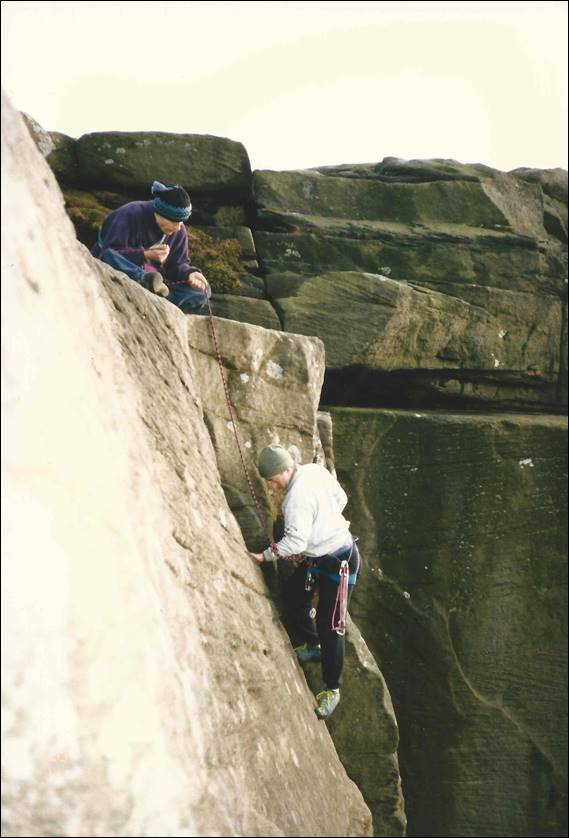
There are a few reasons for having quarried sections. Gritstone was the main building material for a long time, not only for houses and cattle troughs but mile upon mile of drystone walls are made from this durable stuff. The other use for gritstone was for millstones, and in fact while worldwide from a climbers perspective it is called grit the rock is in fact referred to locally as Millstone Grit. It comprises a compacted sandstone, finer grained and more compact than it’s Staffordshire cousin found at the Roaches. Some may be wondering what a millstone is so… it is a circular rock that is used as a grinding stone and commonly used in old in cornmills (approx. 1.3m diameter and 0.3m deep and weighing in at a hefty ¾ of a ton!). Quarrying for this last purpose occurred mostly along the eastern edges of the Peak District. Millstone Edge, which I will get to later, was the major area but the remnants of quarrying can be found at Froggatt and Baslow and also Stanage. I find it amazing that despite the wonder of seeing abandoned millstones that were not quite perfect being scattered around these areas I never thought to take any images! I could take an image from the web, but feel like that is cheating so if you are keen to see them I’ll leave you to do that. Below, on an early trek to Froggatt, is John belaying Rob on the fine Sunset Crack. Hopefully the names are becoming familiar with Rob who was introduced in the Roaches, he was known to us as Hand Jam Rob. Why the nick names, in truth just for fun:
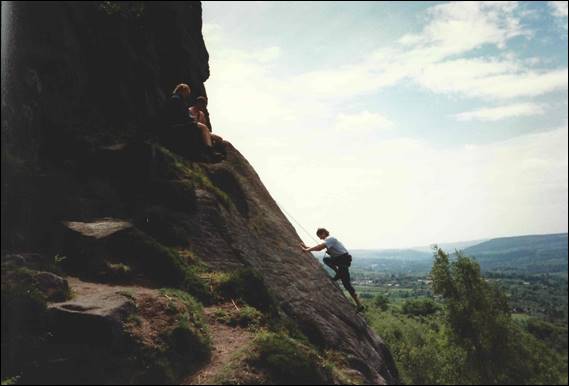
Above Rob is doing some fancy footwork on the slabby face, and below is one of the classic slab routes at Froggatt that is a must do. It has marginal protection and the name gives away the only features (other than friction) available. Three Pebble Slab has, you guessed it three small protruding nodules and that is all you get to make your way nervously up this route. One of the differences between Staffordshire and Derbyshire grit being that the latter has these nodules or pebbles and at times they are all that is available to use on the route. When they pop the route is gone, but luckily it is a hard wearing rock. There are numerous other classics at Froggatt but the one I want to mention is what is referenced to as a historic HVS, named Valkyrie. First climbed in 1949 by the legendary Joe Brown this route is near the top of so many hit lists, and is a brilliant climb. I waited some time to attempt this and when I did I savoured every move and position. Post war there was a club that was formed called the Valkyrie Club, it was short lived but this small committed group put up many great and often hard routes including Valkyrie, a name they used for a line both at Froggatt and the Roaches. The one at the Roaches is equally renowned but my experiences, due to trying to link the second and third pitch was less than enjoyable due to the massive rope drag despite having two ropes:
It is now time to mention the place that every climber should have on their wish list to visit, Stanage Edge. It was not the first place that climbs are recorded on. That was Wharncliffe in the mid-1880 and is reputed to be one of the birth places of UK rock climbing, looking back it is sadly a place I never went too. Stanage is however the longest crag in the Peaks stretching 3.5 miles and offering some 2000 routes, and could be regarded as the most popular crag in UK. On a day’s climb there would be hundreds of cars lined up along the road, and that was just at the popular right hand end. Climbing here started in the 1890’s but due to access issues development was significantly restricted. The crag was located on a private grouse moor and ‘the early pioneers of rock-climbing were forced to make secret visits or bribe the gamekeepers with barrels of beer’. This meant that the crag was not included in the first guidebook to the Peak District that was published in 1913. After the second world war access was opened up and the area received an onslaught. This all started with Peter Harding’s brilliant ascent of Goliath’s Groove in 1947 (I can testify that it is an absorbing line even today) and gathered pace in the 1950’s, which is when two icon climbers of Joe Brown and not long after Don Whillans came on the scene. The place has every style and grade of route imaginable and as such attracts climbers of all calibres, and due to the length (despite its popularity) there was always somewhere relatively quiet we could retreat too when we wanted:
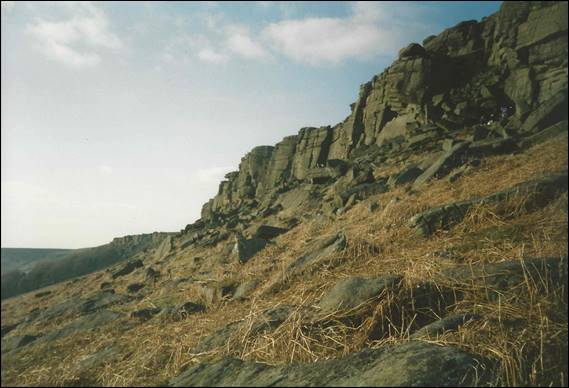
Stanage Edge is where I met John, I happened to be there with Andy and was attempting a route near where John was climbing with Tom. We got chatting and stuck together for the day, Tom by far was the more willing to push the limits with leading. During this first meeting there was a fine but thin face climb that he had his eye on, so off he set. The gear was marginal above a small ledge but he pushed through. Above this he began to get nervous and eventually fell, his ankle hit the ledge as he came down making him summersault and come down head first. He landed wedged between a large detached flake and the wall. Our first thoughts were how lucky he was not to have split his head open, so as we de-wedged him and sat him down I put a brew on. I still remember sometime after, John recounted how when showing Tom’s mum an image of the scene she asked what that person (me) was doing in the background, and was then aghast to find out I was making a cup of tea! Tom never climbed again and had to use a walking aid for at least a year, due to severely damaged his knee. I bought his harness of him and John and I used that rope for many years to come. Despite yet another shaky experience I was not put off leading and enjoyed the thrill of runouts and exposure. John and I teamed up regularly, mostly on trips to the Peaks and the Lake District. The Peaks offered a great place to have a mob of people meet up and we built up a fun crew, sieging lines, bagging each other out and general loving life. It was this crew that dished out the nick names and mine was Layback. Below John is racked up and ready to tackle the fine Paradise Wall during one of our earlier visits to Stanage:
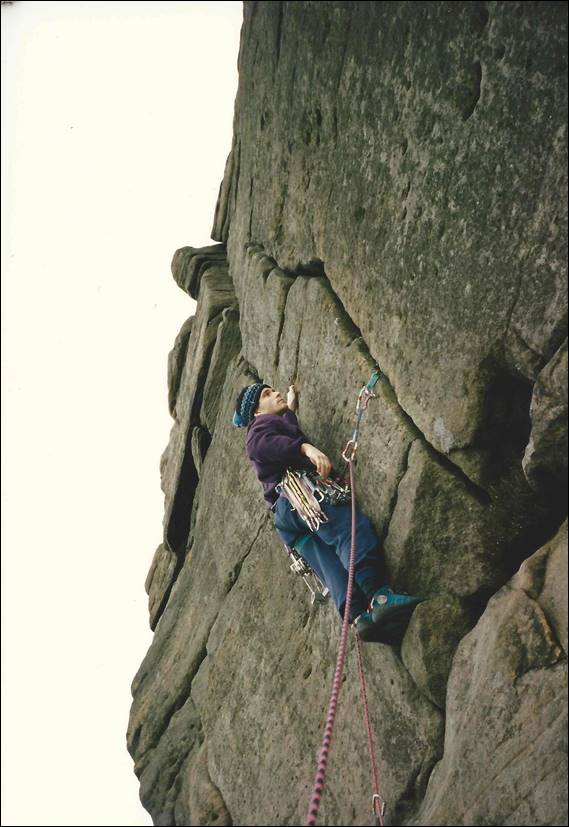
Climbing with John was a bit of a stop start experience, he lacked confidence on lead but was fine on second. So at times it may take some time to build up the courage to get going and then to complete the lead but most times he got there. Below he has just finished the traverse to the rib on Inverted V, yet another classic line on many an up and coming climbers tick list. With long summer days and the ability to pack in so many routes in the Peaks we didn’t always have to start early, so we at times would head over to the Grindleford Station café for early morning feed. This hugely popular café with climbers and walkers alike was always packed and offered the biggest ‘greasy joe’ breakfast meals I have ever seen at low prices, but make sure you never ever ask for mushrooms! The owner Phil was eccentric and not someone to cross, he had put up heaps of very blunt notices all over the cafe that might offend some. We would in our usual way have a chat and got on his good side. During one discussion, and I have no idea how the topic came up, we talked about the milk crate challenge. With the back of your head (not neck) on one chair and your ankles on the edge of another you have to hold a milk crate and pass it round your body without it or you touching the floor. It was a game I used to do at university and held the record, and it intrigued Phil to the point that he wanted to challenge me. So on my return from a long holiday to Australia he had a party going and invited us along were he sprung the challenge on me. He told me he had been training for months and subsequently smashed me. I have just read that Phil passed away in 2007 from a heart attack at the age of 63, which he sustained while dancing at a party (it is way he would have wanted to go):
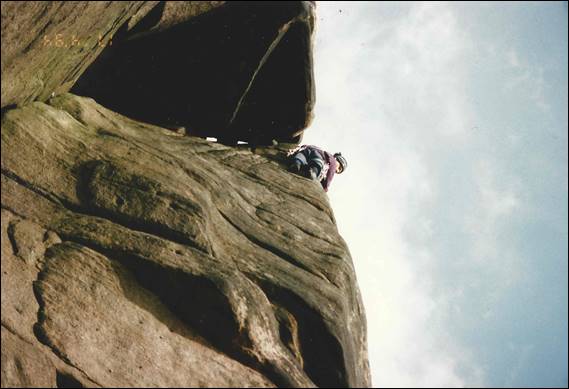
Just up the road from the Grindleford Station café is Yarncliffe Quarry. A sandy crag with a splattering of routes from the disgusting to the very pleasant. We went there a few times due to its sheltered nature and proximity to food. It is at this crag that I witnessed outdoor speed climbing for the first and only time. A group having set up top ropes on two similar climbs on a slab were racing each other up the routes. Interesting but not my cup of tea, instead I soloed a fair few lines here and remember Sulu as probably the scariest solo I’ve done. As I was climbing the line someone was being given a guided tour of the routes and I heard them say that the route that guy (i.e. me) was soling is great but had the crux at the top. It was a steep 25m line up a narrow face with a tricky and steep lower half and bold top out, when I returned a few weeks later I tried to lead it and couldn’t even get off the ground! Back to Stanage and here I’ve just topped out on Crack and Corner, and Mike is about to follow me up. Another highly rated route, and great for novices of which Mike was one. The image shows how in a short distance it is easy to pick a myriad of lines up these walls. Not all of them were as featured, but we generally stuck to the easier ground:
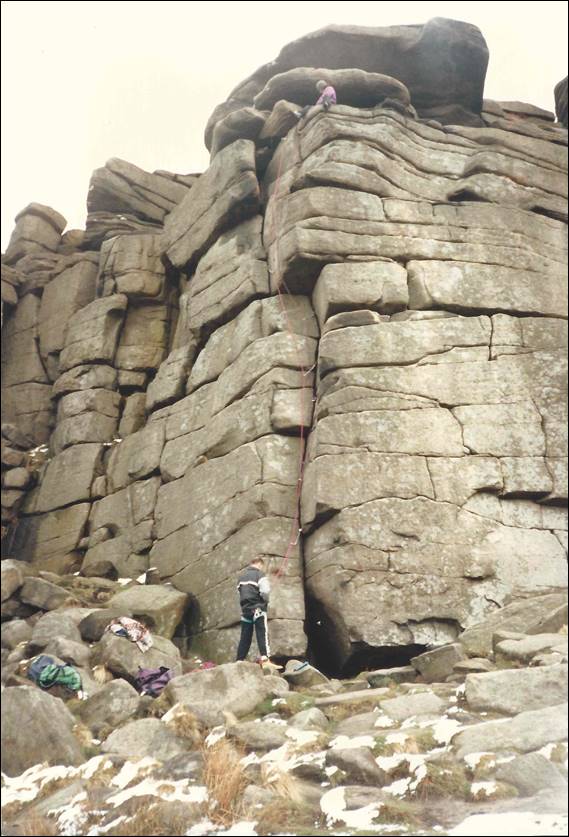
There is snow above and I’m sure you’ll realise by now that I climbed year round and had a few people willing to follow me out even on those crisp and cold days. In 1995 there was one trip that sticks in my mind, I arrived at my usual haunt The Plough as darkness was falling and had a pint. I stepped outside and snow had fallen, just a few inches but it was coming down thick and fast. By the morning there was a solid foot of snow covering the car and we were immersed in a winter wonderland. Before I talk more about that weekend The Plough needs a mention, it was one of the few places in the Peaks for camping at the time and on a good weekend there would be in excess of 200 tents in their massive back area. The pub was a climbers haven, with a big log fire toasting the place up, great affordable pub food and an extensive array of beers on tap. I got on really well with Bob & Cynthia (the owners) and had my own tankard hanging from the bar and would on occasion pop by and have a cuppa in their home. I also got along well with all the staff and the head barman Tom will get a mention later on. My time in the Peaks was made special not only by the climbing but the great friends I made there and The Plough was like a second home in my early climbing years, so much so I’ve named a climb after it in the SW of WA at Moses Rocks:
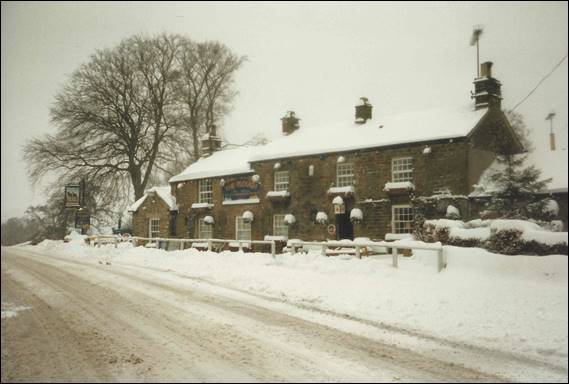
It was not often there would be big whiteout and when it happened so unexpectedly it felt all the more special. On that weekend when we awoke to find everything covered in snow there was not much else to do but go walking. We would usually go away for a weekend prepared for any weather but that said I was able to endure most stuff in my woolly hat, buffalo and baggy bottoms. So instead of brooding in a café or pub about not getting out climbing we would along some of the tracks and ridges and then eat and drink our fill next to a roaring fire. There was also some poly bagging to be done, the cheap version of sledging. With not much between you and the ground this often led to bruised backs and bums when we tried it on rutted farm tracks. We would also wander into the village of Hathersage, which The Plough is on the edge of, to go into Outside. This climbing/outdoor shop had it all and we would browse the many wares always coming out with something we were not intending to buy, as a result weekends like this tending to get more expensive than others. Hatherage happens to be the name of the first route in SW WA that I attempted but backed off, as I was soloing it. Like the climb I named The Plough it is located at Moses Rocks:
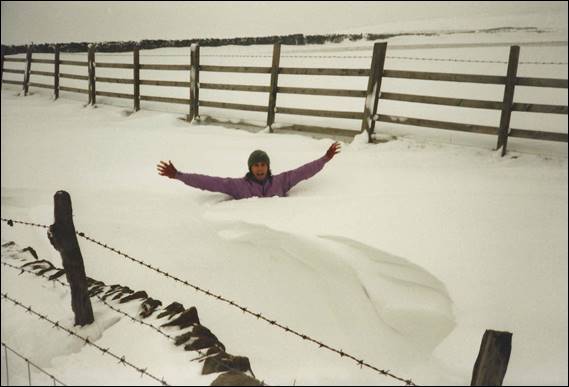
Another place we once visited when the snow had fallen was Kinder Scout a moorland plateau in the north west of the Peaks. I toyed with the idea of adding an image of that place as the peatbogs gave it a moonscape feeling but none stood out enough. Luckily we had someone who knew it really well as the landscape looked similar everywhere you looked and there have been cases of people becoming lost and dying up there. On that day is was wild and the snow was driven at us almost horizontally, then when we got to Kinder Falls the water was being blown back up over the drop. The sun poked it’s head out briefly as we watched this spectacle and it was made more amazing as a rainbow formed in the water as it was driven against gravity upwards. Back to gritstone and the following image was taken on a day that was particularly special. It was Christmas eve and there was only one thing to do, go and climb Christmas Crack on Stanage. It is a tradition of the area that people would come and climb this route and place Christmas cards into the crack. The tradition was for this to happen on the big day itself but my family may have been upset if I wasn’t there so we went up the day before. There was still a queue of people waiting to have their turn on this fine route, while all other lines were empty. I took advantage of this and went up a few of them too, but on that day no one wanted to follow me up additional lines. So in looking back at my images, what seemed like something normal for me I ended up soloing them, probably thinking that the snow may soften any unexpected landings. Luckily I didn’t test the theory:
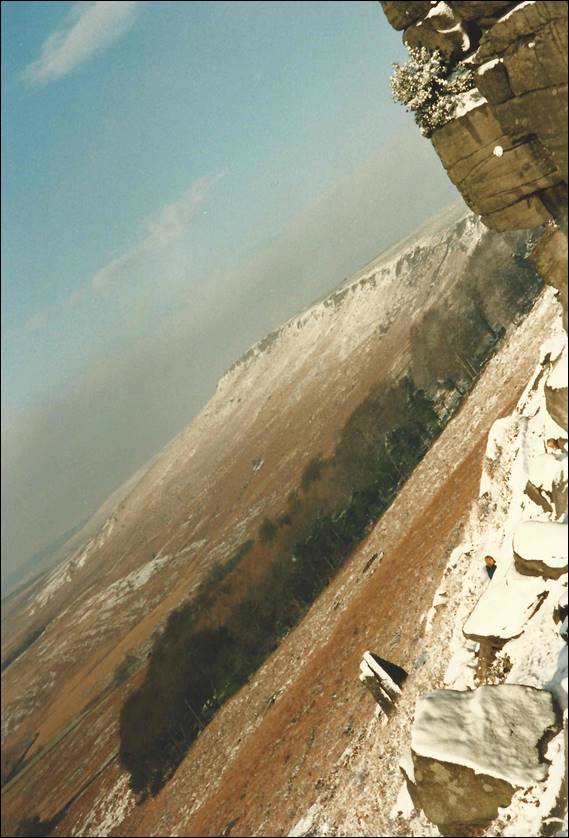
Now another one of our ragged band of merry people was Phil, or to us Phil the Flump. Phil was a walking guidebook in the Peaks, he lived there and knew the crags like the back of his hand. Phil could even provide advice on the type of protection climbs offered. This was made all the more amazing with the fact that Phil hardly ever led anything and never climbed that hard. Below you can just see Phil belaying me on Evening Wall at Burbage North. This edge provides relatively short routes as it horseshoes round the top of Burbage Valley, the routes to the south are harder and far bolder and while we went there a few times we more often went to the northern areas. Before I led the route below I had jumped onto Ash Tree Variations, a line that was protected by a gymnastically move which took some thinking out. After getting up it one of the non-climbers who had tagged along that day asked to have a go and instead of admitting defeat he continually jumped up and down on the rope shouting at me to take in and then claiming he had climbed the route. I was pretty angry watching my rope get abused like that and Phil saw it, so took me off to the side and allowed me to channel the energy into leading a few good lines. Thanks Phil:
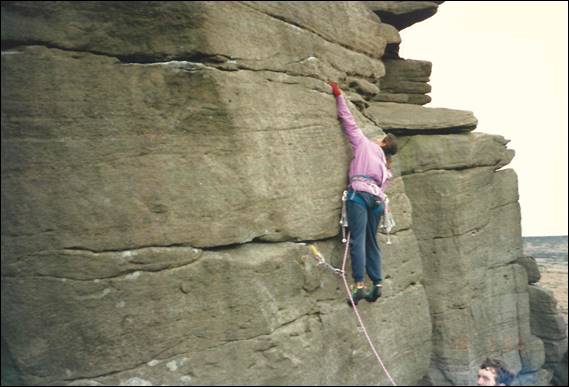
Phil happened to share a flat with Tom the barman from The Plough for a year or two, located in the small village of Bamford. It sat below yet another edge not surprisingly called Bamford Edge. Bamford Moor in which this crag is located has access restrictions due to still being used as a grouse moor, like Stanage used to, and being located on land privately owned as part of the Moscar lodge. Restriction also apply in May and June due to being a nesting area for ring ouzels. Another aspect that keeps many climbers away is the fact that it has predominately mid to low grade routes, there is nothing too hard. Being not frequented means that it provides a uniquely unspoilt natural gritstone edge, better friction and no polished routes. With awesome views down a steeper valley towards a big reservoir and rock that dries super quick, it made for a great crag. On weekends when I stayed with Phil and Tom this would be a good place to go, not only to climb but also to just muck about on the many easier lines. Below Rob is soloing Hypotenuse, relatively new to climbing this was a good place to get his head into gear and we spent some fun afternoons pushing him:
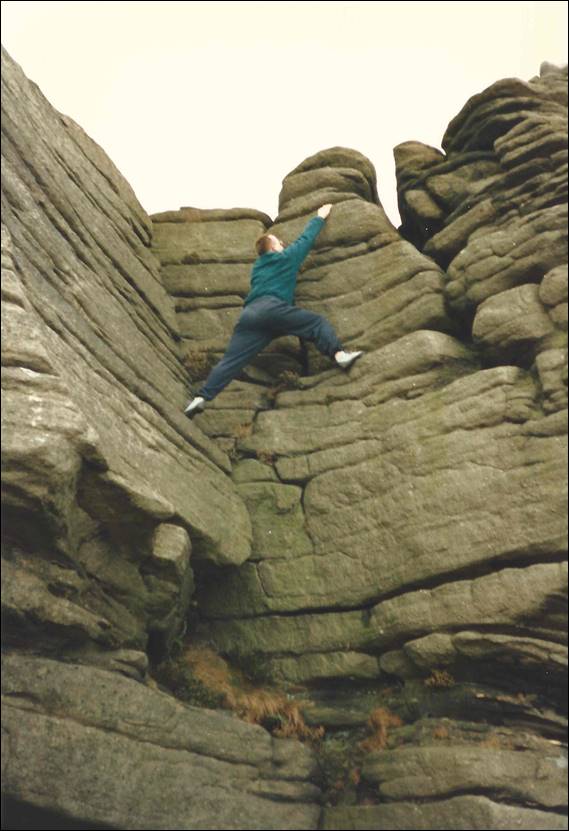
There was a bit of a night scene in the Peaks and a few pubs had late night venues where the music would be pumping and beer flowing. Tom liked his night life, he wasn’t a climber and didn’t like mornings, and when I stayed at their place we would often end up stay out longer than I would normally. Tom didn’t drink and was a willing taxi service for us, but he would also be the one who wanted to stay out as late as possible so we were at his mercy to. Some mornings were fuzzy and on those occasions I’d be even more grateful for having Bamford Edge to be able to walk to from their place. On one such occasion Phil and Sue were not up for climbing but fancied some fresh air, so we hiked up there. I couldn’t help myself from soloing the classic and uncharacteristically long route of the edge, Gargoyle Flake. A great hugely exposed line that builds with momentum and requiring utmost faith in the gargoyle or chicken heads at the top lip. Phil was not too impressed with me on that day, with grumblings of my recklessness. Now just to prove the nick names I’ve been referencing were not just reserved for blokes Sue was known to us as Chockstone Sue:
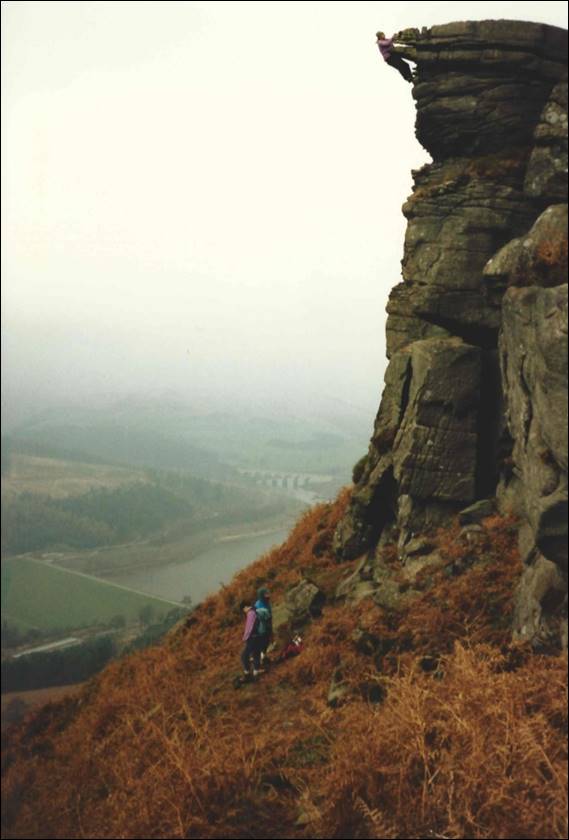
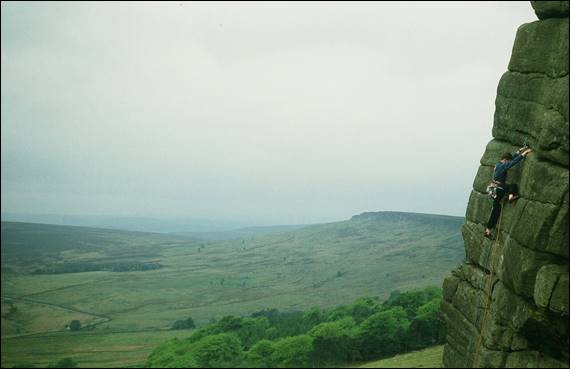
While researching for this email I noticed that Burbage Edge was listed on the UK Climbing website as being a Yorkshire crag. Until now I felt like I had only once climbed on Yorkshire grit, and in truth feel that the grit at Burbage is more akin to the Derbyshire stuff. The one time I did climb on Yorkshire stuff was on a bouldering weekend. I went with a few lads from Mile End climbing wall, Finton was one but I can’t recall the names of the other two. It was a wild and windy Friday night as we drove up the M1 with visibility down to tens of meters, but once again the diligent checking of the forecast paid off. I can’t remember or locate the boulder fields we went too but can vividly remember the much sharper crystals of Yorkshire grit. It was brutal. We climbed for two days and went hard hitting many problems, and by the end our fingers were trashed. I had blood seeping from seven finger tips and the rubber from my new shoes had been sliced to the leather. It was a great trip but I never ventured back to taste any more of that unforgiving rock. Coming back to the Peaks I feel like I haven’t particularly talked up any of the climbs listed so far. It is hard to pick out the standout lines I did as there are just far too many absorbing and consistent routes I’ve done. However, below I have come up with four routes from Stanage that I would rave about starting with Hargreaves Original Route. This slabby route with shallow rounded horizontal breaks is awesome, with enough gear to make it feel safe (with modern gear) the slab keep you on your toes. I liked this one so much I did it a few times and even was known to solo it, it is certainly up there on the hit lists and better still provides for a wicked image with the mighty Stanage stretching out behind:
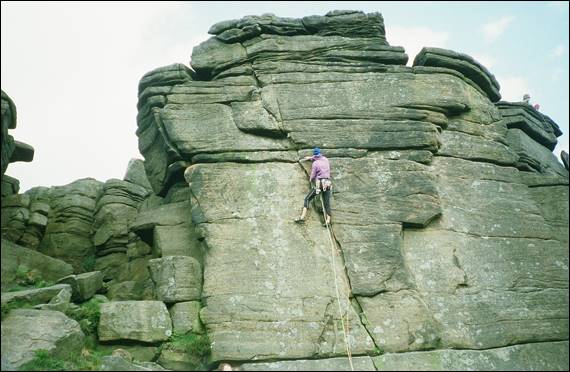
The next one is a Joe Brown mega route (he has a few to his name) and was first climbed in 1949, a pretty astounding feat back then. I’ve seen many historic images of these fearless people climbing with hob-nailed boots, hemp rope and very, very little in the way of protection. Even today with our sticky boots, cams and helmets many find their routes stiff opposition. In fact I want to rave about two lines both led by Joe Brown. These lines are worthy of gods and follow the right and left line of the big flake shown below. The image indicates it is slabby but it is far from that, steep lay-backing and jamming keep you engaged. My memory tells me I was out with Paul (who I introduced you to in Swanage) on this day, sorry if I am wrong Paul. We were keen to do both routes so picked straws, or flipped a coin, and Paul got the harder Left Unconquerable while and I took on the Right Unconquerable. Both were amazing and we did them in style, even avoiding the common belly-flop finish on the route I led. If you ever get to Stanage without a doubt these must be done:
Now it wouldn’t be right not to include Flying Buttress Direct when talking about Stanage. At the far right hand end it too provides a good vista of Stanage and the climbers milling about all over it. I finally had a bash at this route when I was climbing with Finton, I met him at Mile End as I did so many others but we unfortunately didn’t get out together too much. We climbed a pretty similar grade and also style, and as such pushed each other. I remember the first time we climbed together, after he followed me up the first lead his first thoughts were to comment on liking the neat rope work. Not only on the route but also atop, as I would often have the rope looped over a sling or my neck rather than chuck it on the ground. Not so much an issue on single pitch lines but on the multi-pitch routes it was important, I think I have got lazy with that nowadays. He had climbed this route before but didn’t give anything away and I nearly blew it when I tried to go direct-direct. The route takes a slight left dogleg along the lower rail, which I finally sussed out as my arms were burning up. As per the lines above this fine route makes many hit lists and was indeed a hugely satisfying lead:
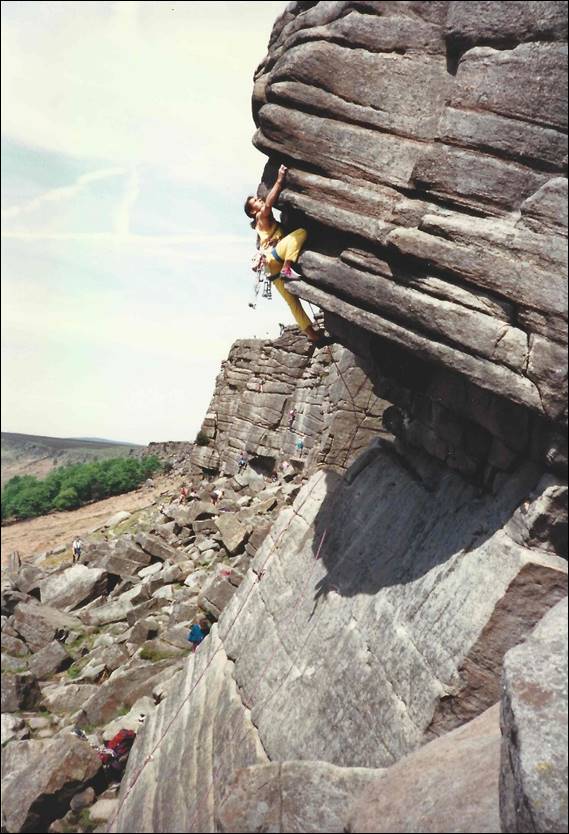
Next up is the Quietus, it has to rank as one of the hardest grit routes I attempted. The climbing to get to the roof is never too hard but siting under the roof was super intimidating. Good gear in the roof crack was thankfully sunk in as I made my way out to the lip. From here two flared cracks in the headwall offered no protection and only hideous jamming to turn the lip, which I failed to use properly. I tried and tried but it had me beat, so eventually I was lowered back down. Thinking back in all my time climbing in the UK I cannot remember any other climb that I didn’t manage to finish off. Most times I had an ethic of ground up ascents and while at times I may have fallen I would have worked things through. While this was not the case with Quietus I still loved the climb, which in the end I dogged up on second after some Aussie who just happened to be walking past asked if he could have a bash. He walked it, but for me I was spent and even on second I struggled to make use of those jams:
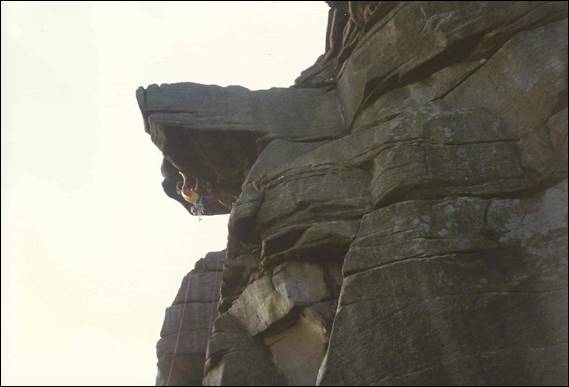
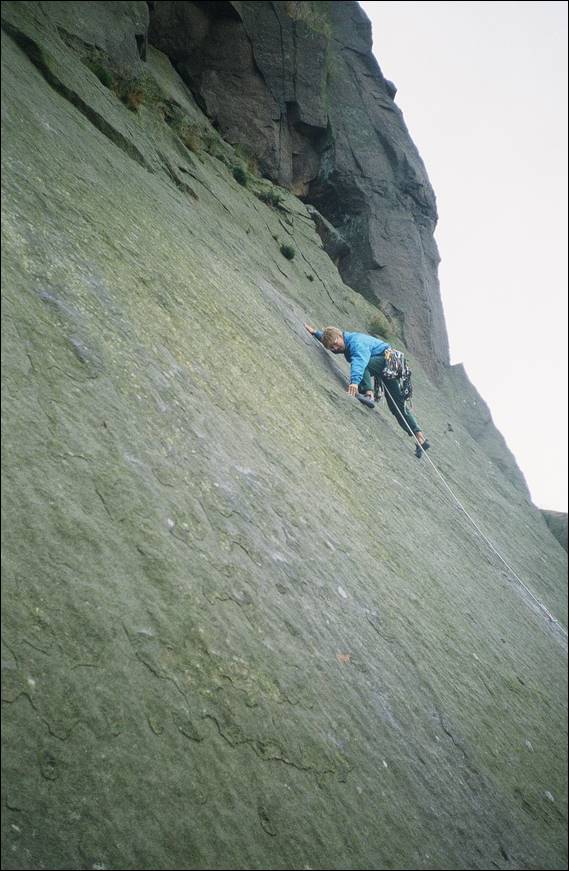
With so many places to climb in the Peaks there are of course those that got away, and some that I really wish I had climbed at more often. One of those places was Millstone Edge, the premiere quarry in the Peaks with many quality routes some of which that are unnaturally long for the area. The clean sheer faces resulting from quarrying activities have left stunning arêtes, faces, slabs and crack lines. The reason I never did much here was that it was intimidating and mostly hard, too much so for most of my climbing partners. However, on one trip with Vince, Sheridan (remember Left Wall in North Wales) and a third person who was the person I climbed with, but can’t remember his name. It was yet another one of those trips where we drove through driving rain to get here, and during the nights it poured down onto the tents. However, daytimes were OK and on one of them we went to Millstone. It was a bit damp and while the wind was biting cold it dried the rock quickly. I was on fire and we gobbled up a number of great lines. This was the first lead I did here which Sheridan then led after me. The Great Slab is never too hard but poorly protected (remember the Peaks is a no bolt area you either have the guts to do it or back off) making it a slow and steady lead, but oh so good:
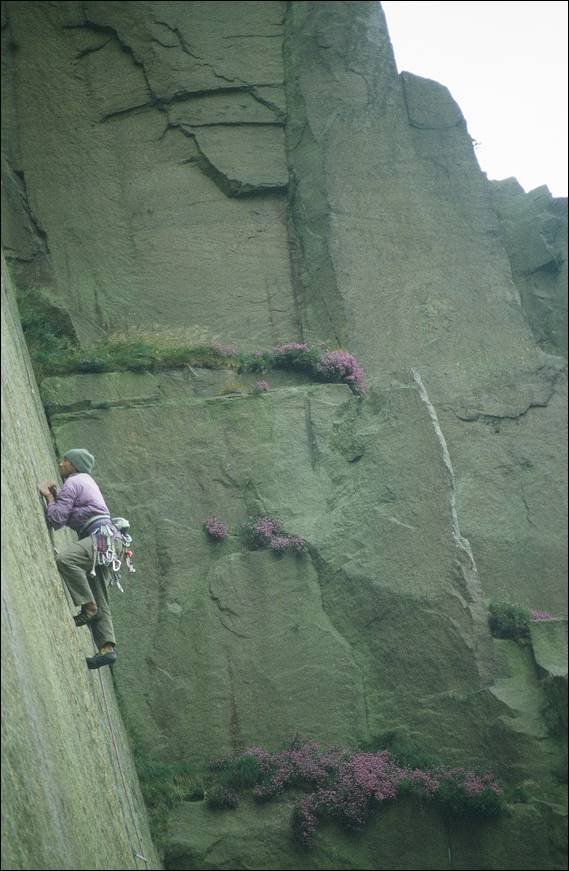
This was however my favourite line that I did here, Embankment 3 is an amazing splitter crack. While there were some friction holds on the faces it was for the most part fingers and toes in the crack. If I had to choose a climbing style I reckon my top three favourite would probably be finger cracks, slabs and layback moves. To add to the pain on this climb I had my stingers on, the only technical shoes I have ever owned. Once and only once have I bought a pair of shoes that were not comfortable and these were them. After this route I jumped onto Great Portland Street another 3 star classic, and very different climbing again being a steep corner with lots of sloping holds that keep you focused on your bridging and pumping out your calves the whole way up. The only saving grace being the awesome gear. We were on fire, but Vince and Sheridan were not so happy. The grades were stiff and the wind was cold so it was with much regret that we left by late morning and sadly went to a café to warm up. As we walked out I kept seeing lines I wanted to try but held my enthusiasm inside, walking out just a little way behind the others due to stopping and yearning to jump on just one more route:
After they had their fill of hot food and drinks we headed back out, but not to Millstone Edge but Burbage North. Much as I love this place it felt like a letdown after all those longer lines, but we did continue the pace and proceeded to jump on line after line. The haulage for the day included this short punchy line call All Stars Gold, which is the hardest technical route I’d climbed in the Peaks. However, due to being a one move wonder not what I would consider the hardest line:
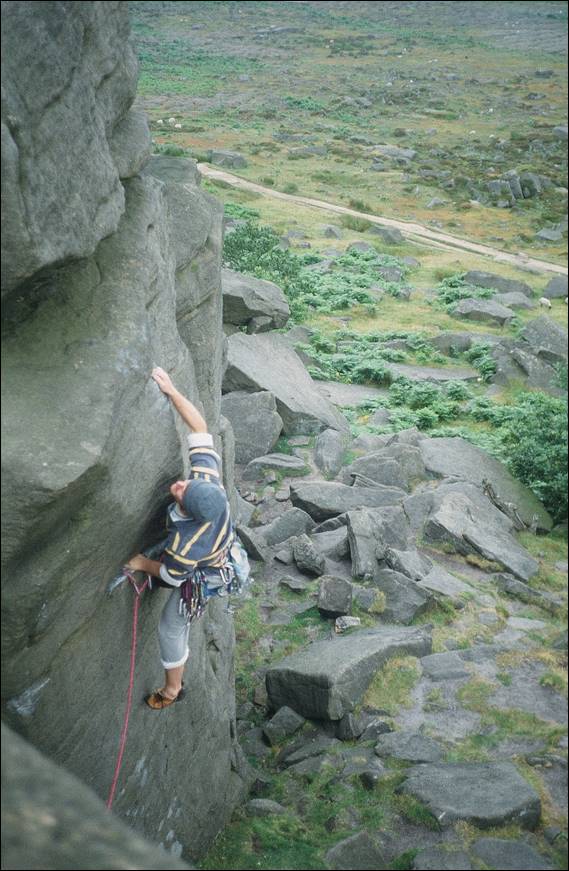
While I am back at Burbage North I have to include the following image of this Romanian boulder I called Joe, on Wobble Stone. I managed somehow to agree to taking up a group of three Romanian climbers whose English was wanting but not as much as my non-existent Romanian! They were boulders not that we had bouldering mats back then, so once again there was not much use of the ropes. This trip stood out for several reasons but mostly that we slept in a barn loft across the road from a pub. I hadn’t heard of it before but they knew about it so I went along with it. It really was a just a loft of a small barn filled with straw, you crammed in with your sleeping bag and put your head down for the night. To get out you had to climb over anyone between you and the small door that was at one end, before climbing down a ladder. It was hilarious and unfortunately I can find no trace of the pub or these sleeping quarters on the internet today so maybe it is no more. I did pull the ropes out for one climb on this trip, and picked The Grogan. A feisty thin finger crack which I can almost claim that I had soloed as my belayer didn’t really know what they were doing. Then when they followed me up they hadn’t a clue how to take gear out so it was highly amusing. Needless to say the rope and gear then went away and we all stuck to bouldering and had a blast:
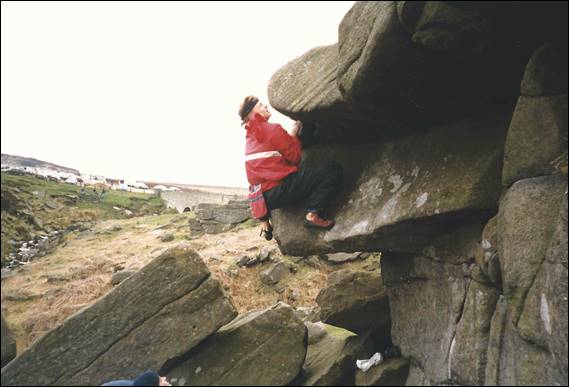
As promised now for something different, limestone. There are many great limestone crags in the Peaks and I don’t recall them ever being as busy as the gritstone crags. That is probably a good thing as the limestone here is softer than that found at Swanage and would soon become polished, looking at the websites now it seems that some of these crags are indeed getting that way. One crag we sampled was Stoney Middleton a real roadside crag and one with a reputation, I went there with Vince when a group of us did a manic road trip that took in the Roaches, Peaks and North Wales in three days. I was a bit of a sucker and if anyone was willing to get out I’d drive despite the distance. The line we picked was polished and grim and the experience didn’t encourage me to return there. I also frequented Wildcat Crag and Willersley Castle Rocks both of which are excellent, nice long routes of 40-50m in tranquil settings on good rock with great gear. We had heard a horror story of how the week before we first sampled Wildcat Crag a woman had to be helicoptered off after she fell and caught her wrist in a crack and was dangling from it after breaking it. I still shiver at the thought of the pain she must have been in. On a lighter note below Sheridan is leading the Sycamore Flake at Willersley Castle Rocks:
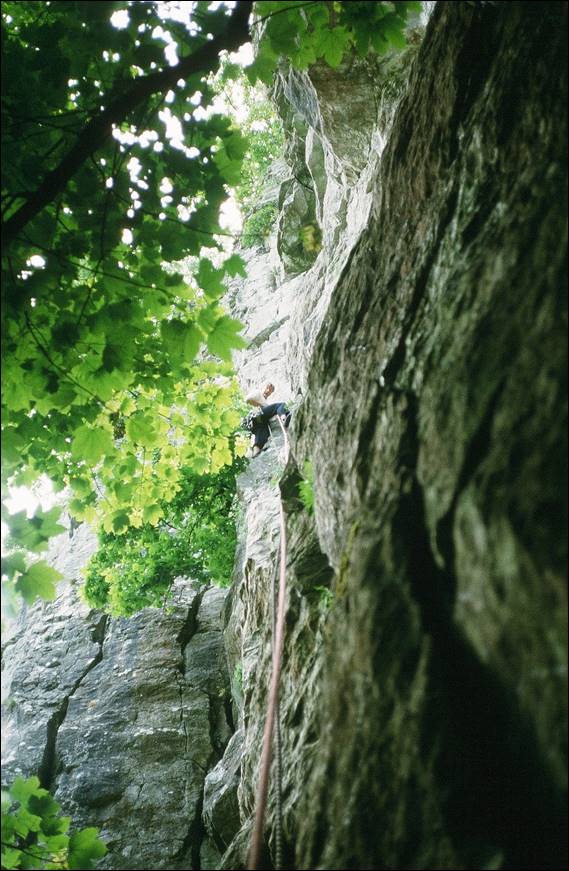
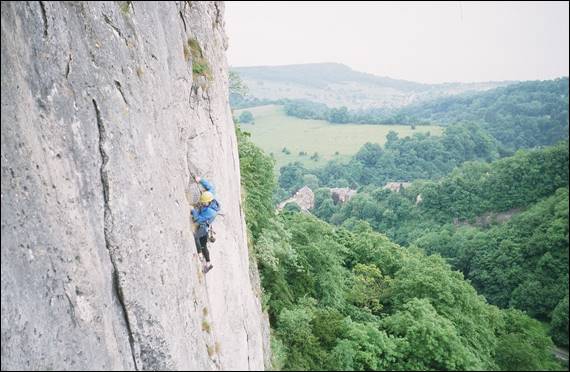
For me the premier limestone crag has to be High Tor. Some would argue it is the best limestone outcrop in the country, but how could it possible trump Swanage! On a side note I got a reply from Bob (who you’ll get introduced to in time) and he recalled taking an ice axe when climbing in Swanage to tackle the top outs, now why did we never think of that idea. High Tor is a serious crag with not much that isn’t given an E grading and deservedly so. Long steep and seriously sustained lines fire above the tree line with the River Derwent slowly flowing way below. It is not until you rap off the wall that the steepness hits you; you land on the ground from the top of some lines a good 5m plus from the base of the crag. A lot of lines go in two pitches, but that may have changed now that 60 and 70m ropes are more common. I spent a day on this awesome face with Sheridan, when we bagged some of the lower grade (for this crag) classics including Debauchery (below), Highlight and Original Route. There was however a line that I had my sights set on, and that was Darius. I was a little nervous as the day before we had passed the crag and I saw someone nearing the top of this route, we came past an hour later and they still hadn’t topped out yet. However, it is rated as one of the best E2’s in the country and up there with Left Wall in North Wales so I had to give it a go:
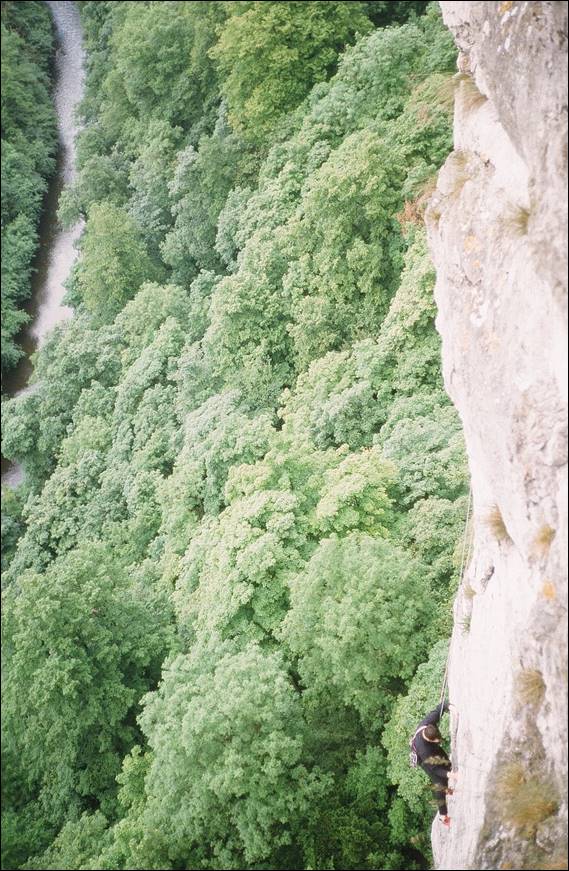
As I climbed Darius I took this image of someone on Original Route. On my line the route finding was a little problematic and my trusty guide book holder that I could unzip to have the book open at the page I needed came in very handy. It was a bit stop start with checking he guide and taking images but still mega. Definitely one that twin ropes was required as it wove left and then right, following groves, over bulges into cracks, up faces and finishing on a very airy corner. I took my time and worked the moves, placed my gear until I got the last part where technical polished moves were required to gain the final steep corner. A peg and wedged horizontal wire several meters below the start of the corner made sure both ropes had gear for this move, as I was tiring and it looked tricky. Sure enough I slipped and fell some 20ft with both ropes tensioning beautifully. This repeated several times but with each attempt I refined my moves, and finally managing to get a good hold at the base of the corner. The last few meters up that corner felt like they would never end, with arms so pumped out that placing gear felt like the wrong thing to do. I belly flopped over the top and it took me some time before I could use my hands well enough to set up a belay, what a line:
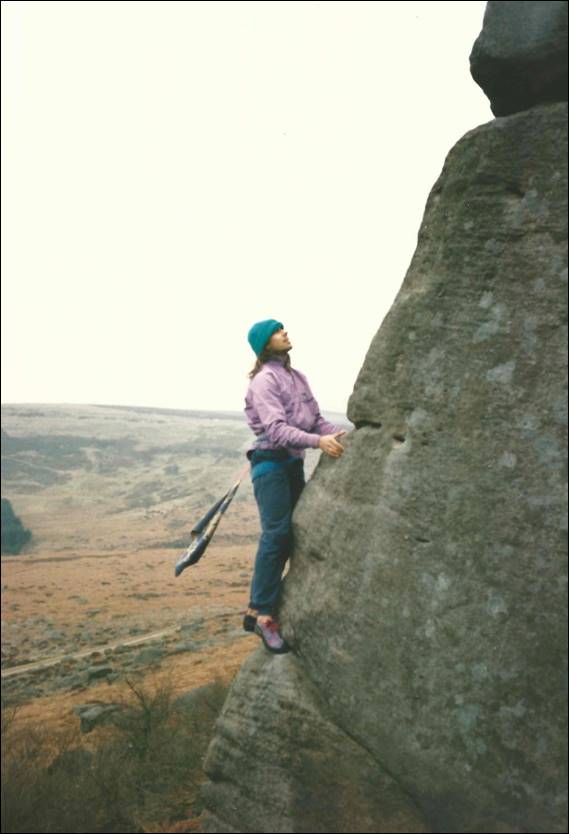
So here we are at the end of my tale of the mighty Peak District and the infamous gritstone. For many it is a place of tall tales and dicing with death, but for me it was mostly a place to cut my teeth, make good friends and enjoy their good company. I did stacks of routes here but not a sniff compared to the 10,000 or so available. Many people would only ever come here, maybe it was the number of routes, good access or familiarity with the place. However, for me while I did a lot of climbing, bouldering and soloing I also travelled to many other places preferring to mix up the rock types, climbing styles and settings. I probably didn’t push myself as much here as I did at other places but I sure did have a great time. The image below probably sums up my memory and experiences of the mighty grit, as I amble up Big Chimney Arête at Burbage North in a relaxed and happy state. Like my first 5.10 slippers, which I am wearing on this route, the Peaks was for me was a comfortable and easy place to slip into:
Next time I’ll take you to a place steeped in history and made famous at the turn of the nineteenth century by William Wordsworth and Samuel Taylor Coleridge, and has only just this month been named as a World Heritage Site.
 Sandbagged
6 thoughts on “Part 4 – The Peak District – learning the ropes”