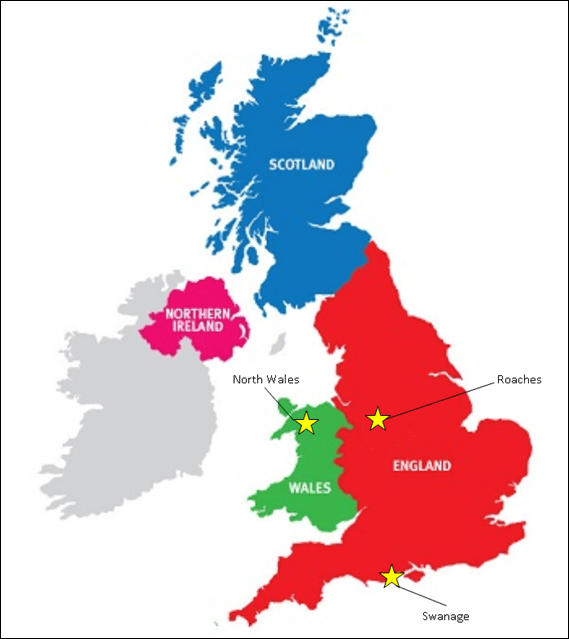
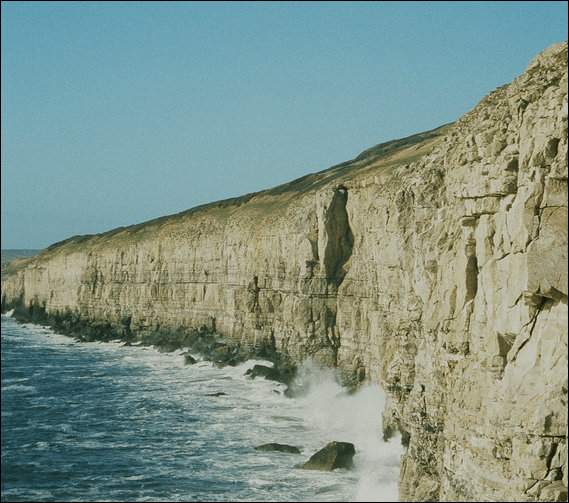
Along the south coast of the UK lies Durlston National Park Nature Reserve, a place of beauty and tranquillity. The land drops sharply into the ocean being guarded by a sheer limestone cliff, which forms a crag that has been described as feeling relatively untouched and in its natural state. As you read on you will maybe get an idea of why this impressive crag still feels like a newly discovered climbing haven for those brave enough to venture here. I would guess that this was the closest crag to London and on a good trip when the traffic was kind I could get here in less than 3hrs (if you ignore the Southern Sandstone crags, which while fun only offered top roping due to the soft nature of the rock):
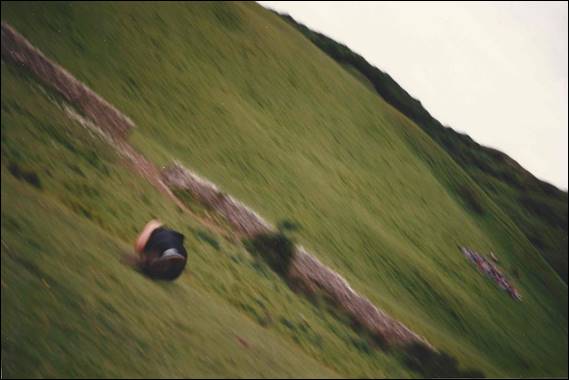
My first trip here was with Andy, who you may remember from North Wales, and Scott the American stockbroker. Andy had recovered from his fall in North Wales and was keen to get out again. As we walked towards the coast, the undulating green hills provided some steep inclines that Scott felt we really had to roll down. Well why not? I remember this clearly because as we whooped and hollered tumbling down these slopes covering ourselves in bruises, in the next paddock there was a big group singing praise. They were playing tambourines and had a donkey or two all dressed up in harnesses covered in ribbons and bells. We were heading into the most easterly cliff called the Subluminal and Lighthouse Cliff. You are guaranteed to see other climbers here and it is known as the place everybody heads to for a first taste of Swanage steepness. For many, if not most, they never venture further. The crag has short 10m climbs that are relatively easy to access and escapable. We played on a number of fine lines and then watched a guy setting up a rap rope for his girlfriend to hang off and take images, while he led Stroof. It took them ages to set up and then he set off, unable to make the crux moves and getting cranky before pulling it all up and heading off. Scott and I reckoned we could see where he was going wrong, but foolishly were put off by his failure and so top roped it. A shame as we both cruised it and cursed that we hadn’t jumped on lead, as it was a great line:
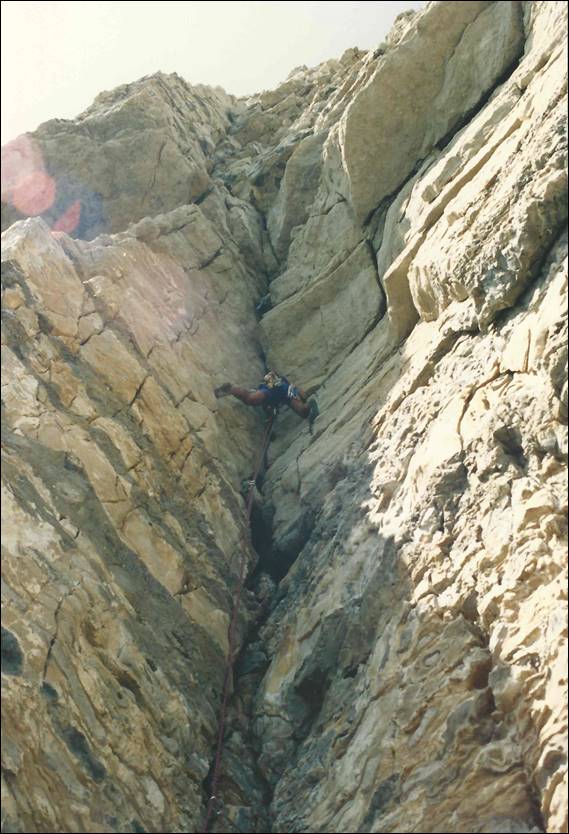
The next day we went to Dancing Ledge, which is at the far west end of the cliff line. It’s an old quarry so a bit away from the ocean and you can walk to the base. Being a quarry the walls were steep and smooth and this place, wait for it, was a sports crag. What can I say, Scott was keen so we went there to play on hard technical 10m sport routes. The place didn’t inspire me and I never went back and no I won’t use any images from there in this email. These two locations are 3km apart and in-between them is where Swanage comes into its own, with a wonderful limestone cliff that is just shy of 50m. It is broken into different sections and on the afternoon of the first day we sampled Boulder Ruckle, where I took on the classic corner of Finale Groove and linked the two pitches into one rope stretcher. It got more and more exciting the higher I went, with the corner in the upper half narrowing up and becoming steeper with height. It was a ripper, and will get another mention later on:
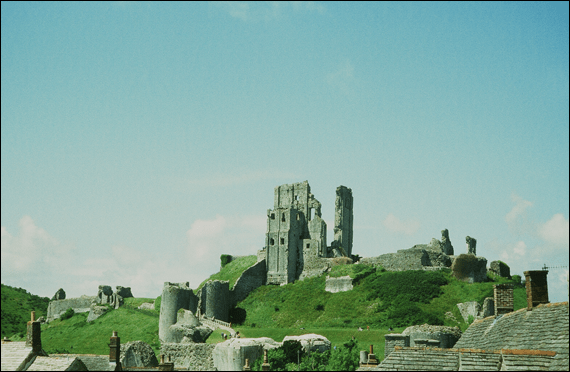
The big walls had me hooked and I also found out that this was Gareth’s other favourite location, so when he was available to get out we would mostly head out to North Wales or this spot. In the first few years when we lived in the same town we would leave Bishop Stortford at 5’ish on a Friday heading down the M1 going against the traffic, as everyone poured out of London for the weekend. Then round the M25 until we hit the M3, then we would join the throngs as they slowly moved away from the big smoke heading west. They went slow for two reasons, the pure mass of traffic and on clear days the glare of the sun, as it dipped towards the horizon. My folks lived in Basingstoke a short way down, and just off the M3 so we would pop in for a visit, cuppa and bite to eat before continuing the journey once the traffic had eased. After hitting Poole we would turn south and head towards the coast, on these winding roads we knew we were close when we saw the spectacular sight of Corfe Castle. This castle ruin is lit up at night so seemed like a beacon calling us to it, but then we would pass it by always remarking on its beauty before carrying on to Swanage to camp for the night:
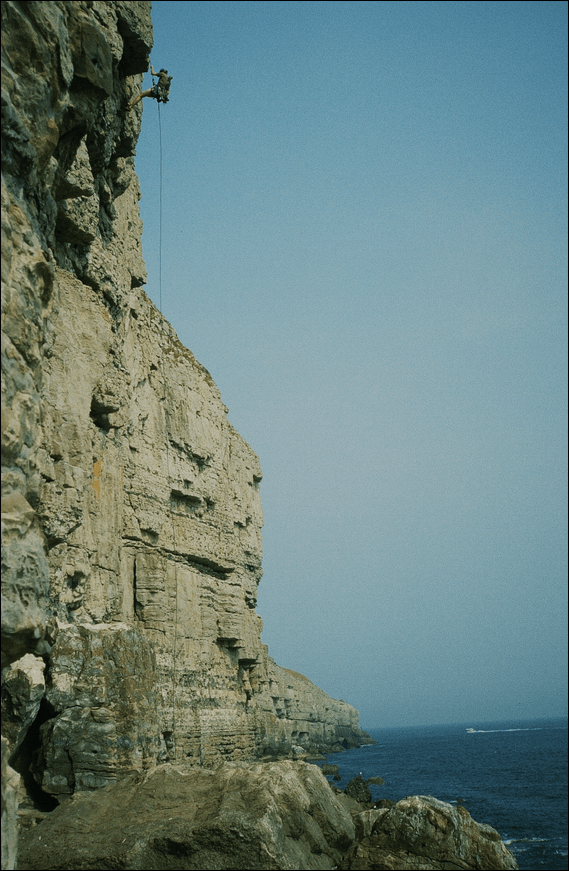
In the morning it would depend on who I was out with as to what the routine would be. Swanage is a thriving beach destination and gets packed, but despite having a strong fishing industry the café opening times were more attuned to the late night revellers opening at 8am even in summer. Most people I went with would want breakfast first, but not all. Then after the short drive to the Purbeck Heritage Coast information centre it was a brisk 20min walk to get to the bigger cliffs. It was mostly downhill which was great for going in but on the way back the legs felt it. Now I’ve talked the reputation of this place up a fair bit, and below is the second and third reason. Secondly: You need to bring a rap rope, as once you are down you can’t walk out and swimming can be treacherous so if you need to escape it would be a 50m prussic. Thirdly: The place is steep and intimidating. There is a horizontal break about half height, which is where many of the first pitches end and above this the wall gets steeper making for amazing exposure. Here Paul is rapping into Boulder Ruckle for another day of adventure. He is yet another one of my tall climbing friends and was often able to bypass sections that would make me stop and think. There was however one route I led here, and I think it was Cloud Nine, which did beat him due to being a compressed roof section that he simply couldn’t squeeze into. That route will pop up again for another reason:
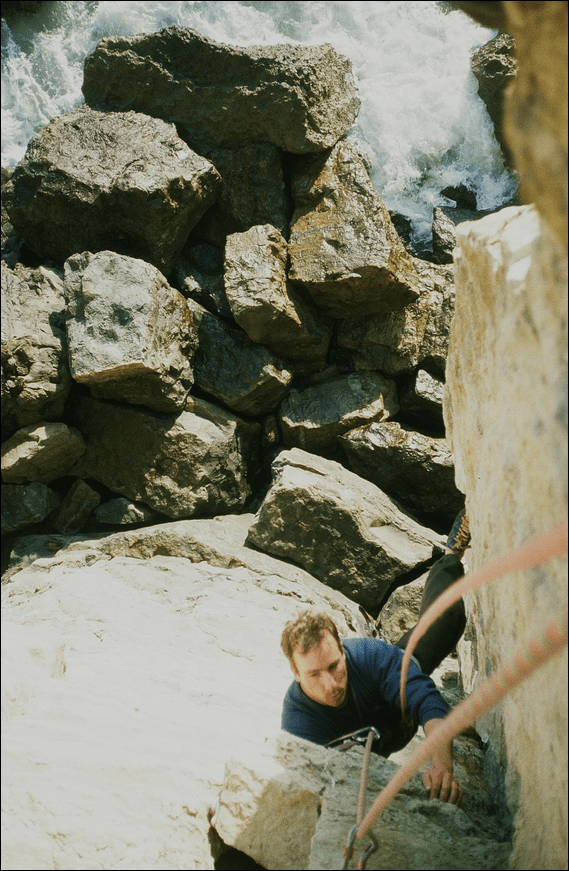
Before I show you the first reason why many avoid this place, it seems timely for a small geology lesson. The cliffs are formed from the youngest limestone formation in the UK and are different to the limestone I have mentioned as being found in Derbyshire (Peak District). It is also different to the limestone in Pembroke and Wye Valley (South Wales) or Bristol and Torbay (Devon) that will all get a mention another time. It is one of the aspects that makes the UK such a brilliant place to climb, every trip can find you in a very different setting on very different rock. This helps with building up a full range of climbing styles and techniques, unless you tended to only go to set places which some people did. Occasionally as you climbed on the limestone at Swanage you would come across a fossil, and on even rarer occasions you’d find a large ammonite that would provide a welcome jug or sling placement. The limestone here is of a blocky nature and massive car to house sized fallen blocks protect much, but not all of the cliff base. The following image shows this well as Gareth follows me up the second pitch of Heidelburg Creature. Despite these blocks forming a great defence against the full fury of the ocean it’s not a place you want to get caught out during rough seas:
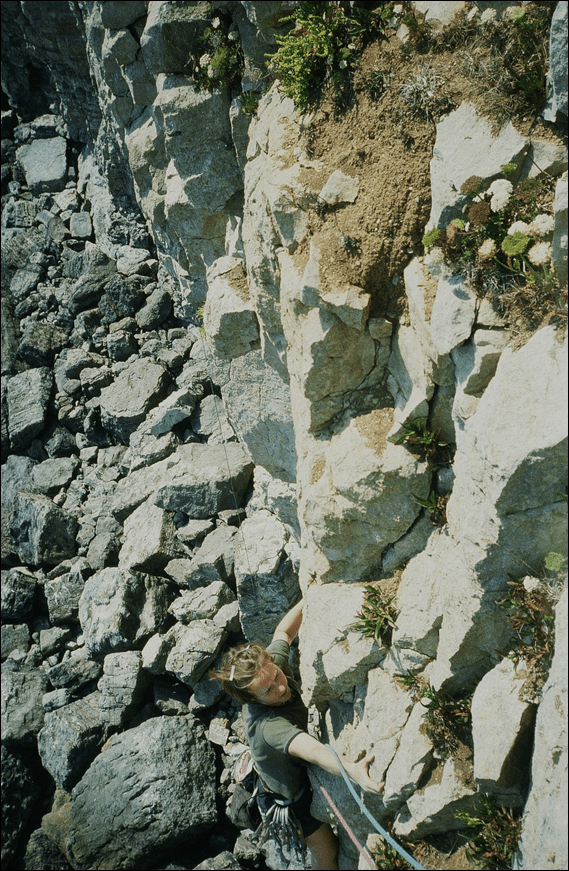
This is the first reason that puts most people off this area… the top outs. While there are a few clean rock top outs, but not many and none along Boulder Ruckle. Here as you walk along the top you’ll find star pickets driven deep into the earth. Despite their depth they can often be easily lifted out, but are firm enough for a sideways pull. Good job as you have to trust these as your abseil and belay anchors. The reasons being that the ground makes a sweeping arch towards the top of the cliff and the exposed top section of the limestone can be broken and loose. This means that after climbing you may have to navigate several meters of loose rock and then a steep scramble up the loose earth to reach the star picket, making at times for a 10m runout above your last piece of gear. This certainly adds to the excitement and for many I reckon it is simply too much, so they walk on by. That said in all the time we climbed here we never had an accident, nor heard of anyone else having had an epic during top outs:
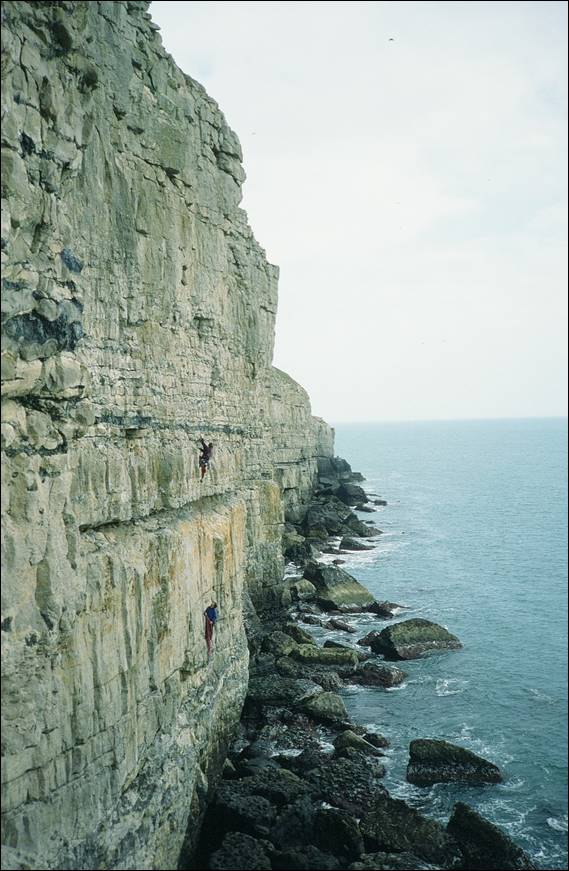
So not surprisingly we hardly ever saw anyone else climbing on the big walls. We would see throngs of climbers at the smaller more friendly sections at the far eastern end, but there it would be us who walk on by. Thinking back I can remember one time we saw someone else on the big walls, it was so unusual that I took the image below. There were three sections of this wall that we went to most, going from west to east they were Guillemot Ledge, Cormorant Ledge and of course the mighty Boulder Ruckle. The last was the one we went to most and this 1km section boasts a girdle (or traverse) along its entire length, but we never did that as there were too many great routes plus since it had been established there had been section affected by rock fall. There is a climb I put up in Central Australia and I named after Boulder Ruckle, on that route there was a horizontal traverse along a jamming crack and as I made my way along that it was impossible to avoid dislodging loose rock onto my belayer. Something we never did at Swanage I might add, but it just made me think of those top outs! Now the pair below are on Gypsy, a climb I had seen and dreamt of (yes I really did) many a time, there is a picture of it in the guidebook and the line itself simply looks stunning and was calling out to be climbed:
Swanage offers a wide variety of climbing, but not many slabs. Below shows the amazing first pitch of Strongbow a clean steep corner with good rock and great gear, you can sink a whole rack into most of the routes here, except for the top or so 10m! Not all lines were straight from top to bottom and often involved a dog leg, traverse or zig zag through epic stacked roofs or rooflets. As such on most trips we took twin ropes to avoid drag but not always. However, long extenders were essential and there was none of this using quick draw rubbish; that would simply get you into trouble. Now I have to admit that on these walls there are a few pegs that can be found from earlier ascents, and being a sea cliff you have to tread carefully with these insitu bits of gear. Possibly a reason that Paul didn’t follow me up Could Nine cleanly may not have only been the compressed moves required below the roof of the second pitch, but the sight of the gear I had above it. The guide mentions a peg and as I held onto the lip of the roof and peered over it I saw not a peg but a rusty stump that looked like a Cadburys flake. With no other options I crow footed a sling to it and pulled through thankfully not testing it. When Paul saw it he just shook his head in disbelief:
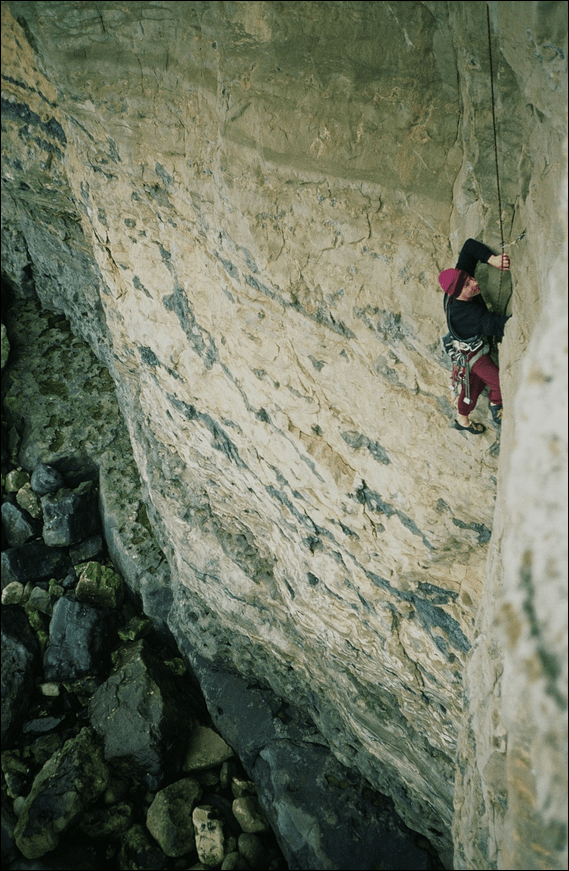
Below I’m on Elysium a good example of the fine face climbing on offer. Flakes, cracks, horizontals, underlings, crimps, jams you name it and you’ll come across it at Swanage and often all in one route. Below I bathed in glorious sunlight, which for the UK may sound idyllic but not at Swanage and especially not on still days. The combination of a south facing cliff, mostly white rock and glassy blue ocean makes for one hell of a heat trap. It’s the one place I would guzzle water and we would make sure we brought plenty of it on those long summer days. You’ll notice my rack is all passive gear and this place lends itself to wires, hexes and stoppers and we hardly ever needed to use cams. In fact for my first three years of climbing I didn’t really like using cams preferring to fiddle a bit of passive gear in. I owned cams but just didn’t trust all those moving parts, a phobia that has long since disappeared:
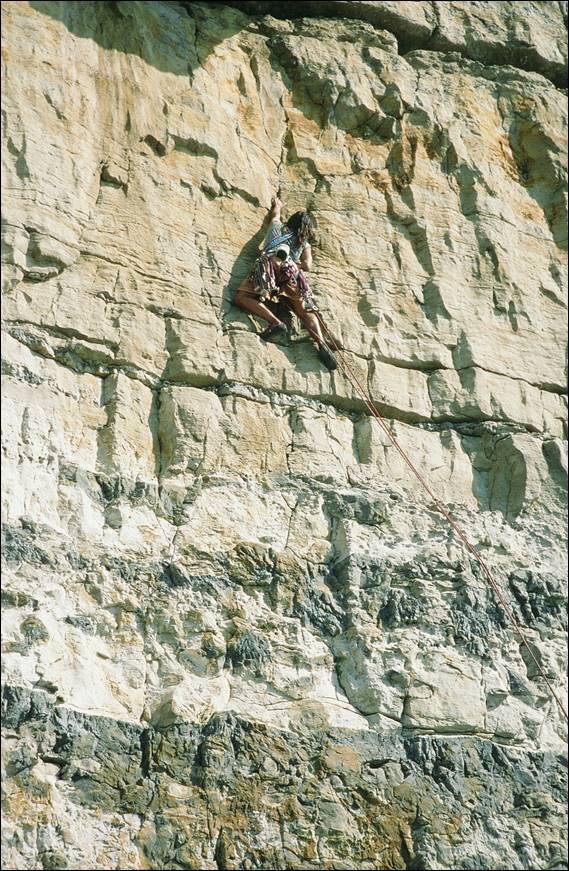
As mentioned a few places had better top outs, and some also had more comfortable bases were on a sunny day it was possible to get comfy for the belay. On hot days these spots also offered safer access into the ocean and on occasion we were known to have a dip. Guillemot Ledge is one of those places and below Gareth is fighting off having a snooze while watching me lead Zo Zo. In truth we had a pretty relaxed attitude to climbing, which may seem a strange thing to say when all I’ve gone on about is early starts and long days. However, we didn’t chase grades and picked the lines that appealed. It meant at times we would pass by what the guide regarded as the better climb, and on other days we didn’t anything too (relatively) hard. One reason was the length of those long days that in mid-summer would provide us a full twelve hours plus at the crag, on these big days we would take a heap of food with us and have snack breaks while taking in the scenery. Due to being at the crag from first light to dusk we, Gareth and I, also had a routine for camping at Swanage, by arriving late and leaving early we snuck in and out of a camp spot in town and didn’t pay (others were not so keen). We considered that was okay as all we did was sneak in and use a small patch of grass for less than eight hours and maybe use the toilets:
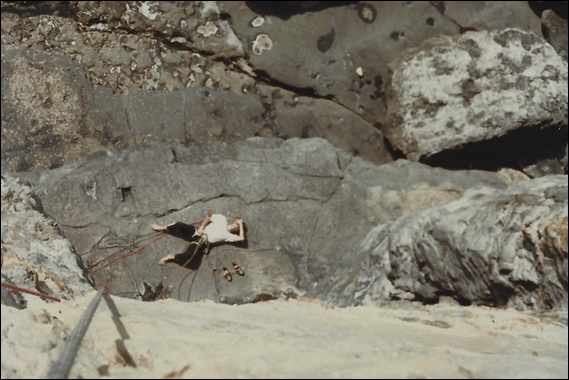
The upper section of Boulder Ruckle got steep, and the exposure was at times heightened by the need to make a traverse out above a roof, such as on Lightening Wall below. We got used to having lots of air below our feet. The plus side was that mostly the holds were positive. This also meant that the need for chalk was limited, the general rule of thumb being the hotter it got the more you might use but we never used too much. Being a white rock even if there had been other parties you would never have noticed a trail of white signs leading the way up a route, and maybe that is one reason why the place seems relatively untouched and in its natural state. I still remember the hottest day we had a crew down and by mid-afternoon we couldn’t take the heat anymore so we wandered out. Near the lighthouse, which is passed as you walk-in there is a pub, well in truth it is more of a restaurant in Durlston Castle and if even more truth be told it is a little posh (for us). After the long morning in that hot sun my partners in crime all urged me to put my long sleeve top back on (used to keep the sun off me) to avoid me offending the other gentry that were using the establishment. We were all guilty of polluting the air and I’m not sure it worked as we still got a fair few stares and were grateful when we got out of there:
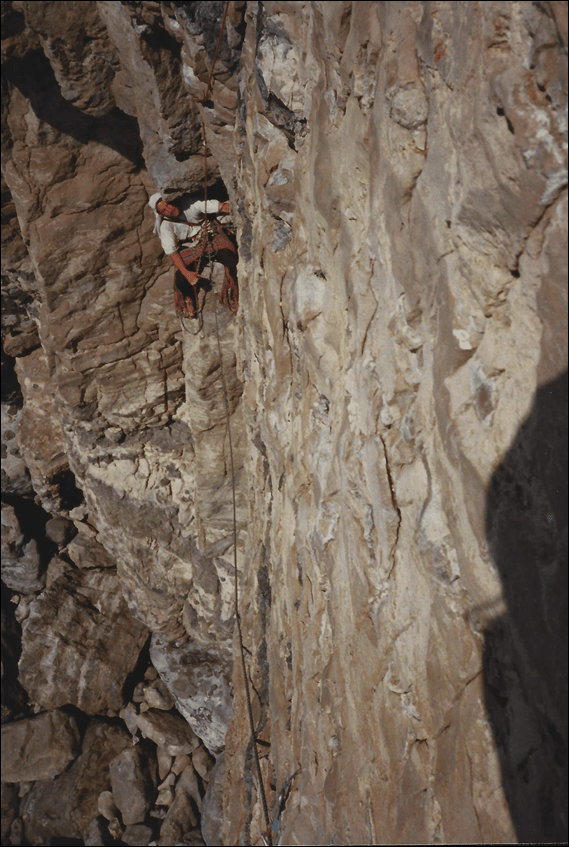
Here Kate is taking on pitch two of Silhouette Arête, which is accessed by another great traverse with plenty of air. I mentioned that many of the holds here were positive and you always knew they would be good when you found them on the grey nodules. If you flick through the images you will notice the white limestone has bands of grey, some sections more pronounced and denser than others. I’ve always referred to these as flint nodules, a great rock for making thin cutting flakes due to its structure but this also means that the edges you hold onto can be very sharp. However, I have been using the wrong term all this time and they are in fact chert nodules. Similar to flint as they are both formed through a chemical reaction whereby the calcium carbonate is replaced with silica. For those of a wont of real detail I found out that these nodules are cryptocrystalline or polycrystalline quartz, and called chert when formed in limestone (and other formations) and flint when formed in chalk or marl:
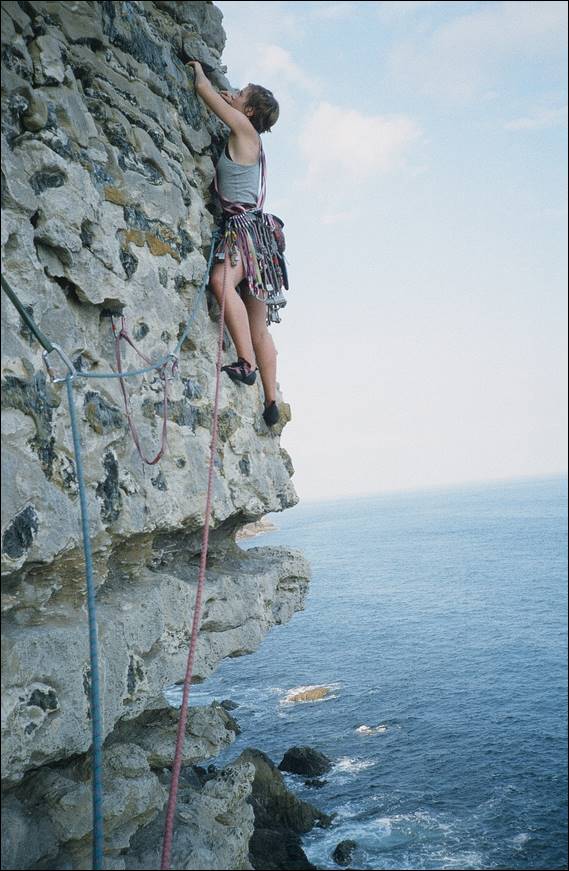
A few of the cliff sections had seabird names and as with most sea cliffs in the UK there are seasonal climbing bans. Swanage has sections that are open year round and others closed between 1 March to 31 July to help protect nesting sea-birds rare to this particular part of the coastline. Over 270 species of bids have been recorded in the Durlston National Park Nature Reserve ranging from the mega rare, scarce and common. Not all use the cliffs but the Shag, Fulmar, Great Black-backed Gull, Herring Gull, Razorbill, Kittiwake and Puffin can be seen here. It is also has one of the UK’s most productive Guillemots colonies with an average of 350 birds returning each year. On the walk path along the top of the cliff there are wooden markers, red zones mean a seasonally ban area and green is good to go. Despite the demarcation the birds don’t take notice and on occasion we had to change our plans, such as this time when we spotted a nesting Herring Gull:
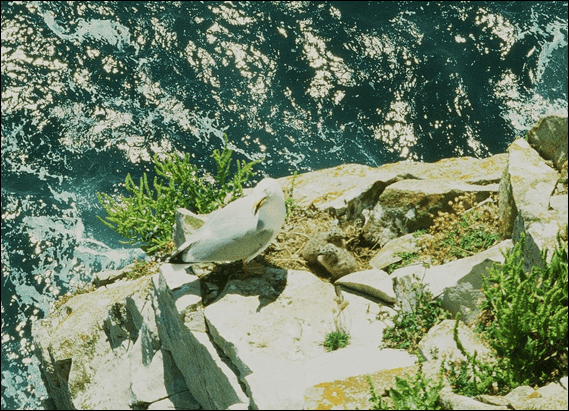
Some may be foolish enough to climb regardless, but there is no wrath such as a nesting seagull that feels threatened. I’ll recount another such instance or two in other emails but on this occasion as Kate was leading Mistaken Identity when we unknowingly got a bit too close to a nest. Luckily not that close, so all we got were a few warning fly overs and screeching calls to say don’t come any closer. These birds can get pretty big and are not afraid to dive bomb you, which could lead to a nasty fall. This route is on a section of Guillemot Ledge that is a decent distance outside of the banned area. However, as I said birds don’t take notice of the coloured markers. I also wonder how they set when bans come into effect these days, considering how climate change is impacting on the breading cycles of numerous birds. Enough said about our feather friends, Kate and I moved onto another section of the cliff that offered plenty of quality routes:
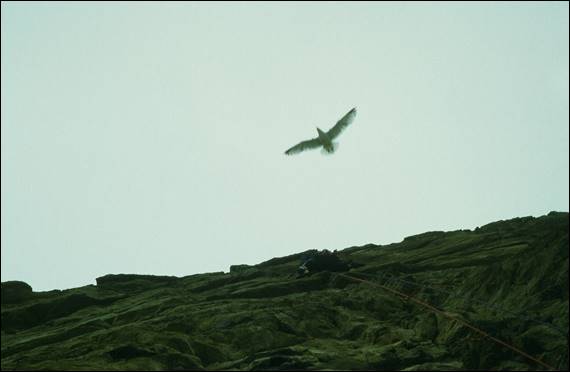
I’m not one to rave about abseiling, in fact I’m really not that keen on it but there were some that we did here which were fun. At times the line would drop straight into the sink so the first one down would need to get back to the wall and secure the line for the next person. The abseil into the main area of Cormorant Ledge provided a great opportunity for the second person to enjoy a hands free ride, with just enough tension on the rope to control the descent, and on this occasion it was Gareth’s turn! The abseil access here was from Reforn Quarry, it seems a strange place and small in size for a quarry but it does provide the best top outs on the main cliffs. Clean rock from start to finish and onto a level grassed area, with a perfect niche at the back of the quarry to set up a belay, make a brew and sit with your back against the wall looking out. The area has a raft of great quality lines and the one that sticks out was Quality Street which tackled the clean face to the left of the obvious crack in the wall behind the abseil. During one trip we were contemplating this area but felt uneasy, as it didn’t have as much protection against the ocean as other areas. So we sat for a bit and watched the sets of waves come in, it looked ok so we started to rack up when we heard a massive crash and a big wave had engulfed the entire platform you need to abseil onto. Decision made, we moved on:
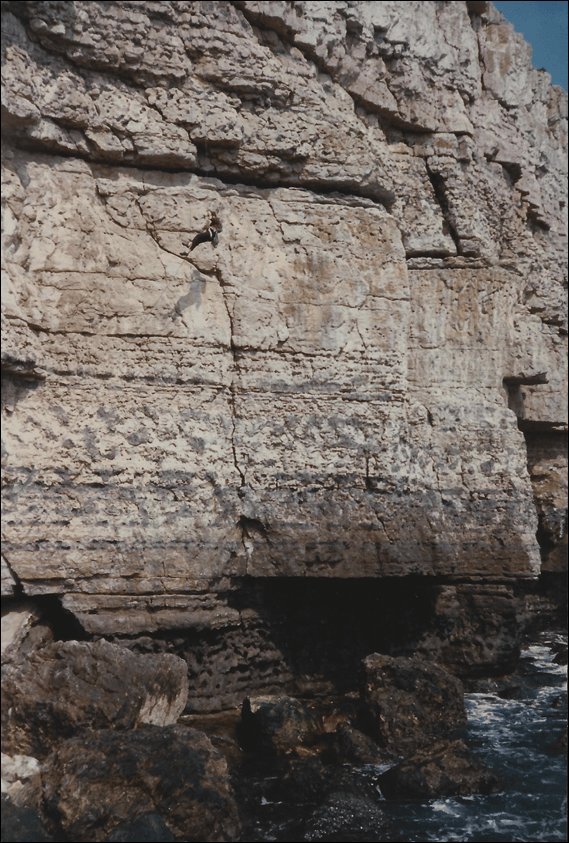
Oran, again at Cormorant Ledge was probably one of the easiest lines we climbed at Swanage, but as I found with all routes on this cliff it was nothing but quality. Flicking through the guide to re-familiarise myself with some of the finer details to include for you I’m impressed at just how many lines I’ve climbed at Swanage . There are of course a few that got away in particular Tudor Rose and the Buccaneer, but I can’t complain and this is one of those rare places where I really can say every route was awesome. That could be a biased opinion because I loved the setting and exposed nature of the routes, plus the added benefit of having the place to ourselves each time we visited. In fact it probably is bias, as I remember going up the wrong line once and having to climb past a fair bit of dodgy loose rock, but the line itself was impressive and I still got up it with a huge smile feeling very satisfied with my choice:

It was with Kate I finally had one of my dreams come true and climbed Gypsy. The guide talks about the upper pitch having been previously protected by two pegs which were removed by a falling leader, who survived. But it was still highly regarded and simply begged to be climbed. Pitch 2 was the glory pitch that followed a line of layback flakes that just kept coming at you, placing gear was pumpy but it never got too technical. In fact looking online they reckon it’s ‘never too desperate’ but I would add to that ‘if you have the required stamina’. On this trip despite so many previous visits there were still plenty of good looking lines to jump on, and the other one that I will never forget was the Grim Reaper. Kate had a bash at the first pitch but after being foxed for ages midway up she backed off and offered me the lead. After double and triple checking that she was sure I eagerly gobbled the route up, the first pitch ended at a roof and required a full hanging belay, what fun! The second pitch wove a wonderful line through roofs, I guess you can tell just how much I loved Swanage:
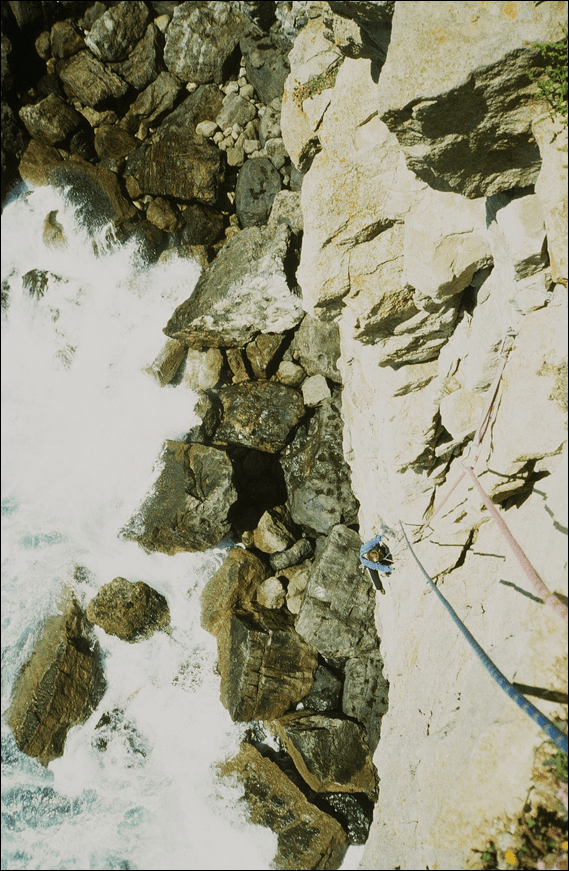
I couldn’t resist another image of the route I first led on the big wall, one reason being this shot really shows the way the upper wall steepens up. I forgot this guy’s name, he came out with us once and once only. It was summer and the light arrived early so we drove through town before any cafes or shops were open. We had warned him that it would be an early start and I think he thought we were joking, but as we arrived at the lonely carpark it dawned on him that he would not get a hearty breakfast or as a minimum a coffee. We had been open and honest the whole time, but that made little difference and I don’t think the food and water we took to the crag made up for it. When we abseiled down it seemed that all was forgiven and seeing his glee we offered the first lead to him. He fancied Finale Groove, a good choice. However on the way up he ‘tweaked’ his finger and he didn’t want to further aggravate it so opted not to climb any more. So we left him atop while we got some more routes in, I still saw him down Mile End and got on okay with him but this trip never got mentioned again:
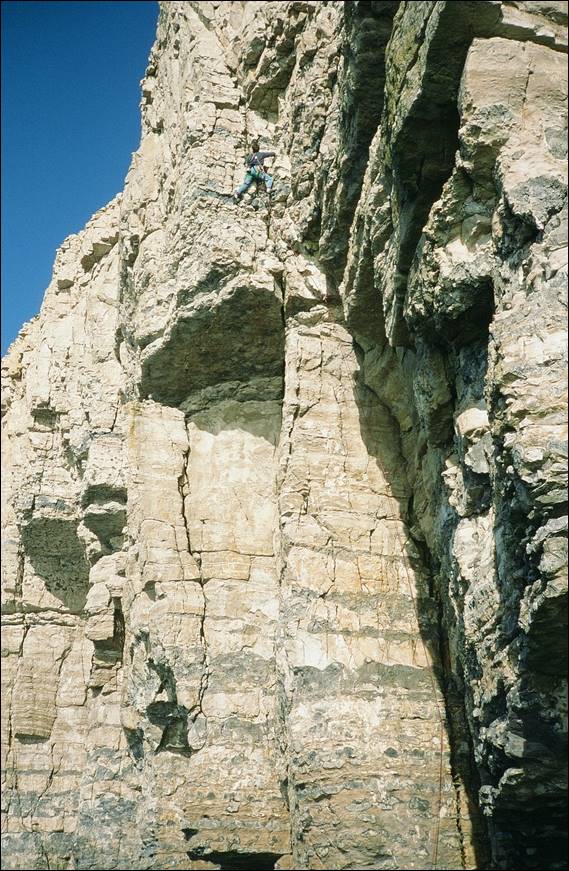
That was the day that I also bagged Elysium on which there was an amazing bridging corner above the good face that I showed in an earlier image, so I just couldn’t resist including this image. There is nothing like an early morning stretch, but not sure if I am still able to go quite this far anymore. I’ve talked about Swanage being a bustling tourist destination with beaches packed, well in the evening it isn’t any different and there are arcades with flashing lights and music blaring. After a big day on the crag Gareth and I used to go to the arcades and play on the rafting and speedway bike games, the first was a killer and the arms and shoulders would complain no end the second was just pure fun. Then we would head to the Purbeck Hotel, which is really a good old fashioned pub. Here we would order a big meal that would set us up for the next day’s climbing, and wash it down with a couple of pints of good ales. On occasion we would hit the pool table and on one night we had a marathon 26 game session that remarkably ended in a 13-all draw. Then we would sneak into the campground:
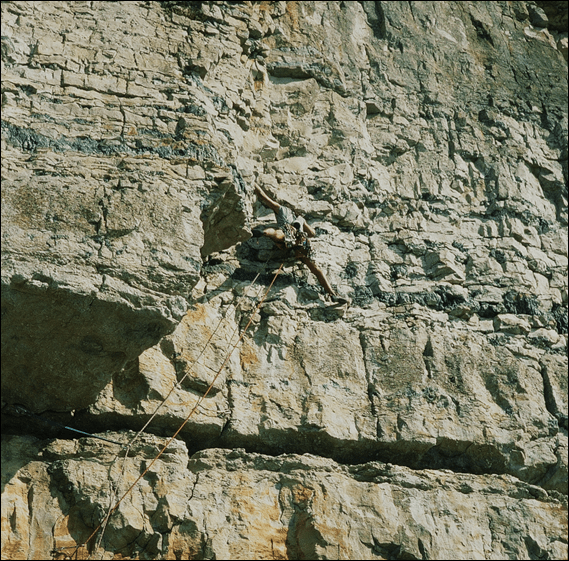
Earlier I mentioned Dancing Ledge, a small sport crag abutting the trad mecca. Interestingly the guidebook comes as a double pack for both Swanage and Portland. Portland is not far away from Swanage and provides one of the UK’s best venues for well-bolted sport routes across the grades. There is also a mob of really good deep water soloing. While I have not seen the deep water soloing areas I have climbed twice at Portland, once with Gareth and another time when the climbing gym I used to frequent organised an outdoor trip. Both trips were fun and the routes were good but it was also bolt clipping and when offered the option of trad against bolts you can probably guess which one I would choose. A little side story… one night at the climbing gym not Mile End but one near Leatherhead (where I lived for nine months) south of London we had a bouldering comp and none other than Ron Fawcet walked in and joined in the fun. In the 70s he was the Yorkshire boy who stunned/upset the North Wales climbing community when he established Lord of the Flies on the right wall of Cenotaph Corner on Dinas Cromlech. I was feeling pretty smart when he failed on his first attempt of a route I flashed, but he then proceeded to smash everything else. He was a lovely fella and damn impressive climber:
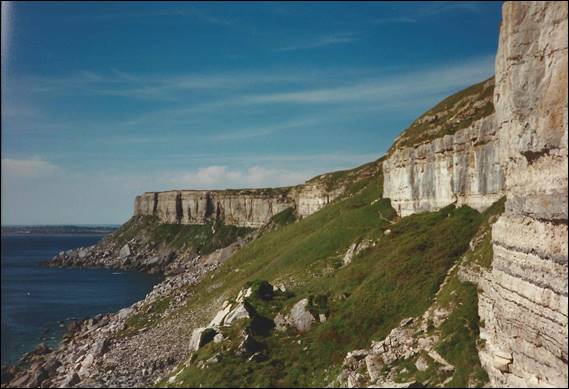
Portland offers another two miles (3km) of limestone walls. These are high above the waterline and shorter in length allowing for a single rope descent from the rap anchors on most climbs, a few were longer. The limestone here is not of the same blocky nature as Swanage, and it is pretty well devoid of rooves. However, the steep pocketed more compact faces make for more technical climbing and minimal chances for using trad gear. The area that I enjoyed the most was not the pocket limestone, which reminded me of the stuff I’d climbed in Italy, but the flowstone routes. These formations have smooth surfaces and the funkiest holds making for really fun routes, below Gareth is tackling Slings Shot on Blacknor Cliffs:
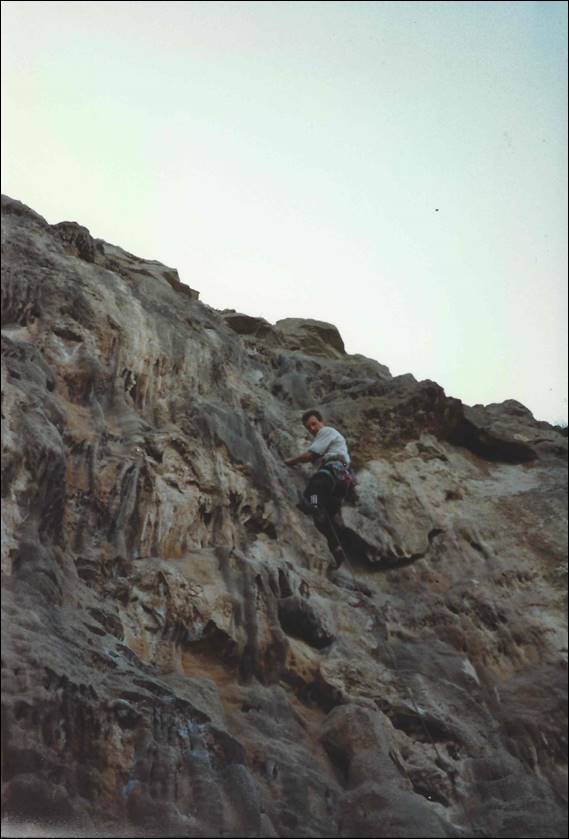
As my move out to Australia loomed closer I was packing in trips to my favourite spots, and below we are rapping in on my last day in Swanage. Of course we picked Boulder Ruckle and we still found routes that we hadn’t been on before with my last lead being Heidelburg Creature, the image that I used near the start of this email. The mighty cliffs were once again devoid of anyone else, and this image is great for showing the scary earth runnel top outs that kept so many other climbers away. The guide says ‘the finish is often the most troublesome part of a Swanage climb irrespective of its grade’, however for those adventurous enough to take the plunge I would be surprised if it didn’t rank as one of the most exhilarating places to climb. Flicking through the guide as I write this so many route names jump out at me to say I’ve climbed them. I feel confident in saying that every one of them was precisely what the guide says ‘steep, exposed and dramatic’:
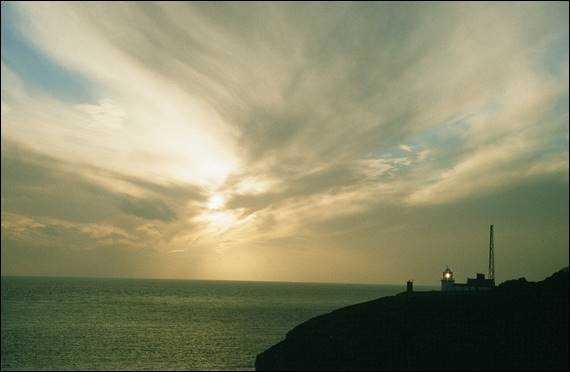
As we walked out one last time the sun was going down behind the lighthouse, and so ended yet another amazing trip to the stunning cliffs of Swanage. When Lisa, Elseya and I first went back to the UK I had selfishly organised to meet up with Gareth only a few days after landing in the country; I did the same when I returned from two years in West Africa, but being single on that occasion it wasn’t a selfish act. Lisa, Elseya and I went to Swanage and stayed in the top floor of a hotel in the summer of August 2003, which happened to be the hottest summer on record since the mid-1500s and reportedly lead to approx. 35,000 deaths across Europe. It was in the mid-thirties and the room we were staying in was like a sauna and we didn’t sleep well, the next day Gareth rocked up and while we managed a few good lines the rock was smouldering. We baked both on and off the rock but damn it was good being back at Swanage and a big thank you to Lisa and, at the time, four month old Elseya for letting me indulge my rock fettish:
The next stage of this journey will take us back into the heart of the UK to see more gritstone, as well as some of the limestone crags the Derbyshire Peak District has on offer.
 Sandbagged
2 thoughts on “Part 3 – Swanage – the bold and the beautiful”