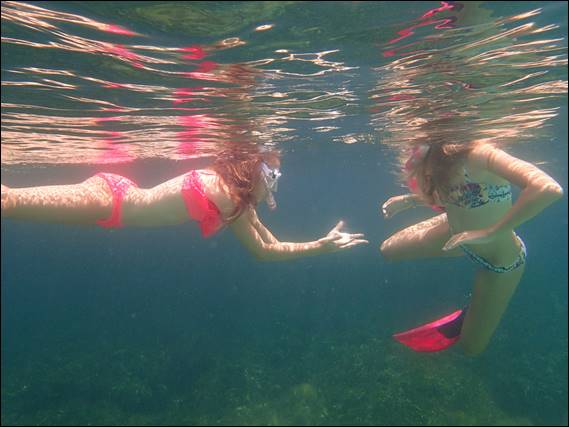
In the last few weeks I have been getting out for a snorkel, and over the last couple of days have been down at our local beach. My memory of the place was that there wasn’t that much to find but in two days and three snorkels I have changed my mind big time. The following images are from a snorkel with Elseya and her friend Chloe, the main attraction was to come and swim with the (non-stinging) Jellyfish. Elseya has one in her hand in the image below:
We soon got distracted by some of the many other seas creatures about, there is a lot of weed and the fish tend to hide in amongst it popping their heads out but being quick to withdraw if you get too close. I did however manage to get a good snap of this female Shaws Cowfish, by duck diving away from it and then sneaking up on it. It was also in my favour that these fish cannot swim very fast. Their slow speed has resulted in them hunting for prey in an unusual way, they blow a jet of water at the sand to expose prey hidden beneath:

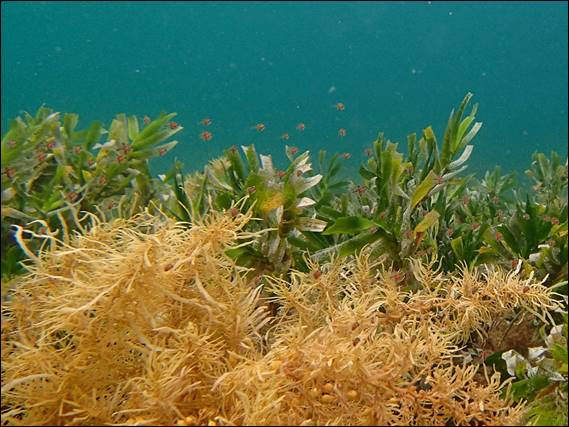
It was not only the fish that attracted out attention but also the many types of weed, these bright almost fluorescent tubular weeds sway gently in the current and look like balloons. I think the scientific name for these is Gloiosaccion, which literally translates to ‘glue sacks’. The common name is Slimy Bags because they contain a thick slimy substance, and Elseya loves finding them on the beach. If you look closely there is another interesting fella just to the right of the weed, and I reckon it may be a little Surge Demoiselle, a fish I found in a few other places but escaped the lens:

We also found a few sea stars, which were much easier to get close, there is something wonderful about these and we have found a great variety of them over the years. This one I believe to be a Fromia indica, but lie the weed I’ve found them tricky to pin down:

There are also a heap of baby fish out there, and they usually stay in shoals and close to the weed for camouflage and somewhere to hide in if someone or something gets too close. I’m not even going to take a stab in the dark as to what these are, but I managed to creep up on them and catch them while they were still in the relative open:
There are some fish that are less afraid of being caught in the open water, such as this Western Smooth Boxfish. Probably because when threatened or stressed, they excrete a toxin from specialized skin cells into the water, poisoning marine life who get too close. With such an impressive defence system they make it into the top five most poisonous fish:

After a great half an hour or more of finding so much we were getting cold so it was time to warm up. My fingertips were tingling as the rest of me warmed up. But soon enough Elseya was back in the water this time encouraging the poodles to swim, rather forcefully by carrying them out and then making them swim back. For water dogs these two really don’t like the water as much as they should:
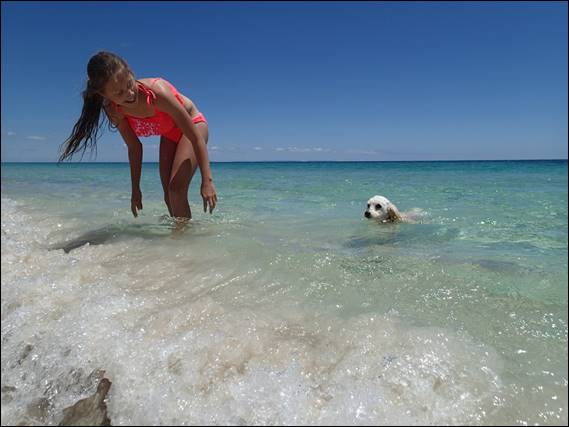
Still when they need to they have no problem swimming back to shore, and when we have had them in a kayak or on the paddleboard they have quite enjoyed being out there:

Soon it was time to get the dogs back home but getting the girls to head back too was the harder part. So I agreed to stay with them for just five more minutes while Lisa took the poodles home. We have to be careful with Nicka as she is fair skinned and she is likely to suffer if she gets too much sun time. While all that is very interesting the real reason for including this image was to show the amazing colours and lack of other people on the beach. We count our lucky stars at times like these:

As we were getting ready to go I spied a familiar dark shape in the water casually swimming parallel to the shoreline. We all three quickly grabbed our snorkel masks and heading out in search of the ray. I was the only one to see it in the water and it quickly detected us and promptly swam in the opposite direction and a less leisurely pace. It was an Eagle Ray, and got away:

But before we could head back in Elseya spotted a more impressive find. We thought it may have been a Cone Shell that can be dangerous, but having looked it up it was in fact a Bailer Shell and the home of a very large sea snail. We were very lucky as these creatures normally emerge at night to search for food. They are carnivores and smother their prey with their large muscular foot, as well as using a muscular rasping tongue and jaws to devour the prey. I’ve read the shells grow to a maximum size of 275mm and this one much have been close to that:

Just to give you an idea of the size we took the time to duck dive down to it a few times, being careful not to touch it in case it was a Cone Shell. After that we headed back in to shore and packed up to go home, and I’m secretly hoping that Elseya will be keen to head out for another snorkel soon:

Before I finish off this email I couldn’t resist putting in just a couple of images from my last two snorkels at Peppy Breach. While a couple of you will have seen these they help to show just how much there is too see at our local beach, starting with another sea star that I think is a Austrofromia polypora:

Next up is a Sand Gobbler, more commonly called a Sea Cucumber. I’m pretty sure this one is a Thelenota anax. It is a small one at only 30cm long and having done a bit more research it seems they can get up to 1m long, so this really is a baby:

Peppy is lucky to have some reef and you will often find a Strongylocentrotus purpuratus or two, Purple Sea Urchins. They have pale spines which is what gives them away and each time I see them they seem to have found the perfectly sized hidey hole:

People head here to go cray fishing, but they normally head out to at least 200m off shore. That is way past my comfort zone when snorkelling, but just this morning (yes I’ve been out twice today) I came across not one but three Western Rock Lobsters a short 20/30m off shore. I hope the cray fishers don’t find these so I can enjoy watching them again:

Finally the reason that Elseya went out with me today, the Comb Jellyfish that is part of the Ctenophores family. When you watch them you can see lights work their way up the ridges of the outer body, and the lights change colour as they go:

The light is in fact caused by the diffracting the light of the sun as tiny filaments, called combs, move. In the image below you can make these combs out and there can be thousands. They are used predominately for swimming, and propel the Jellyfish with the mouth (at the pointy end) facing forward, which is how it catches food without having tentacles:

One last image just because I found them to be such fascinating creatures. I hope you have enjoyed reading about and seeing the creatures, as much as I have enjoyed researching them:

 Sandbagged